I’ve previously discussed reading Ferdinand de Saussure’s work, mainly around the variant texts of his posthumously published Course on General Linguistics, and some of his early work on Indo-European languages.
Saussure’s notes on German legends are one of the other major posthumous publishing projects of his work. He had the project of seeing how the structures of legends could be related to the structure of language, but it was unfinished and he published almost nothing. (The one very minor exception, to my knowledge, is a report of a paper delivered in Geneva, published as “Les Burgondes et la langue burgonde en pays roman” in 1915, and reprinted in the posthumous Recueil des publications scientifiques, p. 606.)
The overall project is one which his biographer John Joseph describes this way:
He had anticipated the basic methods of the ‘structuralist’ analysis that, inspired by his Course on General Linguistics, would take over ethnography, literature, and a range of other areas of studies for several decades starting in the mid-1950s. Had he actually managed to complete and publish this book half a century earlier, and had it been widely read and appreciated, the whole of twentieth-century intellectual history might look vastly different.
John E. Joseph, Saussure, p. 469
There are various collections of the manuscripts in Geneva. Robert Godel did the initial cataloguing, and provides a useful “Inventaire des manuscrits de F. de Saussure remis a la Bibliothèque publique et universitaire de Genève” in the Cahiers Ferdinand de Saussure 17, 1960, 5-11. There he mentions “Ms fr 3958-3959, Nibelungen, 18 cahiers; dossiers de notes”. (Other material has been deposited in Geneva since, and there are other manuscripts at Harvard, but none of these, I think, are on this theme.)
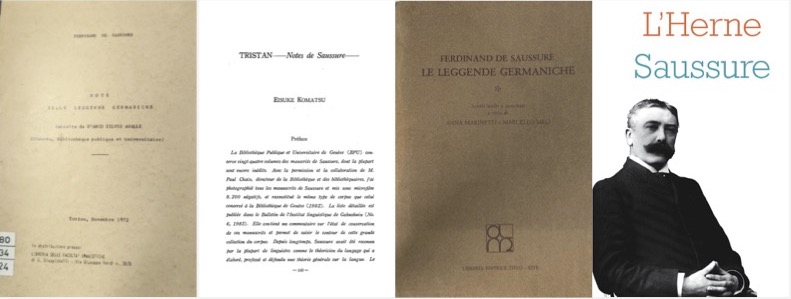
I first read “Légendes et récits d’Europe du Nord: de Sigfrid à Tristan”, ed. Béatrice Turpin, in Le Cahier de l’Herne: Saussure, 2003, 351-429. This led me to Komatsu Eisuke, “Tristan – Notes de Saussure”, The Annual Collection of Essays and Studies, Faculty of Letters, Gakushin University XXXII, 1985, 149-229 [online], and the collection Le Leggende Germaniche, edited by Anna Marinetti and Marcello Meli, Este: Liberia Editrice Zielo, 1986.
Turpin says Le Leggende Germaniche is “The most complete edition, with variants, but not easy to read [Édition la plus complete, avec variants, mais de lecture peu aisée]” (p. 355). It’s not in many libraries, but I recently found a copy on sale second-hand. I’d agree with Turpin’s assessment of readability – while Saussure’s text is in French, the apparatus is in Italian, and it’s in a typewritten non-proportional/monospaced font, with notes and commentary in a still smaller size.
I’d also seen references to an earlier collection in a pamphlet Note sulle Leggende Germaniche, ed. d’Arco Silvio Avalle (Torino, 1972). It took some time before I was able to locate a copy – but now have a scan thanks to Johannes Schmitthenner. This is also typed with some handwritten bits.
As far as I’m aware, these are the main collections of Saussure’s notes on this theme, with nothing translated into English. There is a lot of overlap between these collections.
Note sulle Leggende Germaniche
Note sulle Leggende Germaniche is only 21 pages long, and Le Leggende Germaniche is 511 pages, so I’d assumed all the pieces in the first would be in the second. That is indeed the case, but it took a bit longer to locate them than I expected.
Note sulle Leggende Germaniche comprises ten excerpts, numbered I-X, of a page or two except for the longer excerpt VI. It gives archival references and sometimes a description of the type of paper, or how it was organised. It tends to count page numbers on both recto and verso. Le Leggende Germaniche in contrast provides recto and verso after a sheet number. This means the references don’t immediately match.
The list below provides a cross-reference between Note sulle leggende Germaniche (NSLG) and Le leggende Germaniche (LG). It begins with note number in NSLG, the pages, and the archive reference given there; and then the equivalent passage with pages and archive reference in LG. This would allow someone who saw a reference to the 1972 pamphlet, but couldn’t access a copy, to find the relevant passage in the more comprehensive, and (slightly) more widely-available book.
I, NSLG, pp. 5-6; Ms. fr. 3958-4, p. 1 = LG, pp. 30-31; 3958.4.1o risv. cop. – 1r
II, NSLG, p. 7; Ms. fr. 3959-10, p. 18 = LG, pp. 307-8; 3959.10.18
III, NSLG, pp. 7-8; Ms. fr. 3958-6, verso de la couverture = LG, p. 129; 3959.6.49r (=retro copertina)
IV, NSLG, pp. 8-9; Ms. fr. 3958-6, p. 7 = LG, pp. 131-32; 3959.6.45v (=4r)
V, NSLG, pp. 9-10; Ms. fr. 3958-4, p. 126 = LG, p. 77; 3958.4.63v-64r
VI, NSLG, pp. 10-17; Ms. fr. 3958-8, pp. 41-45 = LG, pp. 191-95; 3958.8.21r-23r
VII, NSLG, pp. 17-18; Ms. fr. 3959-11: un feuillet double cf. X = LG, p. 314; 3959.11
VIII, NSLG, pp. 18-19; Ms. fr. 3958-4, p. 130 = LG, pp. 79-80; 3958.4.66r
IX, NSLG, pp. 19-20; Ms. fr. 3959-11: un Feuillet = LG, p. 312; 3959.11X, NSLG, pp. 20-21; Ms. fr. 3959-11: un feuillet double cf VII = LG, p. 313; 3959.11
The ten excerpts in Note sulla leggende Germaniche are also included in d’Arco Silvio Avalle, “La sémiologie de la narrativité chez Saussure”, Essais de la théorie du texte, Paris: Galilée, 1973, 19-49. There they are numbered as sections 2.2-2.11 – section 2.1 is introductory. In other words, add one to the note numbers above, and that will point to the passage in Le leggende Germaniche.
Komatsu Eisuke, “Tristan – Notes de Saussure”
Komatsu Eisuke, “Tristan – Notes de Saussure”, 176-228 is a partial edition of Ms. fr. 3959-10. Parts of this text are published in Le Leggende Germaniche, pp. 301-09, but Eisuke’s edition is more comprehensive. Excerpt II from Note sulle leggende Germaniche (Ms. fr. 3959-10, p. 18) is found here on p. 212.
Several other passages from related manuscripts are provided in Komatsu Eisuke’s long Introduction. All of these are found in Note sulle leggende Germaniche as well as Le Leggende Germaniche.
p. 165, Ms. fr. 3958/4 = NSLG, I (first part) = LG, p. 30
pp. 165-66, Ms. fr. 3958/4 = NSLG, I (second part) = LG, pp. 30-31
pp. 166-67, Ms. fr. 3958/6 = NSLG, III = LG, p. 129
p. 167, Ms. fr. 3958/4 = NSLG, V (part) = LG, p. 77
p. 167, Ms. fr. 3958/4 = NSLG, V (part) = LG, p. 77
p. 168, Ms. fr. 3959/11 = NSLG, IX = LG, p. 312
pp. 168-69, Ms. fr. 3959/11 = NSLG, VII (part) = LG, p. 314
pp. 169-70, Ms. fr. 3958/8 = NSLG, VI (part) = LG, pp. 192-93
pp. 170-71, Ms. fr. 3958/8 = NSLG, VI (part) = LG, pp. 191-92
“Légendes et récits d’Europe du Nord: de Sigfrid à Tristan”, ed. Béatrice Turpin
“Légendes et récits d’Europe du Nord: de Sigfrid à Tristan” includes excerpts from several notebooks and manuscripts. These are generally included in Le Leggende Germaniche, but not always easy to locate. My best attempt at locating the passages:
pp. 360-61, Ms. fr. 3958/1 = LG, pp. 15-17
pp. 361-64, Ms. fr. 3958/2 = LG, pp. 17-21, 22-23, 24, 25, 26
pp. 364-67, Ms. fr. 3959/4 = LG, pp. 226-27, 229-31, 238, 239-40
pp. 367-82, Ms. fr. 3958/4 = LG, pp. 30-31, 32-40, 41-42, 64, 50-51, 59-60, 76, 107, 76-77, 82, 78, 79-80, 88, 89, 108-09, 111, 110, 112-15, 116-17
p. 382, Ms. fr. 3958/5 = LG, pp. 117-18
p. 383, Ms. fr. 3958/6 = LG, pp. 129, 130, 132
p. 384, Ms. fr. 3958/3 = LG, p. 28
pp. 384-85, Ms. fr. 3958/6 = LG, pp. 125, 126
pp. 385-86, Ms. fr. 3959/5 = LG, pp. 253-54
pp. 386-90, Ms. fr. 3958/8 = LG, pp. 190, 190-95, 199, 204-05
pp. 390-4, Ms. fr. 3958/7 = LG, cf. 140, pp. 141-42, 143-44, cf. 159, cf. 160, 160, 174, 175-77
pp. 394-96, Ms. fr. 3959/6 = LG, pp. 260-62
pp. 394-96, Ms. fr. 3959/7 = LG, pp. 269, 274, 275
p. 397, Ms. fr. 3959/9 = LG, p. 300
p. 398, Ms. fr. 3958/7, cf. LG, p. 144
p. 398, Ms. fr. 3958/8, cf. LG, pp. 201-02
pp. 398-99, Ms. fr. 3959/2, cf. LG, pp. 215, 216-17
pp. 399-403, Ms. fr. 3959/3 = LG cf. 218, pp. 218-20, cf. 220-21, p. 221, cf. 221, pp. 221-22, cf. 222, pp. 224, 225
pp. 403-15, Ms. fr. 3959/8 = LG, pp. 277, 79, 280-84, 285, cf 286, cf 287, 287-90, 290-91, cf. 292, 292-96, cf 296-97, 297-99, cf 300
pp. 415-22, Ms. fr. 3959/10 = LG, cf 301, pp. 301, cf. 301, 302, cf. 303-04, 304, 306-08, cf 308-09.
pp. 422-29, Ms. fr. 3959/11 – here the manuscript numbering used by Turpin is more recent than Le Leggende Germaniche, which presents this pages of this file in a very different order (pp. 310-448). Turpin provides the ms. page number in brackets. The equivalent pages in Le Leggende Germaniche are as follows: [6] = p. 319; [11] = p. 317; [12] = p. 318; [109] = p. 418; [149] = p. 382; [2] = pp. 319-20; [124] = pp. 399-400; [177] = p. 357; [192] = pp. 349-50; [102] = ? [I can’t find this single sentence]; [179] = pp. 357-58; [203] = pp. 341-42; [178] = p. 358; [173] = pp. 361-62; [155] = pp. 380-81; [147] = p. 388 [Turpin deciphers a difficult-to-read word: “De deux cas de rapprochement…”]; [15] = pp. 312-13; [19] = p. 313; [20] = p. 314; [21] = p. 314; [21 suite] = pp. 324-25; [169] = p. 367.
Summary
For just about everything on this theme, see Le Leggende Germaniche, if you can locate a copy.
All the texts presented by d’Arco Silvio Avalle, in both Note sulla leggende Germaniche and “La sémiologie de la narrativité chez Saussure”, are in Le Leggende Germaniche.
Komatsu Eisuke, “Tristan – Notes de Saussure” [online] provides a much fuller version of one notebook than the text provided in Le Leggende Germaniche. It is therefore a very useful supplement to that volume.
Béatrice Turpin, “Légendes et récits d’Europe du Nord: de Sigfrid à Tristan” gives a more manageable and readable sample. For most people, that’s probably enough.
But this comparison shows how the work of editing these manuscripts is not a neutral task, but the selection, arrangement, notes and interpretation all show the choices of the editors.
Hopefully this is useful to someone! I would have liked something like this to be available when I first started work on this question… Any corrections or additions are most welcome.
[Minor updating 21 June 2023, with links to the Harvard and Geneva online inventories; and Godel’s published version. And I tidied up WordPress’s erratic italics. 23 June 2023: added one minor reference.]
There are some other research resources related to my project on Mapping Indo-European Thought listed here – bibliographies of Benveniste translations, and some Dumézil textual comparisons, and links to audio and video recordings.


