
Jean-Paul Sartre’s Situations is difficult to navigate, both in French and in translation. The first edition, produced by Sartre himself, had ten volumes. But the second edition, produced initially by Arlette Elkaïm-Sartre, reorganises material chronologically. Eight volumes have been published so far. But this means that many essays are in different volumes of the two editions.
There are also issues with the English translations. The English book Situations is a partial translation of Volume IV, while Literary and Philosophical Essays picks essays from volumes I and III. Seagull have done some important work in translating Volumes I, III and IV of the first edition complete, but they are not explicitly labelled as translations of the series. They also have a lot of thematic volumes which take essays from different volumes. Colonialism and Neocolonialism is a translation of volume V of the first edition. As far as I know, there are no plans to translate the second, more complete, and chronological edition.
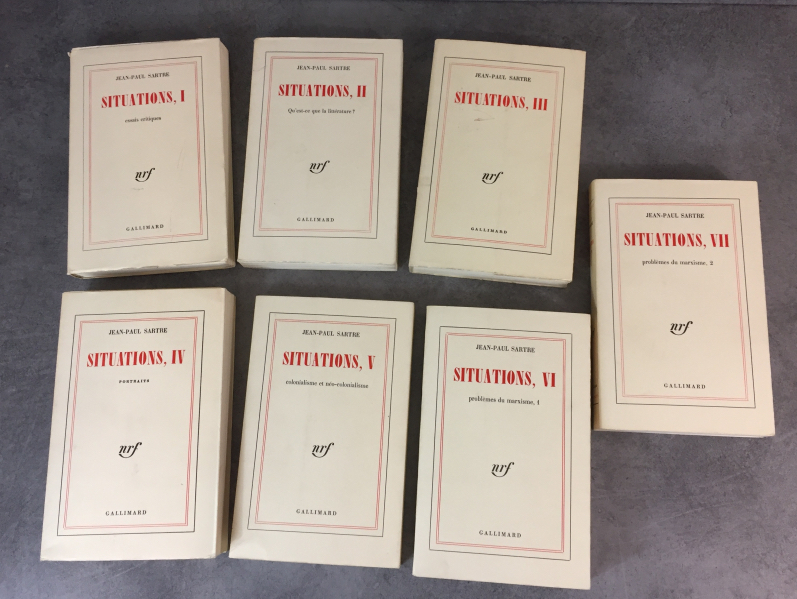
What is below is an attempt to make sense of the first few volumes, with links to the useful French Wikipedia articles and Gallimard pages which give details for the second editions, and a list of the places where essays are available in English. I’ve not yet included the Seagull thematic volumes, which include many of these pieces. And I’m sure I’ve missed some of the pieces which appeared in journals or other collections. Corrections and additions welcome. As with the other resource pages on this site, this is intended to be a work in progress.
Abbreviations
LPE – Literary and Philosophical Essays
MT – Modern Times
SP – Situations Philosophiques
Situations – first edition. Reprinted as Critiques littéraires. All translated in Critical Essays.
- Sartoris par W. Faulkner [trans. in LPE]
- À propos de John dos Passos et de 1919 [trans. in LPE]
- La Conspiration par Paul Nizan
- Une idée fondamentale de la phénoménologie de Husserl : l’intentionnalité [also in SP]
- M. François Mauriac et la liberté [trans. in LPE]
- Vladimir Nabokov : La Méprise
- Denis de Rougemont : L’Amour et l’Occident
- À propos de Le Bruit et la Fureur : La temporalité chez Faulkner
- M. Jean Giraudoux et la philosophie d’Aristote. À propos de Choix des Élues [trans. in LPE]
- Explication de L’Étranger [= trans. in LPE?]
- Aminadab ou du fantastique considéré comme un langage [trans. in LPE]
- Un nouveau mystique
- Aller et retour [also in SP]
- L’homme et les choses
- L’homme ligoté. Notes sur le Journal de Jules Renard »
- La liberté cartésienne [also in SP; trans. in LPE]
The second edition removed the final essay and added 11 other texts. For details see Gallimard and Wikipedia.
Situations II – first edition
- Présentation des Temps Modernes
- La responsabilité de l’écrivain
- Qu’est-ce que la littérature :
- Qu’est-ce qu’écrire ?
- Pourquoi écrire ?
- Pour qui écrit-on ?
- Situation de l’écrivain en 1947
The four parts of “Qu’est-ce que la littérature” are reprinted as a book of that name; translated as What is Literature?
The second edition contains entirely different material. For details see Gallimard and Wikipedia. “Qu’est-ce que la littérature” instead appears in the second edition of Situations III.
Situations III – first edition. All translated in The Aftermath of War.
I.
- La République du silence
- Paris sous l’Occupation
- Qu’est-ce qu’un collaborateur ?
- La Fin de la guerre
II.
- Individualisme et conformisme aux États-Unis
- Villes d’Amérique [trans. in LPE]
- New York, ville colonial [trans. in LPE and MT]
- U.S.A. présentation
III.
- Matérialisme et revolution [also in SP; trans. in LPE]]
- Le Mythe révolutionnaire
- La Philosophie de la révolution
IV.
- Orphée noir [also translated as “Black Orpheus“, The Massachusetts Review, Vol. 6, No. 1. 1964-65, 13-52]
V.
- La Recherche de l’absolu
- Les Mobiles de Calder
The second edition contains largely different essays, including “Qu’est-ce que la littérature”. For details see Gallimard and Wikipedia.
Situations IV – first edition. Parts I and II, and the first two essays of Part III are translated in Situations (1965), though the sequence is different. All translated in Portraits.
I. Préfaces
- Portrait d’un inconnu de Nathalie Sarraute
- L’artiste et sa conscience de René Leibowitz
- Des rats et des hommes de André Gorz
II. Tombeaux littéraires
- Gide vivant [trans in MT]
- Réponse à Albert Camus [trans in MT]
- Albert Camus (janvier 1960) [trans in MT]
- Préface à Aden Arabie de Paul Nizan
- Merleau-Ponty [also in SP]
III. Sur la peinture
- Le séquestré de Venise : Les fourberies de Jacopo, sur le Tintoret, Les Temps modernes (novembre 1957)
- Les peintures de Giacometti, Derrière le miroir
- Le peintre sans privilèges
- Masson
- Doigts et non-doigts, sur Wols
- Un parterre de capucines,
- Venise, de ma fenêtre
The second edition contains largely different essays. For details see Gallimard and Wikipedia.
Situations V – first edition. Translated as Colonialism and Neocolonialism.
- D’une Chine à l’autre
- Le colonialisme est un système
- Portrait du colonisé », précédé du « Portrait du colonisateur
- Vous êtes formidables
- Nous sommes tous des assassins
- Une victoire
- Le Prétendant
- La Constitution du mépris
- Les grenouilles qui demandent un roi
- L’analyse du Référendum
- Les somnambules
- Les Damnés de la terre
- La pensée politique de Patrice Lumumba
The second edition contains a different arrangement with some of the first edition essays and others. See the Gallimard and Wikipedia pages.
Situations vols VI, VII, VIII, IX and X followed.
To date, vols VI, VII, VIII and IX have been reedited with chronological rather than thematic arrangements. For the Wikipedia pages describing the content see here and follow links to other volumes.
Parts of the original VIII and IX are included in Between Existentialism and Marxism, trans. John Matthews, London: Verso, 2025 [2008].
[Updated: 18 July 2024 – added a link to a translation of “Black Orpheus”; 28 May 2025 – added a reference to Between Existentialism and Marxism]
There are lots of other research resources on this site, relating to Foucault, Bataille, Lefebvre, Althusser, Sloterdijk, Binswanger and others.


