
Details of events in Manchester and London – as part of the Spring project.
The Socialist President Salvadore Allende was elected to power in Chile in 1970, and embarked upon a series of radical reforms to Chilean society and the economy. As an alternative to a Soviet style ‘centrally planned’ economy, Allende’s government instead looked for another route through which to replace the market.
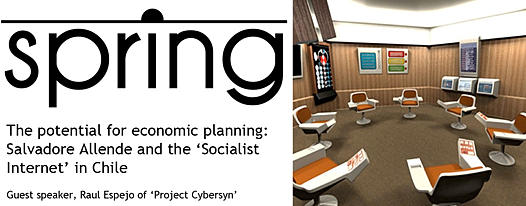
At the heart of this strategy was Project Cybersyn, a prototype internet system designed to link together the needs of the economy via ‘central nervous system’. A radical experiment in grass-roots networking, Cybersyn aimed to directly involve workers at all levels of production and distribution in the organic management of the economy.
Speaking at this event will be Nathan Coombs (Research Fellow at Edinburgh University) who will be speaking on the technological potentials of economic planning. Alongside him will be former Director of Project Cybersyn Raul Espejo, who will discuss his experiences with Cybersyn and the ‘Third Route’ to economic planning.
MANCHESTER: December 9th, 7pm, Instituto Cervantes, 326 Deansgate, M3 4FN, £4 entry (£3 concession)
LONDON: December 16th, 7pm, The Blue Posts, 28 Rupert St, W1D 6DJ, FREE ENTRY
Discover more from Progressive Geographies
Subscribe to get the latest posts sent to your email.


Reblogged this on DEMOCRACITIES.
Reblogged this on Progressive Geographies and commented:
A reminder of the London part of this event on Monday.
Reblogged this on In Rhizomia, http://www.rhizomia.net.
And I added in my post that Eden Medina wrote a book in 2011 on MIT Press on CyberSyn, called “Cybernetic Revolutionaries: Technology and Politics in Allende’s Chile” where she “tells the history of two intersecting utopian visions, one political and one technological. The first was Chile’s experiment with peaceful socialist change under Salvador Allende; the second was the simultaneous attempt to build a computer system that would manage Chile’s economy. Neither vision was fully realized–Allende’s government ended with a violent military coup; the system, known as Project Cybersyn, was never completely implemented–but they hold lessons for today about the relationship between technology and politics.”
http://mitpress.mit.edu/books/cybernetic-revolutionaries
/Henrik