
[Update September 2023 – thanks to a comment below for saying these are available via the Wayback Machine: 1; 2; 3; 4
Update Nov 2018 – these links appear to be dead. Please comment if they become live again or you know of another source]
History of the Present, the newsletter devoted to Foucault’s work published by Paul Rabinow and edited by him and other people at Berkeley is available online. I’d been looking for copies in libraries, and the online version took a little while to find, so I hope others will find it helpful.
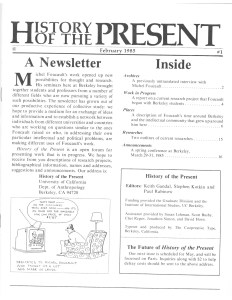 – February 1985 Issue (pdf)
– Spring 1986 Issue (pdf)
– Fall 1987 Issue (pdf)
– Spring 1988 Issue (pdf)
They include translations of interviews with Foucault, at least one of which is not available elsewhere, an interview with Deleuze, reviews, pieces by researchers using Foucault’s ideas, and so on. I’m intrigued by the stage performance of History of Sexuality…
These, and many other publications, are listed on the webpage of Paul Rabinow’s Anthropos Lab.
I’ve also added these to the list of uncollected notes, lectures and interviews on this site.
Discover more from Progressive Geographies
Subscribe to get the latest posts sent to your email.


Pingback: Top posts this week on Progressive Geographies | Progressive Geographies
Pingback: History of the Present journal– online | Foucault News
Reblogged this on multipliciudades and commented:
Stuart Elden provides the links to History of the Present, Paul Rabinow’s (ed.) newsletter on Foucault.
Pingback: Top posts on Progressive Geographies this week | Progressive Geographies
These can still be accessed via the Internet Archive:
1#
Click to access hotp1985.pdf
2#
Click to access hotp1986.pdf
3#
Click to access hotp1987.pdf
4#
Click to access hotp1988.pdf
Pingback: History of the Present – the Berkeley newsletter on Foucault’s work online via the Wayback Machine | Progressive Geographies