
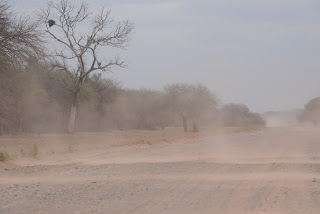
 One of the key people I am in dialogue with for my work on terrain is UBC Anthropology Professor, Gaston Gordillo. He provides a preview of a forthcoming essay on terrain at his Space and Politics blog. It will appear in Lexicon for an Anthropocene Yet Unseen, edited by Anand Pandian and Cymene Howe (2017, Punctum).
The piece begins with the rich ethnographic description familiar to readers of his books Landscapes of Devils: Tensions of Place and Memory in the Argentinean Chaco and Rubble: The Afterlife of Destruction. But it shifts into a powerful emphasis on the concept of terrain:
Global warming challenges human-centered views of places, landscapes, and territories as socially configured spatial fields for a simple reason: it confronts us with the vast, uncontrollable physicality of terrain. I propose “terrain” for our lexicon of the future because only this term admits that all actually-existing places have volumes, forms, and textures that are irreducible and indifferent to human practice, and whose dynamism becomes most apparent in the elusive physicality of the wind. And the air moves because we live in a planet in motion that rhythmically exposes the ocean and the atmosphere to the heat of the sun, creating temperature imbalances, flows, and currents in a state of flux.
You can learn more about his remarkable work in an interview I conducted with him for the Society and Space open site a couple of years ago.
Discover more from Progressive Geographies
Subscribe to get the latest posts sent to your email.


1 Response to Gastón Gordillo on Terrain