
Morten Paul, Suhrkamp Theorie: Eine Buchreihe im philosophischen Nachkrieg – Spector, February 2023
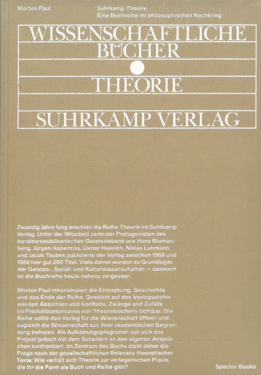
Suhrkamp’s “Theory” series appeared over a period of 20 years, from 1966 to 1986. The publishing house included over 200 titles in the series, including basic texts on the humanities and cultural studies: Kuhn’s ‘The Structure of Scientific Revolutions’, Habermas’s ‘Knowledge and Human Interests’, Althusser’s ‘For Marx’, Mauss’s ‘The Gift’, Bourdieu’s ‘Zur Soziologie der symbolischen Formen’, Searle’s ‘Speech Acts’, Foucault’s ‘The Archaeology of Knowledge’, Knorr-Cetina’s ‘The Manufacture of Knowledge’. With the help of archival records, interviews, and readings, Morten Paul reconstructs the creation of the series against the backdrop of questions relating to the social relevance of theoretical texts. How does theory behave in relation to practice, which supplies it with form as a text, book, or series? How does this form determine the social impact of theory? And why was this series ultimately doomed to failure, given the success of edition suhrkamp and suhrkamp taschenbuch wissenschaft? The book is part of the series Applied Publishing Studies.
Morten Paul, (b. in 1987), wrote his thesis on the “Theory” series in the Suhrkamp Research Group at the German Literature Archive Marbach, obtaining his doctorate at the University of Konstanz.
Discover more from Progressive Geographies
Subscribe to get the latest posts sent to your email.


Hi Stuart, as someone with an interest in the journal Antipode, I have some disturbing news from Wiley, which I believe should be deserving of a post by your good self to highlight a troubling development in the world of scholarly journal access. I’m a subscriber to Antipode, and it’s been a long standing practice by Wiley to provide access via ‘affordable’ subscriber rates to students and low wage earners. As one such low-wage subscriber it provided access to online + print at $60USD. I’ve just been informed that as of November 2022 Antipode is online only. But that’s not the kicker. Print copies are only available via POD partner Sheridan available at…wait for it…at the institutional rate which I was quoted in black n white for $1,886.50. So Wiley have closed off access to low wage people, to students, and any member of the general public who is lets be frank not wealthy, from access to Antipode. To anticipate your next question, well at least they still offer ‘online’ access, that distracts from where the attention should be focused on and that is why did Wiley take this route? For one, why did the special arrangement with POD partner Sheridan stipulate print copies were scaled at the institutional rate? That effectively excludes and kills off access to print editions for low income people. I won’t get into the debate about print vs online and the cost rubrics justifying those as ‘financial decisions’ because that just doesn’t stack up to scrutiny. Wiley is a global behemoth in the world of academic journals, and while many will argue print copies going the way of the dodo is inev itable in this post covid age ( a false choice and bargain) the implications for the critical role of print editions of a journal in disseminating knowledge to a broader publics will and should endure as a forceful argument. Journals like Antipode provide an important public function, not just a platform for academics and professional researchers. Obviously Wiley have demonstrated contempt for this ‘paying audience’. And not everyone has access to a University Library. Wiley’s decision is retrograde, regressive, and highly undemocratic and reinforces the perception, indeed reality, that access to new research and writing is only available to those few who can afford to pay for the privilege. I would urge that you investigate this further. I have sent emails to Wiley, who’ve refused to provide any clarity on why they’ve chosen to go this route, a rather contemptuous approach. This is deserving of public exposure and discussion, and some push back. cheers. Martin
I’m sorry to hear this. In recent weeks I’ve objected to editorial board members not getting a copy of the journal; and contributors to issues not getting a copy. Journals are moving more and more to online only. Books feel like they are not far behind – I was asked to be involved in editing a monograph series that would be online only. (I declined.) I’m still fighting on one of these issues, and don’t want to pre-empt a resolution. But I share the concern about this – in terms of the physical object, and access for non-university based people. I’ll have a think about what to say, and when.
Thanks Stuart. These are disturbing developments. One final point further to this, and which reflects on what the Antipode editorial is doing, and not doing. I’ll be emailing exec members of the Antipode board, to express my concerns ( and outrage ) at Wiley’s position. And requesting – as a subscriber – what action they can / will be taking in relation to this. The other bigger, more urgent issue, of publishers moving towards online only access, and the ‘death of the printed object’ is troubling because it’s being framed as inevitable, and inexorable. Nothing could be further from the truth. Decisions are made for specific reasons, and not always in the public interest. I’ll be having a hard think about what else I can do as a public citizen, and stakeholder, to counter this narrative, and practices, that are becoming a corrosive force damaging public and democratic access to knowledge in it’s printed form.
I have raised this with the editors of the journals I mentioned, but they have limited ability to change things. Often it feels like it only when a publisher agreement is negotiated – like a learned society’s journals, for example – that things can be secured or changed. But a lot of key journals are owned by the press themselves. Antipode should be an exception though.
Yes Stuart Antipode should be an exception. As it’s subtitle clearly states its a Radical Journal of Geography. One cannot lose sight of what the founding editorial collective back in 1969 envisaged for its role in agitating for radical democratic practices in everyday life and knowledge production was never imagined to be siloed from the everyday citizen. I note that the Antipode Foundation Ltd is a registered company and charity whose activities are still guided by these founding principles. If change comes in any form to restore those principles I believe the trustees and the Foundation must step forward to add weight to this effort. (One should remember that Wiley didn’t always ‘own’ the rights to the Journal) And do so collectively. I’ll be directing future efforts to communicating this to the trustees….if they’ll listen to what I have to say. If Wiley can pass a decision that effectively kills off the production of the print journal from 2023 it does so in complete ignorance of the implications of their actions, It effectively means that Antipode journal as a physical entity is also dead. Full stop. Can the trustees be comfortable with how that resonates or accords with the Foundations original manifesto it holds dear?