
Canguilhem beyond Epistemology and the History of Science – special issue of Revue Internationale de Philosophie, edited by Federico Testa, No 307, 2024
Congratulations to Federico for bringing this issue together – it has taken a long time, but as authors we think it is worth it. The pieces are all subscription only, unfortunately, but I’m happy to share my piece if you contact me by email – I’m sure the other authors are too.
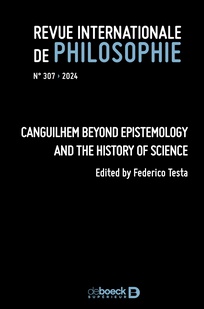
Federico Testa, “Introduction: A Neglected Philosopher—Canguilhem Beyond Epistemology and the History of Science”
Stuart Elden, “Canguilhem, Dumézil, Hyppolite: Georges Canguilhem and his Contemporaries”
Giuseppe Bianco, “Georges Canguilhem’s first reading of Auguste Comte (1926) and positivism’s fortune in the French philosophical field (1830-1930)”
Cristina Chimisso, “Individuals and their Environments in Georges Canguilhem’s Philosophy of Medicine”
Charles Wolfe, “A Note on the Situation of Biological Philosophy”
Samuel Talcott, “Canguilhem following Canguilhem: History of a Philosophical Engagement with Error”
Maria Muhle, “Temptations of the Milieu”
Here’s the abstract for my piece:
In the original preface to his primary doctoral thesis Folie et déraison, Michel Foucault thanked three men as intellectual mentors and influences on his work. In his inaugural lecture at the Collège de France in December 1970 the same three names were invoked: Georges Canguilhem, Georges Dumézil and Jean Hyppolite. The relation between these figures individually with Foucault has been discussed in varying degrees of detail, but this article explores the intellectual affinities and tensions between the three older men. Canguilhem and Hyppolite had been contemporaries at the École normale supérieure in the 1920s, then colleagues in Strasbourg, and perhaps most visibly they took part in a television interview mediated by Alain Badiou and Dina Dreyfus in 1965. While Dumézil and Hyppolite were colleagues at the Collège de France, they appear never to have discussed each other’s work. Nor does Dumézil discuss Canguilhem, but Canguilhem importantly discusses both Dumézil and Hyppolite. The focus here is on Canguilhem’s review of Foucault’s Les mots et les choses, in which he indicates the understated importance of Dumézil to that book; and a report of a largely unknown seminar from autumn 1970 when Foucault discussed Dumézil’s work and Canguilhem responded. The article then moves to Canguilhem’s engagement with Hyppolite’s work, especially in his analysis of “Hegel en France,” and the tributes he wrote to his friend and colleague following Hyppolite’s 1968 death. Exploring his reading of two of his great contemporaries helps to resituate Canguilhem within wider philosophical debates in the mid-20th century.
While written for this issue, I also see ‘Canguilhem, Dumézil, Hyppolite’ as part of an informal trilogy of articles which bridge the Foucault and Canguilhem books, on the one hand, and my new project on Indo-European thought in twentieth-century France, on the other. The other two pieces are on Foucault and Dumézil, one on their understandings of sovereignty was published last year in the Handbook on Governmentality; the other on antiquity is coming out in Journal of the History of Ideas later this year. “The Yoke of Law and the Lustre of Glory: Foucault and Dumézil on Sovereignty” can be found at the official Edward Elgar site here, or a pre-print is available at Warwick’s WRAP site if you don’t have library access. I’ll share a link to the second when it’s available.
Discover more from Progressive Geographies
Subscribe to get the latest posts sent to your email.


Pingback: “Foucault and Structuralism” – a book chapter for Daniele Lorenzini’s collection The Foucauldian Mind | Progressive Geographies
Dear Stuart
Thanks for your ever interesting blogs and updates and I’m glad you are back up and running at what seems like full strength. I’d be delighted if you would share a copy of your piece please.
I have always tried to follow the threads from Canguillhem to Foucault and Hyppolite’s short book on Hegel (bought in that excellent philosophy bookshop on the place de la Sorbonne) was one of the sources that I always found made the most interesting bridge between Hegelian and Foucauldian epistemologies. I would, therefore, be really interested to read a systematic account of the relationships between these two major and direct influences on Foucault’s thinking.
All best wishes Mike
>
Thanks for the interest. I’ve sent a copy to what I hope is the right address. If you don’t get it, please let me know the right address to use. There is more about Canguilhem and Hyppolite’s importance to Foucault in the books on Foucault, especially The Early Foucault, but this piece is hopefully interesting for the links between Canguilhem and Hyppolite, who knew each other for many decades.