
It’s Immanuel Kant’s 300th birthday today.
I’ve not written much on Kant, but he was the topic of perhaps my favourite of the essay collections I’ve edited or co-edited – Stuart Elden and Eduardo Mendieta (eds.), Reading Kant’s Geography, SUNY Press, 2011.
Eduardo and I discussed the idea and while we realised we couldn’t write the book together, we did know or know of the people who could. We brought many of them together for workshops in New York and Durham. It’s very much a book I think of as one by many hands – not just a collection of pieces on a theme, but one where the pieces fit together to cover most of the aspects of a topic.
The book came out shortly before the translation of one of the versions of Kant’s lectures was translated into English in the Natural Science collection. The problems of that text are discussed in the book in detail – we had contributions from the English and French translators, and the German editors.
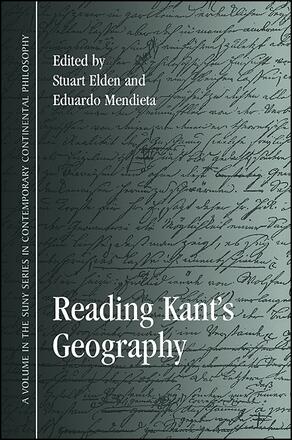
Perspectives on Kant’s teachings on geography and how they relate his understanding of the world.
For almost forty years, German enlightenment philosopher Immanuel Kant gave lectures on geography, more than almost any other subject. Kant believed that geography and anthropology together provided knowledge of the world, an empirical ground for his thought. Above all, he thought that knowledge of the world was indispensable to the development of an informed cosmopolitan citizenry that would be self-ruling. While these lectures have received very little attention compared to his work on other subjects, they are an indispensable source of material and insight for understanding his work, specifically his thinking and contributions to anthropology, race theory, space and time, history, the environment and the emergence of a mature public. This indispensable volume brings together world-renowned scholars of geography, philosophy and related disciplines to offer a broad discussion of the importance of Kant’s work on this topic for contemporary philosophical and geographical work.
It was not the easiest of books to get contracted – I remember clearly one rejection, only moments after we’d sent a carefully-crafted pitch, which was basically to say “philosophers aren’t interested in geography; geographers aren’t interested in Kant”. But it found a good home with SUNY Press, thanks to the interest of Dennis J. Schmidt in the project.
The table of contents is:
Acknowledgments
Reintroducing Kant’s Geography
Stuart Elden
I. The Invention of Geography: Kant and His Times
Immanuel Kant and the Emergence of Modern Geography
Michael Church
Kant’s Geography in Comparative Perspective
Charles W. J. Withers
II. From a Lecture Course of Forty Years to a Book Manuscript: Textual Issues
Kant’s Lectures on “Physical Geography”: A Brief Outline of Its Origins, Transmission, and Development: 1754–1805
Werner Stark
Historical and Philological References on the Question of a Possible Hierarchy of Human “Races,” “Peoples,” or “Populations” in Immanuel Kant—A Supplement.
Werner Stark
Translating Kant’s Physical Geography: Travails and Insights into Eighteenth Century Science (and Philosophy)
Olaf Reinhardt
Writing Space: Historical Narrative and Geographical Description in Kant’s Physical Geography
Max Marcuzzi
III. Towards a Cosmopolitan Education: Geography and Anthropology
“The Play of Nature”: Human Beings in Kant’s Geography
Robert Louden
The Pragmatic Use of Kant’s Physical Geography Lectures
Holly Wilson
The Place of the Organism in Kantian Philosophy: Geography, Teleology, and the Limits of Philosophy
David Morris
IV. Kant’s Geography of Reason: Reason and Its Spatiality
Kant’s Geography of Reason
Jeff Malpas and Karsten Thiel
Orientation in Thinking: Geographical Problems, Political Solutions
Onora O’Neill
“The Unity of All Places on the Face of the Earth”: Original Community, Acquisition, and Universal Will in Kant’s Doctrine of Right
Jeffrey Edwards
V. Gender, Race, History, and Geography
Cosmopolitanism in the Anthropology and Geography
David Harvey
Is there Still Room for Freedom? A Commentary on David Harvey’s “Cosmopolitanism in the Anthropology and Geography”
Ed Casey
Kant’s Third Thoughts on Race
Robert Bernasconi
The Darker Side of the Enlightenment: A De-Colonial Reading of Kant’s Geography
Walter Mignolo
Geography is to History as Woman is to Man: Kant on Sex, Race, and Geography
Eduardo Mendieta
An earlier essay of mine, “Reassessing Kant’s Geography” was published in Journal of Historical Geography in 2009. My introduction to the edited volume was a shorter, and revised version of this text. I’m happy to share the pdf of the essay if you email me.
Some nice things were said about the book:
“…a timely collection of eighteen essays woven into a coherent matrix by the two editors Stuart Elden and Eduardo Mendieta. A splendid job, by its nature an inherently interdisciplinary endeavour, at the same time a window to the past and a gate-opener to the future. ” —Gunnar Olsson, Geografiska Annaler Series B
“One of the great strengths of Reading Kant’s Geography is that it brings together geographers and philosophers to engage with the nexus between Kant and geography. ” — Robert Mayhew, Journal of Historical Geography
“A moment of Kantian enlightenment! In a splendid, interdisciplinary set of interrogations, the nature and significance of Immanuel Kant’s geography is brought into full light for the very first time. This remarkable work of retrieval thus enlightens, at once, Kant’s own Enlightenment project, and geography’s place in the project of Enlightenment. Whether dealing with racial geography, philosophical topography, or cosmopolitan politics, Reading Kant’s Geography constantly illuminates and instructs. If, as is sometimes said, geography is too important to be left to geographers, it’s no less true that it’s too important to be left to philosophers. ” — David N. Livingstone, author of Adam’s Ancestors: Race, Religion, and the Politics of Human Origins
“This volume of impeccable scholarship and sustained critical inquiry performs an invaluable service. It is a major contribution to writings on the history of geography, but it also shows that Kant’s geography was far from incidental to the whole outworking of his philosophy, nor to what he claimed about the potentialities and pitfalls in shared human occupation of the planet. As such, this volume needs to be read by anyone concerned with enlightenment, modernity, and issues such as cosmopolitanism and transnationalism. ” — Chris Philo, editor of Theory and Methods: Critical Essays in Human Geography
“This excellent book, which oozes scholarly seriousness from start to finish, offers something new to philosophers and geographers alike… There is a pleasing consistency to Reading Kant’s Geography that the editors and contributors must be congratulated for. Despite involving nineteen different authors and two translators, all the pieces are intellectually rich, carefully argued, well structured and written in crisp English. There was clearly a collective desire to ensure that this book meets the highest scholarly standards. The SUNY Press have also done an excellent presentational job: from the cover sleeve to the font choice to the extensive end notes and beyond, the book makes you want to pick it up and dive in. Reading Kant’s Geography is both authoritative and attractive in equal measure”. — Noel Castree, Annals of the Association of American Geographers
Discover more from Progressive Geographies
Subscribe to get the latest posts sent to your email.


Pingback: Eduardo Mendieta (1963-2025) | Progressive Geographies