
Federico Testa, On the Politics of the Living: Foucault and Canguilhem on Life and Norms – Bloomsbury, December 2024
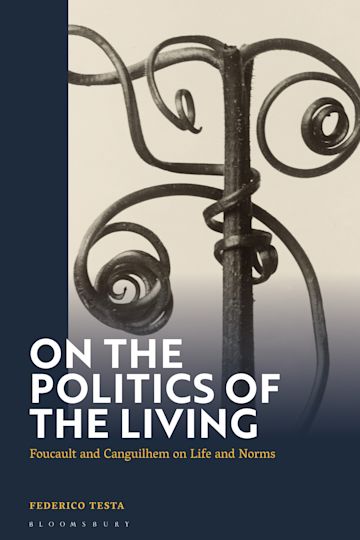
Bringing the philosophies of Michel Foucault and Georges Canguilhem into dialogue, Federico Testa examines the notions of life and norms underlying our modern experience of politics.
Today’s global health crisis acts as a stark reminder that life is at the core of our political debates and dilemmas. We can no longer think of forms of political organization, citizenship and participation without considering the materiality and precarity of our own organic life. Ours is a politics of the living.
Within this context, this book examines Foucault’s work on the politicization of life and biopolitics through the lens of Canguilhem’s notion of norms. Testa extracts from Canguilhem’s philosophy the conceptual tools to re-interpret Foucault’s ideas on power, and reconceptualises normativity as a process of the creation of norms that provide tools for political and social analysis and for thinking resistance. In so doing, he uncovers new and important possibilities for biopolitical resistance.
Demonstrating not only Canguilhem’s underexplored social and political concerns but also the intellectual osmosis between the two thinkers, On the Politics of the Living is an urgent examination of the ever-increasing significance of the concepts of life, care and health in today’s political discourse.
Discover more from Progressive Geographies
Subscribe to get the latest posts sent to your email.


sadly James C Scott has died, hope there is enough of his rivers book done to publish, he will be missed.
According to reports on social media he completed the edits before he died, so it will be published. Am hesitating about posting given the CIA links and the polarised nature of the debate about him. But Seeing Like a State was a significant book – I don’t know much about his other work.
thanks for letting me know, whatever makes sense to you, yes he did a lot of work on territory/territorialization that fed much of what we now see on native resistance/decolonization
That was in the 1960s. The work is significant, highlighting peasant strategies to avoid state surveillance and control, and the benefits of self-organised communities. Based on much more fieldwork than most theorists I might add [including Foucault]
people should take it with whatever grains of salt suit them but he framed it this way:
“9:51:20 I was very much involved with anthropologists against the War; when I worked for the National Students Association it turned out, after I was elected to be International Vice-President, I was delivering some resolutions we had passed at our annual student meeting on Haiti and other places, in Washington; I was asked to go to a meeting with someone who turned out to be a CIA agent, who wanted me to write reports for them; at the time I don’t think I was ideologically opposed to that but I refused; it turned out that during my period working for the National Student Association, all my reports were sent by the president, who had been recruited by the CIA, to them; I wasn’t paid, but I was in effect a CIA agent; I had some sense of being a little cog in a machine I didn’t much care for, so the idea that anthropologists should be involved in counter-insurgency – an issue that has come up again – it was clear to me that this must never happen; I knew some of the people – David Wilson and the Tribal Research Center in Thailand – so I was very heavily involved in this, and in the protests against Sam Huntington’s ideas on relocation of people in Vietnam too; there were huge demonstrations at the Association of Asian Studies over Huntington’s work, and I was very much a part of this; there were at least five or six years at Wisconsin devoted to intellectual work, both against the war in Vietnam and also practical speaking; I met Eric Wolf a couple of times but before meeting him, I met his wife Sydel Silverman; I think ‘Peasant Wars of the Twentieth Century’ and his little book on ‘Peasants’ are excellent; if you look at my book that is coming out in September it starts out with Pierre Clastres’ argument about people with history and people without, and it can be seen as homage to Eric Wolf; I think ‘Europe and the People without History’ is a great book; I think he did an admirable job, taking the same political situation that I faced and doing a kind of scholarship that transcended just the particular moment”
http://www.alanmacfarlane.com/DO/filmshow/scott2_fast.htm