
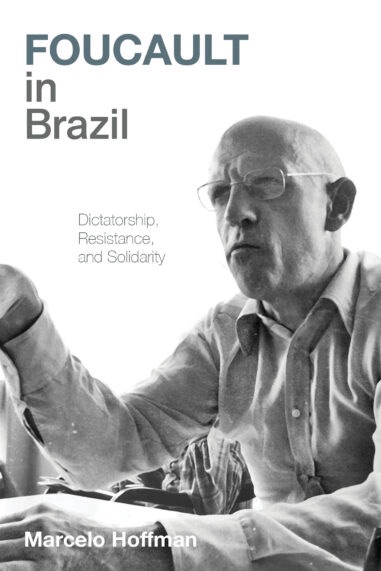
My review of Marcelo Hoffman’s remarkable book Foucault in Brazil is scheduled to appear in Political Theory next year, but is now available online first. Many thanks to Verena Erlenbusch-Anderson for asking me to write the review, and Marcelo for such a good book to discuss.
The review is subscription only, but if you want to read it and you can’t get a copy another way, email me or request on ResearchGate. Here are the first two paragraphs:
Michel Foucault made five visits to Brazil—one in 1965 and four in the mid-1970s. All took place under the military dictatorship that lasted from 1964 until 1985. Each time, Foucault delivered important lectures, some of which were published in his lifetime while others have remained largely unknown. In 1965, he gave a course on his book-in-progress, Les mots et les choses, translated as The Order of Things. The course manuscript is an early draft of the book itself and is due to be edited by Philippe Sabot for the new series of “Cours et travaux” (“Courses and Works”) that precede Foucault’s time at the Collège de France. In 1973, Foucault gave five lectures in Rio de Janeiro, which have been translated as “Truth and Juridical Forms.” In 1974, he gave a number of lectures on social medicine and public health, of which three have been published. In 1975, he gave a course on sexuality, which preceded the first volume of The History of Sexuality the following year and which gave valuable insight into the originally envisioned plan for its subsequent unpublished volumes. It is due to be published in Généalogies de la sexualité. In 1976, his last visit, he gave lectures of which “The Meshes of Power” is the key published source. During these visits, he spent time with academics and students, activists and friends. There were some important interviews with Brazilian interlocutors and discussions following some of the lectures.
In his remarkable book, Foucault in Brazil: Dictatorship, Resistance, and Solidarity, Marcelo Hoffman adds significantly to our understanding of this period of Foucault’s career. It comes after two other important contributions—Heliana de Barros Conde Rodrigues’s Ensaios sobre Michel Foucault no Brasil (2016; translated into French in 2020) and an issue of the Carceral Notebooks on “Foucault and the Politics of Resistance in Brazil,” edited by Hoffman himself in 2017. The lectures that have been published from Foucault’s visits have also been discussed in various works. Hoffman suggests that previous discussions of the lectures have missed the specifically Brazilian context in which they were delivered and that Conde Rodrigues provides a great deal of context but relatively little on the content of the lectures (6). Hoffman’s aim, and his major contribution, is to resituate the intellectual projects Foucault outlines within the specifics of the place in which and the audience to which they were delivered. The political context is brought, importantly, to the fore.
Discover more from Progressive Geographies
Subscribe to get the latest posts sent to your email.


