
Since the last update in September, I’ve continued working on the chapter of this project which looks at Benveniste and Dumézil’s parallel teaching careers at the Collège de France, through the 1950s and 1960s. This is the planned topic of an online Social Anthropology seminar at the University of St Andrews in November.
Much of the time recently has been spent in Paris, with shorter visits to archives and libraries in London and Cambridge. The main work in Paris was to continue working through Benveniste’s papers at the Bibliothèque nationale. A lot of these relate to journal articles or book chapters, where there was some combination of a manuscript, rough notes, a typescript, often with a lot of corrections, and then proofs. His typists were very good. Even though his handwriting is a lot better than some of the other people I’m working on, they would still have been challenging manuscripts to work with, especially the diacritics, transliterations and other alphabets. Occasionally there were letters to Benveniste, perhaps relating to the request to write something, or sending the proofs. Generally, these files related to published material, and were not especially revealing. More interesting, though harder to make sense of, are things relating to his teaching. Much has already been dated by the archivists, but having a list of his courses helps to situate them, between his annual courses at the EPHE and the Collège de France, and the year. The lack of a detailed online inventory for several boxes means I am not sure what is where – and there isn’t an obvious logic to the organisation. But I would probably want to work through everything myself anyway. Although I won’t need to look at every box again, I plan to return to some, and so one important task is making sufficiently detailed notes that I can find things again at some future point.
There is also a lot of material relating to Benveniste’s Vocabulaire book, some of which has caused me to rethink some of the assumptions I’d made about that project. I’m not sure how it all fits together quite yet, but it seems to me to be the most revealing part of the archive in terms of his publications. I also took a look at some of Tzvetan Todorov’s papers, also at the Bibliothèque nationale, for the material they have in relation to Benveniste, some of whose final courses Todorov attended.
One thing that really struck me, perhaps even more than in the similar work I’ve done with Dumézil’s archive, is just how many pieces Benveniste published were in Festschriften or other volumes celebrating another great scholar, perhaps for their 60th or 70th birthday. Dumézil does a lot of these too, and it’s very much a generational thing. Of the next generation, I’m struck that Foucault did almost none. There was a Hommage à Jean Hyppolite that he led, after Hyppolite’s death, to which he contributed the famous “Nietzsche, Genealogy, History” essay and a brief avertissement which is not included in Dits et écrits (a scan is here). He and Georges Canguilhem had earlier spoken at a memorial event for Hyppolite at the ENS, and those were also published. But these are not tributes to a living scholar. Foucault reworked his introduction to Canguilhem’s The Normal and the Pathological for a special issue of a journal on Canguilhem shortly before his death, which was in 1985, which is probably as close as he got (a comparison is here). But those are two exceptions, for people Foucault was enormously indebted to as a teacher and/or as a mentor. I can’t think of examples where he was writing a piece for a collection of someone he knew much less well. With the Hyppolite ENS tribute and Canguilhem he is also writing about the person being remembered or honoured, while with the Hommage volume it is a piece on a different topic – something that is more common in a Festschrift. With Benveniste and Dumézil there are large numbers of those kinds of pieces. When I shared these thoughts on social media, Philipp Kendar pointed out that Foucault also contributed to a special issue of Critique on Georges Bataille in 1964. I should have remembered that – I even bought a copy of the issue a few years ago, since I wanted to see Foucault’s piece in context. But, again, it’s a tribute to someone recently deceased, and it is about their work.
The Festschrift as a literary form still endures, but it doesn’t seem to be nearly as common, or have nearly the same kind of status today as it once had. And while there were certainly problems with the model, they did include some interesting pieces that were probably quite difficult to place elsewhere – more than a review, not quite an article or more standard book chapter. But, they can be really difficult to track down if you are looking for a piece published in one. (My old thoughts on this, here.)

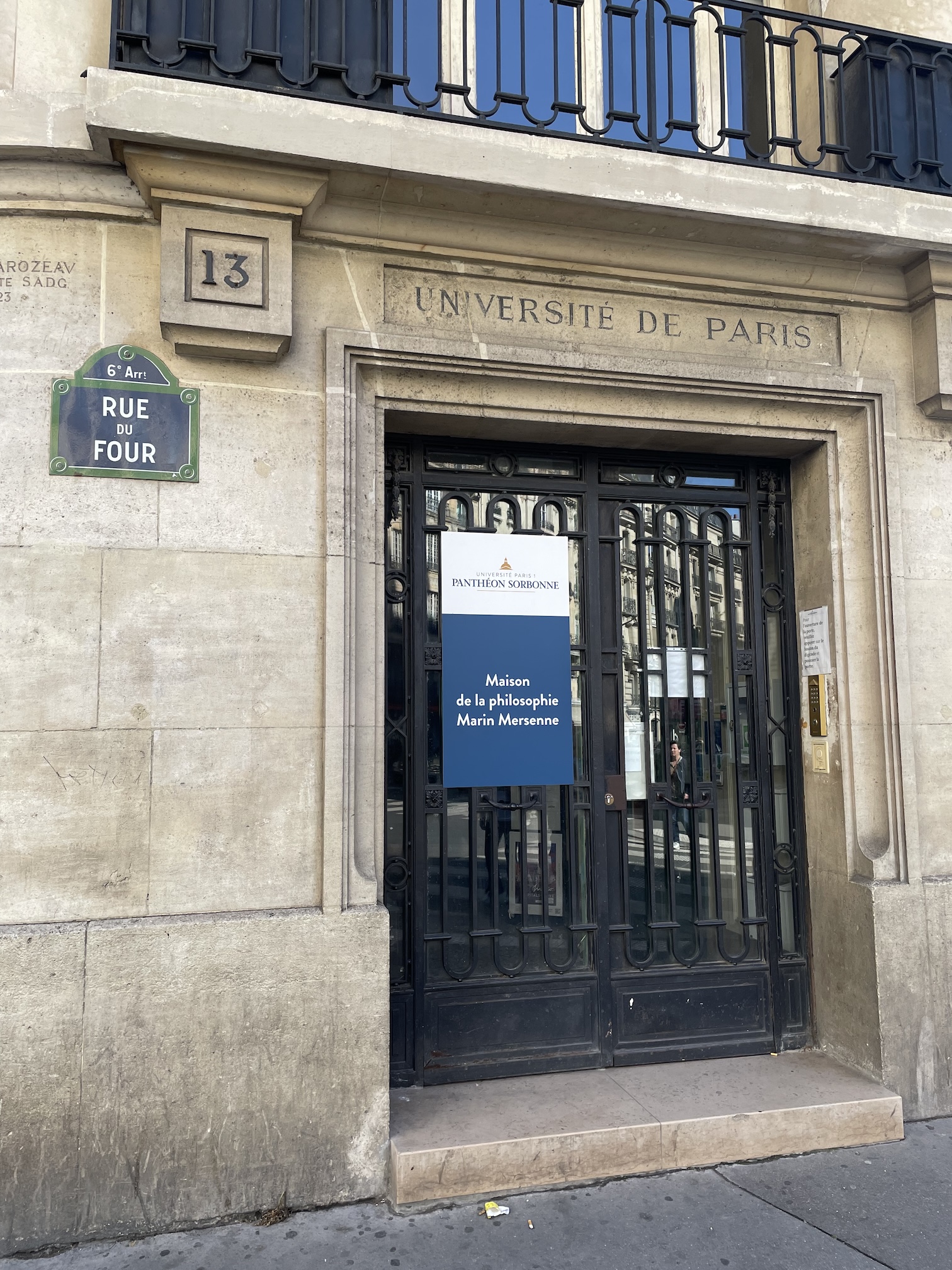
On the corner of the rue de Richelieu and the rue Colbert there is a rather dilapidated building which I understand now belongs to the BnF. It is the Hôtel Nevers, which once was the home of Cardinal Mazarin. But in 1958, it was where the Centre de recherches d’histoire des sciences et des techniques was established, directed by Alexandre Koyré, at the Centre International de Synthèse. It’s right next to the BnF Richelieu site. A little sign gives some of its history, but not what it was used for in the late 20th century. The Centre, now the Centre Alexandre Koyré, was relocated to the Museum of Natural History in the Jardin des Plantes in 1989, and is now at the Campus Condorcet. I’m interested in how much this Centre was an alternative centre in Paris to the Institut d’histoire des sciences et des techniques of the University of Paris, on the rue du Four, which Gaston Bachelard, Canguilhem and Suzanne Bachelard all directed.
The Koyré work is a parallel and growing side-project to the Indo-European work, although he is likely to feature as a minor character in the story I’m telling. As well as the article I wrote on his failure to get elected to the Collège de France (open access in History of European Ideas), I wrote a piece on Canguilhem and Koyré for a workshop on Canguilhem, and that paper opens up a wider discussion of his situation within a French tradition in the history of sciences, and beyond. An audio recording of my talk is here. Doing the research for that paper took me back to the Canguilhem archive at CAPHÉS at the École normale supérieure, and I also found that the Bibliothèque nationale has some correspondence between Koyré and the geographer Jean Gottmann, which I went to look at one afternoon. I say a bit more about those connections here. I also tried to find out a bit about Koyré’s visiting posts in Cairo, though as far as I can tell there are relatively few published sources for this part of his career. I also made a trip to the Archives nationales, which has some papers relating to Koyré and also to Dumézil’s teaching of Armenian. At the moment the last file I know I need to consult there is unavailable – there is apparently asbestos in one of the stores – and the date it might be accessible keeps getting put back.
While I was in Paris, my MacBook starting crashing, and trying to recover it made it worse; a factory reset at the Apple Store didn’t resolve the problem; and the cost of repair was so high (and the laptop relatively old), that I had to replace it when I got home. What this meant was that for several days in Paris I was working with pencil and notebook, which was fine for taking notes – though there was a lot I needed to write up when I had a working system again. (And, at times, I was trying to decipher my own handwriting…) But it made me realise how reliant I am on being able to check files when I’m working in libraries and archives. I have lots of lists of things to check, colour-coded highlights in my draft chapters and papers, indicating to me why I need to look at something or how it fits with things I’ve already consulted. Or an archive file had a draft of a published text and I wanted to compare it to the published one, many of which I have as a pdf. I was pulling up those files on the iPad while in the libraries, but it wasn’t nearly as coordinated a work process as I was used to having. It did make me grateful that nothing was saved on the laptop alone, and that I could access everything online in some way. For reading that was manageable, much less so for writing. As it was, I was able to work through most of the archive files I wanted to on this visit, and I didn’t have a pressing writing deadline which would have caused more problems. Fortunately, I’d already written my paper for Bristol the week after I returned. Writing emails or comments on PhD work was much harder. All the people I work on did their initial work by hand, and then usually got someone else to type it up before they corrected it, often by hand. It’s not a model I’m keen to replicate again.
Back in England, I had a lot of things to catch up on and the Bristol conference, as well as some library work in London. One archive I’ve visited a few times before is the Ancient India and Iran Trust in Cambridge, which has the papers of Harold Bailey which include correspondence with many of the people I’m discussing. In particular, his correspondence with Benveniste – who examined his doctoral thesis – is extensive and covers many decades. But the Trust also has the papers of the Corpus Inscriptionum Iranicarum, and this shed some light on Benveniste’s planned volume on Old Persian Inscriptions, which was never completed. There is an interesting story here, I think, which I’ve been trying to reconstruct. There is some material relating to Benveniste’s progress there, but the draft parts of the text are missing, and I’m trying to find out where they might have ended up. The most recent reference I can find to them and their whereabouts is in 1994 – almost twenty years after Benveniste’s death – but thirty years ago now.
For various reasons I am unsure when I will next be able to get to these archives, but I feel I’ve made some good progress recently.
Previous updates on this project can be found here, along with links to some research resources and forthcoming publications. The re-edition of Georges Dumézil’s Mitra-Varuna is now scheduled for December 2024. There is a lot more about the earlier Foucault work here. The final volume of the series is The Archaeology of Foucault, and the special issue of Theory, Culture & Society I co-edited on “Foucault before the Collège de France” has some important contributions on the earlier parts of Foucault’s career, and is currently available free to access. My article “Foucault and Dumézil on Antiquity” is in the current issue of Journal of the History of Ideas; “Alexandre Koyré and the Collège de France” is online first and open access.
Discover more from Progressive Geographies
Subscribe to get the latest posts sent to your email.


