
Julia Jorati, Slavery and Race: Philosophical Debates in the Eighteenth Century – Oxford University Press, November 2023
review by Peter K. J. Park at NDPR
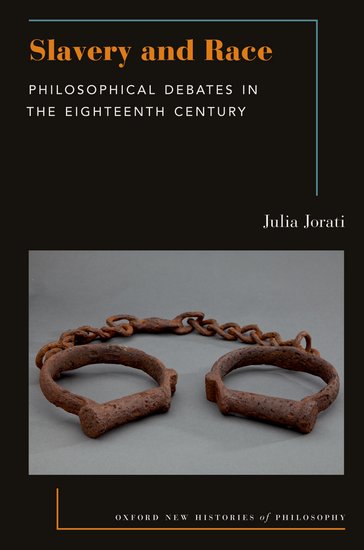
Millions of Africans were enslaved and transported to the Americas in the eighteenth century. Europeans–many of whom viewed themselves as enlightened–endorsed, funded, legislated, and executed the slave trade. This atrocity had a profound impact on philosophy, but historians of the discipline have so far neglected to address the topics of slavery and race. Many authors–including enslaved and formerly enslaved Black authors–used philosophical ideas to advocate for abolition, analyze racist attitudes, and critique racial bias. Other authors attempted to justify the transatlantic slave trade by advancing philosophical defenses of racial chattel slavery.
Slavery and Race: Philosophical Debates in the Eighteenth Century explores these philosophical ideas and arguments, with a focus on the role race played in discussions of slavery. In doing so, author Julia Jorati reveals how closely associated Blackness and slavery were at that time and how many White people viewed Black people as naturally destined for slavery. In addition to examining well-known authors like David Hume, Immanuel Kant, and Jean-Jacques Rousseau, Jorati also discusses less widely studied philosophers like Quobna Ottobah Cugoano, Lemuel Haynes, and Olympe de Gouges. By revealing important aspects of debates about slavery in North America and Europe, this book and its companion volume on the sixteenth and seventeeth centuries are valuable resources for readers interested in a more complete history of early modern philosophy.
Jorati’s book Slavery and Race: Philosophical Debates in the Sixteenth and Seventeenth Centuries, also with Oxford University Press was published in July 2024.

Philosophers from Europe and colonial America engaged in heated debates about the morality of slavery in the sixteenth and seventeenth centuries, and these debates provide insights into the roots of modern racism. Julia Jorati explores the philosophical ideas, theories, and arguments that are central to early modern discussions of slavery. Some texts explicitly examine the morality of the transatlantic slave trade or of the enslavement of indigenous people in the Americas; others discuss slavery in predominantly theoretical ways. Based on these texts, Jorati shows that race and slavery came to be closely associated in this period. This association was often made through an endorsement of the theory of natural slavery: Black and indigenous people were commonly viewed as natural slaves, or naturally destined for slavery. The theory that some people are natural slaves also features prominently in theoretical discussions of slavery, and many philosophers in the sixteenth and seventeenth centuries embraced versions of it.
Jorati surveys a wide range of historical material, from the views of Thomas Hobbes, John Locke, and Gottfried Wilhelm Leibniz, to many less widely studied philosophers like Gabrielle Suchon, Morgan Godwyn, and Epifanio de Moirans. Jorati’s volume, along with its companion Slavery and Race: Philosophical Debates in the Eighteenth Century, illustrates the significance and philosophical sophistication of early modern debates about slavery, and serves as a valuable resource for scholars, instructors, and students who are curious about this widely neglected topic.
Discover more from Progressive Geographies
Subscribe to get the latest posts sent to your email.


