
Since the last update in December, I’ve been making some good progress on this project. The focus has mainly been on Benveniste’s work in the 1960s. But, as ever, I’ve found myself backtracking to earlier parts of his career and seeing some potentially interesting diversions from that focus.
I went down a little detour about the decipherment of Linear B, as both Benveniste and Dumézil used this as an example in their teaching, and because both attended the first international conference on Mycenaean studies in 1956, held just outside of Paris and organised by Michel Lejeune and Pierre Chantraine. While the story of the deciphering has been told, the French connection is less explored, particularly in terms of Lejeune’s subsequent work. I say more about that story here.
I also discovered that there is a record of Benveniste’s 1937 lecture to the Prague Linguistic Circle, for which he told Roman Jakobson after the war that his papers were lost when his flat in Paris was occupied. The short summary, published in Czech, is translated by John Raimo and discussed by me here. I also mention Jakobson’s report of a lecture Benveniste gave in Brno on the same visit to Czechoslovakia. A couple of small pieces of evidence to add to the story of Benveniste’s early career.
Returning to my current focus on his final publications, I worked on Benveniste’s book Titres et noms propres en iranien ancien. It is another very specialist study, but which helps to shed some light on some of his other projects, some incomplete, and his collaborative work with archaeologists and epigraphists. It’s also interesting I think, because it touches on similar themes to his Dictionary of Indo-European Concepts and Society, but unlike that book it has more academic references. The discussion of Benveniste’s final few courses is now properly supported by references to the shorter publications from the 1960s, many of which are in Problémes de linguistique générale, especially its second volume. (Only a few pieces in there are in English translation.) A few late pieces which are not collected there or elsewhere can be difficult to find, but I think I’ve located most of them.
I also wrote a short piece on Foucault’s 1972 visit to Cornell University, though I’d hoped the archives there might shed some more light on his short lecture trip. Posting that led to a source of which I was unaware which adds a bit more detail. I also updated an earlier post about Marie-Louise Sjoestedt – an interesting and tragic French Celtic scholar, who was a friend and colleague of both Benveniste and Dumézil. The updated piece is here. I’m hoping that I’ll make time in 2025 for more of these short pieces – brief sketches of a history, notes towards something, thoughts on a recent book, a development of an idea I only touch upon in a more formal text. I say more about these pieces, and a couple of others I’ve shared so far, which I’m calling ‘Sunday histories’, here.
Much of the work in early January was trying to get the text into as good a shape as possible before my New York trip. I didn’t manage to get as much done as I’d hoped, and the two main tasks left for this chapter are Benveniste’s Vocabulaire – the Dictionary of Indo-European Concepts and Society, and then the parallel discussion of Dumézil’s career.


I’ve been in New York a couple of weeks, spending time at the Remarque Institute at New York University where I’m based, and going to some events there, and a few elsewhere at NYU. I’ve committed to giving very few talks while I’m here. One was online for the University of Nottingham Futures of Ideology series. I’ll be making a side-trip to Buffalo to speak to the Just Theory series in Comparative Literature, and giving two short papers to events at Remarque.
One of the reasons why some time in the United States was appealing was the chance to get to some archives. I haven’t been here for several years and there are some interesting things to explore. Dumézil and Benveniste visited the US a few times. Dumézil had a series of visiting posts here after his retirement from the Collège de France, but there are, to my knowledge, relatively few sources here for his story. But other related figures do have material here. This includes Claude Lévi-Strauss, who spent much of the war in the United States, and Roman Jakobson, who also came at that time, but ended up staying here after the war. Jakobson’s main archive is at MIT, but there are some things here in New York. Walter Henning, whose main archive is in Germany, spent the final years of his career here. There is also correspondence between some of the people I’m working on in various archives. Some of these are further afield, and so I’ve been sending off a lot of requests to find out the extent of material. Some archives are very generous in scanning material, either free of charge or for a small fee. Others have digitised a lot of material already. One in New York only permits researchers to use their reading room if material is not already scanned, and led me to 11,000 pages of material relating to Ernst Kantorowicz. He’s certainly someone I’m interested in, but only as a very peripheral figure to the main story. When it is of that scale, I’d rather spend some weeks working through it on site than looking at it on a screen. But when it’s more like 20 pages, having something scanned and saving a flight is really appreciated.
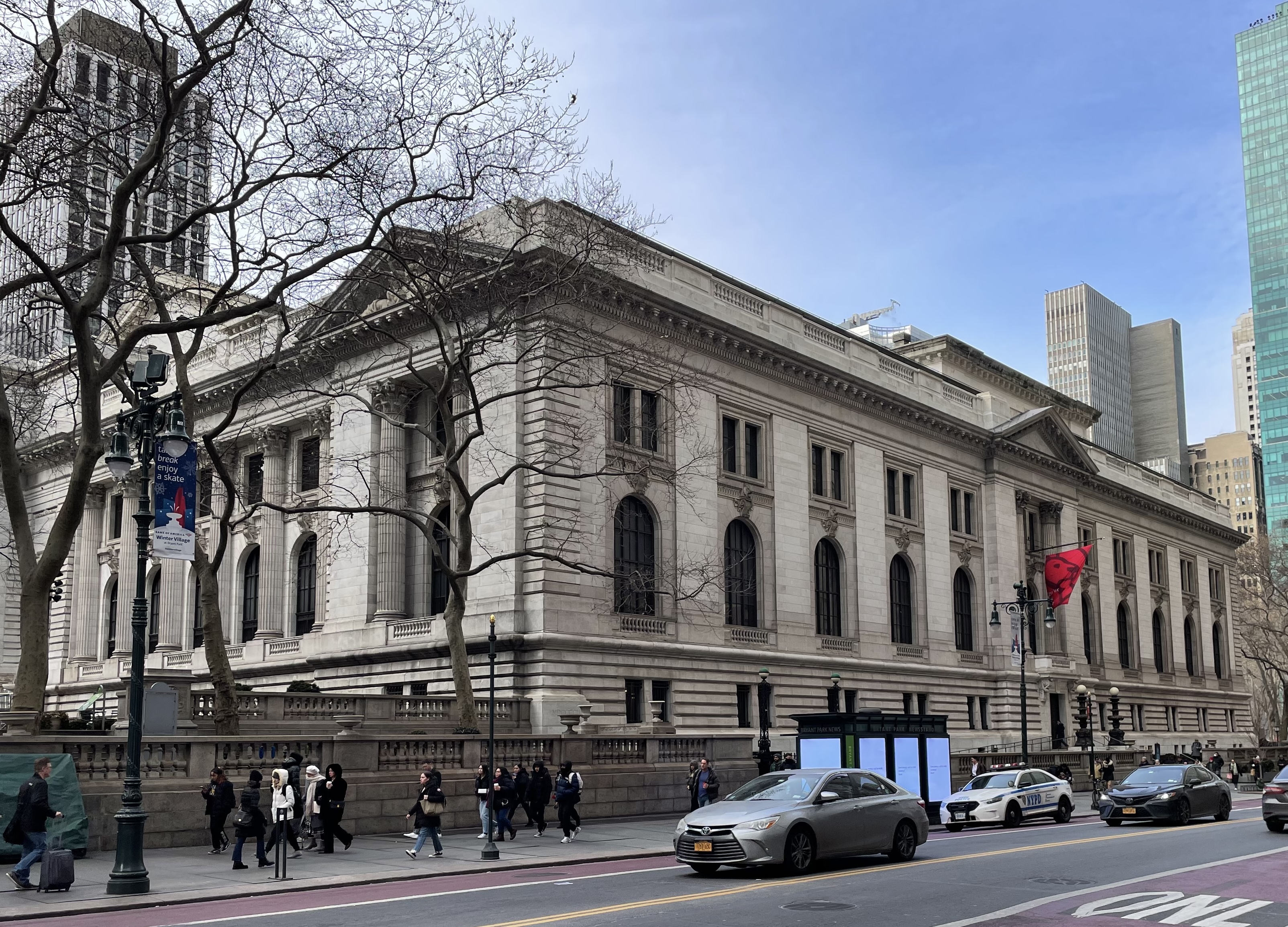
I first looked at some of the Semiotext(e) papers at New York University, but that didn’t have as much about their conference on Benveniste as I’d hoped. The conference was initially planned for an issue of the Semiotext(e) journal, but ended up in Thomas Sebeok’s journal Semiotica instead. More useful material was at the New York Public Library, which has the papers of the Emergency Committee in Aid of Displaced Foreign Scholars. There is some interesting detail on a few people connected to my project. I’d not used their archive collections before, but there is at least one reason to go back.
Columbia University has some materials relating to Jakobson, who taught there for a few years before moving to Harvard. They also have the archives of a few people who were in correspondence with him and Alexandre Koyré, so it’s an interesting source of material. My first ever experience of working with archives was at Columbia, over twenty years ago, when I was working on Henri Lefebvre, as they have the archives of his friend and co-author Norbert Gutermann. The reading room has changed a lot but it was good to be back. I have a couple more trips there planned.
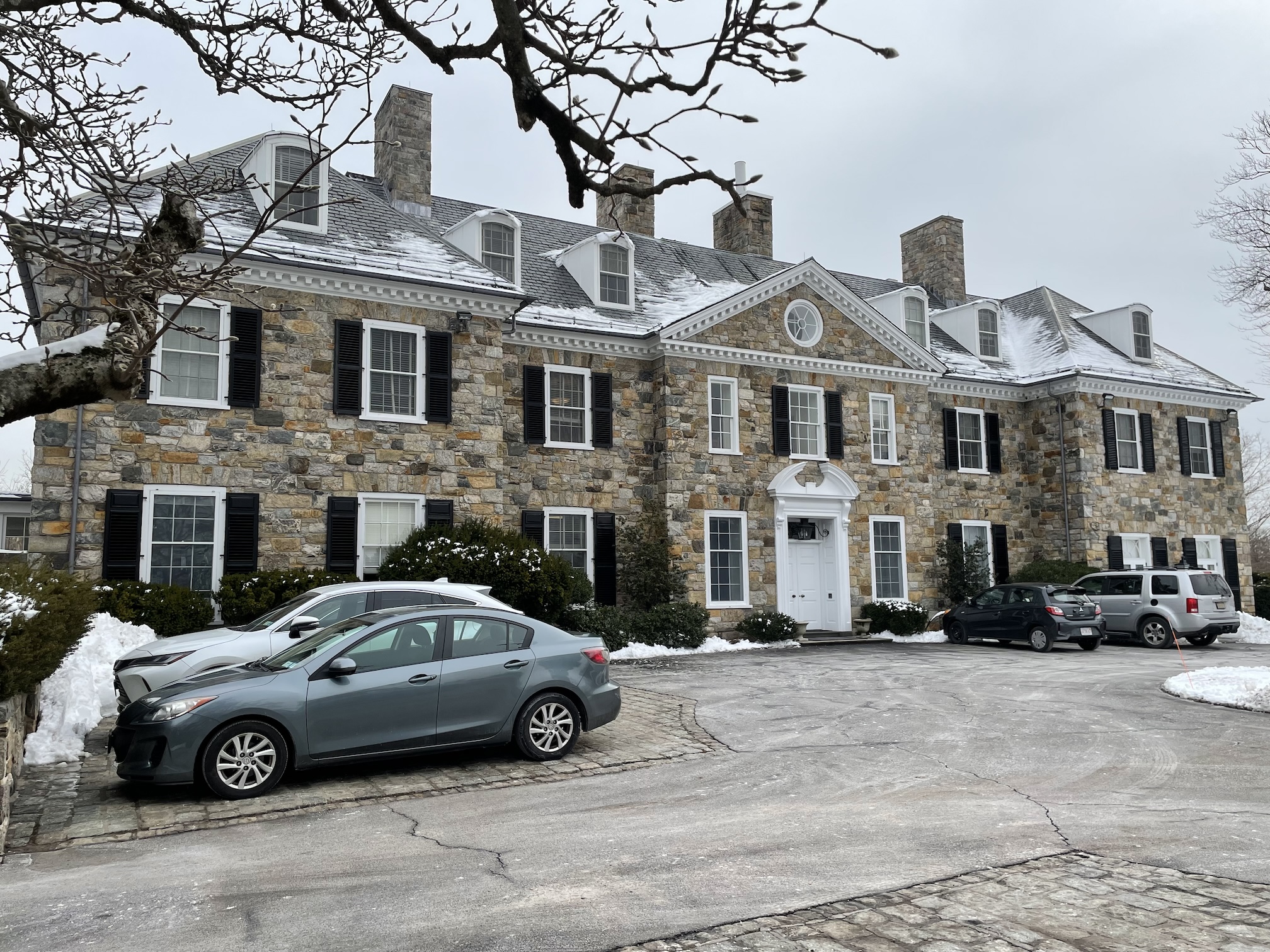
I also made a first visit to the Rockefeller Archives Center, which is about an hour north of New York City in Sleepy Hollow. My first appointment was cancelled due to the weather – it has been very cold here, with quite a bit of snow. The archives here have some material relating to funding for refugee scholars in the 1930s and 1940s, including Jakobson and Koyré, but also the papers of the Ford Foundation who funded Claude Lévi-Strauss in the 1950s. the Rockefeller Foundation also supported some projects that Benveniste undertook in the 1950s, including meetings with American linguists, a conference he organised in Nice, and his linguistic fieldtrips to work with native American groups in the Pacific northwest. There was a lot more material than I expected, and I hope I can get back.
It’s also been great to have such excellent libraries here. The Bobst Library of NYU is one I’ve used before, and has a great collection. The Butler library at Columbia has a huge collection, and on previous New York trips it has been a regular place to visit. The current security at the Columbia campus means that just using the library is difficult, but if you have an appointment with manuscripts then you get a QR code to allow access. So, for that reason I’ve been using the New York Public Library more for its main collection. I’ve also been up to the Institute for the Study of the Ancient World, part of NYU near Central Park, which had a couple of hard-to-find things.
While I’m in Buffalo I plan to look at their archives relating to Foucault’s two visits in 1970 and 1972, and I also have a planned trip to Harvard and MIT to look at some things there. I’m also trying to get ahead with what I think will be the next project after this one, on Koyré. I’m not sure what form that will take yet, but I hope at least a couple more articles beyond the one I’ve published (open access) and the one on Canguilhem and Koyré I’ve presented (audio). Koyré was in the United States during the war, teaching at the École Libre des Hautes Études and the New School, and then was here in several visiting positions in the post-war period. There are some records of his teaching in these different places, and some correspondence. Some of this is nearby, other parts are further afield, so I’m making a lot more requests. A couple of the future ‘Sunday Histories’ will say more about what I’m finding out about him, his teaching and his intellectual friendships.
Previous updates on this project can be found here, along with links to some research resources and forthcoming publications. The re-edition of Georges Dumézil’s Mitra-Varuna is now published. There is a lot more about the earlier Foucault work here. The final volume of the series is The Archaeology of Foucault, and the special issue of Theory, Culture & Society I co-edited on “Foucault before the Collège de France” has some important contributions on the earlier parts of Foucault’s career, and is currently available free to access. My article “Foucault and Dumézil on Antiquity” was published in the Journal of the History of Ideas; “Alexandre Koyré and the Collège de France” is online first and open access.
Discover more from Progressive Geographies
Subscribe to get the latest posts sent to your email.


