
Walter Bruno Henning spent part of the 1955-56 academic year at the Institute for Advanced Study in Princeton. His project at the time was described by him as “Analysis of the Khwarezmian language; collection of material for the Corpus Inscriptionem Iranicarum”. Khwarezmian is an eastern Iranian language, related to Sogdian. Henning was one of the first Western scholars of Sogdian, working with texts brought back from the German Turfan expeditions, initially under the direction of Friedrich Carl Andreas in Berlin, and later in London, where he had a post at the School of Oriental and African Studies (SOAS). Henning was awarded a post at the IAS for the second term of the academic year, and was informed of this by the director Robert Oppenheimer on 12 October 1954.
Henning had been encouraged to apply by faculty at the IAS, including the medieval historian Ernst Kantorowicz. Kantorowicz had solicited the advice of Richard N. Frye, Professor of Iranian Studies at Harvard University. Frye told Kantorowicz that five or six years ago he had described Henning as “the outstanding scholar in the world in Iranian Studies” who would benefit from time at the IAS, and would offer much too. “Since that time Henning has grown in stature and is without question the most outstanding scholar of all time in the Iranian field”. He noted that Henning was already so eminent, yet only in his mid-40s. Kantorowicz and his colleague Llewelyn Woodward therefore encouraged Henning to apply. Kantorowicz wrote to Woodward, then spending the summer in Oxford, to encourage this, and at the same time noted that Woodward had left Princeton for Oxford just before the 1954 hearing which revoked Oppenheimer’s US government security clearance. Kantorowicz was one of Oppenheimer’s IAS colleagues who sent him a telegram of support during the hearing (quoted in Abraham Pais with Robert P. Crease, J. Robert Oppenheimer: A Life, 260).
Oppenheimer remained director of the IAS until 1966, and Kantorowicz had had his own problems with anti-Communism, refusing to sign the loyalty oath in California in 1949, which is what led to his move from Berkeley to the IAS. (I write about that here.) Henning was keen on the idea of time in Princeton, describing the prospect of being at the IAS as “the scholar’s paradise”. But he did wonder if a visiting post there might require “a great deal of sociability”, noting that he was “somewhat of a retiring disposition” and hoped it would be more of a retreat to get some serious work done.
The reply to this question must have been sufficient to allay Henning’s fears. He was formally offered a position in October 1954, which came with a grant of $4000 and a suggestion to apply for a Fullbright grant to cover travel expenses. Once he had permission from SOAS to come to Princeton he did apply for a Fulbright grant, but was unsuccessful, because of the remuneration provided by the IAS. During the term he spent at the IAS in 1956, he produced a substantial treatment of Middle-Iranian for the Handbuch der Orientalistik.
Henning moved to a post at the University of California, Berkeley in 1961. He applied for membership of the IAS again for 1964-65. He said in his research programme that he intended to complete his work on the Khwarezmian language, begun as far back as 1936.
This work consists of reading, interpreting, and compiling a dictionary of, the Khwarezmian words written in the Arabic script and included in various medieval Arabic books. Its result, reviving a late form of that lost Eastern Iranian language, will supply the key to the decipherment, hitherto tried without success, of the Khwarezmian documents written in indigenous script and excavated by Soviet archaeologists in Khwarezm, at the southern shore of Lake Aral in the heart of Soviet Central Asia.
He indicates the progress of the dictionary had been slowed by other duties, and that it was “just impossible to carry it forward amidst the distractions of ordinary academic life”. For the 25 years he was at the University of London he was not given a sabbatical, but now teaching at Berkeley he was due a semester’s leave in the second half of 1964-65. He was hopeful that he could get unpaid leave for the other half. He hoped that another period at the IAS would provide “sufficient time to reach a final conclusion of this work and to prepare the aimed-for comprehensive publication”.
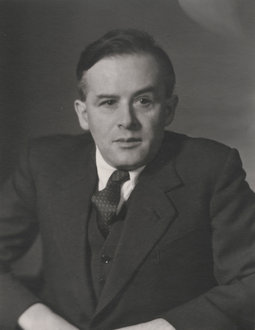

Andrew Alföldi of the IAS’s School of Historical Studies warned Henning that there would be competition, but that they would treat his application sympathetically. His application was, however, rejected. Henning never completed work on the dictionary. He broke his leg in December 1966, developed pulmonary edema, and died in January 1967. He was just 58 years old. Only a small part of the planned dictionary was published posthumously in 1971 as A Fragment of a Khwarezmian Dictionary. It was edited by D.N. MacKenzie, who also did important work on the language. As well as publishing Henning’s fragment, MacKenzie was working on a dictionary of his own, but this was also never completed. Based on the extant manuscript in Hamburg it is now being developed by Adam Benkato – see the project website.
[Update March 2026: I write about Henning’s dispute with Franz Altheim here.]
References
Adam Benkato, Chorasmian Online, https://chorasmianonline.melc.berkeley.edu
W. B. Henning, “Mitteliranisch” in Bertold Spuler (ed.), Handbuch der Orientalistik Erste Abteilung Vierter Band: Iranistik, Erster Abschnitt: Linguistik, Leiden: E.J. Brill, 1958.
Walter Bruno Henning, A Fragment of a Khwarezmian Dictionary, ed. D.N. MacKenzie, London: Lund Humphries, 1971.
W. B. Henning, Selected Papers, ed. J. Duchesne-Guillemin, Téhéran-Liège/Leiden: Bibliothèque Pahlavi/E.J. Brill, two volumes, 1977.
Desmond Durkin-Meisterernst, “MacKenzie, David Neil”, Encyclopedia Iranica, 2002, https://www.iranicaonline.org/articles/mackenzie-david-neil-1
Abraham Pais with Robert P. Crease, J. Robert Oppenheimer: A Life, Oxford: Oxford University Press, 2006 (while far from the best biography, this is the most detailed source I know on his role as IAS director).
Werner Sundermann, “Henning, Walter Bruno”, Encyclopedia Iranica, 2003, https://www.iranicaonline.org/articles/henning-walter-bruno
Archives
Henning’s own archives are at the Deutsches Exilarchiv 1933-1945, part of the Deutsche Nationalbibliothek. For a detailed study, see Adam Benkato, The Nachlass of Walter B. Henning: An Annotated Inventory, https://escholarship.org/uc/item/3gc5755t (open access)
The Institute for Advanced Study archives in Princeton have Director’s Office and School of Historical Studies files on Henning.
My thanks to Caitlin Rizzo of the IAS archives for scanning materials relating to Henning’s visit and later application, and Adam Benkato for his interest.
This is the eighth post of an occasional series, where I try to post short essays with some indications of further reading and sources, but which are not as formal as something I’d try to publish more conventionally. They are usually tangential to my main writing focus, a home for spare ideas, asides, dead-ends and possible futures. I hope there is some interest in them. They are provisional and suggestions are welcome. The other posts so far are:
Benveniste, Dumézil, Lejeune and the decipherment of Linear B – 5 January 2025
Foucault’s 1972 visit to Cornell University – 12 January 2025 (updated 14 January)
Benveniste and the Linguistic Circle of Prague – 19 January 2025
Marie-Louise Sjoestedt (1900-1940): an important scholar of Celtic languages and mythology – 26 January 2025
Thomas Sebeok, Umberto Eco and the Semiotics of Nuclear Waste – 2 February 2025
Vladimir Nabokov, Roman Jakobson, Marc Szeftel and The Song of Igor – 9 February 2025
Ernst Kantorowicz and the California Loyalty Oath – 16 February 2025
The full list of ‘Sunday histories’ is here.
Discover more from Progressive Geographies
Subscribe to get the latest posts sent to your email.


Pingback: Sunday histories – short essays on Progressive Geographies | Progressive Geographies
Pingback: The Friendship between Hannah Arendt and Alexandre Koyré | Progressive Geographies
Pingback: Alexandre Koyré’s Wartime Teaching at the École Libre des Hautes Études and the New School | Progressive Geographies
Pingback: Indo-European Thought in Twentieth-Century France update 27: more archive work on Saussure, Blanchot, Foucault, Jakobson and Koyré, two recordings, and a talk at the University at Buffalo | Progressive Geographies
Pingback: Indo-European Thought in Twentieth-Century France update 27: more archive work on Saussure, Blanchot, Foucault, Jakobson and Koyré, two recordings, and a talk at the University at Buffalo | Progressive Geographies
Pingback: Indo-European Thought in Twentieth-Century France update 28: archives in Princeton, Chicago and final work in New York | Progressive Geographies
Pingback: Six Months of ‘Sunday Histories’ – weekly short essays on Progressive Geographies | Progressive Geographies
Pingback: Herman Lommel and the ancient Aryans – Hegel’s great-grandson, Saussure translator and his links to Benveniste, Dumézil and Wikander | Progressive Geographies
Pingback: Books written by French professors while prisoners of war in World War II, and the Université de Captivité in Oflag XVII-A | Progressive Geographies
Pingback: Walter Bruno Henning, Franz Altheim and the Politics of Reviews | Progressive Geographies