
Seyla Benhabib and Ayelet Shahar (eds.), Lawless Zones, Rightless Subjects: Migration, Asylum and Shifting Borders – Cambridge University Press, January 2025 (print and open access)
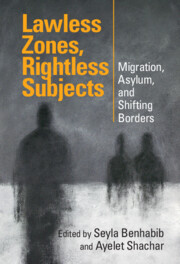
Responding to ever-increasing pressures of migration, states, supranational, and subnational actors deploy complex moves and maneuvers to reconfigure borders, rights, and territory, giving rise to a changing legal cartography of international relations and international law. The purpose of this volume is to study this new reconfiguration of rights, territoriality, and jurisdiction at the empirical and normative levels and to examine its implications for the future of democratic governance within and across borders. Written by a diverse and accomplished group of scholars, the chapters in this volume employ legal, historical, philosophical, critical, discursive, and postcolonial perspectives to explore how the territoriality of the modern states – ostensibly, the most stable and unquestionable element undergirding the current international system – has been rewritten and dramatically reimagined. This title is also available as Open Access on Cambridge Core.
- Provides an innovative perspective on the reconfiguration of territory, rights, and jurisdiction which helps to enlighten states’ behaviors in their attempts to deal with the movement of peoples across borders and their international obligations
- Features fresh theoretical insights into pressing questions of sovereignty and migration, drawing on real world examples from the United States and Europe, as well as Turkey, Rwanda, Canada and South Asia
- A rich methodological diversity combines empirical and normative approaches to the study of migration, territoriality, refugee law and policy, and democratic governance of human mobility across borders
- This title is also available as Open Access on Cambridge Core
Discover more from Progressive Geographies
Subscribe to get the latest posts sent to your email.


