
Georges Dumézil, Mitra-Varuna: An Essay on Two Indo-European Representations of Sovereignty, translated by Derek Coltman, edited by Stuart Elden, afterword by Veena Das – HAU books, December 2024
Pleased to say that the book is now available as an open-access e-book, as well as in print via University of Chicago Press
Hau set a low level of copies which needed to be sold before the book was fully available open access. This was to cover the costs of rights, and the book’s production, rather than to pay me as editor. That level has been met, so it is now freely available. The Introduction and Afterword were available open access from publication.
The edition uses the existing translation by Derek Coltman, long out of print, and has a new critical apparatus and Introduction by me. There is a discussion of the editing work here. This is part of the work of my Mapping Indo-European thought in twentieth-century France research project, funded by the Leverhulme Trust.
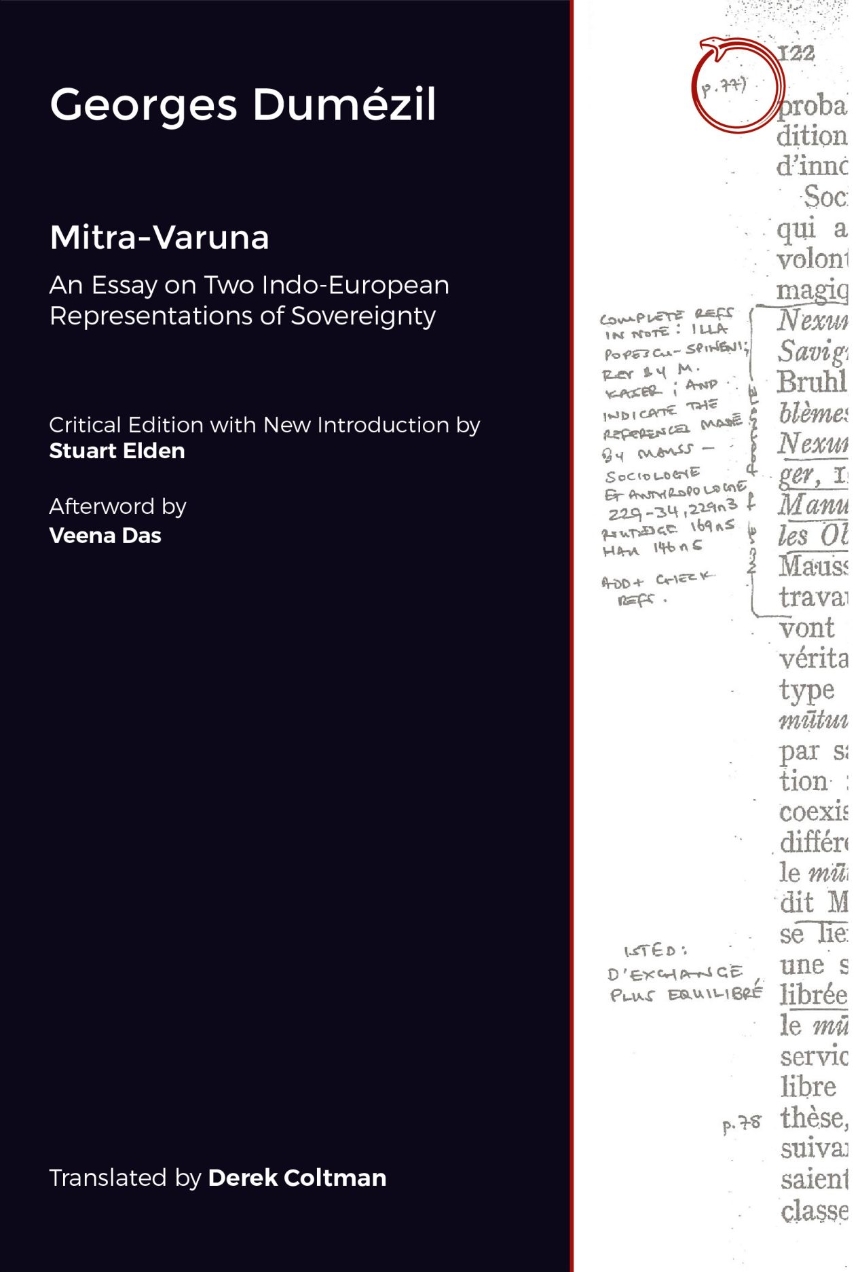
A classic text that develops one prong of Dumézil’s tripartite hypothesis of Indo-European tribes: the sacred sovereign.
Georges Dumézil’s fascination with the myths and histories of India, Rome, Scandinavia, and the Celts yielded an idea that became his most influential scholarly legacy: the tripartite hypothesis, which divides Indo-European societal functions into three classes: the sacred sovereign, the warrior, and the producer. Mitra-Varuna, originally published in 1940, concentrates on the first function, that of sovereignty. Dumézil identifies two types of rulers, the first judicial and worldly, the second divine and supernatural. These figures, both priestly, are oppositional but complementary. The title nods to these roles, referring to the gods Mitra, a rational mediator, and Varuna, an awesome religious figure.
Stuart Elden’s critical edition, based on the 1988 English translation by Derek Coltman, identifies variations between the first and second French editions and completes—and in places corrects—Dumézil’s references. The editor’s detailed introduction situates Mitra-Varuna within Dumézil’s career, outlines how his treatment of its themes developed over time, and relates the book to the political controversy around his ideas. Two new appendices contain passages that did not appear in the second French edition.
Discover more from Progressive Geographies
Subscribe to get the latest posts sent to your email.


