
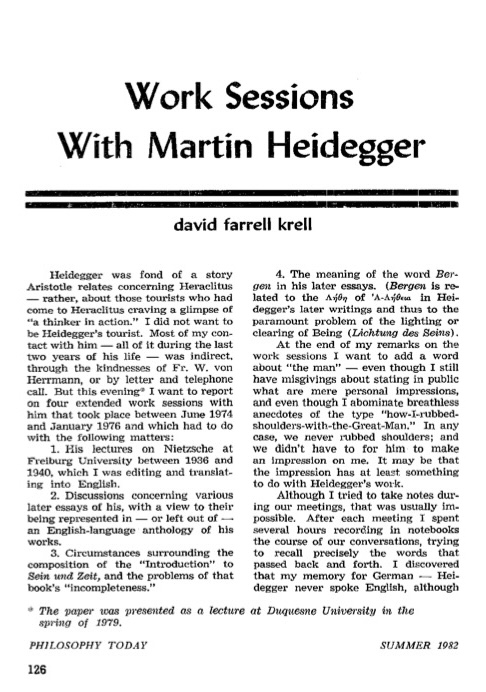
Some years ago, when I was working on Heidegger, I read David Farrell Krell’s “Work Sessions with Martin Heidegger” essay. These were sessions in which Krell discussed some of Heidegger’s vocabulary and worked with him on possible English renderings, as well as questions of interpretation and chronology. Krell was a really important editor and translator of Heidegger, from Early Greek Thinking in 1975 with Frank Capuzzi, to Basic Writings in 1977 (with a second edition from 1993), and the four Nietzsche volumes, with Capuzzi and Joan Stambaugh (between 1979 and 1987, and reprinted in two volumes in 1991.) Krell also discussed with Heidegger which essays to include in Basic Writings. Krell has written a huge amount on Heidegger, and many other themes. Of the Heidegger work, I particularly liked his Daimon Life. All very important for me during the PhD and a few years afterwards. I haven’t been reading the Heidegger literature for a long time now, and have not revisited my own early work on him. But I did review Krell’s book on Derrida’s Geschlecht series of essays on Heidegger, Phantoms of the Other, for Derrida Today. So, I was curious when Krell published his Three Encounters: Heidegger, Arendt, Derrida book in 2023.

All of Three Encounters is extremely interesting, and the discussion of Derrida, who he knew well for many years, is very revealing of the work and the man. But for me the most fascinating parts are his discussions of working with Heidegger and Arendt on translations of Heidegger. An earlier version of part of the Heidegger discussion was published in the Heidegger and his Anglo-American Reception collection, and some of it is, of course, similar to the “Work Sessions” piece, though he notes that in the book he is transcribing from his journals afresh (Three Encounters, 45). Krell only knew Heidegger right at the end of his life – Heidegger died in 1976 – and Arendt for only a couple of years too, since she died just before Heidegger in 1975. Arendt’s involvement in English Heidegger translations is something I’ve known for a long time – it’s mentioned in passing in most of the biographies (i.e. Young-Bruehl on Arendt, 304, 442; Safranski on Heidegger, 427; Grunenberg, 248-49) – but Krell adds a lot of detail to the story. He stresses how closely Arendt was involved, notably alongside J. Glenn Gray, in the Harper & Row editions. Gray had translated What is Called Thinking? in 1968, which was one of the first translations of Heidegger’s later work. As Krell says: “Nothing appeared in the Harper series in those days that did not pass through her hands and under her alert eyes” (Three Encounters, 17-18; see Arendt to Heidegger 17 March 1968; 19 August 1971). The late 1960s was also when Arendt very publicly wrote about Heidegger, in the “Martin Heidegger at Eighty” piece, first published in English in The New York Review of Books.
The whole question of Arendt and Heidegger’s relationship, from student and lover to a complicated post-war friendship and partial reconciliation has been discussed in great detail by her biographers and others. Antonia Grunenberg’s Hannah Arendt and Martin Heidegger is especially good. There is an even larger literature on Heidegger’s politics, on which Arendt briefly and notoriously wrote in a note to the “Martin Heidegger at Eighty” piece. Neither their personal relation nor the political question is my concern here. I have written about the political issue before. But the translation question is one that interests me.
While looking at Alexandre Koyré’s letters to Arendt (I discuss their friendship here), I went to the Library of Congress website, which has digitised much of the Arendt archive. Although the Koyré-Arendt letters have been published, it’s always nice to see the originals, and comparing a handwritten text to a printed one is a good way to learn the idiosyncrasies of written style before I attempted my own transcriptions of some of his other letters. Immediately after ‘Koyré’ in the Finding Aid is ‘Krell’. The file online has several Krell offprints, taking up over half of the pages in the document. But then there is some very interesting correspondence. Some, but not all, is quoted by Krell in Three Encounters. I also wondered if the archive had the originals of correspondence with Heidegger, even though that has of course also been published. I quickly realised that those letters are actually in Marbach, at the Deutsche Literaturarchiv. Samantha Rose Hill writes about visiting that archive here, and the Library of Congress here. But the Library of Congress does have two Heidegger files online, which contain letters to and from Arendt about Heidegger, and they were very interesting too. There is also a file of notes of a seminar Arendt taught on Heidegger and Jaspers in 1951, and some other material, including the German text of “Martin Heidegger at Eighty”, which was initially a lecture, and a French version, presumably also given as a talk.
The correspondence at the Library of Congress shows that Arendt was involved with Heidegger’s translation into English long before Krell became involved in the early to mid-1970s. Krell indicates that the most recent edition of the Arendt-Heidegger correspondence adds a letter that shows she was in correspondence with Edward Robinson in 1954 about a translation of Being and Time (Arendt to Heidegger, 29 April 1954, copied to Robinson). Krell says it is unclear when Robinson began working with John Macquarrie (Three Encounters, 187-88). The Arendt-Robinson letters clarify this. Arendt praises Robinson’s translation sample, but offers a whole range of very detailed comments on terminology – it’s on five typewritten, single-spaced pages. In subsequent letters to Robinson she tries to help with funding for the project, which was considered at one point might be bilingual, on facing pages, but the German publisher prevented this. Nor did Robinson have much luck with English publishers. One rejection is quoted by Robinson: “I think the greatest service we could perform for Professor Robinson would be to persuade him not to spend any more time on this hopeless and thankless task”. Robinson nevertheless continued, and one press he contacted said that they had already been in contact with Macquarrie about doing a translation. By April 1955 Macquarrie and Robinson are working together, and are asking Arendt’s advice on translation issues, on Heidegger’s prompting. The Macquarrie and Robinson translation was published in 1962, with SCM [Student Christian Movement] Press, which became part of Blackwell, rather than other presses which were being discussed. Krell’s Basic Writings includes a different version of Being and Time’s Introduction, translated by Stambaugh. She was working on a translation of the whole book for years, which stretched to decades, and it was finally published in 1996, before that version was revised by Dennis J. Schmitt in 2010. Krell praises Schmitt’s “valiant efforts” but thinks it “has to be retranslated from beginning to end”. He doubts this will be anytime soon (Three Encounters, 32).
In Three Encounters Krell uses his own archives and correspondence with Heidegger and Arendt, as well as with his parents and others to provide a lot of detail about his translating and editing work on Heidegger, along with some of the rights issues that complicated the work of Basic Writings. Heidegger and, especially after Heidegger’s death, his wife were involved in some of the negotiations. Some of the translations were already in English, and there was a complication about whether the publishers of those controlled the English rights, even if the translations were to be done anew. This was complicated by Vittorio Klostermann – the man initially, and then the press that bears his name – beginning the work of editing the Gesamtausgabe of Heidegger’s writings in the mid-1970s. The problem was that some of Heidegger’s books had been published by different German presses. The volumes of the Gesamtausgabe which edit texts published with different publishers in Heidegger’s lifetime are therefore only available to subscribers to the edition, not for individual sale. But it also meant Klostermann could not release the rights to some texts for Basic Writings, which delayed the book until the Heideggers intervened. There was a plan for a follow-up volume of essays edited by Krell in the history of being, but this never materialised.
There are some indications of Arendt’s work on the translations in her letters to Heidegger, but the Arendt archives add a lot of interesting detail. There are many letters from Krell to Arendt, and some of her replies to him. She was also writing on his behalf to get funding, as was Gray. There are also letters to others that relate to this story, including with Fred Wieck of Harper & Row about some of the other translations in the Harper series, and Friedrich-Wilhelm von Herrmann about plans for the Gesamtausgabe, which von Herrmann edited. Krell also sent Arendt at least one of his work notes written up after one of the meetings with Heidegger. There are some other letters sent to Arendt, often with replies, where people were asking her questions about interpretation of his work or, at times, his political actions. And a little correspondence about a failed plan to bring Heidegger to America, of which he had doubts, and which was prevented in the end by his health.
So, although Arendt’s involvement in the translation of Heidegger is mentioned in studies of her and Heidegger, it is so overshadowed by the biographical, and at times the intellectual links, that it doesn’t receive much discussion. There are other published sources for a fuller story. Krell published some parts of his correspondence with Gray in 1981, and says he still has sixty-eight letters from 1973 to 1977 (Three Encounters, 25). He also adds in a note: “I am also wondering whether Glenn and Hannah’s correspondence will be published; clearly, it would be crucial for understanding her writing of The Life of the Mind” (Three Encounters, 33 n. 8). Many of those letters are available in the Arendt papers, along with the typescript of her Introduction to Gray’s The Warriors. Discussing them would require a whole new post, at least – they are very interesting on precise terminological choices in translating Heidegger, the challenges of publication, the problems of the translators they commissioned, and other issues.
I don’t think Arendt mentions the detail of translating Heidegger in her letters to her second husband Heinrich Blücher, but in 1958 she does mention corresponding with Ralph Manheim, who translated An Introduction to Metaphysics, and reading the galley proofs of Heidegger’s 1961 Nietzsche book (Within Four Walls, 328, 369-70, 373, 375-76). Blücher died before Krell was in contact with Arendt, so he’s not mentioned in these letters, and nor is Gray. But it seems to me that there is a lot available now – from Krell’s fascinating memories to correspondence and these archives – which would enable a much fuller treatment.
In 2020 Krell wrote a piece called “Three Last Dubious Projects”, in which he outlines ideas for books he is not sure he will manage to complete. One of them is this book on the memories of Arendt, Heidegger and Derrida, and in the essay it is the theme which receives by far the most discussion. The two other projects are a “genealogy of Nietzsche interpretations devolving from Bataille and Heidegger” and “a discussion of Derrida’s strange mix of biology and biography in his work on Nietzsche”. I’d very much like to read both.
References
Hannah Arendt, “Martin Heidegger at Eighty”, trans. Albert Hofstadter, New York Review of Books, 21 October 1971; reprinted in Michael Murray (ed.), Heidegger and Modern Philosophy: Critical Essays, New Haven: Yale University Press, 1978, 293–303.
Hannah Arendt and Heinrich Blücher, Within Four Walls: The Correspondence between Hannah Arendt and Heinrich Blücher, ed. Lotte Kohler, trans. Peter Constantine, New York: Harcourt, Inc., 1996.
Hannah Arendt and Martin Heidegger, Letters 1925-1975, ed. Ursula Ludz, trans. Andrew Shields, Orlando: Harcourt Inc., 2004.
Stuart Elden, Speaking Against Number: Heidegger, Language and the Politics of Calculation, Edinburgh: Edinburgh University Press, 2006.
Stuart Elden, “David Farrell Krell, Phantoms of the Other: Four Generations of Derrida’s Geschlecht, Albany: State University of New York, 2015”, Derrida Today 9 (1), 2016, 85-88.
Antonia Grunenberg, Hannah Arendt and Martin Heidegger: History of a Love, trans. Peg Birmingham, Kristina Lebedeva and Elizabeth von Witzke Birmingham, Bloomington: Indiana University Press, 2017.
Martin Heidegger, Being and Time, trans. Edward Robinson and John Macquarrie Oxford: Blackwell, 1962; trans. Joan Stambaugh, Albany: State University of New York Press, 1996.
Martin Heidegger, What is Called Thinking? trans. J. Glenn Gray, New York: Harper & Row, 1968.
Martin Heidegger, Nietzsche, ed. David Farrell Krell, San Francisco: Harper Collins, four volumes, 1991.
Martin Heidegger, Basic Writings, ed. David Farrell Krell, London: Routledge, 2nd edition 1993.
David Farrell Krell, “A Smile and a Sense of Tragedy: Letters from J. Glenn Gray”, Philosophy Today 25 (2), 1981, 95-113.
David Farrell Krell, “Work Sessions with Martin Heidegger”, Philosophy Today 26 (2), 1982, 126-38.
David Farrell Krell, Daimon Life: Heidegger and Life-Philosophy, Indiana: Indiana University Press, 1992.
David Farrell Krell, Phantoms of the Other: Four Generations of Derrida’s Geschlecht, Albany: State University of New York, 2015.
David Farrell Krell, “Three Last Dubious Projects”, Research in Phenomenology 50 (3), 2020, 407-24.
David Farrell Krell, Three Encounters: Heidegger, Arendt, Derrida, Bloomington: Indiana University Press, 2023.
Samantha Rose-Hill, Hannah Arendt, London: Reaktion, 2021.
Rüdiger Safranski, Martin Heidegger: Beyond Good and Evil, trans. Ewald Osers, Cambridge: Harvard University Press, 1998.
Elisabeth Young-Bruehl, Hannah Arendt: For Love of the World, New Haven: Yale University Press, 2nd edition, 2004 [1982].
Archives
Hannah Arendt Papers, Library of Congress, https://www.loc.gov/collections/hannah-arendt-papers/ – correspondence with Gray, Krell, Robinson et. al.
This is the eleventh post of an occasional series, where I try to post short essays with some indications of further reading and sources, but which are not as formal as something I’d try to publish more conventionally. They are usually tangential to my main writing focus, a home for spare ideas, asides, dead-ends and possible futures. I hope there is some interest in them. They are provisional and suggestions are welcome.
The full list of ‘Sunday histories’ is here.
Discover more from Progressive Geographies
Subscribe to get the latest posts sent to your email.


Pingback: Sunday histories – short essays on Progressive Geographies | Progressive Geographies
Pingback: Indo-European Thought in Twentieth-Century France update 27: more archive work on Saussure, Blanchot, Foucault, Jakobson and Koyré, two recordings, and a talk at the University at Buffalo | Progressive Geographies
Pingback: Indo-European Thought in Twentieth-Century France update 27: more archive work on Saussure, Blanchot, Foucault, Jakobson and Koyré, two recordings, and a talk at the University at Buffalo | Progressive Geographies
Pingback: Six Months of ‘Sunday Histories’ – weekly short essays on Progressive Geographies | Progressive Geographies