
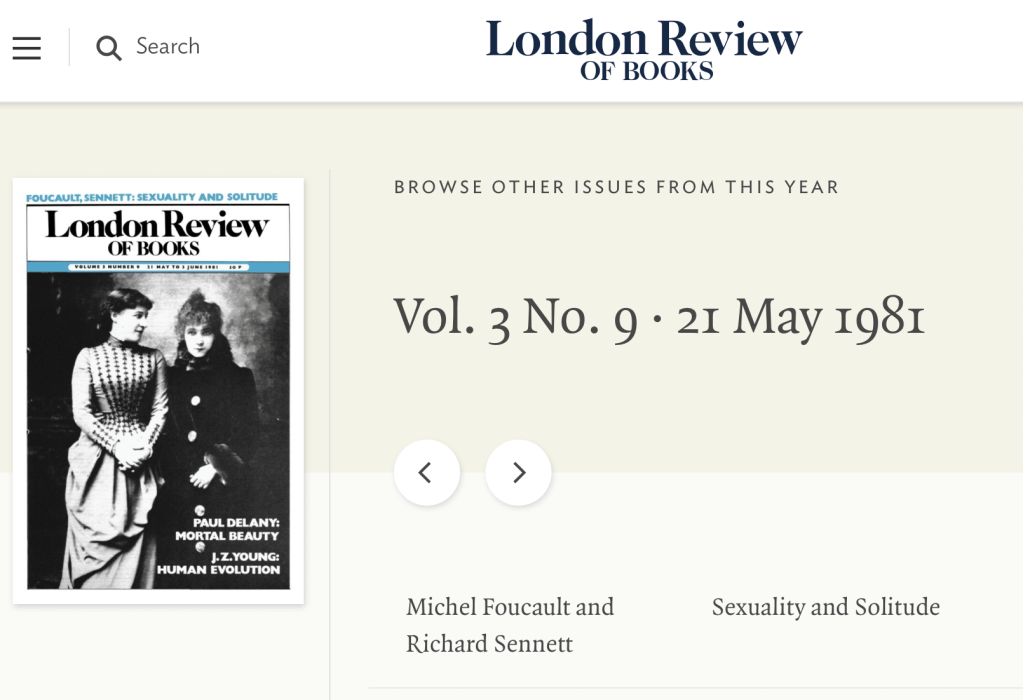
The “Sexuality and Solitude” lecture was delivered by Richard Sennett and Michel Foucault to the New York Institute for the Humanities on 20 November 1980 at 5.30pm. It was held in the Tishman Auditorium of Vanderbilt Hall on Washington Square. A 400-seat room, attendance was such that at the beginning Sennett voices a concern about safety and the Fire department. It was published in the London Review of Books in May 1981 (open access). Reprints of the lecture in collections of Foucault’s work remove the Sennett introduction and his second part, and just reproduce the middle part by Foucault. A recording of the lecture (without some of the opening remarks) is available at the New Books Network – part of The Vault of NYIH recordings.
The lecture was reporting on a joint seminar run by Foucault and Sennett at New York University, which took place in three sessions on 31 October, 7 November and 14 November 1980. The sessions were held in the Bobst Library, room 1135 at 2.30pm. While at least one session of the seminar was recorded, the first publication of the seminar was in 2024, alongside other material, in the important Généalogies de la sexualité volume edited by Daniele Lorenzini and Henri-Paul Fruchaud, and with an introduction by the editors and Arnold Davidson. This includes a French version of Foucault’s manuscript for the seminar, divided into four sessions, and a French translation of the English version of that text, divided into three sessions, along with Foucault’s part of the lecture. As the editors of Généalogies de la sexualité indicate, the English version of the seminar material “is not a translation of the French version, but rather a rewriting” (p. 322). For the English version they translated, they were able to use the recording of the first session, alongside the manuscript. An English edition and translation of this volume should appear in the University of Chicago Press series, The Chicago Foucault Project.
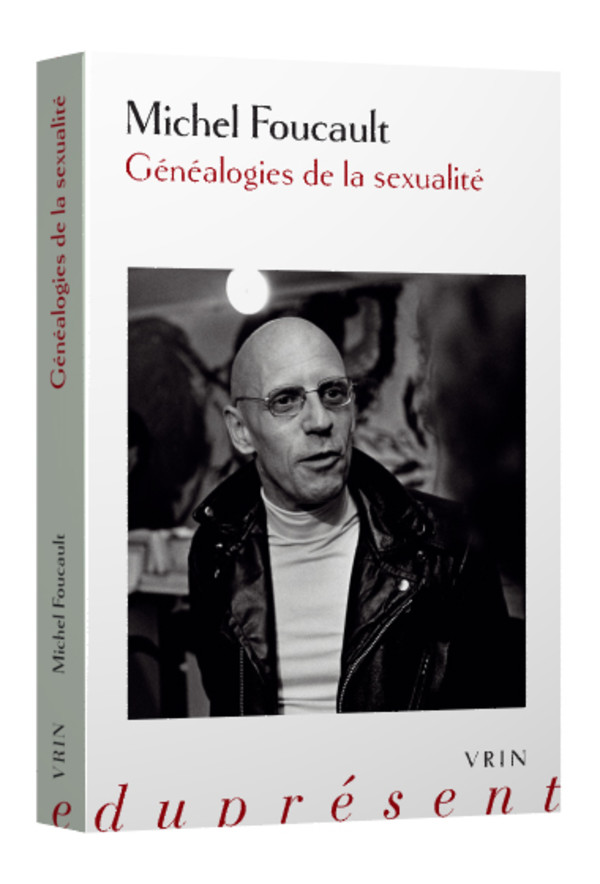
The material in Généalogies de la sexualité is excellent for getting a fuller sense of what Foucault presented, and also for giving an insight into his thinking in late 1980 about his History of Sexuality project, which was going through some important changes. As Lorenzini, Fruchaud and Davidson rightly note (pp. 12, 35-36, 321), the seminar and lecture present material which, in a revised form, would appear in Confessions of the Flesh, the fourth volume of the series. When I wrote Foucault’s Last Decade, I briefly discussed the lecture, and other lectures from a similar time, in that light (pp. 122, 125-26). The fourth volume, left incomplete at Foucault’s death, was unpublished until 2018.
The archives of the New York Institute for the Humanities, at New York University, have some material relating to the Foucault and Sennett seminar and lecture. Box 29, folder 4, includes a rough transcription of the lecture, an improved transcription, and the London Review of Books page proofs, with some corrections to Sennett’s part. A few opening words are not in the published version. Folders 2 and 3 contain some more interesting material. Folder 2 includes a lot of correspondence about the seminar, and folder 3 some photocopies of reading material in relation to the sessions.
Sennett was in correspondence with various people about the seminar, inviting them to be involved. This included Princeton history professors Natalie Zemon Davis and Lawrence Stone, the journalist and historian Frances Fitzgerald, and the philosopher William Earle. Davis certainly attended some of the sessions, and sent Sennett some reading suggestions and material. Stone, who later had an exchange about Foucault’s History of Madness in The New York Review (following a review of books he saw as inspired by Foucault), seems to have attended too. Perhaps their sharp words later develop from a disagreement at this time. Others requested that they be allowed to join, including Michael S. Roth, then a PhD researcher at Princeton, who went on to publish especially on Freud and Hegel and is now president of Wesleyan University. Susan Sontag sent her apologies as she would be in Turin rehearsing the Pirandello play. John Boswell, a history professor at Yale, attended some sessions. Other names from the attendance list will be familiar to Foucault scholars – Richard Howard, Sylvère Lotringer, John Rajchman, and Mark Blasius. Thomas Nagel, Edward Said and Edmund White are listed too. Sennett says in his invitations that he hoped to keep it to about 25 people; the final attendance list suggests just over 30 seminar members.
Folder 3 includes some photocopies of reading material. It isn’t clear that all of these were assigned as readings for the seminar participants, but they certainly relate to the seminars, as the editors recognise (see “Introduction”, pp. 37-38). As they note, some of these relate to Foucault’s focus at the time; others to Sennett’s contribution to the seminar and lecture. A simple list of the material in this folder follows (I’ve identified editions where I can provide this, and/or indicated sections for works with more than one edition):
- Natalie Zemon Davis, “‘Women’s History’ in Transition: The European Case”, Feminist Studies III (3/4), 1976, 83-103 [handwritten note indicates especially p. 89].
- Sigmund Freud, The Interpretation of Dreams, 208-19 [Chapter V, part B. Infantile Material, section II].
- C. Schorske, Fin du siècle Vienna, [New York: Alfred A. Knopf, 1979,] pp. 193-98.
- Richard von Krafft-Ebling, Psychopathia Sexualis: A Medico-Forensic Study, trans. H.E. Wedeck [G.P. Putnam’s Sons, 1965], pp. 306-27 [“General Pathology”, section on “Antipathic Sexuality”].
- S.A.D. Tissot, Onanism, 1766, xiii-xvi, 12-13, 18-19, 22-27, 48-51.
- Owen Chadwick, John Cassian: A Study in Primitive Monasticism, Cambridge, University Press, 1950, 50-51.
- Jean Cassian, Institutions Cénobitiques, Latin-French edition, ed. and trans. Jean-Claude Guy, Paris: Les Éditions du Cerf, 1965, book VI, “De l’esprit de fornication”, pp. 261-89.
- Jean Cassian, Conférences I-VII, Latin-French edition, ed. and trans. E. Pichery, Paris: Les Éditions du Cerf, 1955, VIII, “De la mobilité de l’âme et des esprits du mal”, pp. 241-77.
Natalie Davis also sent Sennett a copy of Ludovico Maria Sinistrari (1622-1701), Peccatum Mutum: The Secret Sin, pp. 19-51, and part of the syllabus of “Society and Sexes in Early Modern Europe, History 348”, including a passage from “Jacques du Val—A Physician on Male-Female Sexual Experience (1612)” (four typed pages). There are also some plates copied from a book by Havelock Ellis (plates 5-8) and a page of a work about Ellis (p. 222).
One thing which is interesting is that Sennett’s focus relates to Foucault’s earlier plan for a volume of the History of Sexuality on masturbation, abandoned in the mid 1970s, but a topic on which Foucault lectured in the 1974-75 course Les Anormaux, translated as Abnormal. Notes and draft materials for the planned book, La Croisade des enfants [The Children’s Crusade], exist in Foucault’s archives at the Bibliothèque nationale de France.
References
Stuart Elden, Foucault’s Last Decade, Cambridge: Polity, 2016.
Michel Foucault, Les Aveux de la chair, ed. Frédéric Gros, Paris: Gallimard, 2018; The Confessions of the Flesh: the History of Sexuality Volume 4, trans. Robert Hurley, 2022.
Michel Foucault, Généalogies de la sexualité, eds. Daniele Lorenzini and Henri-Paul Fruchaud, Paris: Vrin, 2024.
Michel Foucault and Richard Sennett, “Sexuality and Solitude”, London Review of Books, 21 May 1981, https://www.lrb.co.uk/the-paper/v03/n09/michel-foucault/sexuality-and-solitude (Foucault’s part is translated in Dits et écrits and reprinted in Essential Works and elsewhere.)
Daniele Lorenzini, Henri-Paul Fruchaud and Arnold I. Davidson, “Introduction”, in Michel Foucault, Généalogies de la sexualité eds. Daniele Lorenzini and Henri-Paul Fruchaud, Paris: Vrin, 2024, 7-49.
Archives
Records of the New York Institute for the Humanities, New York University special collections, RG.37.4, box 29, folders 2, 3 and 4, https://findingaids.library.nyu.edu/archives/rg_37_4/
Fonds Michel Foucault, Bibliothèque nationale de France, NAF 28730, https://archivesetmanuscrits.bnf.fr/ark:/12148/cc98634s
This is the twelfth post of an occasional series, where I try to post short essays with some indications of further reading and sources, but which are not as formal as something I’d try to publish more conventionally. They are usually tangential to my main writing focus, a home for spare ideas, asides, dead-ends and possible futures. I hope there is some interest in them. They are provisional and suggestions are welcome.
The full list of ‘Sunday histories’ is here.
Discover more from Progressive Geographies
Subscribe to get the latest posts sent to your email.


passed this along to Richard and suggested that if he had anything to add on the subject that he let you know.
Pingback: Indo-European Thought in Twentieth-Century France update 27: more archive work on Saussure, Blanchot, Foucault, Jakobson and Koyré, two recordings, and a talk at the University at Buffalo | Progressive Geographies
Pingback: Sunday histories – short essays on Progressive Geographies | Progressive Geographies
Pingback: Indo-European Thought in Twentieth-Century France update 27: more archive work on Saussure, Blanchot, Foucault, Jakobson and Koyré, two recordings, and a talk at the University at Buffalo | Progressive Geographies
Pingback: The Early Edward Said, Michel Foucault and Jonathan Swift | Progressive Geographies
Pingback: Josué V. Harari, the Marquis de Sade, and Michel Foucault’s 1970 lectures in Buffalo | Progressive Geographies
Pingback: From a Watershed to the Parting of the Waters: A Note on Michel Foucault and Peter Brown | Progressive Geographies