
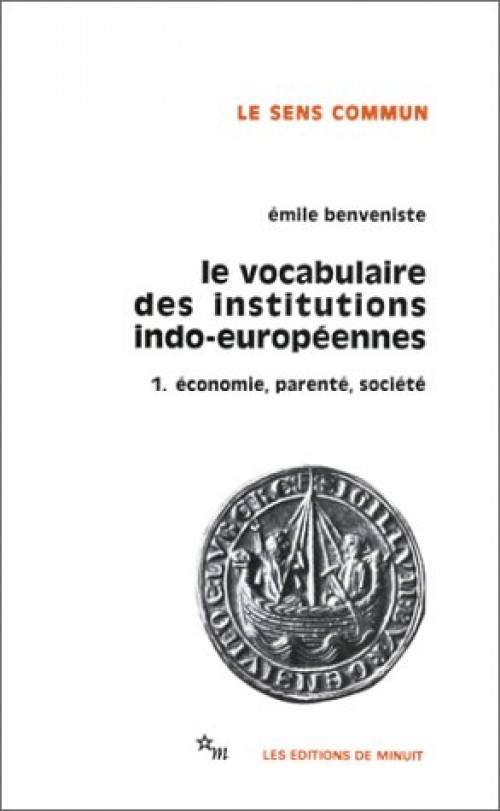
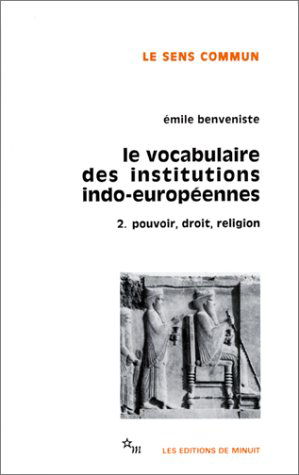
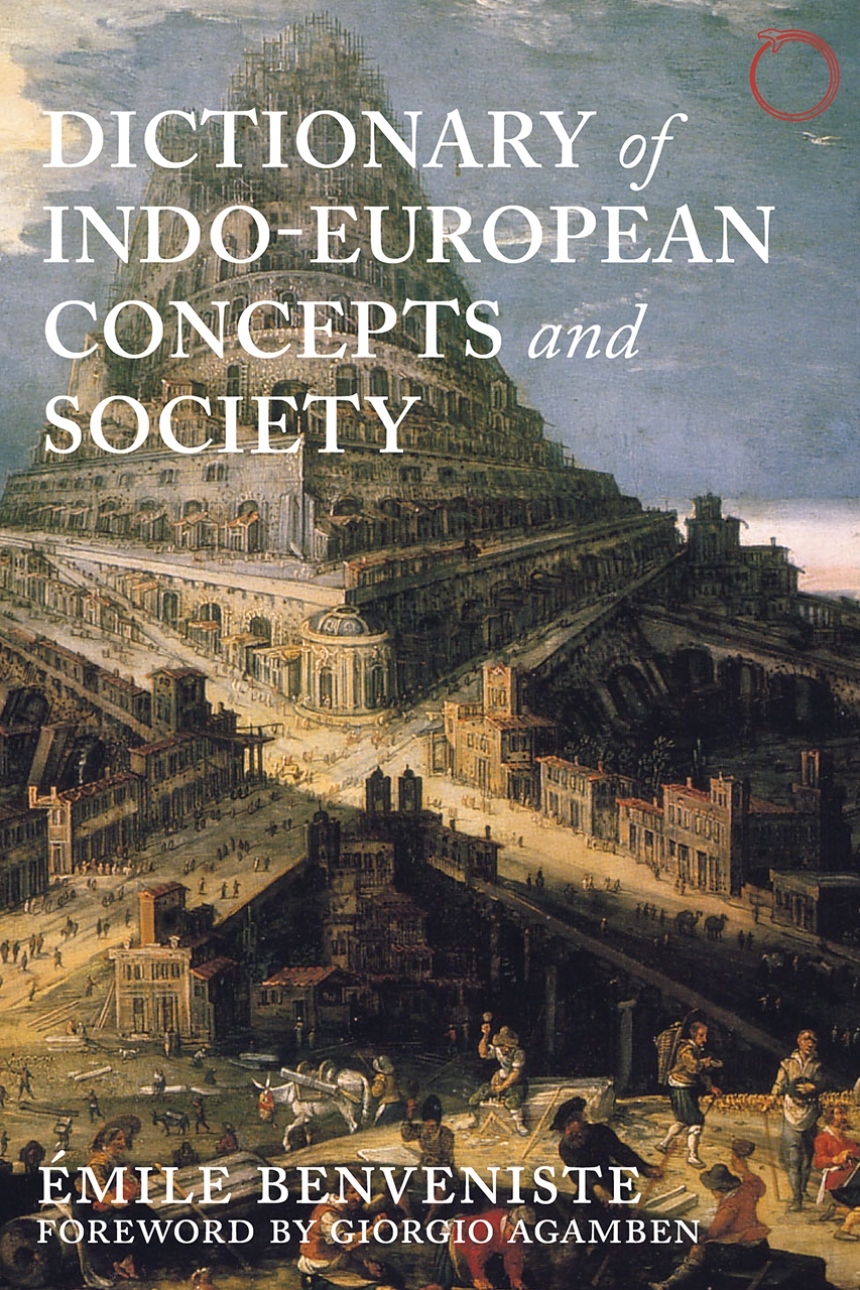
If I was writing The Birth of Territory again, I would certainly have found a little space for a brief discussion of Émile Benveniste and his Le Vocabulaire des institutions indo-européennes, now available in English again as the Dictionary of Indo-European Concepts and Society and open access from Hau. I remember reading the earlier edition of the English book (same translation, but with the title Indo-European Language and Society) while doing the research, but finding no entry on territory or really any spatial vocabulary, I didn’t give it much attention. But something of the book must have had an impact on me, because The Birth of Territory does attempt something similar to what Benveniste undertakes, in terms of working with both the practices and concepts evoked by words and the terms used to designate concepts and practices. In The Birth of Territory (p. 7), I quoted Reinhart Koselleck’s distinction between “semasiological and onamasiological questions” from Futures Past (p. 88) – the question of meaning and the question of designation. Of course, Benveniste does this far more skilfully than me, across many languages and with much greater attention to linguistic complexity. And only now, as I work through all Benveniste’s writings, and material in his archives, do I have a much better sense of what he was doing, and his enormous range.
It’s not explicit in my book, but I remember using this double question in talks about it. How should we translate territorium and what is the Latin word for ‘territory’? My point was that if we looked at the Roman republic and empire, neither question has a straight-forward answer. I would outline the rare instances of territorium in classical Latin, which come in Cicero, Varro, Seneca and Pliny the Elder, and explain the senses the word had there. And then I’d show how the Roman historians – Livy, Tacitus, Caesar, Sallust, for example – don’t use the word, but modern translations regularly use ‘territory’ or ‘territories’ to render different Latin words in their texts. The places where the word is used most often is in legal or surveying texts, notably the Digest and the Corpus Agrimensorum Romanorum, but with those in particular there are questions of the transmission of the material as they are later compendia. Territorium becomes a more common word in Latin, but somewhat later than classical Rome.
It’s all too easy to assume that because ‘territory’, and related words in most Western European languages, derive from territorium, this must be a concept in Latin that means much the same. But the territorium was, most commonly, the surrounding lands around a city, what we might call the hinterland. A city would have a territorium, but its own space would not be quite the same – perhaps distinguished by the city walls or another sacred boundary. It was, I think, an important shift when cities were seen as being within a territorium, a particular kind of settlement within it. In Terror and Territory I discuss the etymological debates about territorium and its relation to terra (land, earth) and terrere (to frighten, to terrify) in some detail, but suggest that though interesting, “we do not need to rely on this suspect etymological basis” to see the relation between terror and territory (pp. xxviii-xxx).
A fuller analysis of Indo-European vocabulary about spatiality is well beyond what I can achieve here, but I want to return to Benveniste’s Vocabulaire with this question of territory. It is curious to me, still, that there is relatively little on questions of geography in the text. The relative neglect of spatial terms is more striking to me now because the courses from which the book was derived did discuss some of these questions, as he did elsewhere. I also checked Benveniste’s teacher Antoine Meillet and Alfred Ernout’s Dictionnaire Etymologique de Langue Latine, but that only briefly touches on territorium and indicates the same sources from Varro to the Digest that I explored in my earlier works.
But I think I was a bit hasty in my initial reaction to Benveniste’s text. Reading the book again with different questions in mind and a different focus makes for a different book. While there is little that directly discusses spatial terminology, there are references to these terms in other places. In what follows, references are to the French text by volume and page, and page of the recent English version, which has both volumes in one.
In the Vocabulaire, Benveniste most often uses geographical words in the general sense of lands or region. The English translation often renders domaine and l’aire – domain, area – as ‘territory’. So, there are references to the “Indo-European territory [domaine]” or “territory [l’aire] (I, 171/134; I, 172/134; I, 240/193; see I, 127/95, I, 171/135; I, 211/167); the “Indo-Iranian domaine]” or “l’aire” (I, 34/15, I/35/16); “Germanic territory [domaine]” (I, 131/99); “Iranian territory [domaine]” (I, 240/192; I, 369/300) or “Persian territory [l’aire]” (I, 369/300), and “Indian territory [domaine]” (I, 265/213). Sometimes spatial terms are used in a sense of expansion, but in a sense of one word supplanting another: “it gained territory [il a gagne du terrain]” (I, 271/218). He equally recognises that there might be instances of further division, talking of “part of the territory [une partie du domaine]” (I, 211/167) or “only part of the territory [domaine]” (I, 262/211). Broadly though, these uses simply seem to mean the linguistic range or extent of a language, and for these Benveniste does not use territoire. The question of linguistic geography is interesting, and it is something he would explore in fieldwork with modern Iranian and Native American languages and dialects, but it’s not my focus here.
There are, however, some more interesting uses of the term territoire in the book. For example, there are some instances where the sense is both of a people controlling a land and the language spoken there, and here he does use territoire – “Dorian territory [territoire]” (I, 328/267) or “another part of Hellenic territory [territoire]” (II, 93/381). He also talks of the “territory [territoire]” of the “ancient Scythian peoples” (I, 369/300), or of a group of people, who are “the most extensive in the tribal order, and hence also the territory they occupy [l’aire territoriale]” (I, 318/260). Benveniste’s concern here is certainly with the relation between people and place. Equally there are uses of spatial vocabulary where there might easily have been another term used: “Everywhere hagnós evokes the idea of a ‘forbidden’ territory [territoire «interdit»] or a place [lieu] which is defended by respect for a god” (II, 203/473-74). Thinking back to my question, Benveniste’s territoire is not always as simple as the English territory; and the English ‘territory’ does not always translate territoire.
He hints at the idea that the city might have a territory, rather than there being a territory within which there are cities, when he talks of “the city and the territory [la cité et le territoire] of Iguvium” (I, 364/296). Earlier in the text he had discussed the wider question of “Cities and Communities” (Book III, Chapter Six) which is perhaps the most spatially-led discussion of the book. His point here is that there is not a single term in Indo-European vocabulary to designate “an organised society”. But this does not mean they were lacking the concept:
In fact there are a whole series of terms which encompass the whole extent of territorial and social units of varying dimensions [l’étendue d’une division territoriale et sociale des dimensions variables]. From the beginning these territorial organizations [organisations territoriales] appear to be of great complexity, and each people presents a distinct variety (I, 364/296).
Now we might quibble with the use of ‘territorial’ to describe these, but the analysis of the spatial or geographical aspects of social organisation is certainly interesting. This is particularly the case if there is an attempt to recognise these may have had a different basis – it’s not just that the territories were different, the borders in different places, but the understanding of geography may have been different.
One of his examples comes from the Iguvine tables or tablets, a set of legal codes written in Umbrian. Benveniste indicates that: “The tablets describe the ceremony of the annual lustration performed by the priests; it consists of a circumambulation of the territory of the city [du territoire de la cité]” (I, 291/237). This last usage is ambiguous, since it could either mean the city is itself the territorial extent, or it could mean the territory belonging to the city, that is distinct from it. Benveniste is most interested here in the Umbrian word tota, which he says is the equivalent of the Latin urbs or civitas, town or city. But some further analysis of the Iguvine tablets, and their Umbrian vocabulary, might be interesting for how they designated the boundaries of this settlement. This is a question picked up by Dumézil in Archaic Roman Religion.
Another example elsewhere in the text comes when Benveniste discusses a Greek example.
In the Greek territory [territoire] which was occupied by Dorians in ancient times, a district of Elis is called Triphulía (Τριφυλία), clearly attesting the division into ‘three tribes’ of the first inhabitants. We would have here the rough correspondent of the Latin tribus, if it signifies ‘a third (of the territory [territoire])’ (I, 259/208).
When discussing family relations, he recounts an example from Livy (V, 34), which talks of the Gaulish King Ambigatus asking “the two sons of his sister to lead a portion of the tribe to new territories [territoires]” (I, 232/185). But here, Livy talks of them settling where the gods would assign them, within mentioning this explicitly as a place, locale or territory.
In the discussion of hospitality, Benveniste discusses the grammarian Sextus Pompeius Festus: “In contrast to the peregrinus, who lived outside the boundaries of the territory [territoire], hostis is ‘the stranger insofar as he is recognized as enjoying equal rights to those of the Roman citizens’” (I, 93/67). Here there is some sense of territorial organisation between different citizen groups.
There is also a discussion of the relation between the Greek orégo, to ‘stretch out in a straight line’ and the Latin rex, King. The question of extent is important in understanding rule.
This sense is also present in Latin. The important word regio did not originally mean ‘region’ but ‘the point reached in a straight line’. This explains the phrase e regione ‘opposite’, that is, ‘at the straight point, opposite’. In the language of augury regio indicates ‘the point reached by a straight line traced out on the ground or in the sky’, and ‘the space enclosed between such straight lines drawn in different directions’ (II, 14/311).
This relates to the term rectus, a straight line, and a regula, a ruler as an instrument and the moral or political sense. Benveniste claims that “in order to understand the formation of rex and the verb regere we must start with this notion, which was wholly material to begin with but was susceptible to development in a moral sense” (II, 14/311). This leads him to a discussion of the term regere fines, “a religious act which a preliminary to building”, and one of the acts of the sovereign power.
Regere fines means literally ‘trace out the limits [frontières – also borders] by straight lines’. This is the operation carried out by the high priest before a temple or a town is built, and it consists in the delimitation on a given terrain of a sacred plot of ground [le terrain l’espace consacré]. The magical character of this operation is evident: what is involved is the delimitation of the interior and the exterior, the realm of the sacred and the realm of the profane, the national territory and foreign territory [le territoire national et le territoire étranger]. The tracing of these limits is carried out by the person invested with the highest powers, the rex (II, 14; 312).
Perhaps most intriguingly, he discusses the idea of wánaks, or wanax, an old Greek word, which he describes as the “holder of royal power, even if we cannot define the extent of his territory [l’étendue de son territoire]” (II, 24/320). He develops this claim a little later in the chapter.
This implies that wánaks alone designates the reality of royal power; basileús is no more than a traditional title held by the chief of the génos, but which does not correspond to a territorial sovereignty [une souveraineté territoriale] and which a number of persons may hold in the same place (II, 26/321).
The current academic discussion of the wanax is dependent on the Linear B texts in Mycenaean Greek, of which Benveniste and Dumézil were participants in the first international conference after Michael Ventris’s decipherment in the early 1950s (on which, see here). The meaning of wanax opens up a complicated debate, and one to which I hope to return in a future post, because of its interest in relation to the spatial question. [Update July 2025 – a longer discussion of wanax is here.]
In other words, although a specific focus on spatial questions is largely absent in the Vocabulaire, and there is no entry on territory in the list of concepts, Benveniste does provide some interesting material. My attempt here at a cataloguing of most of the instances where he does talk about the relation between people, place and power provides some useful indications of themes to develop further. I am particularly interested in what he has to say about Greek vocabulary before the classical age, or Umbrian terms before the rise of Rome and the dominance of Latin. On the wanax, in particular, I think there are other sources that better illuminate the geographical aspects.
There is much more to discuss in this fascinating book, but perhaps this picking apart of some of the spatial questions is of interest.
References
Émile Benveniste, Le Vocabulaire des institutions indo-européennes, 2 volumes, Paris: Éditions de Minuit, 1969.
Émile Benveniste, Dictionary of Indo-European Concepts and Society, trans. Elizabeth Palmer, Chicago: Hau Books, 2016; originally published as Indo-European Language and Society, Coral Gables: University of Miami Press, 1973.
Georges Dumézil, Archaic Roman religion, with an appendix on the religion of the Etruscans, trans. Philip Krapp, Chicago: University of Chicago Press, two volumes, 1970 (reprinted Johns Hopkins University Press, 1996.)
Stuart Elden, Terror and Territory: The Spatial Extent of Sovereignty, Minneapolis: University of Minnesota Press, 2009.
Stuart Elden, The Birth of Territory, Chicago: University of Chicago Press, 2013.
Reinhard Koselleck, Futures Past: On the Semantics of Historical Time, trans. Keith Tribe, New York: Columbia University Press, 2004.
This is the thirteenth post of an occasional series, where I try to post short essays with some indications of further reading and sources, but which are not as formal as something I’d try to publish more conventionally. They are usually tangential to my main writing focus, a home for spare ideas, asides, dead-ends and possible futures. I hope there is some interest in them. They are provisional and suggestions are welcome.
The full list of ‘Sunday histories’ is here.
Discover more from Progressive Geographies
Subscribe to get the latest posts sent to your email.


Pingback: Sunday histories – short essays on Progressive Geographies | Progressive Geographies
Pingback: Indo-European Thought in Twentieth-Century France update 28: archives in Princeton, Chicago and final work in New York | Progressive Geographies
Pingback: Six Months of ‘Sunday Histories’ – weekly short essays on Progressive Geographies | Progressive Geographies
Pingback: Two Greek Words for Kings and the Question of Territory: Wanax, Basileus and Émile Benveniste’s Vocabulaire | Progressive Geographies
Pingback: Lucien Gerschel, Georges Dumézil, William Shakespeare and the history of Coriolanus | Progressive Geographies
Pingback: Indo-European Thought in Twentieth-Century France update 29: working on Benveniste’s Vocabulaire, Dumézil’s Bilan and other work | Progressive Geographies
Pingback: Roland Barthes and the Question of Territory – Animals, Spaces and Sound | Progressive Geographies