
In the preface to the second edition of his Mitra-Varuna, Georges Dumézil mentions some of the people who attended the lecture course which became the book. Delivered at the École Pratique des Hautes Études in 1938-39, this was the last year of teaching before the war. Attendees included Roger Caillois, Lucien Gerschel, Marie-Louise Sjoestedt, Deborah Lifschitz and Elisabeth Raucq. He also mentions an assistant professor at the University of Ghent called Pintelon (English edition, p. xxxvii). Some of these people – Sjoestedt, Lifschitz and Pintelon – did not survive the war. Dumézil says his fondness for this class is therefore “a memory peopled by ghosts” (p. xxxvii). Caillois is a well-known figure; Gerschel was one of Dumézil and Benveniste’s most loyal students. I have written about the Celtic language scholar Sjoestedt before on this site.
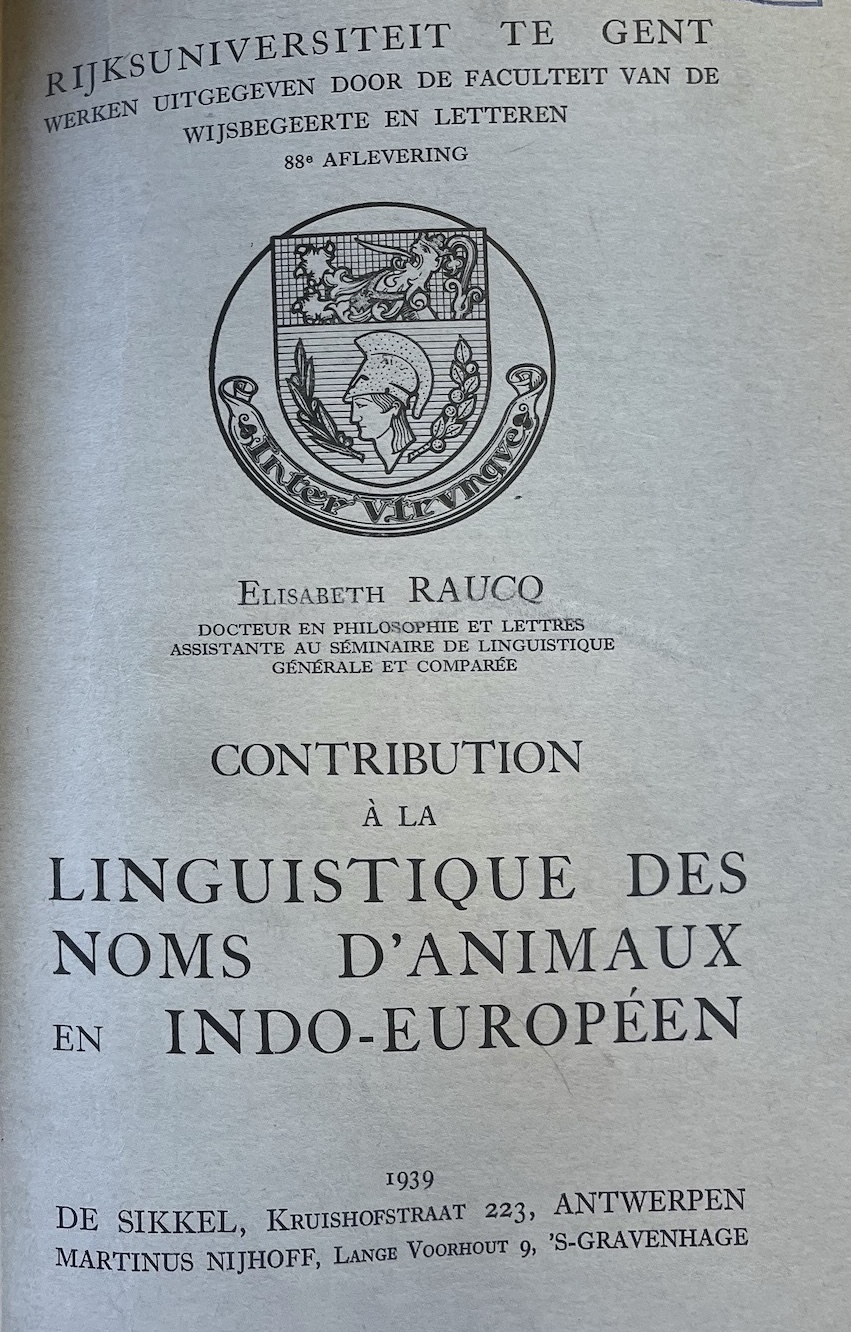
Here I want to say something about the work of Elisabeth Raucq, though there are few published traces of her career. Raucq also attended Émile Benveniste’s Comparative Grammar and Iranian lecture courses in 1938-39, as well as classes with Jules Bloch and Jean Filliozat. There are no indications she attended the EPHE in previous years, so it seems this was a visiting year from the University of Ghent, where she was working with George van Langenhove. The book which I focus on is a linguistic study of animal names or nouns in Indo-European languages: Contribution à la linguistique des noms d’animaux en indo-européen, published by De Sikkel in Antwerp in 1939. This was a publication series from the University of Ghent, and I suspect it was her thesis. She is working in the tradition of van Langenhove, and references work by Antoine Meillet in the book, and two of his most important students, Jerzy Kuryłowicz and Benveniste. Her reference to Benveniste’s work is to his 1936 book Origines de la formation des noms en indo-européen.
Given what else was happening in 1939 it is unsurprising there were few reviews at the time of publication. The three I know are by the medievalist Urban T. Holmes Jr. in Language in 1940, Alfred Ernout in the Revue de Philologie, de Littérature et d’Histoire Anciennes, and by Berhard Rosenkranz in Indogermanische Forschungen, both in 1941. Ernout’s review is just a book note, but in only a few words raises some significant issues:
This book develops from the teaching of Monsieur van Langenhove: it is an application of his theory of the structure of ‘primitive’ Indo-European. According to Mlle Raucq in her preface, “Animal nouns are fixed [immotivés] in the system of nominal formations characteristic of Indo-European in the verbal period. They can be analysed as semantemes belonging to the static period of Indo-European” [p. viii]. Her study is devoted to this analysis. The noun ox [bœuf], for example, can be traced back to a root ǝg2 suffixed by *-eu- and variously expanded (p. 88), or rather to a primary IE form *ǝg2ǝ3eu- (p. 90). One can admire the ease with which Mlle Raucq proceeds with these reconstructions. For my part, they worry me a bit, and I see emerging, more or less implicitly, the idea that through Indo-European we can reconstitute ‘original’ forms. It is the same idea, rejuvenated and presented in a more complicated form, that Bopp expressed in the preface of his 1833 Grammar: I am afraid it will lead to the same misunderstandings.
Holmes also situates Raucq within the lineage of van Langenhove, but includes Meillet’s students too: “In this investigation of the semantemes and idea-signifiers of pre-dialectal Indo-European, the author is a disciple of Van Langenhove, and therefore of Kurylowicz and Benveniste” (241). Holmes concludes: “This type of linguistic reasoning is still in its experimental stage, and no one as yet can judge its ultimate value. We must read with care the studies of Benveniste, Kurylowicz, Van Langenhove, Raucq, and others” (p. 241).
Rosenkranz suggests the book “appears extremely convincing… partly due to the consistency with which she pursues her principles and methods”. But he identifies “serious concerns”, particularly around the way it follows a line, excludes material which does not fit, and proposes some dubious etymologies. Ultimately he sees Raucq’s “‘test case’” for van Langenhove’s theory as “a failure” (p. 61). The book is also mentioned in passing by Albert Cuny in the Revue Hittite et Asianique in 1939, again seeing it in the lineage of van Langenhove, but on a topic outside the scope of that journal.
Another review appeared somewhat belatedly, because of the war, in the Bulletin de la société de linguistique de Paris, in an issue spanning 1942-45. The author of this review was Benveniste, who discussed the book alongside the first two volumes of van Langenhove’s Linguistische Studiën. It is, frankly, brutal, and clearly disassociates his work from this approach. While he acknowledges van Langenhove makes some valuable analyses of Germanic morphology, he is sceptical of the wider claims. “I must confess that, in these long considerations and these meticulous analyses, I was unable to grasp any useful ideas; I even admit that most of the principles behind them remain unintelligible to me” (p. 44). He contrasts the documentation and the theory: the former is “extensive, precise, generally taken from the best authors”, but the latter is a “nebulous and inconsistent doctrine which is superimposed on it” (pp. 44-45).
In the second part of his review he argues that Raucq’s project is entirely based on these “pseudo-principles”, because she believes only van Langenhove’s method “leads to results”. This is its problem for Benveniste: “it is a question of establishing that nouns considered simple are prehistoric compounds”. Her work is misled by thinking about Greek words without considering they are “borrowings from some other Indo-European language”. He closes with the wish that “I hope Mlle Raucq abandons these sterile paths and in future devotes her gifts and knowledge to more real objects” (p. 45).
For a while at least, Raucq continued in the lineage of van Langenhove. Her other book-length study was a Dutch work, Bijdrage tot de studie van de morphologie van het Indo-Europeesch verbum, published in 1947, but completed on 14 July 1943 (p. 194). Its title would translate as Contribution to the study of the morphology of the Indo-European verb. Being in Dutch would have narrowed its audience, even within linguistic specialists, and I cannot find any indication it was translated into another language. From the reviews I have seen (i.e. Edgar Polomé in 1951 and Arthur Beattie in 1952), it seems that this continued to build on van Langenhove’s work. He died, suddenly, in 1943, at the age of just 51, and a third volume of his Linguistische Studiën was published posthumously in 1946, edited by two of his colleagues. The first volume of this series is mostly in Dutch; one essay of the first volume and the other two volumes in French. There were plans for additional volumes, which van Langenhove did not achieve. Raucq dedicates Bijdrage tot de studie to van Langenhove’s memory: the completion date is the day of his death.
The only other publication by Raucq of which I’m aware is a very specialist study of a manuscript held in Brussels, “Die Runen des Brüsseler Codex No. 9565 – 9566”. Runes were another of van Langenhove’s interests. The article begins with a Dutch summary, but is mostly in German. It is in a 1941 issue, but notes that it was a paper delivered on 21 June 1942. (I suspect this discrepancy is because publication schedules were erratic during the war, and that the 1941 volume was delayed enough to allow a 1942 paper to appear within it.)


Beyond these pieces, I can find nothing of what Raucq went on to do. The cover page of Bijdrage tot de studie says that she was an “assistant to the seminar in general and comparative linguistics (1938-1944)”. Perhaps that role did not continue after van Langenhove’s death. Or she may have married and changed her name. It is possible she did not pursue an academic career. If that is the case, it’s hard not to think the highly critical reviews played a part.
Her career therefore appears to be highly abbreviated: a 1939 book, a 1942 paper, and another book completed in 1943 and published in 1947. One each in French, German and Dutch. The book on animals is especially remarkable for its date of 1939. The methodological differences are significant between Benveniste and Raucq, as his review indicates, but thematically there are parallels. Benveniste would himself publish on animal nouns in his later work, both in Indo-European in 1949 and in the High-Yukon native American language in 1953. It is striking that, even as a contrast, Benveniste does not mention Raucq’s book in the first of these. The Native American essay was based on fieldwork on the Pacific Northwest coast, and builds on the limited work on native American languages in European research of the time. It lists the names of multiple kinds of mammals, birds, fish and insects, and provides a short text, “The Bear and the Porcupine”, with a translation.
Raucq’s work might even be seen as something of a model for Benveniste’s later work on the vocabulary of Indo-European institutions, which we have in English as the Dictionary of Indo-European Concepts and Society. But in that work, Benveniste is not so much concerned with trying to reconstruct words in Indo-European but rather the subsequent forms, their relations and significations. It is also a book which by its nature is much more explicitly political.
References
A.J. Beattie, “E. Raucq: Bijdrage tot de Studie van de Morphologie van het Indo-Europeesch Verbum…”, The Classical Review 2 (2), 1952, 111-12.
Émile Benveniste, Origines de la formation des noms en indo-européen, Paris, Adrien Maisonneuve, 1935.
Émile Benveniste, “George van Langenhove. – Linguistische Studiën I, II… Élisabeth Raucq. – Contribution à la linguistique des noms d’animaux…”, Bulletin de la société de linguistique 42 (2), 1942-45, 44-45.
Émile Benveniste, “Noms d’animaux en indo-européen”, Bulletin de la Société de linguistique 45 (1), 1949, 74-103.
Émile Benveniste, “Le vocabulaire de la vie animale chez les indiens du Haut-Yukon”, Bulletin de la société de linguistique 138 (1), 1953, 79-106.
Émile Benveniste, Le Vocabulaire des institutions indo-européennes, 2 volumes, Paris: Éditions de Minuit, 1969; Dictionary of Indo-European Concepts and Society, trans. Elizabeth Palmer, Chicago: Hau Books, 2016; originally published as Indo-European Language and Society, Coral Gables: University of Miami Press, 1973.
Albert Cuny, “G. van Langenhove, Linguistische Studiën, II”, Revue Hittite et Asianique 5 (37-38), 1939, 185-86.
Georges Dumézil, Mitra-Varuna. Essai sur deux représentations indo-européennes de la souveraineté, Paris: Gallimard, second edition, 1948; Mitra-Varuna: An Essay on Two Indo-European Representations of Sovereignty, critical edition, trans. Derek Coltman, ed. Stuart Elden, Chicago: Hau, 2023.
A. Ernout, “Elisabeth Raucq, Contributions à la Linguistique des Noms d’Animaux en Indo-Européen”, Revue de Philologie, de Littérature et d’Histoire Anciennes 15, 1941, 177.
Urban T. Holmes, Jr., “Contributions à la Linguistique des Noms d’Animaux en Indo-Européen by Elisabeth Raucq”, Language 16 (3), 1940, 241.
Klaus Karttunen, “Langenhove, George van”, Who Was Who in Indology, 2017, https://whowaswho-indology.info/6644/langenhove-george-charles-van/
George van Langenhove, Linguistische Studiën, Antwerpen: De Sikkel, three volumes, 1936-46.
E. Polomé, “Raucq (E.). Bijdrage tot de studie van de morphologie van het indo-europeesch verbum”, Revue belge de philologie et d’histoire 29 (4), 1951, 1199-1205.
Elisabeth Raucq, Contribution à la linguistique des noms d’animaux en indo-européen, Antwerpen: De Sikkel, 1939.
Elisabeth Raucq, “Die Runen des Brüsseler Codex n° 9565-9566”, in Mededeelingen van de Koninklijke Vlaamsche Academie voor wetenschappen, Letteren en schoone kunsten van België. Klasse der letteren III (4), 1941, 1-26.
Elisabeth Raucq, Bijdrage tot de studie van de morphologie van het Indo-Europeesch verbum, Brugge: De Tempel, 1947.
B. Rosenkranz, “George van Langenhove: Linguistische Studien II: Essais de linguistique indo-européenne… Elisabeth Raucq, Contribution à la linguistique des noms d’animaux en Indo-Européen…”, Gnomon 17 (2), 1941, 56-61.
Archives and Sources
Fonds Georges Dumézil, Collège de France, DMZ 56.4.
École pratique des hautes études, Section des sciences historiques et philologiques. Annuaire 1939-1940, 1939.
This is the fifteenth post of a weekly series, where I post short essays with some indications of further reading and sources, but which are not as formal as something I’d try to publish more conventionally. They are usually tangential to my main writing focus, a home for spare ideas, asides, dead-ends and possible futures. I hope there is some interest in them. They are provisional and suggestions are welcome.
The full list of ‘Sunday histories’ is here.
Discover more from Progressive Geographies
Subscribe to get the latest posts sent to your email.


Pingback: Indo-European Thought in Twentieth-Century France update 28: archives in Princeton, Chicago and final work in New York | Progressive Geographies
Pingback: Sunday histories – short essays on Progressive Geographies | Progressive Geographies
Pingback: Six Months of ‘Sunday Histories’ – weekly short essays on Progressive Geographies | Progressive Geographies
Pingback: Lucien Gerschel, Georges Dumézil, William Shakespeare and the history of Coriolanus | Progressive Geographies