
I’ve continued my work with archives in the USA over the past several weeks. Some of this has been in relation to the Indo-European Thought project, but I’ve managed to work on some peripheral things too.
I had two days in Princeton, one at the Derrida book collection in the Firestone Library of Princeton University, and one at the special collections of the Institute of Advanced Study. I had everything set up for a visit to the Derrida library in March 2020 – flight, hotel, book orders – but it had to be cancelled due to the pandemic restrictions. An archivist there was willing to help with the work on Foucault via a virtual consultation – a Teams call with a document camera, where I could watch her turning the pages of Derrida’s copy of Foucault’s Folie et déraison. This was invaluable at the time, and it enabled me to finish The Early Foucault. But it was good to see the actual book itself, albeit five years later than planned. There are some other books by Foucault in Derrida’s collection, some dedicated by Foucault and some marked up. I also looked at a few things by Benveniste, Dumézil, Eliade and Koyré in the collection.
At the IAS, I asked to see the files on Jean de Menasce and Jean Gottmann. So many people central or peripheral to this project spent time there. I’d already been given scans of material relating to other people I had an interest in – Georges Dumézil, Ernst Kantorowicz, Alexandre Koyré, and Walter Bruno Henning. I discuss what the Henning files reveal about his Khwarezmian dictionary project here. But though I’m really grateful for the remote access, I wanted to visit at least once – I’d never been to Princeton before. I did walk around the lake (famously used in the Oppenheimer film) and went to the Einstein statue in the lunch break.
In New York, I went to the Berg collection of the New York Public Library, to look at two things in the Vladimir Nabokov collection – his correspondence with Roman Jakobson, and the marked-up typescript of his translation of The Song of Igor. I had to get permission from the Nabokov estate to access the letters, which took a little while. I had previously written a short piece on this site about the failed collaboration on a critical edition of the Igor text by Jakobson and English translation by Nabokov. I’ve since found some new sources for this story – some published and some not, and wrote an update on this story.
One of the reasons for the falling out was that Nabokov was convinced that Jakobson was a Soviet agent. Exploring the basis for this accusation has become a very deep rabbit-hole. It’s led me through the Columbia and MIT archives, and to some unexpected places. One of those was the Gottesman libraries of Teachers College of Columbia University, which has some interesting documents relating to the climate at Columbia in the late 1940s and early 1950s. There is a lot more in the main Columbia archives relating to the story. I am not sure what I will do with this, but I have more than a draft of something. At the very least it’s been interesting and opens up a whole range of questions.
I also had a few days in Chicago, mainly working with the Mircea Eliade papers and a few things relating to Eliade in the Ioan Culianu collection at the Regenstein library. This was one of the US archives I’d initially planned to visit for the Indo-European project, but it ended up being almost the last I got to visit. I hope to have a chapter on the decade Eliade spent in Paris after the Second World War. There isn’t much realting to that period in Chicago, but there is an extensive correspondence with Dumézil, which is important for the story of his career. Some of what I looked at in Chicago got me thinking about a notorious story relating to Eliade – the murder of Ioan Culianu. I wrote a piece about that, partly in relation to Bruce Lincoln’s recent book on the story, for this site.


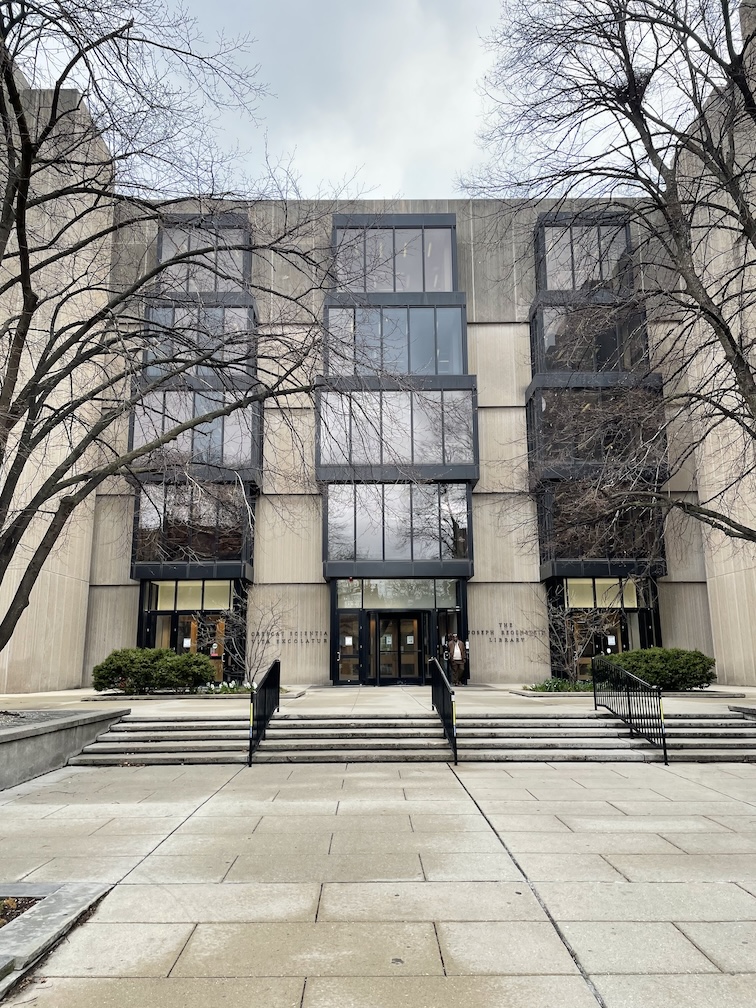
Clockwise from left: Firestone Library, Princeton University; Institute for Advanced Study; Regenstein Library, University of Chicago; Teachers College
I made some additional visits to Columbia University archives, some relating to the Jakobson story and some things from the Edward Said papers, and had one day back at the Rockefeller Archives Center to go over things I hadn’t had time with on the previous visit. Some of the initial work Jakobson did in the United States in 1941 and 1942 related to North American and Siberian languages, from material given by Franz Boas to the New York Public Library, so I took a look at that. He also did some work on the medieval Yiddish spoke by Czech Jews for YIVO, the Yiddish Scientific Institute which is just a few minutes’ walk from the Remarque Institute. They don’t have much in the archives relating to Jakobson, as far as I can tell, but I did look at some correspondence they have. I will write about Jakobson’s library work in the next ‘Sunday History’ [update: now available here].
I also presented on Benveniste again at an event at Remarque, on the theme of ‘Troubling Classical Bodies’, with Brooke Holmes and Anurima Banerji. There is a video of the event here, and the text of my piece on “Émile Benveniste and the Sogdian Word for ‘Knee’” is here.
Some more of the things I’ve discovered have been shared in the ‘Sunday Histories’ series of posts. Some of these pieces would never have been written had I not found things in the archives – not always things I was looking for, which is often the most interesting part of this work. Two pieces on Foucault, for example, on the question of who translated The Order of Things, and the confusion over an English king mentioned in the History of Madness, both came out of chance discoveries. Some of the work relating to Benveniste, and in particular his Vocabulaire project, led to another couple of short pieces – one on territory and one on animal names and the different approach of Elisabeth Raucq.
My time in New York ended last week and I’m now back in the UK. I’m not sure when I’ll next be back in the US. I spent most of the time there doing archival work or – as important – writing up the notes on the things I’ve seen or photographed there. I really didn’t want to head back with too many files of things unprocessed. That is definitely the less glamorous part of archival work.
I really appreciate that so many archives are willing to digitise things, and I made a lot of requests. Sometimes those are of things I realised were more important than I’d initially thought in an archive I’d been to already; others were more speculative requests for any correspondence with someone that is in an archive. I did a few side trips, but wasn’t able to get everywhere. Archives in Baltimore, Wisconsin, Cincinnati and Philadelphia were all really helpful at a distance. But I also stumbled across things that happened to be in the next folder to one I was initially looking at; or some other chance discovery. With archives nearby in New York it wasn’t difficult to go back. I’ll miss that, and much more, about my time there. I can thoroughly recommend the Remarque Institute as a place to spend time – I feel very fortunate to have had a semester there.
Previous updates on this project can be found here, along with links to some research resources and forthcoming publications. The re-edition of Georges Dumézil’s Mitra-Varuna is now available open access. There is a lot more about the earlier Foucault work here. The final volume of the series is The Archaeology of Foucault, and the special issue of Theory, Culture & Society I co-edited on “Foucault before the Collège de France” has some important contributions on the earlier parts of Foucault’s career, and is currently available free to access. Recent articles include “Foucault, Dynastics and Power Relations” in Philosophy, Politics and Critique and “Foucault and Dumézil on Antiquity” in Journal of the History of Ideas (both require subscription, so ask if you’d like a copy); and “Alexandre Koyré and the Collège de France” in History of European Ideas (open access).
Discover more from Progressive Geographies
Subscribe to get the latest posts sent to your email.


Pingback: Indo-European Thought in Twentieth-Century France update 28: archives in Princeton, Chicago and final work in New York | Rashid's Blog: Portal for Inquisitive Learners