
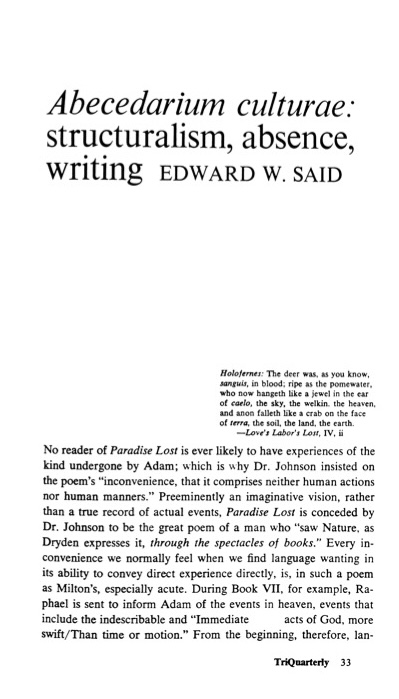
Given all his other achievements, Edward Said’s role in bringing Foucault’s work to an anglophone audience is perhaps understated today. His 1971 essay “Abecedarium culturae”, in Northwestern’s literary journal TriQuarterly was a significant piece on so-called “structuralism”, and the following year’s “Michel Foucault as an Intellectual Imagination” was one of the first articles devoted to Foucault in the United States. It was possibly the first, apart from reviews. “Michel Foucault as an Intellectual Imagination” appeared as the first article in the launch issue of boundary 2, invited by William Spanos. “Abecedarium culturae” was reprinted in Modern French Criticism: From Proust and Valery to Structuralism, a collection edited by Foucault’s host for his visits to Buffalo, John K. Simon. Said’s 1975 book Beginnings has a chapter entitled “Abecedarium culturae” which takes material from both the earlier essays.

Foucault was an important inspiration for Said’s other work, most notably Orientalism, though from the late 1970s Said began to take a distance from Foucault (though he did attend his late 1980 seminar at New York University). Even by the time of “An Ethics of Language” in 1974, Said’s review essay on The Archaeology of Knowledge, there are some criticisms beginning to appear. Timothy Brennan in Places of Mind: A Life of Edward Said provides some discussion of Said’s changing relation to Foucault, which was partly for intellectual reasons and partly motivated by politics (pp. 174-77). Karlis Racevskis has written a good survey of the connections and criticisms. In a piece about “My Encounter with Sartre”, which took place in Foucault’s apartment, Said says something of his disillusionment with French intellectuals.
As I’ve been going to Columbia University archives for various things connected to my Indo-European project, especially concerning Roman Jakobson, I also requested the Said boxes containing his work on Foucault. One of the archivists told me that the Said papers were the most consulted of their collections. There are boxes with the manuscripts, typescripts and correspondence relating to both the early pieces on Foucault and the later tributes – Foucault’s obituary and “Foucault and the Imagination of Power”. Both those later essays are reprinted in Reflections on Exile. In the correspondence files there is also a November 1972 letter from Foucault to Said, most of which is translated by Brennan in Places of Mind (p. 176):
Upon my return from America, I found the article that you were willing to write about my work. I do not need to tell you how grateful I am for the effort you have made reading, understanding, and analyzing the stutterings I have managed to get out… I infinitely admire your intelligence, your mastery, and the rigor of your analyses to the point that on many points you have helped me clarify the nature of my own future work.
I very much hope that we will have the chance to meet one day, and to have the chance to discuss the theories which concern us both. I would like to find out about where your work is heading.
Foucault to Said, 5 November 1972, Edward Said Papers, box 5a, folder 3. (The ellipses are Foucault’s.)
Foucault’s trip to America was to teach at Cornell; at the time Said was on sabbatical in Beirut. Said proposed a meeting in Paris in spring 1973. However, it was a small detail in the archives which led me down an interesting detour. In 1972 boundary 2 asked Said to give them a brief biographical note to go with his essay. He wrote back to give them this draft:
Was born in Jerusalem, Palestine, and received secondary education there, and in Egypt. BA from Princeton, and PhD from Harvard. Since 1963 I have been at Columbia, and since 1970 I have been Professor of English and Comparative Literature. Guggenheim Fellow, 1972-3; Fellow-Elect, Center for Advanced Study in the Behavioral Sciences, Palo Alto. Author of numerous articles published in English, French and Arabic. Books are Joseph Conrad and the Fiction of Autobiography (Harvard, 1966); Beginnings: Intention and Method (Basic, 1973); Swift’s Tory Anarchy (Harvard, forthcoming).
Said to Ms. [Ann] Yeoman, 21 April 1972, Edward Said Papers, box 168b, folder 29
Said tells the journal to edit this text as they see fit, and the briefer note they published reads:
EDWARD W. SAID, Professor of English and Comparative Literature at Columbia, is the author of numerous articles published in English, French and Arabic. His books are Joseph Conrad and the Fiction of Autobiography, Beginnings: Intention and Method, and the forthcoming Swift’s Tory Anarchy.
boundary 2 1, 246
The forthcoming book on Jonathan Swift was a surprise. I knew there was an essay of this title, but not a book.
The essay on Swift was published in Eighteenth-Century Studies in 1969, and it was reprinted as Chapter 2 in The World, the Text, and the Critic, along with another essay, “Swift as Intellectual”, as Chapter 3. That collection was with Harvard University Press, published in 1983. (Its working title was Criticism between Culture and System.) Said never completed his book on Swift. The indication in his own version of the note that it was to be published with Harvard University Press suggests it was more than just an idea for a future project. The project is discussed in Brennan’s biography (pp. 113-21), where he indicates that it was commissioned by Harvard, and that for a while Said worked on it in parallel to Beginnings.


Said’s archive has some materials relating to the Swift book project. As well as a typescript of the “Swift’s Tory Anarchy” article (box 110c), these boxes include various reading notes (boxes 110b and c). One folder has the text of the “Swift as Intellectual” essay (box 76a, with a draft in 110b). It was delivered as a lecture with the title “Swift as Intellectual: Language and Political Action”, at UCLA on 18 January 1980. There it was part of a series with the title “Augustan Myths and Modern Readers”, organised by Alan H. Roper in the 1979-80 academic year at the William Andrews Clark Memorial Library (the rare books and manuscript library). Other speakers included Murray Krieger, Geoffrey Hartman, Eugenio Donato, Margaret Doody, Stanley Fish. Much more interesting for this story is that the archive also includes a three-page proposal for a project with the title “Swift in History” (there are copies in both box 76a and 110b).
Said describes this project as “a study of Swift’s life and work as seen interacting with the history of which they are vital parts” (proposal, p. 1). He argues that in the period Swift is working, there is a “remarkable congruence during the age between literature and politics” (p. 1). His references to Swift’s work are wide-ranging, and he gives lots of historical examples of events and figures. “I read Swift’s work then as a totality, albeit made up of diverse parts, yet very much a unity” (p. 3). As the biographical note indicates, Said’s first book, based on his doctoral thesis, was on Joseph Conrad. In this proposal, he indicates that his “Swift in History” project will work in a related way. He describes the earlier book as “a portrait of Conrad’s mind viewed in his life and work as a structured universe with patterned characteristics” (p. 3). He concludes by saying that he had been teaching on Swift at Columbia for the past two years, and much of the work had therefore already been undertaken (p. 3). Teaching materials in box 110b indicate this means the proposal dates from the late 1960s – one course is from 1965-66 (English C3037x). Said also taught a course on “Jonathan Swift and the Early Eighteenth Century” at a Harvard Summer School in 1968 (English S-247).
Beyond what is said by Brennan, I know of two main pieces exploring Said’s engagement with Swift. One, by Clive Probyn, written before Said’s archives became available, is based on the two essays included in The World, the Text, and the Critic. The other, which makes use of materials in the archive, is by Helen Deutsch, who has written a very interesting piece on Said’s career-long engagement with Swift for boundary 2. Both Deutsch and Brennan call the unfinished book Swift in History, after the proposal, rather than the title given in the author note for boundary 2. Deutsch is working on a book on the Said-Swift relation, under the working title of The Last Amateur, due to be published by University of Chicago Press in 2026. As Deutsch said a few years ago of this intriguing project:
My book argues that Swift was an important and enduring influence on Said, whose abandoned book would have been titled Swift in History, and would have followed his first book, Joseph Conrad and the Fiction of Autobiography (1966). I have spent some of the most thrilling hours of my scholarly life with Said’s papers at Columbia University, documenting his research and teaching on Swift, a truly absorbing and moving experience. But my experience in Said’s archive confirmed my sense that I was not writing a traditional monograph; instead, it started my search for a form that stays true to the notes, the fragments, the urgently underlined jottings that kept Said’s thought alive and unfinished. Swift was a model for Said of how to be a public intellectual: how to speak, from a position of exile, for a human collective that might never exist. In the Drapier’s Letters (1724), Swift called “the whole people of Ireland” into imaginary being a century before an Irish nation was a reality. Author of monumental field-defining monographs though he was, Said was also, as he described Swift, “an occasional writer, an essayist, a pamphleteer.” Accordingly, I read Said in a minor key, building to my final claim that Said’s early unfinished book on Swift inspired his last unfinished book on late style.
It would have been nice if I could have closed the triangle, after talking of Said on Foucault, and Said on Swift, but I can only think of a very few references to Swift by Foucault. One comes in the radio lecture “Le corps utopique” in 1966, recently included in Entretiens radiophoniques. Foucault mentioned Gulliver’s Travels and René Farabet read a passage from the second part, “A Voyage to Brobdingnag”. (The passage is not included in the earlier publication of Foucault’s text, nor its English translation.) There are also brief mentions of Swift in the History of Madness in relation to melancholy, and in Foucault’s 1969 course on sexuality at Vincennes in relation to utopias. In these passing mentions there is little which Said could have directly used to inform his own study. But Said’s engagement with Foucault was very much in the sense of appropriating ideas and tools from his work – notably around discourse and Foucault’s archaeological writings. He didn’t need Foucault to have written about Swift to use Foucault to read Swift.
But how Foucauldian might Said’s study of Swift have been? In The World, the Text and the Critic, the first of the Swift texts is from 1969, before Foucault was a major focus for Said; the second is from 1980, by which time Said was taking his distance from Foucault. Indeed, the only reference to Foucault in either of the two Swift essays comes in “Swift as Intellectual” in 1980:
In general, contemporary criticism has been concerned with authors and texts whose formal characteristics exist in some disjunctive relationship with their ideological or thematic surface: thus the critic’s job is to illuminate the disjunction by exposing, or deconstructing, the contradictions woven into the text’s formal being. Moreover, the critic’s position about the texts he analyzes is a marginal one; that is, the text is important whereas the critic’s role is a secondary one, limited to revealing the text’s conditions of being. This procedure is true, I think, of the Derridean school, the school of Marxist readers, of Foucault’s disciples, the semioticians, of the so-called Yale school.
Swift resists this approach and, as I said earlier, it is his resistance that makes him so interesting and challenging a figure. My argument is that the main avenue to understanding Swift is that we take seriously the way in which he resists any kind of critical approach that does not make his existence, his functioning, and above all his self-consciousness as an intellectual—albeit an intellectual in the special historical circumstances of his cultural moment—the main avenue to approaching him (p. 87).
The “Swift in History” book proposal seems to date between these two essays. It is a development of the “Swift’s Tory Anarchy” essay, but the project is seemingly abandoned by the time of “Swift as Intellectual”. But from the brief proposal it does not seem Foucault was intended to be a major focus. Said mentions four Francophone theorists – Lucien Goldmann (Romanian-born, though lived and worked in France), Jean Starobinski (who was Swiss), Georges Poulet (Belgian) and Roland Barthes, the only one of the four who was, like Foucault, French. It will be interesting to read Helen Deutsch’s book on Said on Swift.
References
Timothy Brennan, Places of Mind: A Life of Edward Said, New York: Farrar, Strauss & Giroux, 2021.
Helen Deutsch, “Living at this Hour: Jonathan Swift, Edward Said, and the Profession of Literature”, boundary 2 46 (4), 2019, 31–62.
Helen Deutsch, “We Must Keep Moving”, The Rambling, 7 August 2020, https://the-rambling.com/2020/08/07/issue9-deutsch/
Michel Foucault, Sexuality: The 1964 Clermont-Ferrand and 1969 Vincennes Lectures, ed. Claude-Olivier Doron, trans. Graham Burchell, Columbia: Columbia University Press, 2021.
Michel Foucault, “Le corps utopique”, in Entretiens radiophoniques: 1961-1983, ed. Henri-Paul Fruchaud, Paris: Flammarion/Vrin/INA, 2024, 413-22.
Clive Probyn, “Blindness and Insight: The World, the Text (of Jonathan Swift), and the Criticism of Edward Said”, Eighteenth-Century Life 32 (2), 2008, 68-80.
Karlis Racevskis, “Edward Said and Michel Foucault: Affinities and Dissonances”, Research in African Literatures 36 (3), 2005, 83-97.
Edward W. Said, Conrad and the Fiction of Autobiography, New York: Columbia University Press, 2008 [1966].
Edward W. Said, “Swift’s Tory Anarchy”, Eighteenth-Century Studies 3 (1), 1969, 48-66, reprinted in The World, the Text, and the Critic, Cambridge, MA: Harvard University Press, 1983, 54-71.
Edward W. Said, “Abecedarium Culturae: Structuralism, Absence, Writing”, c, 1971, 33-71; reprinted in John K. Simon (ed.), Modern French Criticism: From Proust and Valéry to Structuralism, Chicago: The University of Chicago Press, 1972, 341-92.
Edward W. Said, “Michel Foucault as an Intellectual Imagination”, boundary 2 1 (1), 1972, 1-36.
Edward W. Said, “An Ethics of Language”, Diacritics 4 (2), 1974, 28-37.
Edward W. Said, Beginnings: Intention and Method, New York: Basic Books, 1975.
Edward W. Said, The World, the Text, and the Critic, Cambridge, MA: Harvard University Press, 1983.
Edward W. Said, “Foucault and the Imagination of Power”, in David Couzens Hoy ed., Foucault: A Critical Reader, Oxford: Blackwell, 1986, 149-55.
Edward W. Said, Reflections on Exile and Other Literary and Cultural Essays, London: Granta, 2000.
Edward W. Said, “My Encounter with Sartre”, London Review of Books, 1 June 2000.
Archives
Edward Said papers, 1940-2006, MS#1524, Rare Book and Manuscript Library, Columbia University, https://findingaids.library.columbia.edu/archives/cul-5483040
This is the twenty-first post of a weekly series, where I post short essays with some indications of further reading and sources, but which are not as formal as something I’d try to publish more conventionally. They are usually tangential to my main writing focus, a home for spare ideas, asides, dead-ends and possible futures. I hope there is some interest in them. They are provisional and suggestions are welcome.
The full list of ‘Sunday histories’ is here.
Discover more from Progressive Geographies
Subscribe to get the latest posts sent to your email.


Goffman archives & book
https://newbooksnetwork.com/erving-manuel-goffman
Pingback: Josué V. Harari, the Marquis de Sade, and Michel Foucault’s 1970 lectures in Buffalo | Progressive Geographies
Pingback: “Before California: Foucault’s Early Visits to the Americas” – audio recording of talk at Maison Française, Oxford, 16 June 2025 | Progressive Geographies
Pingback: Sunday histories – short essays on Progressive Geographies | Progressive Geographies
Pingback: Six Months of ‘Sunday Histories’ – weekly short essays on Progressive Geographies | Progressive Geographies
Pingback: Indo-European Thought in Twentieth-Century France update 29: working on Benveniste’s Vocabulaire, Dumézil’s Bilan and other work | Progressive Geographies
Pingback: The Early Edward Said, Michel Foucault and Jonathan Swift – reposted for the 90th anniversary of Said’s birth | Progressive Geographies