
While I’ve been working on my Indo-European thought project, I’ve looked at a few books from the University of Warwick’s library which came from the Gillian Rose collection. Some of the books from that collection could not be borrowed – ones where she had marked the pages in some way. Warwick also has the Rose archive at the Modern Records Centre, and I’ve been hoping to consult that at some point. There has been a welcome resurgence of interest in Rose recently – the reissue of Love’s Work; the editing of lectures on Marxist Modernism; and a theme issue of Thesis Eleven.
I wasn’t initially sure where in her work Rose might discuss some of the people I was interested in, and whose books she had owned. There are odd references – Émile Benveniste, Georges Dumézil and Mircea Eliade are all mentioned in passing in Dialectic of Nihilism, for example. (That was the first book of hers I read, when writing my PhD.) Of the three, she mentions Benveniste the most often, mainly his Vocabulaire or Dictionary of Indo-European Concepts and Society.
Benveniste is referenced on “jurisdiction: ius dicere, to speak the law” and on the oath (see Dialectic of Nihilism, 89; 89 n. 17; 135 n. 22). On the first of these questions, she also references Dumézil’s Archaic Roman Religion on the “ius-dicere, declaring the law, the different forms which battle over jurisdiction have taken”, as a contrast to Derrida’s discussion of phone (voice) and writing (Dialectic of Nihilism, 169 and 169 n. 190). She also mentions Benveniste’s essay on subjectivity in relation to language (Dialectic of Nihilism, 111 n. 3), and Mircea Eliade’s The Myth of the Eternal Return on “the contrast of Greek archetype and Hebrew event” (Dialectic of Nihilism, 80 n. 16).
I had thought the place where she engages with this work the most would be The Broken Middle. This is one of her books which is perhaps neglected today. As Maya Krishnan and Nick Gane have both indicated, it is perhaps unfortunate that Rose’s Love’s Work is her best-known book today, rather than her philosophy. Krishnan says “Jacqueline Rose reports that Gillian regarded The Broken Middle (1992) as her masterpiece”. Krishnan adds:
It is certainly her hardest book. Here Rose takes on Kierkegaard, modern Jewish philosophy and theology, and literature and theory ranging across Kafka, Mann, Girard, Arendt and Luxemburg. The book revolves around a contrast between two metaphors: the “holy middle” and the “broken middle.” A “holy middle” is a kind of theoretical fairy tale, a place where the risk of perpetuating violence has been banished. The “holy middle” isn’t something anyone intends to create, but on Rose’s view, it’s what most post-Kantian philosophers have wound up fabricating…
As in Dialectic of Nihilism, in The Broken Middle Rose uses close readings of her interlocutors to show how, without realizing it, they pursue impossible and confused “philosophical purifications.” Rose puts forward the “broken middle” as her alternative. There are no abstract guarantees of justice and goodness. It’s a meta-philosophical thesis: philosophy cannot decide in advance of politics which courses of action will turn out to be genuinely violent.
But The Broken Middle is not a book which has an explicit engagement with the Indo-Europeanists. There are no references to Benveniste, Dumézil or Eliade. But there is a reason, I think, for this. Rose is engaging across the Graeco-Christian and Jewish traditions, in a way that those thinkers never really did. The Semitic was outside of the language and cultural groups that they were interested in. There may be political reasons for this. But even Benveniste – who was Jewish, had been born in Ottoman Syria, and whose parents were teachers for the Alliance israélite universelle – does not often draw on examples from the Semitic languages. Rose, though, as Krishnan indicates, turns her attention much more to Jewish figures within Western thought. She continues this in the companion book of essays, Judaism and Modernity.
One of the chapters in The Broken Middle has a reading of Thomas Mann’s four-part novel Joseph and his Brothers [Joseph und seine Brüder]. Mann’s book was published between 1933 and 1943, and written between 1926 and 1942. The first and second volumes were written in Germany, and published in Berlin, but by their publication Mann was already in exile from Hitler’s Germany in Switzerland. The third volume on Joseph in Egypt was mostly written in exile and published in Vienna, where the publisher had moved; the fourth volume in neutral Sweden. The later volumes were written in Czechoslovakia, Switzerland, Princeton and the final volume in California (on the book’s history, see Woods’s “Introduction”, xiii-xiv).
Rose’s reading is in no sense an engagement with Indo-European work, but the section title is one that is much on my mind when reading that tradition: “Myth out of the Hands of the Fascists” (pp. 115-33). The title is a slightly adapted quotation from Mann’s 17 November 1942 lecture at the Library of Congress about the work: “The Theme of the Joseph Novels”:
In this book, the myth has been taken out of Fascist hands and humanized down to the last recess of its language,—if posterity finds anything remarkable about it, it will be this (p. 21).
But instead of critically engaging with the work of, for example, Dumézil and Eliade – both mythologists with far-right affiliations – Rose’s reading turns, of the French mythologists of the twentieth-century, to René Girard. And Girard was working much more in a Judeo-Christian tradition than the Indo-European one.
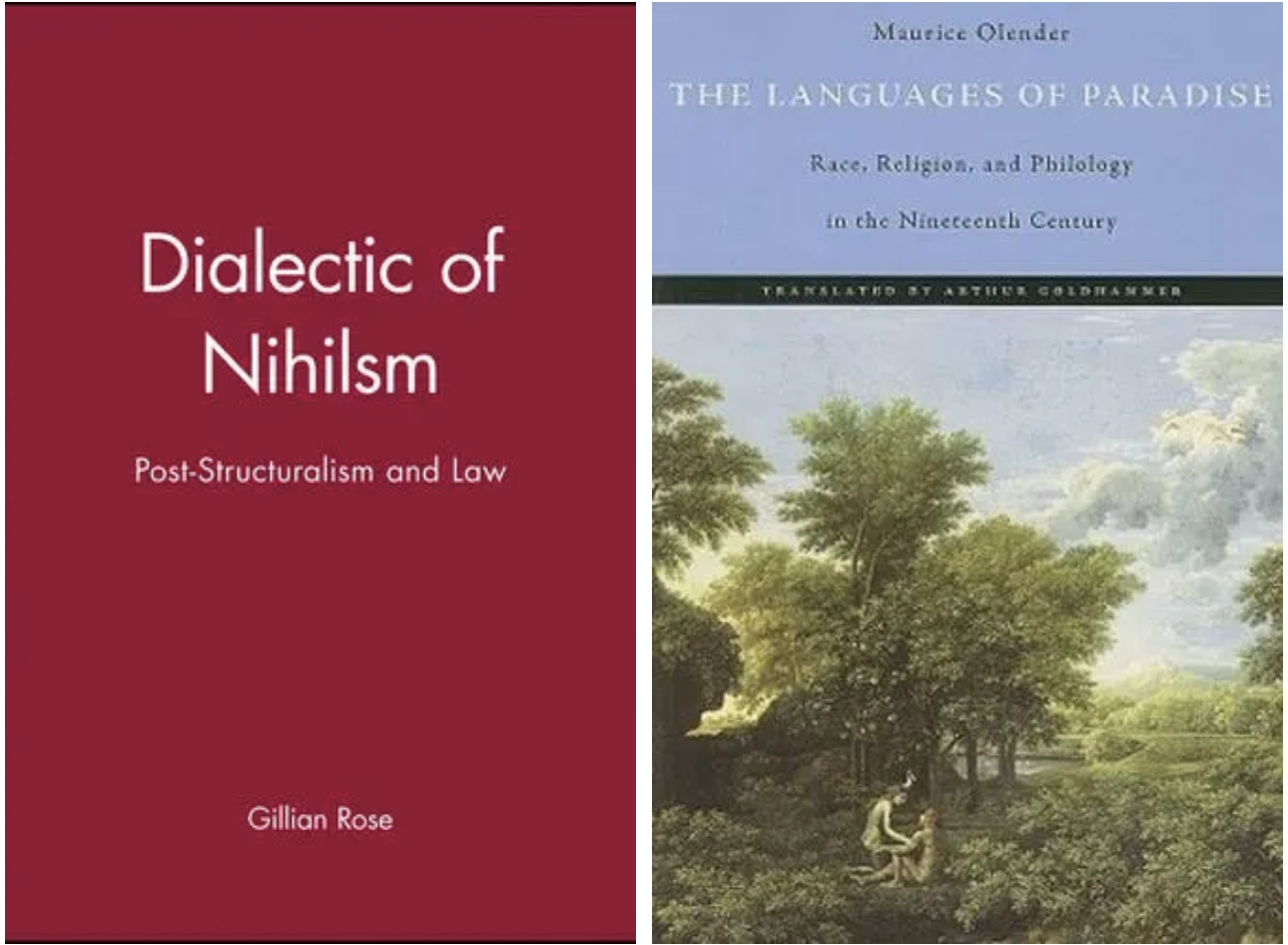
There are themes in Rose’s unfinished and posthumously published Paradiso which could conceivably have connected to the work of the Indo-Europeanists, especially in mystical theology – though Rose is again working on a Judeo-Christian, rather than pagan tradition. The published book, which includes a few sections only, pairs studies of ideas with people. I wonder what she would have made of Maurice Olender’s remarkable book Languages of Paradise, first published in French in 1989 and translated in 1992. It’s not a book in the Warwick library, which suggests Rose didn’t own a copy, though apparently the collection is not exhaustive, since until they introduced stricter controls, some books were stolen.
In his preface to the book, Jean-Pierre Vernant begins with a biblical story to engage with the Indo-European tradition of thought. The questions he asks are deceptively simple: where is the Garden of Eden and what language did Adam and Eve speak there? Hebrew is just one of the answers that has been given. In the book itself, Olender engages with hypotheses, ideas, histories and prejudices about primal languages, from Semitic to Indo-European, or, as it was sometimes known Indo-German or Aryan. This indicates understandings of the relation of Western European languages to Sanskrit, racial ideals and intellectual trends. It concentrates on the nineteenth century but anticipates debates of the twentieth. It is a book which speaks to so many questions Rose was interested in – relation, religion, language and politics – and crosses between the Indo-European and Semitic language groups.
Olender died in 2022, and I remember thinking at the time it was a shame he hadn’t done more work in the style of Languages of Paradise. I only knew his other book Race and Erudition. This led me to look for his other work, which is surprisingly brief. But then I learned that his major contribution to scholarship was as an editor, at Hachette, Fayard and Éditions du Seuil. Markus Messling has a good piece in tribute to him, which explains that important role. The list of people he published is quite extraordinary. His archives are at IMEC in Normandy, in 753 boxes!
References
Nicholas Gane, “Gillian Rose and the Promise of Speculative Sociology”, Journal of Classical Sociology, online first, https://doi.org/10.1177/1468795X241312298
Maya Krishnan, “The Risk of the Universal: The Philosophy of Gilian Rose”, 2024, https://thepointmag.com/politics/the-risk-of-the-universal/
Thomas Mann, The Theme of the Joseph Novels, Washington: Library of Congress, 1942 (also available at https://en.wikisource.org/wiki/The_Theme_of_the_Joseph_Novels)
Thomas Mann, Joseph and his Brothers, trans. John E. Woods, New York: Alfred A. Knopf/Everyman’s Library, 2005 (four volumes in one).
Markus Messling, “Writing as Commitment: In Memory of the Philologist and Editor Maurice Olender (1946–2022)”, Philological Encounters 8, 2023, 364-73.
Maurice Olender, Les langues du Paradis: Aryens et Sémites, un couple providential, Paris: Seuil, 1989, revised edition 2002; original version translated as Languages of Paradise: Race, Religion, and Philology in the Nineteenth Century, Cambridge, MA: Harvard University Press, trans. Arthur Goldhammer, 1992.
Maurice Olender, Race sans histoire, Seuil, 2009; parts in Race and Erudition, trans. Jane Marie Todd, Harvard University Press, 2009.
Gillian Rose, Dialectic of Nihilism: Post-Structuralism and Law, Oxford: Basil Blackwell, 1984.
Gillian Rose, The Broken Middle: Out of Our Ancient Society, Oxford: Blackwell, 1992.
Gillian Rose, Judaism and Modernity: Philosophical Essays, Oxford: Blackwell, 1993.
Gillian Rose, Mourning Becomes the Law: Philosophy and Representation, Cambridge: Cambridge University Press, 1996.
Gillian Rose, Paradiso, ed. Howard Caygill, London: The Menard Press, 1999.
Gillian Rose, “Interview with Gillian Rose”, ed. Vincent Lloyd, Theory, Culture & Society 25 (7-8), 2008, 201-18.
Kate Schick, Gillian Rose: A Good Enough Justice, Edinburgh: Edinburgh University Press, 2012.
John E. Woods, “Introduction”, in Thomas Mann, Joseph and his Brothers, trans. John E. Woods, New York: Alfred A. Knopf/Everyman’s Library, 2005, xiii-xvi.
Archives
Gillian Rose’s personal papers 1981-1994, Modern Records Centre, University of Warwick, MSS.377, https://mrc-catalogue.warwick.ac.uk/records/ROS
Fonds Maurice Olender, IMEC, https://collections.imec-archives.com/ark:/29414/a011450969339ebTnyS
This is the twenty-third post of a weekly series, where I post short essays with some indications of further reading and sources, but which are not as formal as something I’d try to publish more conventionally. They are usually tangential to my main writing focus, a home for spare ideas, asides, dead-ends and possible futures. I hope there is some interest in them. They are provisional and suggestions are welcome.
The full list of ‘Sunday histories’ is here.
Discover more from Progressive Geographies
Subscribe to get the latest posts sent to your email.


Pingback: Gillian Rose and the Indo-Europeanists | Rashid's Blog: Portal for Inquisitive Learners
Pingback: Gillian Rose and the Indo-Europeanists | Rashid's Blog: Portal for Inquisitive Learners
Pingback: Sunday histories – short essays on Progressive Geographies | Progressive Geographies
Pingback: Indo-European Thought in Twentieth-Century France update 29: working on Benveniste’s Vocabulaire, Dumézil’s Bilan and other work | Progressive Geographies
Pingback: Gillian Rose – a few links for the thirtieth anniversary | Progressive Geographies