
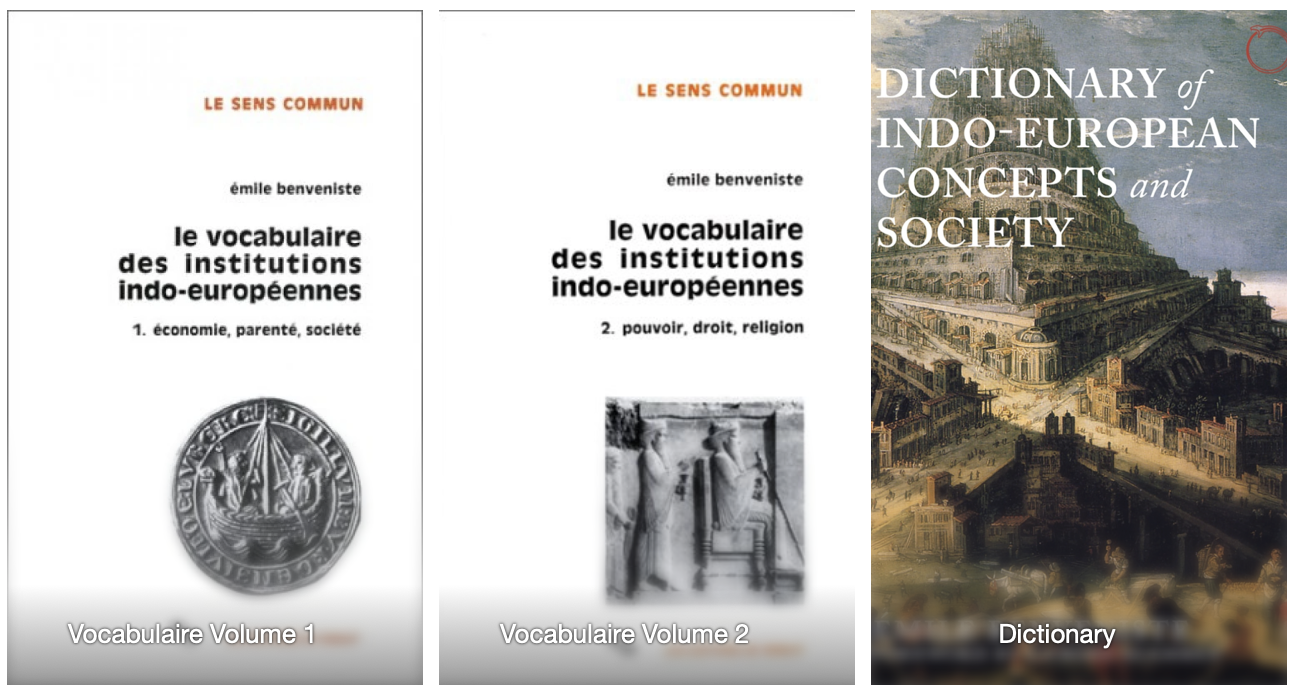
In his Vocabulaire, the Dictionary of Indo-European Concepts and Society, Émile Benveniste mentions some questions relating to spatiality and territory that I have briefly surveyed here. One question he raised I said was worthy of further attention.
In his French text, and its English translation, the word in question is transliterated as wánaks, but it is usually rendered as wanax. It is a term from Mycenaean Greek, first accessed through the deciphering of the Linear B script. It is found in a later form in Homer, usually written as anax, but there is a danger in assuming that term straight-forwardly explains the earlier one (see Palaima, “The Nature of the Mycenaean Wanax”, 123; Yamagata, “ἂναξ and βασιλεύς in Homer”). (I understand the difference in spelling is because the letter digamma or wau at the beginning of the word became obsolete.) James T. Hooker sets out the linguistic evidence, and its limitations, in “The wanax in the Linear B Texts”; Lothar Willms explores its plausible roots in “On the IE Etymology of Greek (w)anax”.
Benveniste was an interested participant in the first international conference after Michael Ventris’s decipherment of Linear B in the early 1950s (on which, see here). In his Vocabulaire Benveniste describes the wanax as the “holder of royal power, even if we cannot define the extent of his territory [l’étendue de son territoire]” (Vocabulaire Vol II, 24; Dictionary, 320). In the earlier post I gave this as one example of how his work was more interesting for spatial and territorial questions than I had perhaps previously recognised.
Benveniste indicates that:
Greek possesses two names for the king, basileús (βασιλεύς) and wánaks (wάναξ). These two terms do not exist on the same level, but they both defy any etymological analysis. They have no correspondent in other languages, and we cannot even detect any connections, even partial ones, within Greek itself (Vocabulaire Vol II, 23; Dictionary, 319).
For Benveniste, the Mycenaean sources indicate that “the basileús was merely a local chieftain, a man of rank [notable] but far from a king”, without “political authority”, whereas the wánaks was “the holder of royal power” (Vocabulaire Vol II, 24; Dictionary, 320). Benveniste suggests that the analysis of the words in Homer can be revealing. Wánaks is a term used to describe Apollo and also Zeus, while basileús is not used to describe a god. A human could be both a wánaks and a basileús, but not all the chieftains have the higher status. “There are even degrees and a kind of hierarchy among basileîs, to judge by the comparative basileúteros and the superlative basileútatos, whereas there is no such variation on wánaks in Homer” (Vocabulaire Vol II, 25; Dictionary, 321). Benveniste therefore suggests this distinction:
This implies that wánaks alone designates the reality of royal power; basileús is no more than a traditional title held by the chief of the génos, but which does not correspond to a territorial sovereignty [une souveraineté territoriale] and which a number of persons may hold in the same place (Vocabulaire II, 26; Dictionary, 321).
The relation of the basileus, often translated as king, to the genos, the people in the sense of a shared kinship or tribe, is another question entirely. But the idea of the wanax is interesting, since it suggests a higher form of kingships over more tribal chiefs, with a meaning close to king of kings or high king. If the basilieús is subservient, Benveniste stresses that this form of power could be shared and is not territorial in its object.
As Margalit Fox indicates:
At the head of each palace hierarchy stood the wanax, the early Greek word for ‘king’ or ‘ruler’, written, according to Linear B spelling rules, as wa-na-ka. (The word’s descendant, anax, meaning ‘lord’ or ‘master’, turns up five hundred years later in Homeric Greek. The wanax was the administrative leader of each Mycenaean kingdom, overseeing domestic economics and foreign trade, military preparedness, ritual observance, law, and in an inevitability that seems a hallmark of every human civilization, taxation (The Riddle of the Labyrinth, 272).
This is important in terms of a type of political power and its relation to a spatial question. In a discussion of the Greek word krátos, Benveniste draws some distinctions. In the first sense, it implies “superiority [prevalence] or advantage”, which may be “power [pouvoir] as an individual attribute”, i.e. being master of oneself, or“‘power [pouvoir]’ as power [puissance] in a territorial or political sense”. The other sense is about power as hard compared to soft, and may mean “brutal, cruel, painful”. Of the latter, he says that “it never acquires a social or political value and it has unfavourable connotations” (Vocabulaire II, 80-81; Dictionary, 369). The first though, itself split, and there is a distinction made between pouvoir and puissance, hard to render in English, but perhaps power as capacity and power as force might capture something of this. (Foucault almost exclusively uses ‘pouvoir’.)
If some rulers do not necessarily have a spatial extent of their power, Benveniste does recognise that other terms do have a spatial component. One example is the demos, from which of course we get the word democracy – the kratos of the demos. “Dēmos is a territorial and political concept [concept territorial et politique], and it designates both a division of land [une portion de territoire] and the people who inhabit it” (Vocabulaire II, 90; Dictionary, 378). This fits with an analysis I have made elsewhere of the different senses of the Greek deme (see Elden, The Birth of Territory, Chapter 1, 37-38).
The wanáks or wanax might be a large land-owner, but the power they exercise is not primarily tied to land. As Cynthia Shelmerdine says:
His superior rank and title make it easy to see him as the political and administrative head of state, and the throne in the main megaron [great hall] was no doubt reserved for him, but other archaeological evidence for kingship is almost non-existent: the Mycenaeans, like the Minoans, lacked the impulse to depict their ruler in frescoes or other arts. The limited focus of the tablets, in turn, means that it is hard to discern the full range of his functions. We never see the king acting directly as a military leader, a lawgiver, or an international statesman. Indeed, the noun wanax appears fewer than 20 times in the whole Linear B corpus of some 4500 tablets, and only two texts show the king actually doing anything (“Mycenean Society”, 128).
These two instances are appointing someone to a role “probably a provincial official”, and taking part in a ceremony. Shelmerdine says the role is clearer as an “economic administrator” (“Mycenean Society”, 128-29). Thomas G. Palaima offers a detailed discussion, relating this to Georges Dumézil’s analysis of the three functions, and following Dumézil’s cautions about the situation of the king in relation to them. Palaima also wants to guard against projecting back from subsequent understandings into earlier models – the later Greek basileus, the Homeric wanax or basileus, and the Mycenaean wanax may not be straight-forwardly equivalent; nor are these understandings “purely or mainly Indo-European”, since the words are “likely borrowings from foreign cultures” (“The Nature of the Mycenaean Wanax”, 122-23).
While Shelmerdine (and Benveniste) both stress the rule or administrative oversight role are not territorial, other analyses do stress that aspect. Klaus Kilian argues that the wanax is both the “head of the social hierarchy” and “the most important (though not the sole) co-ordinator of the landholding system” (“The Emergence of Wanax Ideology in the Mycenaean Palaces”, 293). He goes on to suggest that the wanax of Tiryns was “the secular and religious lord of his territory” (293-94). Palaima suggests that:
At the pinnacle of the Mycenaean socio-political hierarchy stood the wanax, the figure around whom the Mycenean palatial system was created. It is not difficult to speculate how and why a borrowed, non-Greek term was used for this central figure of authority and power. There was a transition from a society with many locally based chieftains (each a basileus) to one in which single figures (each a wanax) held power over larger, separate territories and over the local communities in which the basilêes continued to function (“The Nature of the Mycenaean Wanax”, 125).
In time, basileus would become the more common term for a ruler, and the wanax seems to have become less common. I would hesitate over the use of ‘territory’ to describe the object of their rule, but the distinction, and the spatial extent of their power, is an interesting question raised by Benveniste, and as I’ve indicated here, by other writers on Greek kingship.
Update August 2025: Roger D. Woodard, Myth, Ritual, and Society in Mycenaean Anatolia: Identifying Asian Influences, Chapter 3 has a detailed discussion of the notion of wanaks and related terms.
References
Émile Benveniste, Le Vocabulaire des institutions indo-européennes, 2 volumes, Paris: Éditions de Minuit, 1969; Dictionary of Indo-European Concepts and Society, trans. Elizabeth Palmer, Chicago: Hau Books, 2016; originally published as Indo-European Language and Society, Coral Gables: University of Miami Press, 1973.
Pierre Carlier, “Wa-na-ka derechef: Nouvelles réflexions sur les royautés mycéniennes”, BCH [Bulletin de Correspondance Hellénique] 122 (2), 1998, 411-15, https://una-editions.fr/wa-na-ka-derechef/
Stuart Elden, The Birth of Territory, Chicago: University of Chicago Press, 2013.
Stuart Elden, “The Territory of the Vocabulary and the Vocabulary of Territory: Emile Benveniste”, Progressive Geographies, 30 March 2025, https://progressivegeographies.com/2025/03/30/the-territory-of-the-vocabulary-and-the-vocabulary-of-territory-emile-benveniste/
Margalit Fox, The Riddle of the Labyrinth: The Quest to Crack an Ancient Code and the Uncovering of a Lost Civilisation, New York: Ecco, 2014.
J.T. Hooker, “The Wanax in the Linear B Texts”, Kadmos 18, 1979, 100-11.
Klaus Kilian, “The Emergence of Wanax Ideology in the Mycenaean Palaces”, Oxford Journal of Archaeology 7 (3), 1988, 291-302.
Stephen O’Brien, “The Development of Warfare and Society in ‘Mycenaean’ Greece”, Stephen O’Brien and Daniel Boatright (eds.), Warfare and Society in the Ancient Eastern Mediterranean. Papers arising from a colloquium held at the University of Liverpool, 13th June 2008, BAR International Series, 2013, 25-42.
Thomas G. Palaima, “The Nature of the Mycenaean Wanax: Non-Indo-European Origins and Priestly Functions”, in Paul Rehak (ed.), The Role of the Ruler in the Prehistoric Aegean, Liège: Université de Liège, 1995, 119-39.
Cynthia W. Shelmerdine, “Mycenaean Society” in Yves Duhoux and Anna Morpurgo Davies (eds.), A Companion to Linear B: Mycenaean Texts and their World, Louvain-la-Neuve: Peeters, 2008, Vol I, 115–58.
Cynthia W. Shelmerdine, “The Individual and the State in Mycenaean Greece”, Bulletin of the Institute of Classical Studies 54 (1), 2011, 19-28.
Lothar Willms, “On the IE Etymology of Greek (w)anax”, Glotta: Zeitschrift für griechische und lateinische Sprache 86, 2010, 232-71.
Roger D. Woodard, Myth, Ritual, and Society in Mycenaean Anatolia: Identifying Asian Influences, Cambridge: Cambridge University Press, 2025.
Naoko Yamagata, “ἂναξ and βασιλεύς in Homer”, The Classical Quarterly 47 (1), 1997, 1-14.
This is the twenty-eight post of a weekly series, where I post short essays with some indications of further reading and sources, but which are not as formal as something I’d try to publish more conventionally. They are usually tangential to my main writing focus, a home for spare ideas, asides, dead-ends and possible futures. I hope there is some interest in them. They are provisional and suggestions are welcome.
The full list of ‘Sunday histories’ is here.
Discover more from Progressive Geographies
Subscribe to get the latest posts sent to your email.


Pingback: The Territory of the Vocabulary and the Vocabulary of Territory: Emile Benveniste | Progressive Geographies
Pingback: Lucien Gerschel, Georges Dumézil, William Shakespeare and the history of Coriolanus | Progressive Geographies
Pingback: Indo-European Thought in Twentieth-Century France update 29: working on Benveniste’s Vocabulaire, Dumézil’s Bilan and other work | Progressive Geographies
Pingback: Roland Barthes and the Question of Territory – Animals, Spaces and Sound | Progressive Geographies