
In 1965, Émile Benveniste published “Structure des relations d’auxiliarité” in Acta Linguistica Hafniensia – a journal founded by the Linguistic Circle of Copenhagen. Its initial editors were Viggo Brøndal and Louis Hjelmslev. Although the journal had been founded in 1939, and published five volumes during the war years, it then became intermittent – volume 6 and 7 in 1951 and 1953, volume 8 only in 1960. (The initial name of the journal was simply Acta Linguistica, and Benveniste had an article in the first issue, “The Nature of the Linguistic Sign”.) Benveniste’s article appeared in volume 9 in 1965, and the journal then published volumes every year or two on a much more regular basis. It continues to appear today.
The Editorial states: “The present volume (IX) marks a new start with a new board of editors”. Some of the delays were due to the death of Brøndal in 1942, after which Eli Fischer-Jørgensen joined Hjelmslev. Hjelmslev died in 1965, and Fischer-Jørgensen worked with Søren Egerod and Hans Christian Sørensen. Benveniste’s text was the lead article, followed by an obituary of Hjelmslev by Fischer-Jørgensen. Fischer-Jørgensen was a phonologist, best known for Trends in Phonological Theory: A Historical Introduction, who had a long-standing correspondence with Roman Jakobson, published in 2020.
There does not seem to be an extensive correspondence between them, but Benveniste was invited to contribute to the journal by Fischer-Jørgensen (8 July 1965) and he must have sent something quickly, because he was asked by Jørgen Rischel for a résumé to accompany the text on 21 September the same year. Benveniste’s article was included in the second volume of his Problèmes de linguistique générale in 1974. That volume was compiled by his students after he had suffered a stroke in 1969 which left him unable to work.
The texts in that volume are generally unchanged from their original publication, though arranged in a thematic way to mirror the structure of the first volume, which Benveniste himself had compiled in 1966. (While the first volume is available in English translation, only a few of the essays in the second have been translated. There is a list here.) The reprint of “Structure des relations d’auxiliarité” in Problèmes 2 is a little different from its original publication – it does not include the summary. It’s not in the archive, but the original article has this summary on the final page (p. 15):
Essai de description synchronique de la relation d’auxiliarité, c’est-à-dire de la fonction des verbes dits auxiliaires et des syntagmes verbaux qu’ils constituent en français moderne. Cette relation, qui se définit comme le rapport entre l’« auxiliant » et l’« auxilié », a une structure binomale. L’analyse permet de dégager trois aspects de l’auxiliation, qui sont successivement étudiés: auxiliation de temporalité (verbe avoir); auxiliation de diathèse (verbe être); auxiliation de modalité (verbe pouvoir). Entre ces trois types d’auxiliation, il y a des possibilités de cumul et aussi des règles d’exclusion. On indique enfin les conditions de l’auxiliation de deuxième degré, ou l’auxiliant devient à son tour auxilié, et les principes généraux relatifs à la structure formelle de l’auxiliation.
An attempt at the synchronic description of the relation of auxiliarity, that is the function of so-called auxiliary verbs and the verbal syntagms/phrases they constitute in modern French. This relation, which is defined as the relation between the ‘auxiliary’ and the ‘auxiliant’, has a binomial structure. The analysis reveals three aspects of auxiliation, which are examined in turn: auxiliation of temporality (verb avoir [to have]); auxiliation of diathesis (verb être [to be]); auxiliation of modality (verb pouvoir [to be able]). Between these three types of auxiliation, are possibilities of accumulation and also rules of exclusion. Finally, the conditions of second-degree auxiliation are indicated, where the auxiliary in turn becomes the auxiliate, and the general principles relating to the formal structure of auxiliation.
(I’m sure this translation could be improved. For the technical terms I’ve tried to follow the precedent of “Mutations of Linguistic Categories”.)
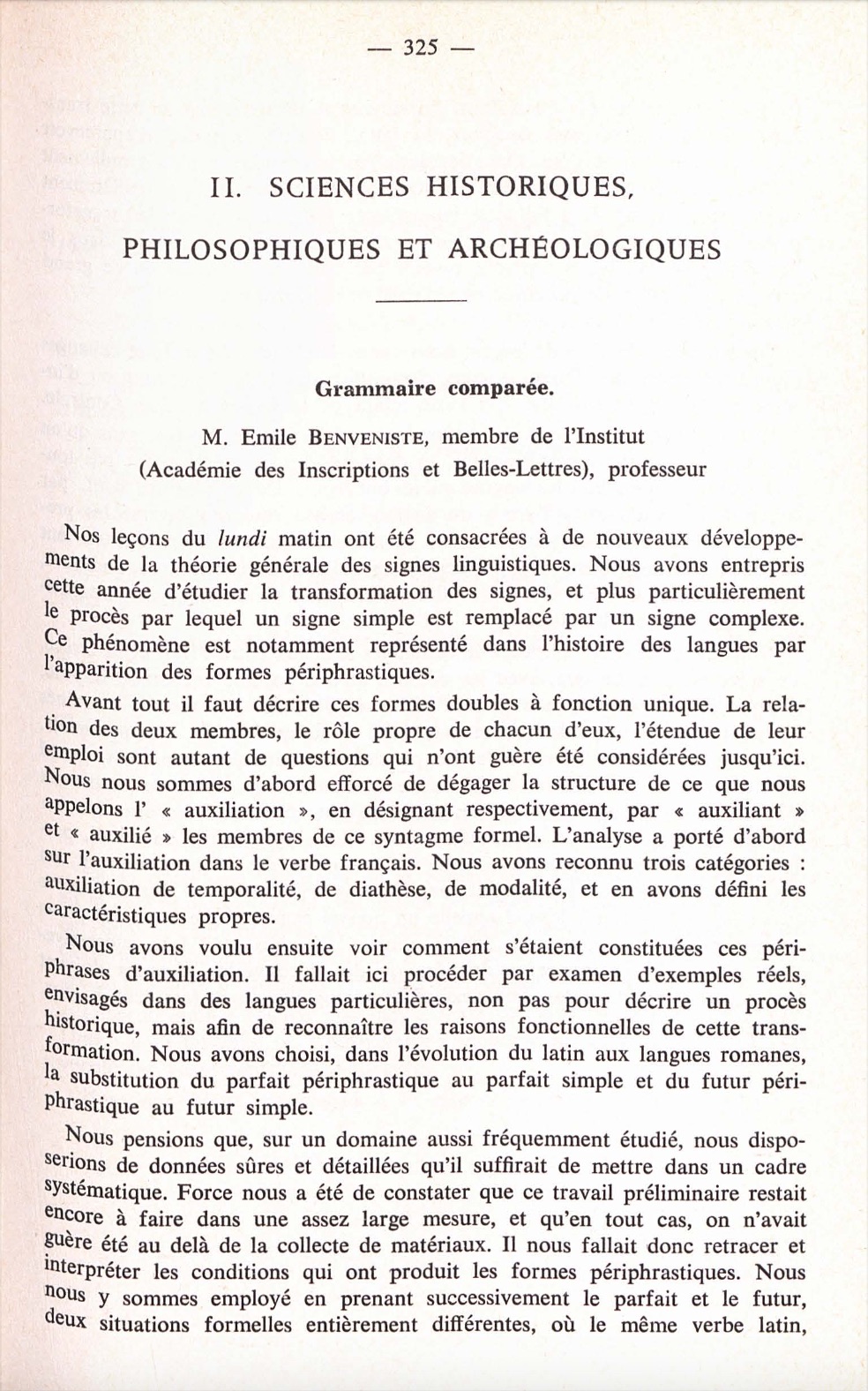
The correspondence is in the same box of Benveniste’s archives as what remains of his first 1965-66 Collège de France course, one of a series under the title of Problèmes de Linguistique générale. These courses are interesting, as they are part of a broad reformulation of Saussure’s project. Because of Benveniste’s illness it is not clear how he would have concluded this study, and the course manuscripts and the summaries in the Collège de France Annuaire give only a partial sense. Lectures from the penultimate year of teaching, and the single lecture of the year he had the stroke, have been edited – on the basis of his notes and those of some of his students – in the Last Lectures volume. Irène Fenoglio has talked about the process of editing material into lectures – particularly challenging when there are no known recordings.
Often Benveniste would work up themes from his teaching into publications, but with the course this year it was the other way round. His course did not begin until 6 December 1965, by which time this article on auxiliarity was already in production. The course summary suggests that his course was a development of the themes of the article. In particular, he seems to have gone beyond French, looking at the transition from Latin to Romance languages, and the relation between periphrastic and simple forms of the perfect and future tenses. Tzvetan Todorov attended some of this course, and his notes are in his archive. Benveniste would develop some of these questions in his April 1966 conference presentation in Austin, Texas, “Mutations [Transformations] of Linguistic Categories”, shortly after the completion of the Paris course. In that lecture he draws on further language examples, including Tunica, Aztec, and Old Turkish. While it is part of Benveniste’s final unfinished project, with the course summary, the article, its résumé and the fragmentary notes, and the Austin lecture, there is quite a lot of information on this specific aspect.
[updated above to note Benveniste had published in the first issue of the journal, when it was still simply called Acta Linguistica. Also added a reference to a discussion of the Benveniste-Hjelmslev correspondence.]
References
Viggo Bank Jensen & Giuseppe D’Ottavi eds. From the Early Years of Phonology: The Roman Jakobson-Eli Fischer Jørgensen correspondence 1949-1982, Copenhagen: The Royal Danish Academy of Sciences and Letters, 2020.
Émile Benveniste, “Nature du signe linguistique”, Acta linguistica 1, 1939, 23-29; reprinted in Problèmes de linguistique générale 1, Paris: Gallimard, 1966, Ch. 4; “The Nature of the Linguistic Sign”, Problems of General Linguistics, trans. Mary Elizabeth Meek, Coral Gables: University of Miami Press, 1971, Ch. 4.
Émile Benveniste, “Structure des relations d’auxiliarité”, Acta Linguistica Hafniensia 9 (1), 1965, 1-15.
Émile Benveniste, Problèmes de linguistic générale 1, Paris: Gallimard, 1966; Problems in General Linguistics, trans. Mary Elizabeth Meek, Coral Gables: University of Miami Press, 1971.
Émile Benveniste, “Grammaire comparée”, Annuaire du Collège de France 66, 1966, 325-26.
Émile Benveniste, “Mutations of Linguistic Categories”, trans. Yakov Malkiel and Marilyn May Vihman, in W.P. Lehman and Yakov Malkiel (eds.), Directions for Historical Linguistics: A Symposium in Historical Linguistics, April 29-30 1966, Austin: University of Texas Press, 1968, 85-94; original French as “Les Transformations des catégories linguistiques” in Problèmes de linguistic générale 2, Paris: Gallimard, 1974, 126-36.
Émile Benveniste, Problèmes de linguistic générale 2, Paris: Gallimard, 1974.
Émile Benveniste, Dernières Leçons: Collège de France 1968 et 1969, ed. Jean-Claude Coquet et Irène Fenoglio, Paris: EHESS/Gallimard/Seuil, 2012; Last Lectures: Collège de France 1968 and 1969, trans. John E. Joseph, Edinburgh: Edinburgh University Press, 2019.
Eli Fischer Jørgensen et. al. “Editorial”, Acta Linguistica Hafniensia, 9 (1), 1965, 1-2.
Eli Fischer-Jørgensen, Trends in Phonological Theory: A Historical Introduction, Copenhagen: Akademisk Forlag, 1975.
Irène Fenoglio, “Éditer un cours de linguistique générale à partir d’archives manuscrites. Essai de méthodologie critique”, Langages 209, 2018, 77-96.
Kenji Tatsukawa, “Sous le signe de Saussure : La correspondance L. Hjelmslev – E. Benveniste (1941-1949)”, Linx 9, 1997, 129-41.
Archives
Papiers d’orientalistes box 59, Emile Benveniste, Bibliothèque nationale de France
Fonds Tzvetan Todorov box 19, Bibliothèque nationale de France
This is the 30th post of a weekly series, where I post short essays with some indications of further reading and sources, but which are not as formal as something I’d try to publish more conventionally. They are usually tangential to my main writing focus, a home for spare ideas, asides, dead-ends and possible futures. I hope there is some interest in them. They are provisional and suggestions are welcome.
The full list of ‘Sunday histories’ is here.
Discover more from Progressive Geographies
Subscribe to get the latest posts sent to your email.


Pingback: Indo-European Thought in Twentieth-Century France update 29: working on Benveniste’s Vocabulaire, Dumézil’s Bilan and other work | Progressive Geographies