
Now it is almost automatic: a new book by Foucault in French is translated within a couple of years. The Collège de France courses, the Vrin series of critical editions of lecture courses and now other material, the fourth volume of the History of Sexuality, the pre-Collège de France courses and works – all have followed this pattern. All of these are, of course, posthumous. In the second half of his career, the pattern was similar –Discipline and Punish and the three volumes of the History of Sexuality were all translated quite quickly. Even the studies of Herculine Barbin and Pierre Rivière were translated in Foucault’s lifetime (1980 and 1982). His 1982 collaborative book with Arlette Farge is a key exception, since the English Disorderly Families only appeared in 2016.
The beginning of his career was quite different. Folie et déraison: Histoire de la folie à l’âge classique was published in 1961, but a complete English translation as History of Madness did not appear until 2005. The abridged version from 1964 was translated in 1965 as Madness and Civilization – the quickest of Foucault’s early works. (On the different editions, see here.) Naissance de la Clinique was published in 1963 and in a second edition in 1972. The 1973 English translation The Birth of the Clinic is an erratic mix of material from both editions, with a new translation of the 1972 text forthcoming, with an apparatus comparing it to the first edition. Raymond Roussel was published in 1963, but in English as Death and the Labyrinth only in 1986, a couple of years after Foucault’s death. Les Mots et les choses took four years before it was translated as The Order of Things (1966 to 1970); L’Archéologie du savoir was translated three years later as The Archaeology of Knowledge (1969 to 1972). Most of these early books appeared with Pantheon in the USA and Tavistock in the UK, and are now published by Penguin Random House and Routledge.
Archives in New York give a little insight into the discussions of the translations of Foucault’s first few works. The main one I’m drawing on here is the Georges Borchardt literary agency, held at Columbia University. Here are some of the things that this archive reveals, also adding information from a few other sources I know about.
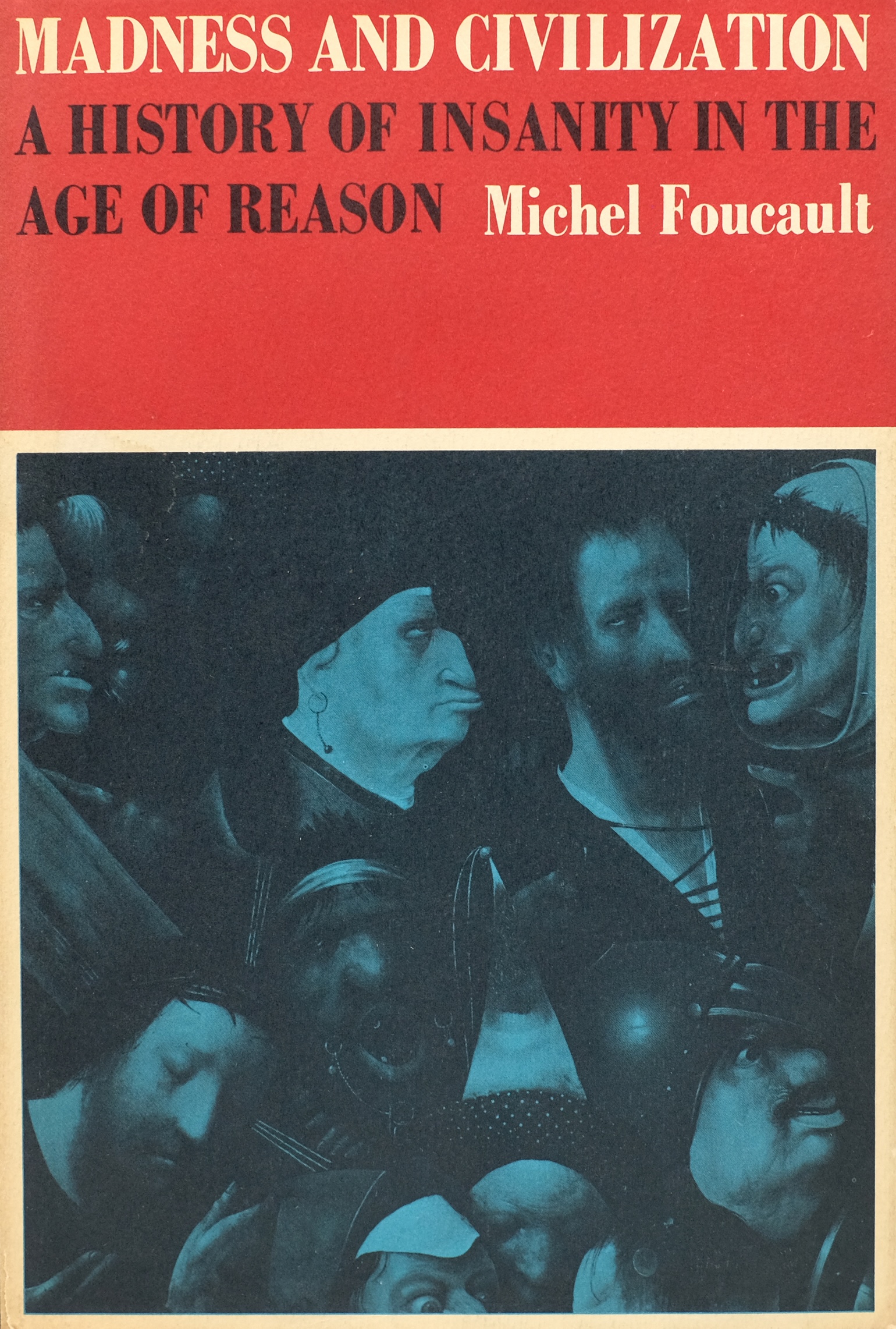
Foucault’s first major book was his principal doctoral thesis Folie et déraison: Histoire de la folie à l’âge classique. The literary agency did try to get Folie et déraison translated, but this was a challenge for a 700-page book by a relatively unknown author. The front-page review of Folie et déraison in The Times Literary Supplement in October 1961 would have helped raise his profile. That review is anonymous, though I’ve seen it credited to Richard Howard. I did ask him about this, but he said it was not by him. Howard went on to translate the abridged version of Histoire de la folie as Madness and Civilization, but he was also a reader of the longer text when it was being considered for translation by George Braziller Inc. in February 1962. His view was that it was more suited for a University Press. Macmillan, The Free Press of Glencoe, McGraw-Hill, Alfred A. Knopf, Inc., and Basic Books also considered the full original book, but all declined. In November 1961 Gerald Gross turned down Histoire de la folie as “a bit special for Pantheon”.
Pantheon were much more enthusiastic about doing a translation of the abridged French version. Foucault made the abridgement himself, and the changes are quite interesting (see The Early Foucault, pp. 185-88.) Pantheon asked if Foucault wanted to make any changes to the text for the translation, and the only one passed on was a correction of a mention of an English king, which I’ve written about here. The English Madness and Civilization does include a chapter not in the abridged French edition, “Passion and Delirium”, but I’ve not seen when or by whom that decision was made. Pantheon editor André Schiffrin has a slightly different story where he says Histoire de la folie was something he was keen to translate after finding it in a Paris bookstore (The Business of Books, p. 48). In the longer account in his memoir A Political Education, he adds that he would meet with Foucault in Paris once a year to discuss his forthcoming works, which Pantheon would translate. He also says that once Foucault was being invited to speak in the United States they would meet in New York too, and it was there that he introduced Foucault to Susan Sontag (pp. 201-2). (Edmund White recalls though that Foucault didn’t like socialising with Sontag.) Schiffrin also admits it was his fault Histoire de la folie was “needlessly retitled Madness and Civilization”. This book appeared with Tavistock Publications in the UK and British Commonwealth a few years later through the interest of R.D. Laing. (His very brief reader report is in the frontmatter of the Routledge translation of History of Madness.) In her memories of working for ‘Tavipubs’, Diana Burfield recalls introducing Schiffrin to Laing “in a NW1 bistro” (p. 220 n. 13). She says that Tavistock did a lot of co-publications with US presses, making books viable through distribution deals (p. 209), but that some were slow to sell:
Editors were increasingly compelled to justify to semi-literate executives their choice of titles that did not return an immediate profit. For example, since only 300 copies of one of Foucault’s works were sold in its first year, it was suggested that the remaining sheets should be pulped. Much time was wasted explaining that difficult, innovative books do not make an immediate impact and that the 300 copies were bought by influential heads of department who would generate a steady readership. Forty years later this book and others by the same author are still in print (p. 220 n. 21).
After Madness and Civilization in 1965, I think the next translation of Foucault was in 1966, when the second chapter of Les Mots et les choses was excerpted to appear in the journal Diogène and was published in English as “The Prose of the World” in the parallel-journal Diogenes, translated by Victor Velan. Diogène/Diogenes was edited by Roger Caillois and supported by UNESCO’s International Council for Philosophy and Human Sciences. Caillois had invited Foucault to contribute personally. Reports differ as to whether Caillois read the book for Gallimard, or was introduced to Foucault’s work by Dumézil. Both may well be true. Caillois certainly did editorial work for Gallimard, and Dumézil called him “the most brilliant of my students”. A 1965 letter from Foucault to Caillois agreeing to an excerpt, and recognising their “shared Dumézilian ancestry”, was published in 1981 (for more details, see my The Archaeology of Foucault, pp. 70-71). A different translation of this chapter was used when the English version of the book itself was published.

I’ve written before about the peculiarity of not naming the translator of The Order of Things. Like most people, I think, I’d been content to follow Alan Sheridan’s claim – in his book on Foucault and on his website – that he was the translator. But then I found a letter in the Zone books archives, also at Columbia University, in which Derek Coltman claims that he translated it. I discuss that, and the different bits of evidence more fully in that earlier post. In the Borchardt archives there is a June 1966 letter reporting that Sontag was encouraging US presses to consider Les Mots et les choses, which helps support Coltman’s claim that she and Howard persuaded him to translate it. (It also indicates that Sontag knew Foucault’s work before Schiffrin introduced them to each other.) Although Tavistock and Pantheon published this translation, whoever translated it, other presses were interested. The Archaeology of Knowledge was also translated by Pantheon, who had an option after doing The Order of Things, though they wanted to see how that book had done first, which might explain part of the time lag between editions. Another factor is that all these books seem to have been discussed for translation after the appearance of the French edition, rather than the rights being discussed when the book was in production. That in itself helps explain some of the time gaps between French and English.

The early book which I’ve not been able to find out about from the Borchardt archive is Naissance de la clinique, which is a shame given my involvement in the new edition. I suspect this is because it was published by Presses Universitaires de France (PUF), rather than Plon (Folie et déraison) or Gallimard (almost all the others). I don’t know if PUF used a different agency to negotiate foreign rights, but it seems likely. I’ve found no evidence his shorter 1954 book Maladie mentale et personnalité, also with PUF, was discussed at the time. It was a book Foucault tried to disown, but unable to prevent its republication he agreed to revise it in 1962 as Maladie mentale et psychologie. The changes are discussed in detail in The Early Foucault (pp. 174-84) and outlined in full here. That revision was translated after Foucault’s death as Mental Illness and Psychology (now republished as the confusingly titled Madness: The Invention of an Idea). University of California Press had wanted to translate the 1954 version, but were prevented by PUF. As I discuss in The Early Foucault, p. 184, their officious view on this, claiming to be defending the “thought and memory” of Foucault, is at odds with their own republication of a book Foucault wanted to bury.
Two other little curiosities from the Borchardt archive. One is that a translation of Raymond Roussel was discussed in 1975, with Donald J. McDonell as a translator. (McDonell wrote a piece on Foucault in 1976, published in the Canadian Journal of Philosophy in 1977, at a time when articles on Foucault were still uncommon.) A copy of Foucault’s letter to McDonell supporting him as its translator is in the Borchardt archive. I don’t know what prevented this, since the book wasn’t actually translated until the mid-1980s, by Charles Ruas. Ruas interviewed Foucault about that book in 1983, which is included in the English translation, and I’ve discussed the differences between the French and English versions of the interview before. Ruas himself replied to that post clarifying why they are different. What this means is that there isn’t an English translation of the Dits et écrits text; nor a French version of the English.
Another curiosity is that James Harkness translated Foucault’s little 1973 book on René Magritte, Ceci n’est pas une pipe, before the English rights were sold. He approached Borchardt in August 1978 to try to negotiate the rights and then to find a publisher. The book did appear with University of California Press as This is Not a Pipe, translated by Harkness, but not until 1983. This is another piece with two French versions, an earlier article and then the expanded book. Again, Essential Works mangles the text. In this case it uses the translation of the book as the basis, revising it to approximate the French article, but missing importance differences and therefore providing a misleading English version which relates to neither French text. Howard had previously translated the article for October. There is more about Foucault’s revised texts, with some comparisons, here.
The Borchardt archive also has some letters concerning requests to publish excerpts of Foucault’s work in different places. When these are parts of books, Borchardt are able to negotiate that; when separate articles they indicate that they are not responsible. I’m sure much more could be done with the question of Foucault’s early translations, but this archive seems to me to reveal quite a lot. The Pantheon archives are also at Columbia, but the ones listed are from 1944 until 1968, while the Tavistock archives are in the Wellcome Collection, largely uncatalogued. Neither appear to have any records relating to Foucault.
Archives
MS#0135, Georges Borchardt Inc. records, 1949-2024, box 234, Foucault, Michel, Rare Books and Manuscript Library, Columbia University, https://findingaids.library.columbia.edu/archives/cul-4078396
Pantheon Books records, 1944-1968, Rare Books and Manuscript Library, Columbia University, https://findingaids.library.columbia.edu/archives/cul-4079194
SA/TIH, Tavistock Institute of Human Relations, Wellcome Collection, https://wellcomecollection.org/works/faa7y7bd
Zone Books records, Rare Books and Manuscript Library, Columbia University, https://findingaids.library.columbia.edu/archives/cul-10080831
References
(I’ve not referenced all the French editions and English translations of Foucault’s books mentioned, for reasons of space.)
“The Story of Unreason”, The Times Literary Supplement, 6 October 1961, 663-64.
Diana Burfield, “Tavistock Publications: A Partial History”, Management & Organizational History 4 (2), 2009, 207-22.
Stuart Elden, The Early Foucault, Cambridge: Polity, 2021.
Stuart Elden, The Archaeology of Foucault, Cambridge: Polity, 2023.
André Schiffrin, The Business of Books: How International Conglomerates Took Over Publishing and Changed the Way We Read, London: Verso, 2000.
André Schiffrin, A Political Education: Coming of Age in Paris and New York, Hoboken, NJ: Melville House, 2007.
Edmund White, “Love Stories”, London Review of Books, 4 November 1993, https://www.lrb.co.uk/the-paper/v15/n21/edmund-white/love-stories
Acknowledgements
Many thanks to Patrick ffrench for leading me to the Schiffrin and Burfield recollections, and to Clare O’Farrell, Maya Gavin and Colm McAuliffe for discussions of related questions.
This is the 34th post of a weekly series, where I post short essays with some indications of further reading and sources, but which are not as formal as something I’d try to publish more conventionally. They are usually tangential to my main writing focus, a home for spare ideas, asides, dead-ends and possible futures. I hope there is some interest in them. They are provisional and suggestions are welcome. A few shorter pieces in a similar style have been posted mid-week.
The full list of ‘Sunday histories’ is here.
Discover more from Progressive Geographies
Subscribe to get the latest posts sent to your email.


Pingback: How Literary Agents Made Italian Publishing Transnational: An Interview with Anna Ferrando | Progressive Geographies
Pingback: Indo-European Thought in Twentieth-Century France update 29: working on Benveniste’s Vocabulaire, Dumézil’s Bilan and other work | Progressive Geographies
For Stuartelden’s information. About Foucault’s book histoire de la folie, a Chinese translation from French (more than 700 pages) was made by Prof. Lin Chi-Ming in Taiwan, and published in 1998 by China Times Publishing Company in Taipei, Taiwan. ISBN 957-13-2619-4. The translation is OK and readable, and I had tried to use it in my graduate courses.
best, Daiwie, dwfu@mx.nthu.edu.tw
Thank you. The story of Foucault’s translation into other languages would be an interesting project – much larger, and would need to be collaborative across multiple languages. My book Foucault’s Last Decade was translated into Chinese last year, and I understand there are plans to translate others in that series.
Pingback: Indo-European Thought in Twentieth-Century France update 30 – archive work in Paris, Bern and Cambridge, MA, and Benveniste’s library | Progressive Geographies