
In Stephen Rudy’s chronology of Roman Jakobson’s career, the entry for 1972 reads, in part:
Visiting Professor, Collège de France, Dec. […]
Professeur d’état, Collège de France. Four lectures, Feb. 3-8.
How many lectures did he give across the visits, and what were they on?
The Annuaire du Collège de France for 1972 reports that Jakobson gave four lectures in February 1972.
Questions perpétuelles et actuelles dans l’étude du langage et de la poésie; le 3 février 1972: Les caractères primordiaux du langage: invariance et variations; le 4 février: Synchronie dynamique; le 7 février – Les fondaments phonologiques du français; le 8 février – La structure du poème (p. 718).
Constant and current questions in the study of language and poetry: 3 February 1972 – The primordial characteristics of language: invariance and variation; 4 February – Dynamic synchrony; 7 February – The phonological foundations of French; 8 February – The structure of the poem.

Those dates are Thursday, Friday, Monday, Tuesday. In 1973 the Annuaire reports the following lectures:
… les 7 et 9 décembre 1972 sur La place de la sémantique dans la science du langage; les 14 et 16 décembre 1972 sur Les problèmes linguistiques de la poésie (analyse d’un poème – réponse aux critiques) (p. 634).
7 and 9 December 1972 on The Place of the semantic in the science of language; 14 and 16 December on Linguistic problems of poetry (analysis of a poem; response to critics).
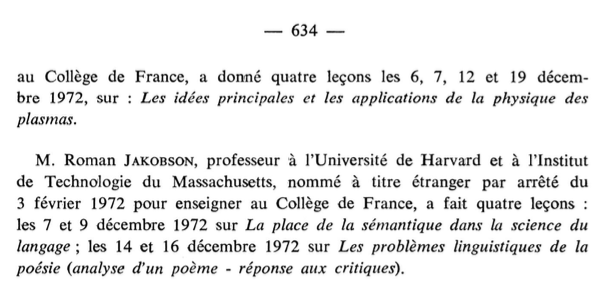
Those dates are Thursday and Saturday in two consecutive weeks. There is nothing on the Collège de France website about either visiting post, but their photographic archives have three images taken in February 1972. One image is of Jakobson alone; another shows Jakobson with Claude Lévi-Strauss and an unknown woman (it is on X/Twitter; and a variant is on Radio France, Libération or the Getty images site). Jakobson’s friendship with Lévi-Strauss is well-known, and there is an extensive published correspondence between them. The other photograph shows Jakobson lecturing, with Lévi-Strauss, Georges Dumézil and the administrator of the Collège, Étienne Wolff, in the front row of the audience. It is included in Emmanuelle Loyer’s biography of Lévi-Strauss. Benveniste was another friend of Jakobson, who would otherwise have been expected to be there, but he had suffered a stroke in December 1969 and was in long-term care in 1972, the year he officially retired. Foucault was elected by this time, but I know of no record that he attended Jakobson’s lectures.

The most valuable source for details of Jakobson’s two visits to the Collège is the Lévi-Strauss correspondence. The letters have been published as a book edited by Loyer and Patrice Maniglier, with some supplements in an article by Pierre-Yves Testenoire. There are other letters from Lévi-Strauss to Wolff in the Laboratoire d’anthropologie sociale archives. A December 1971 letter from Lévi-Strauss to Wolff suggests the initial plan was for a visit by Jakobson in January 1972, with three lectures. A letter from 30 May 1972 discusses the availability of Jakobson for the return later in the year. Some letters relating to the visits are in Jakobson’s archives at MIT. These include Wolff’s formal invitation to Jakobson of 2 December 1971, Jakobson’s acceptance of 10 December, and the originals of several letters included in the Jakobson-Lévi-Strauss correspondence, as well as some between Jakobson and Wolff arranging the later lectures. (One thing I hadn’t realised until looking at these letters is that Jakobson wrote to Lévi-Strauss in English, even though it seems he had good enough French to deliver at least some of his lectures in that language. The published correspondence is all in French, so Jakobson’s letters are translated for the collection.)
Jakobson’s second visit was made possible by funds released by Benveniste’s retirement in May 1972. Lévi-Strauss says he had discussed the idea of Jakobson being appointed on a permanent basis with Wolff, but was told this was not possible, as the Collège had a compulsory retirement age of 70, and Jakobson was born in 1896 (Lévi-Strauss to Jakobson, 20 April 1972). Correspondence from Lévi-Strauss to Wolff from 17 February and 21 March 1972 shows he was also proposing Nicolas Ruwet for an associate post. The associate rather than permanent post was because Ruwet was Belgian and at the time only French citizens could take up chairs. Ruwet was author of a 1967 book on generative grammar and, among other things, one of Jakobson’s French translators. Jakobson wrote briefly but strongly in support (Jakobson to Wolff, 10 January 1973). However, on 30 May Lévi-Strauss writes to say that Ruwet’s post at Paris-Vincennes could not be held open if the associate post was only of short duration, and so therefore the application was withdrawn. Jean Filliozat was proposing the Indologist Ludwik Sternbach for a visiting post at the same time. In the end, the chair in General Grammar held by Benveniste, and Michel Bréal and Antoine Meillet before him, was discontinued. It became a chair in Langues et civilisation de l’Asie mineure, to which the Hittite scholar Emmanuel Laroche was elected in 1973. (Laroche’s course summaries are here.)
There is more correspondence between Lévi-Strauss and Jakobson about the second visit, with the suggestion that Jakobson visit at the end of the calendar year, completing his lectures before the Collège broke up for Christmas on 21 December. The correspondence also specifies that Jakobson gave four lectures, as two pairs – the titles are the same as the Annuaire. Instead of the consecutive lectures of February, for this second visit Jakobson requested one day between them, and of the second pair of lectures said the first would be on sonnet CXIII of Joachim du Bellay’s L’olive, and the second a response to the criticisms of the linguistic analysis of Baudelaire’s “Chats” and “Spleen” (Correspondence, pp. 309-11). Jakobson had written the analysis of “Les Chats” with Lévi-Strauss in 1962. “Spleen” was a part of Les Fleurs du Mal, and Jakobson had written on the last of its four poems in Tel Quel in 1967. Jakobson first delivered his analysis of du Bellay in Rome in 1971, and it seems that the Paris lecture drew on a publication already in production for the conference proceedings, Premarinismo e Pregongorismo.
These different sources therefore confirm that the dates in Rudy’s biographical notes are correct, but his entries are out of sequence. There are a few other sources of information of which I’m aware. Antoine Compagne, in his own inaugural lecture to the Collège de France in 2006, remembers attending a Jakobson lecture there “around 1970” on “a Du Belay sonnet”, saying Jakobson was “a small man who looked like a frail bird”.
After his return to the United States, Jakobson wrote to Wolff to thank him for the invitation. He also notes that he had visited Benveniste and that while one side of the conversation was only gestural, he “understood and responded to everything” (Jakobson to Wolff, 10 January 1973). Jakobson says that Benveniste strongly indicated that general linguistics rather than Indo-Iranian studies was the academic area he remained most attached to, and hoped the Collège would continue to support this area. As indicated above, this wish was unfulfilled.
Box 36, folder 25 of the Jakobson archive has a text for which the catalogue entry reads “Les caractères primordiaux du langage: Invariance et variations – draft of the first lecture at Collège de France, 1972” – the title is indeed the first of the February lectures. The scan I have is of a poor-quality photocopy of a series of index cards, a few to each page, which appears to be all that remains of the lectures. They are in a mixture of French and English, and it seems possible the lectures themselves were given in English. They are not very legible in places, but the index cards are numbered, and it looks that there are two sequences, suggesting perhaps parts of two lectures.
Folder 30 of the same box has “La place de la sémantique / Les problems [sic] linguistiques / Lectures at Collège de France, 1972 December” – the topics of the two pairs of December lectures: “La place de la sémantique” and “Les problèmes linguistiques”. This folder contains the index cards themselves, rather than just a photocopy. Again the material is in a mix of English and French, though predominantly English. Again, there are two main number sequences here, though not all cards have numbers. They seem to relate to the first pair of lectures, on “La place de la sémantique dans la science du langage”, not the lectures on poetry.
I’m unaware of any recordings of these lectures, though it is certainly possible some were made. Foucault’s Collège de France lectures, for example, were being recorded from January 1973. Those recordings of The Punitive Society course no longer seem to exist, but a transcription was made of them at the time, and this is the basis of the published text. There are no known recordings of Foucault’s first two courses at the Collège, but some of his 1970 Buffalo lectures were recorded, and a complete recording of his 1972 lecture course there survives (on the Buffalo records, see here).

A further mention of Jakobson’s Paris lectures came in an unexpected place – Jacques Lacan’s seminar XX, Encore: On Female Sexuality. One of the sessions is entitled “To Jakobson”. This is the session where he comes up with the term “linguisterie” in contrast to linguistique, linguistics. Bruce Fink glosses the neologism as “a kind of specious or fake linguistics” and renders it as “linguistricks” (p. 15 n. 3). Lacan says that he wants to distinguish what he is doing from Jakobson’s domaine réservé of linguistics (French p. 24; English p. 15). This seminar was delivered in the 1972-73 year, and the “To Jakobson” session is dated to 19 December 1972, a Tuesday. Lacan says that:
It seems to me that it is difficult not to speak stupidly about language. That is nevertheless what you, Jakobson, manage to do.
Once again, in the talks that Jakobson gave the past few days at the Collège de France, I had the chance to admire him enough to pay homage to him now (p. 23/14).
Lacan’s mention of one of the lectures being “yesterday” (p. 28/18) seems to be an error, unless the final Saturday lecture was delayed.
Lacan and Jakobson had known each other for some time. Lacan mentions a discussion with him in Formations of the Unconscious in the session of 13 November 1957 (p. 5). Jakobson attended at least one of Lacan’s seminars – Lacan mentions his presence in the opening session of seminar VII, The Ethics of Psychoanalysis, on 18 November 1959 (p. 14). There is a photo of the two of them together in Milan in March 1967.
There are also several references to Jakobson’s work in Lacan’s seminars. Lacan’s work is fundamentally orientated around the idea that the unconscious is structured like a language, and Jakobson was one of the key figures behind the structural analysis of language. Jakobson’s introduction to Lévi-Strauss by Alexandre Koyré, during the Second World War in New York City, is a significant moment in the development of these ideas beyond linguistics. François Dosse has written briefly about the importance of Lacan meeting Jakobson, through Lévi-Strauss. Given the importance of language to Lacan, I was surprised not to be able to find much literature on Lacan and Jakobson beyond this. Russell Grigg and Shirley Sharon-Zisser both have chapters on them. Jeffrey Librett discusses them together in a reading of Freud’s Totem and Taboo.
None of these discussions of Lacan and Jakobson mention Jakobson’s 1972 Paris lectures, which seem not to have published in this form. Other lectures first given in French, such as the war-time lectures at the École Libre des Hautes Études, were first published as Six Leçons sur le son et le sens in 1976 in Kostas Axelos’s Arguments series with Éditions de Minuit, with a brief preface by Lévi-Strauss. They are translated as Six Lectures on Sound and Meaning. Pierre-Yves Testenoire’s recent study Les cours de Roman Jakobson à l’École Libre des Hautes Études: New York, 1942–1946 has the critical edition of four other lectures from those years. It would be interesting if the 1972 lectures discussed here had the same treatment, though the records I’ve seen so far are probably too limited and fragmented.
[Update October 2025: On a return visit to the MIT archives, I was looking at Jakobson’s series of annual reports in which he outlines his teaching, publications, visiting talks and travel. The 1971-72 and 1972-73 annual reports, in box 1, folders 42 and 43, give the same dates and titles for these two lecture series as the Annuaire du Collège de France, but no other details.]
References
Annuaire du Collège de France 1972 and 1973
Antoine Compagnon, “La littérature, pour quoi faire ?” leçon inaugurale Collège de France, 30 November 2006, https://books.openedition.org/cdf/524
François Dosse, “Le jour où… Jacques Lacan fit alliance avec Roman Jakobson”, Sciences Humaines 346, April 2022, 55, https://www.scienceshumaines.com/jacques-lacan-fit-alliance-avec-roman-jakobson_fr_44452.html
Russell Grigg, “Lacan and Jakobson: Metaphor and Metonymy”, Lacan, Language, and Philosophy, Albany: State University of New York Press, 2008, Ch. 11.
Roman Jakobson, Selected Writings, The Hague: Mouton & Co, nine volumes, 1962-
Roman Jakobson, “Si nostre vie: Observations sur la composition et structure de motz dans un sonnet de Joachim du Bellay”, Premarinismo e Pregongorismo: atti del Convegno internazionale, Roma 19-20 aprile 1971, Rome: Accademia nazionale dei Lincei, 1973, 165-95; reprinted in Selected Writings, Vol III, 239-74.
Roman Jakobson, “Une Microscopic du dernier ‘Spleen’ dans Les Fleurs du Mal”, reprinted in Selected Writings, Vol III, 465-81.
Roman Jakobson, Six Leçons sur le son et le sens, Paris: Minuit, 1976, reprinted in Selected Writings, Vol VIII, 321-90; Six Lectures on Sound and Meaning, trans. John Mepham, Cambridge, MA: MIT Press, 1978.
Roman Jakobson and Claude Lévi-Strauss, “‘Les Chats’ de Charles Baudelaire”, L’Homme 2 (1), 1962, 5-21; reprinted in Jakobson, Selected Writings, Vol III, 447-64; “Baudelaire’s ‘Les Chats’”, in Roman Jakobson, Language in Literature, eds. Krystyna Pomorska and Stephen Rudy, Cambridge, MA: The Belknap Press, 1987, 180-97.
Roman Jakobson and Claude Lévi-Strauss, Correspondance 1942-1982, eds. Emmanuelle Loyer and Patrice Maniglier, Paris: Seuil, 2018.
Jacques Lacan, Le Seminaire, Livre XX, Encore, Paris: Éditions du Seuil, 1975; On Feminine Sexuality: The Limits of Love and Knowledge, Seminar Book XX Encore 1972-1973, trans. Bruce Fink, New York: W.W. Norton & Company, 1998.
Jacques Lacan, The Ethics of Psychoanalysis, trans. D. Porter, London: Routledge, 1992.
Jacques Lacan, Formations of the Unconscious: The Seminar of Jacques Lacan Book V, trans. Russell Grigg, Cambridge: Polity, 2017.
Emmanuel Laroche, “Résumés annuels: Langues et civilisation de l’Asie mineure”, Collège de France, https://www.college-de-france.fr/fr/chaire/emmanuel-laroche-langues-et-civilisation-de-asie-mineure-chaire-statutaire/annual-summaries
Jeffrey S. Librett, “Language, Body, Drive: Rereading Totem and Taboo through Jakobson and Lacan”, differences 28 (2), 2017, 46–64.
Emmanuelle Loyer, Lévi-Strauss, Paris: Flammarion, 2015; Lévi-Strauss: A Biography, trans. Ninon Vinsonneau and Jonathan Magidoff, Cambridge: Polity, 2018.
Stephen Rudy, “Roman Jakobson: A Brief Chronology”, Roman Jakobson papers, https://archivesspace.mit.edu/repositories/2/resources/633
Nicolas Ruwet, Introduction à la grammaire générative, Paris: Plon, 1967, second edition 1970; Introduction to Generative Grammar, trans. Norval S.H. Smith, Amsterdam: North-Holland Publishing Company, 1973.
Shirley Sharon-Zisser, “The Poetic Function from Jakobson to Lacan: A Lacanian Theory of Poetics”, in Martin Procházka, Markéta Malá and Pavlína Saldová (eds.), The Prague School and Theories of Structure, Göttingen: V&R unipress, 2010, 281-92.
Pierre-Yves Testenoire, “Compléments à la correspondance Jakobson – Lévi-Strauss”, Acta Structuralica – International Journal for Structuralist Research 4, 2019, https://hal.archives-ouvertes.fr/hal-02455825
Pierre-Yves Testenoire, Les cours de Roman Jakobson à l’École Libre des Hautes Études: New York, 1942–1946, Berlin: De Gruyter, 2025.
Archives
Archives du Laboratoire d’anthropologie sociale (1960-1982), Bibliothèque Claude Lévi-Strauss
- Claude Lévi-Strauss, Correspondance avec le Collège de France 1960-1974
Collège de France archives
- 5 Fi 3, Reportage Photographique de 1972
- 4 AP 629, Assemblée de Professeurs, 5 Mars 1972 (correspondence Lévi-Strauss-Étienne Wolff, 17 February 1972, 21 March 1972, 30 May 1972)
- 14 CDF 46-a, Grammaire Comparée 1864-1973
Roman Jakobson papers, MC-0072, Department of Distinctive Collections, Massachusetts Institute of Technology, https://archivesspace.mit.edu/repositories/2/resources/633
- box 4, folder 31, France, 1966-1980
- box 4, folder 32, Collège de France correspondence
- box 36, folder 25, Les caractères primordiaux du langage: invariance et variations, draft of the first lecture at Collège de France, 1972
- box 36, folder 30, La place de la sémantique les problems linguistiques, lecture notes, Collège de France, 1972 December
This is the 35th post of a weekly series, where I post short essays with some indications of further reading and sources, but which are not as formal as something I’d try to publish more conventionally. They are usually tangential to my main writing focus, a home for spare ideas, asides, dead-ends and possible futures. I hope there is some interest in them. They are provisional and suggestions are welcome. A few shorter pieces in a similar style have been posted mid-week.
The full list of ‘Sunday histories’ is here.
Discover more from Progressive Geographies
Subscribe to get the latest posts sent to your email.


Pingback: Roman Jakobson’s paper to The First World Conference on Yiddish Studies, 1958: “The Languages of the Diaspora as a Particular Linguistic Problem” | Progressive Geographies
Pingback: Indo-European Thought in Twentieth-Century France update 30 – archive work in Paris, Bern and Cambridge, MA, and Benveniste’s library | Progressive Geographies
Pingback: Claude Lévi-Strauss and Roger Caillois – Race, Games and a Ceremonial Sword | Progressive Geographies
Pingback: Roland Barthes and the Question of Territory – Animals, Spaces and Sound | Progressive Geographies
Pingback: Trevor Pateman on Barthes as a teacher, and attending classes by Foucault, Derrida, Lévi-Strauss and Jakobson | Progressive Geographies