
Several journals played a significant role in introducing so-called ‘French Theory’ to the United States. They would include Yale French Studies, Diacritics, boundary 2 and Semiotext(e). Yale French Studies claims to be “the oldest English-language journal in the United States devoted to French and Francophone literature and culture”, and celebrated 75 years in 2023. Diacritics and boundary 2 were founded in 1971 and 1972, and continue publishing today. Semiotext(e) was founded by Sylvère Lotringer in 1974, and shifted more into book publishing over time. I’ve said before that someone looking into the history of theory in the US and its links to the arts more generally could do a lot worse than to make use of the massive Lotringer and Semiotext(e) archives at New York University. I’ve referenced a lot of pieces in MLN (Modern Language Notes) in my pieces on Josué Harari and Eugenio Donato, and the role of organisations such as the Modern Languages Association would be important too. There are other, perhaps less known, journals which play a role, such as SubStance, October and a bit later, Social Text (on these journals, see Cusset, French Theory, pp. 62-65). In the United Kingdom, Radical Philosophy, Economy and Society (both founded 1972), Ideology & Consciousness (1977-79), Theory, Culture & Society (1982) and Environment and Planning D: Society and Space (1983) would be important reference points. A fuller study would need to discuss the relation and tension between these and more political journals, especially Marxist ones, who often reacted critically to these voices.
Here I want to say a little about another interesting journal, much less discussed, which published what was closer to a series of edited books. This was Glyph: Johns Hopkins Literary Studies, which ran for eight issues between 1977 and 1980. Samuel Weber was a constant presence as editor, working with Henry Sussman and Walter Benn Michaels on some issues. The editorial board also comprised Alicia Borinsky, Rodolphe Gasché, Carol Jacobs, Richard Macksey, Louis Marin, Jeffrey Mehlman, Timothy C. Murray, Eduardo Saccone and Marilyn Wyatt. In a retrospective interview about his early career, Weber describes it as a “yearbook”, and though it was biannual, this captures something of its style (“Screen Memories”, p. 279). Inviting contributions they said:
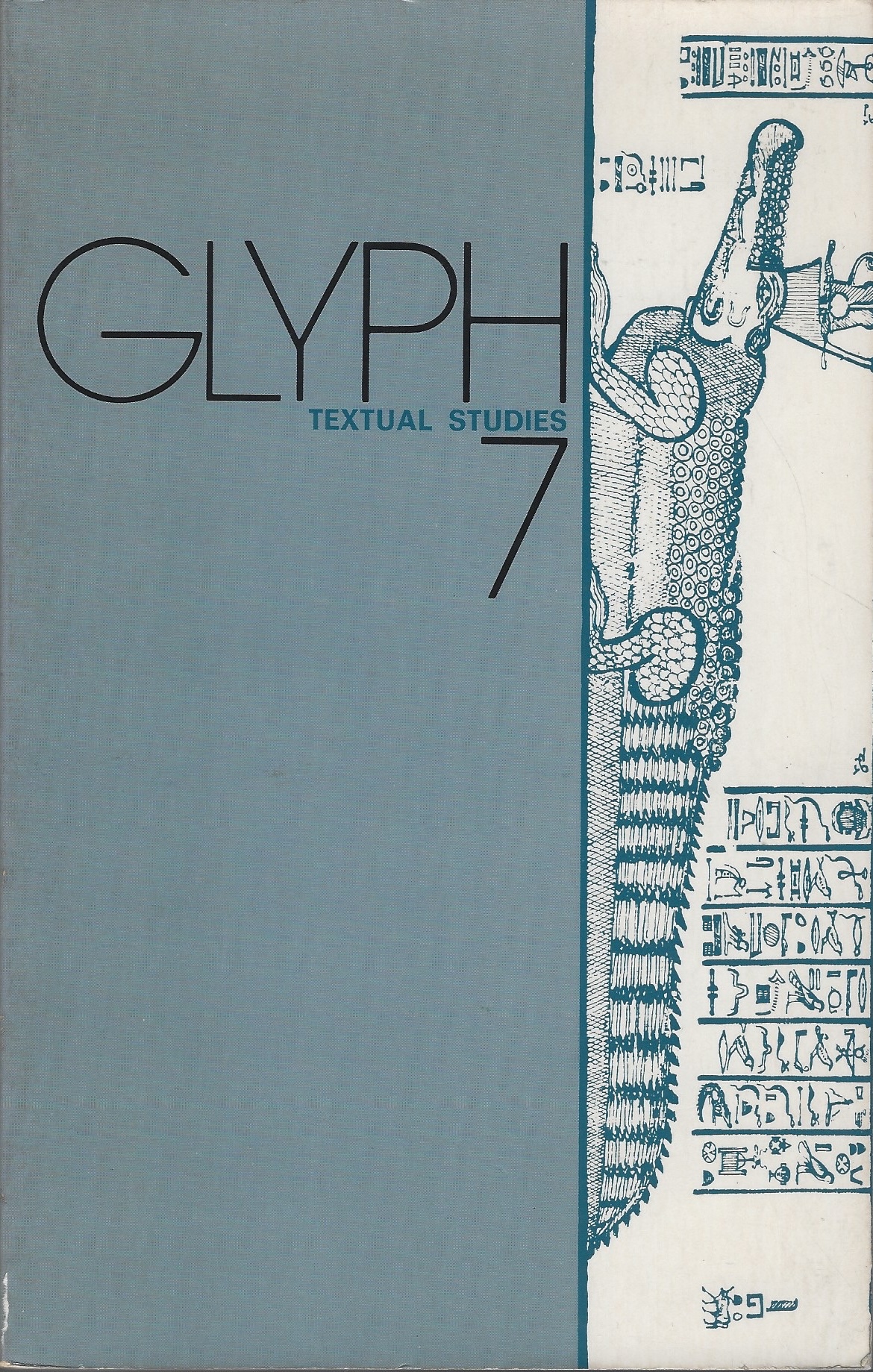
The Editors of Glyph welcome submissions concerned with the problems of representation and textuality, and contributing to the confrontation between American and Continental critical scenes (Glyph, inside cover).
The opening issue contained pieces by young scholars in the United States, and Europeans now teaching in the United States, Paul de Man, Louis Marin and Rodolphe Gasché. Marin taught at Johns Hopkins University from 1974-77; Gasché was a visiting professor there from 1975-78. de Man had taught at Hopkins earlier in his career (1967-70), and had been Weber’s doctoral advisor at Cornell. Weber wrote the first article, “The Divaricator: Remarks on Freud’s Witz”. The first issue was reviewed in Philosophy and Literature by Betty R. McGraw.
The first issue also included the first English translation of Jacques Derrida’s “Signature Event Context”, translated for the journal by Samuel Weber and Jeffrey Mehlman. (A different translation by Alan Bass later appeared in Margins of Philosophy.) This is a piece about J.L. Austin’s speech-act theory, and John Searle wrote a piece in reply: “Reiterating the Differences: A Reply to Derrida”. Derrida’s long response, “Limited Inc: a b c”, appeared in issue 2 of Glyph, translated by Weber. A special supplement to Glyph 2, an 81-page standalone volume, provided the French text. The editors of the supplement note that “‘Limited Inc’ was initially written in view of this discussion and in anticipation of its translation. But the interest of the debate demanded, in our opinion, that the text also be available in the French version” (inside cover). Derrida’s two pieces in English translation, a newly written Afterword, and a summary of Searle’s piece, were collected in the Limited Inc. book in 1988. Searle did not want his article republished alongside Derrida’s response (“Editor’s Foreword”, Limited Inc., p. vii). Derrida’s French text was reissued by Éditions Galilée in 1990. As far as I’m aware, the only place Searle’s comments are published is in Glyph (available on academia.edu). Weber’s essay, “It”, published in Glyph 4 picks up on this debate.
There are doubtless stories to be told of all the issues, but Glyph 7 published some of the papers from a colloquium on Genre at Strasbourg, including pieces by Jean-Luc Nancy, Friedrich Kittler, Gasché, and Derrida. Derrida’s piece appeared in both French and English in the issue – “La Loi du Genre/The Law of Genre”. (For reasons that are not clear to me, the same English translation also appeared in Critical Inquiryat the same time.) In the Foreword to Glyph 7, Weber says that “the full dossier of the Strasbourg proceedings, including the seminars and discussions as well as all written contributions, can be obtained for sending a check…” (p. vii). The proceedings volume Le genre / Die Gattung / Genre is harder to find today, but there is a copy at the Bodleian library in Oxford. It’s 575 typewritten pages – a thorough record of the event and its discussions.
In issue number 8 of Glyph, Weber announced that the “first phase of the publication comes to an end” (“After Eight: Remarking Glyph”, p. 232). He adds that following a “quite unusual initial popularity (the first two volumes sold about 3500 and 3000 copies respectively)” the interest reduced, with “a sharp drop in circulation (to about 2000 for Glyph 3 at present)” (“After Eight: Remarking Glyph”, p. 232). He asked two sympathetic colleagues for their view as to why this was. One said that the translation of Derrida’s Of Grammatology in 1976 meant that readers could now “get their deconstruction directly from the horse’s mouth”, and there was less need for projects such as Glyph. The other said that “the publication in English of Of Grammatology created a vogue of interest that carried Glyph along with it for a while, until the novelty began to wear off”. Weber notes that it was surprising to him “the extent to which Glyph had become identified with the work of a single writer, Derrida, or more precisely, not with that work as such, but with one aspect of it, with something called ‘deconstruction’” (“After Eight: Remarking Glyph”, pp. 232-33). This is perhaps particularly striking for Weber, whose own essays in the journal were more often concerned with psychoanalysis and Freud than deconstruction and Derrida. His earliest publication, I think, was a co-translation with Shierry Weber of a collection of Adorno’s essays, Prisms, with a short introduction; his first book in 1978 was Rückkehr zu Freud: Jacques Lacans Ent-stellung der Psychanalyse, later translated as Return to Freud: Jacques Lacan’s Dislocation of Psychoanalysis. Simon Morgan Wortham’s account of his career in Samuel Weber: Acts of Reading, discusses some aspects of the Glyph story, but I’m unaware of a more focused history.
In his piece in Glyph 8 Weber also discusses some of the ways in which deconstruction can be understood, of the need to turn its scrutiny back upon itself, and ends with a closing of this phase of the journal and an opening to future work:
For Glyph, such a transformation can only mean a rethinking and reworking of the institutional context within which this and similar publications operate, with a renewed reemphasis upon the necessity of an inter- or transdisciplinary approach, conceived not as the conjunction or overlapping of existing, established and self-contained disciplines, no even less as their synthetic overcoming in a higher science of textuality, but rather as an attempt to redefine the manner in which such disciplines have determined their boundaries. Such a process will have to comprise both an ‘historical’ and a ‘structural’ component, both of which, however construed as elements of an ongoing process of which the notions of ‘inscription’ and ‘iterability’ have only begun to give us an inkling. That such a task is as imperative today as it will be difficult is one of the less and ambiguous and more urgent lessons of our very brief history (“After Eight: Remarking Glyph”, p. 237).
After a few years’ absence, in 1986 Glyph was relaunched as Glyph Textual Studies, now with University of Minnesota Press, with the first volume having the title Demarcating the Disciplines: Philosophy, Literature, Art. It is, again, somewhere between an edited book and a journal issue. Weber wrote the Introduction and a long essay entitled “Caught in the Act of Reading”. The unsigned preface announces:
With publication of this volume, Glyph begins a new stage in its existence. A change in publisher – from Johns Hopkins University Press to the University of Minnesota Press – is accompanied by a change in focus. In the future Glyph will be an annual publication organized around specific issues, of which Demarcating the Disciplines is an initial instance. This shift reflects transformations that have affected the intellectual context in which we are situated. When we first began publishing some eight years ago, our primary concern was with providing a forum in which established notions of representation could be problematized and explored, with particular reference to the specific situation of North American ‘critical theory’. Since this time, the greater currency of such concerns has brough with it new problems and priorities which, we are convinced, can best be articulated by a publication that focuses upon particular questions emerging out of the contemporary critical landscape (p. vii).
The description picks up on the continuity and difference:
In its first incarnation Glyph provided a forum in which established notions of reading, writing, and criticism could be questioned and explored. Since then, the greater currency of such concerns has brought with it new problems and priorities. Setting aside the battles of the past, the new Glyph looks ahead – to confront historical issues and to address the institutional and pedagogical questions emerging from the contemporary critical landscape.
Each volume in the new Glyph series is organized around a specific issue. The essays in this first volume explore the relations between the practice of reading and writing and the operations of the institution. Though their approaches differ from one another, the authors of these essays all recognize that the questions of the institution – most notably the university – points toward a series of constraints that define, albeit negatively, the possibilities for change.
The contributors to this volume were Weber, Derrida, Tom Conley, Malcolm Evans, Ruth Salvaggio, Robert Young, Henry Sussman, Peter Middleton, David Punter, and Donald Preziosi. This new series did not run for more than one issue, but the Preface announces some planned future volumes: “‘The Question of War’, ‘On Kant’s Third Critique’, ‘The Interface of Word and Image’, and ‘In Disregard of Philosophy: Heterological Practices’” (p. viii). A set of intriguing possibilities, never realised in that form. So, a journal of some importance, but which promised even more.
One final question. In the “Notes on Contributors” in issue 2 of the original run, Michael Ryan’s entry says: “He is writing a novel with Gayatri Spivak based on the life of Antonio Gramsci”. Whatever became of that? It could be a little joke among friends, but it’s not completely implausible.
Glyph
Glyph: Johns Hopkins Textual Studies, 8 issues, 1977-80; supplement to issue 2.
Glyph Textual Studies [new series] 1: Demarcating the Disciplines: Philosophy, Literature, Art, Minneapolis: University of Minnesota Press, 1986. (On his own website, Weber calls this issue 9.)
Other References
Le genre / Die Gattung / Genre: Colloque international, Université de Strasbourg, 4-8 juillet 1979, Université des sciences humaines de Strasbourg. Groupe de recherches sur les théories du signe et du texte, Strasbourg: Université de Strasbourg, 1980.
Theodor W. Adorno, Prisms, ed. and trans. Samuel and Shierry Weber, Cambridge: MIT Press, 1968.
Johannes Angermuller, Why There is no Poststructuralism in France: The Making of an Intellectual Generation, London: Bloomsbury, 2015.
Warren Breckman, “From the Editors’ Desk Times of Theory: On Writing the History of French Theory”, Journal of the History of Ideas 71 (3), 2010, 339-61.
François Cusset, French Theory: How Foucault, Derrida, Deleuze, & Co. Transformed the Intellectual Life of the United States, trans. Jeff Fort, Minneapolis: University of Minnesota Pres, 2008.
Jacques Derrida, “Signature Event Context”, trans. Samuel Weber, Glyph 1, 1977, 172-97.
Jacques Derrida, “Limited Inc: a b c …”, trans. Samuel Weber, Glyph 2, 1977, 162-254; the French text was published as a supplement to Glyph 2, Baltimore: Johns Hopkins University Press, 1977.
Jacques Derrida, De la grammatologie, Paris: Éditions de Minuit, 1967; Of Grammatology, trans. Gayatri Chakravorty Spivak, Baltimore: Johns Hopkins University Press, 1976.
Jacques Derrida, “La Loi du Genre/The Law of Genre”, French/English version, trans. Avital Rondal, Glyph 7, 1980, 176-232; “The Law of Genre”, trans. Avital Rondal, Critical Inquiry 7 (1), 1980, 55-81.
Jacques Derrida, Marges de la philosophie, Paris: Éditions de Minuit, 1982; Margins of Philosophy, trans. Alan Bass, Chicago: University of Chicago Press, 1982.
Jacques Derrida, Limited Inc., ed. Gerald Graff, trans. Samuel Weber, Evanston: Northwestern University Press, 1988.
Peter Fenves, Kevin McLaughlin, and Marc Redfield eds. Points of Departure: Samuel Weber Between Spectrality and Reading, Evanston: Northwestern University Press, 2016.
Sylvère Lotringer and Sande Cohen (eds.), French Theory in America, New York, Routledge, 2001.
Betty R. McGraw, “Glyph: Johns Hopkins Textual Studies”, Philosophy and Literature 2 (1), 1978, 128-30.
John R. Searle, “Reiterating the Differences: A Reply to Derrida”, Glyph 1, 1977, 198-208.
Samuel Weber, “The Divaricator: Remarks on Freud’s Witz”, Glyph 1, 1977, 1-27.
Samuel Weber, “It”, Glyph 4, 1978, 1-31.
Samuel Weber, “After Eight: Remarking Glyph”, Glyph 8, 1980, 232-37.
Samuel Weber, “Introduction”, Glyph new series 1, 1986, ix-xii.
Samuel Weber, “Caught in the Act of Reading”, Glyph Textual Studies [new series] 1, 1986, 181-214.
Samuel Weber, Rückkehr zu Freud: Jacques Lacans Ent-stellung der Psychanalyse, Frankfurt am Main: Ullstein, 1978; Return to Freud: Jacques Lacan’s Dislocation of Psychoanalysis, trans. Michael Levine, Cambridge: Cambridge University Press, 1991.
Samuel Weber, “Screen Memories: Samuel Weber in Conversation with Irene Albers and Sima Reinisch”, trans. Jonas Rosenbrück, in Peter Fenves, Kevin McLaughlin, and Marc Redfield eds. Points of Departure: Samuel Weber Between Spectrality and Reading, Evanston: Northwestern University Press, 2016, 269-85.
Simon Morgan Wortham, Samuel Weber: Acts of Reading, London: Ashgate 2003.
Simon Morgan Worthan and Gary Hall eds., Experimenting: Essays with Samuel Weber, New York: Fordham University Press 2007.
Archives
MSS.221, Sylvère Lotringer Papers and Semiotext(e) Archive, New York University, https://findingaids.library.nyu.edu/fales/mss_221/
Samuel M. Weber website, http://hydra.humanities.uci.edu/weber/
This is the 36th post of a weekly series, where I post short essays with some indications of further reading and sources, but which are not as formal as something I’d try to publish more conventionally. They are usually tangential to my main writing focus, a home for spare ideas, asides, dead-ends and possible futures. I hope there is some interest in them. They are provisional and suggestions are welcome. A few shorter pieces in a similar style have been posted mid-week.
The full list of ‘Sunday histories’ is here. That list is chronological; but there is also a thematic list.
Discover more from Progressive Geographies
Subscribe to get the latest posts sent to your email.


Pingback: Indo-European Thought in Twentieth-Century France update 30 – archive work in Paris, Bern and Cambridge, MA, and Benveniste’s library | Progressive Geographies