
There are many famous books written in prison, from Boethius, The Consolation of Philosophy to Antonio Gramsci’s Prison Notebooks. Socrates’ final words in prison are dramatized by Plato in the Crito. The Marquis de Sade wrote some of his books in prison, and Miguel de Cervantes wrote at least part of Don Quixote in captivity. The Guardian once published a list of “Ten of the best books written in prison”, including Cervantes, John Bunyan, Sade, Oscar Wilde, and Jean Genet. Antonio Negri’s The Savage Anomaly is another example. As Negri says: “This work was written in prison. And it was also conceived, for the most part, in prison”, listing the sites in which it was composed: “From the prisons of Rovigo, Rebibbia, Fossombrone, Palmi, and Trani: April 7, 1979, to April 7, 1980” (p. 19/p. xxiii).
The Second World War provides other examples, since many of Europe’s finest minds were imprisoned for periods. Jean Wahl was interned in the Drancy camp just outside of Paris, but escaped and made his way to the United States. His story is told in W.C. Hackett’s historical novel Outside the Gates. Hannah Arendt was interned in southern France before her own escape from Europe. While these experiences doubtless impacted on their work, we know little of what they may have written in captivity, although Samantha Rose Hill has recently shared a link to Arendt’s notebook from the 1933-41 period, held by the Leo Baeck Institute in New York. Walter Benjamin’s theses “On the Concept of History” are sometimes said to have been composed out of his experience in an internment camp in Nevers, fleeing arrest into southern France, hiding in Lourdes, before he ended his life while waiting to cross into Spain.
Other people in my current project spent time in camps. Walter Bruno Henning was interned in a camp on the Isle of Man as a German national in Britain, not yet naturalised, despite having a Jewish wife which had caused him to leave Nazi Germany. He was unable to work while in the camp and his book Sogdica was brought to publication by his colleague Harold Bailey. (I write a little about his later career here). Émile Benveniste spent seventeen months in a German work-camp, but seems to have written nothing during this time, nor after his escape – during his time hiding in southern France, in internment camps in Switzerland, or working as a librarian in Fribourg. Marc Bloch was imprisoned and later executed by the Nazis. In a piece in tribute in Annales his friend and colleague Lucien Febvre reports that he taught the history of France to other prisoners in his short incarceration (“De l’histoire au martyre”, p. 3), but I don’t he believe wrote during this time.
Diaries of soldiers are also common, with Jean-Paul Sartre’s posthumously published War Diaries being an interesting example. Ernst Jünger’s war journals, A German Officer in Occupied Paris, are fascinating, though a disturbing insight into the time. Allan Mitchell’s book about Jünger in this period, The Devil’s Captain, is a useful guide. Jean Guéhenno’s Diary of the Dark Years was not written in prison, but under occupation, a time in which he refused to publish because of German censorship. Albert Speer wrote extensively in his captivity in Spandau prison after the Nuremburg trial, and his books provided an inside account, heavily biased in his favour, after his release.
But some French intellectuals wrote books while prisoners of war, which provides some interesting insight into their work and the conditions in camps. The ones I know about so far are from some quite different disciplines.
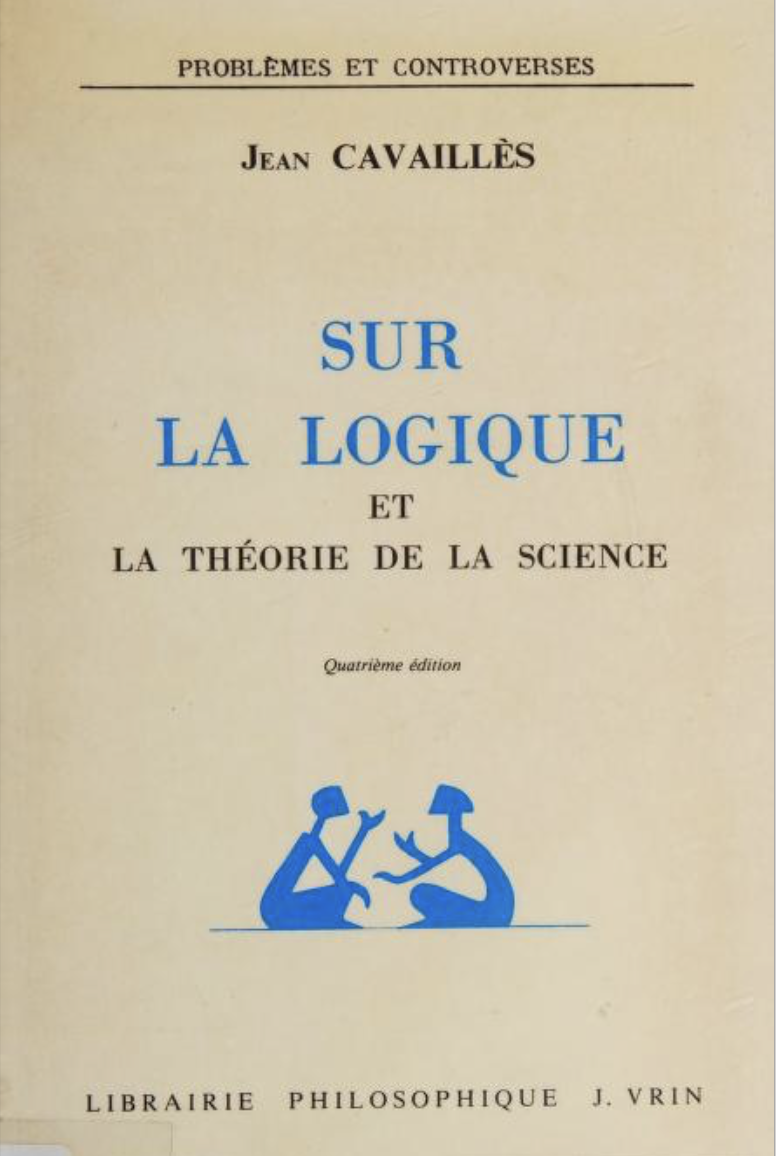
Louis Althusser’s Journal de captivité: Stalag XA 1940-1945 was written while in a camp in Schleswig, northern Germany. It was not intended to be read by others and was published posthumously. Other philosophers, including Georges Gusdorf, Emmanuel Levinas, and Paul Ricoeur were prisoners of war. Levinas wrote Existence and Existents in a camp, and his posthumously published writings relating to this time are collected in the first volume of his Œuvres complétes, Carnets de captivité. The review essays by Howard Caygill and Seán Hand are helpful. Ricœur’s time in a camp has been the subject of some controversy because of his Pétainist sympathies (see, for example, Robert Levy, “Sur la passade pétainiste de Paul Ricoeur: un bref épisode?”). Jean Cavaillès wrote Sur la logique et la théorie de la science while imprisoned in Montpellier, before his escape. When he was recaptured he was executed by the Germans. His text was edited by Charles Ehresmann and Georges Canguilhem and published in 1946. Canguilhem notes that a philosopher preparing for death usually writes an ethics, but Cavaillès wrote a logic, which is his ethics (Vie et mort de Jean Cavaillès, p. 29).
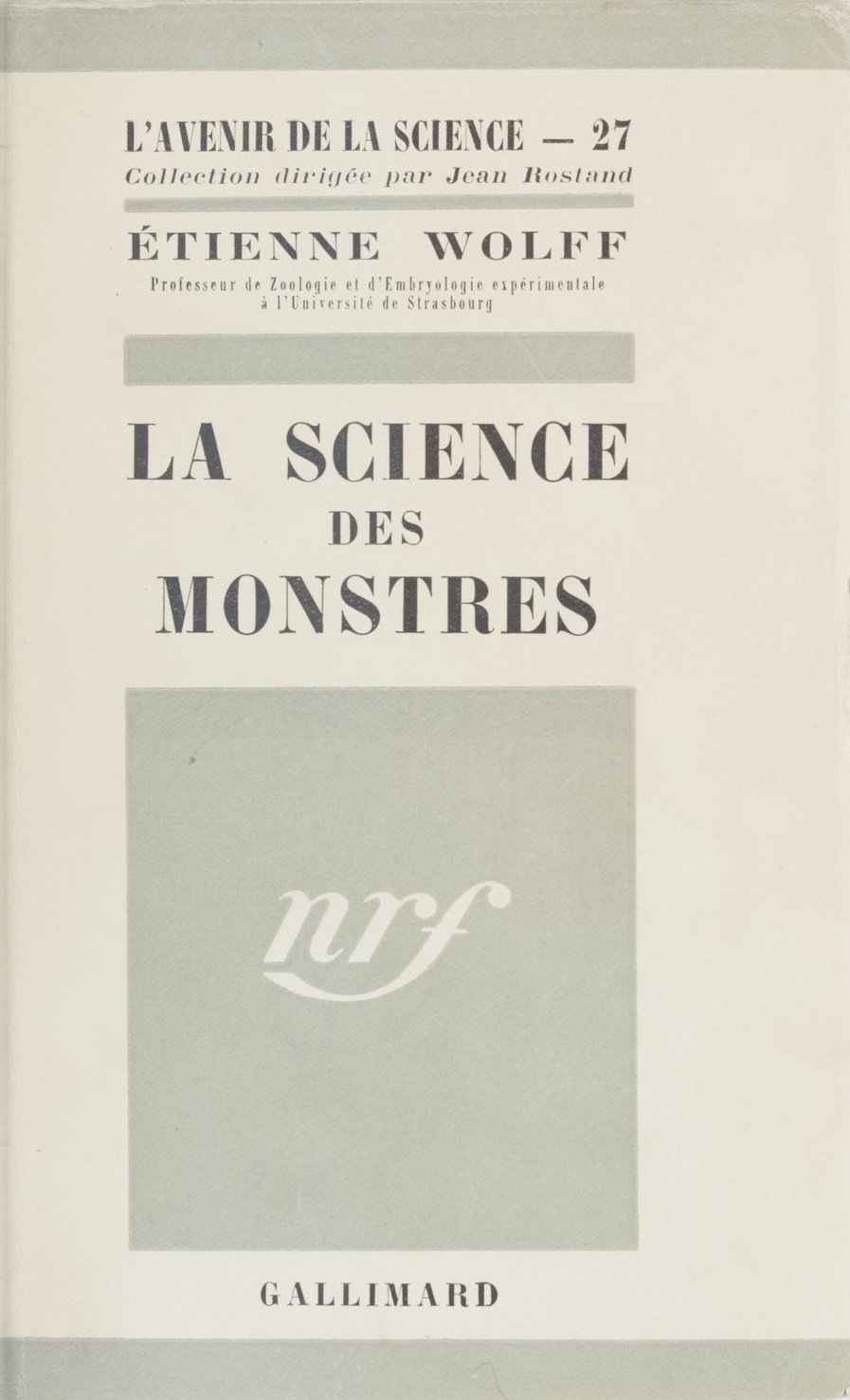
The biologist Étienne Wolff wrote both Les Changements de sexe and La science des monstres in Oflag XVII-A in Edelbach, developing from his teaching at the university in the camp, sometimes called the “Université de Captivité” (or “Université en Captivité”). Wolff went on to a successful career as a professor and later administrator of the Collège de France. I discussed Wolff’s work, including something about these two books here.
The mathematician Jean Leray headed the university in Oflag XVII-A, which taught several courses and awarded diplomas which were ratified by French institutions after the war’s end. He worked on topology during his imprisonment. Leray’s prominent role in the University was partly because Wolff was Jewish, and though he was important in its running, had to keep a low profile in the camp. After the war Leray was elected to a chair at the Collège de France, entitled Theory of differential and functional equations – his biography and annual courses summaries are here.
Thirteen lectures from the camp were published after the war, in Orientation: Recueil de conférences faites au Centre universitaire de l’Oflag XVII A. These give an indication of the breadth of subjects treated – mathematics, physics, biology, history, geography, philosophy, classics, modern literature and theatre – and the range of academics who taught classes there. However, the accounts of the university in the camp I currently know are focused on Leray’s role (Anna Maria Sigmund, Peter Michor, and Karl Sigmund, “Leray in Edelbach”; Christophe Eckes, “Captivité et consécration scientifique”; Sanchez-Palencia, “Recherche et enseignement en captivité”). There are other interesting stories beyond Wolff and Leray.
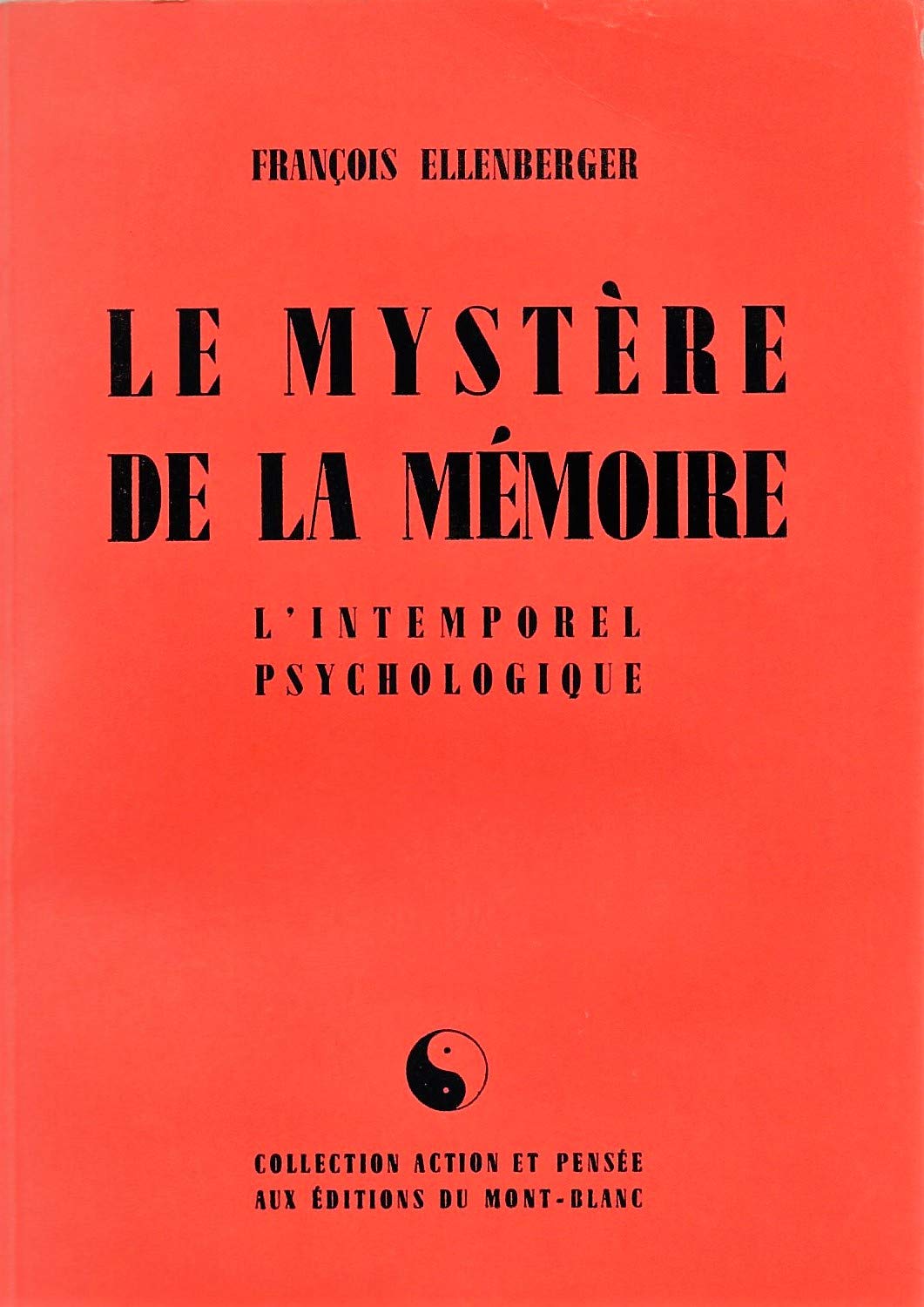
François Ellenberger, best-known as a geologist, wrote Le mystère de la mémoire: L’intemporel psychologique in the same camp. As the title suggests, this is a book about memory and time from a psychological perspective – he was the brother of Henri Ellenberger, a psychiatrist. The book is dated to “27 February 1944, in captivity” (p. 270). He describes the shift in his research focus:
This book was written in captivity. It is the work of a scientist, a geologist, used to questioning the Earth’s past, and contemplating the inhuman solitude of geological time through rocks and fossils. Deprived of any other study material, the author turned to himself with the determination to observe mental phenomena as calmly and with the same impassivity as the facts of the mineral world (p. 9)
Though he taught in the camp, a certificate for Ellenberger’s studies in, among other topics, psychology, anatomy and physiology in the camp is included as illustration 3 in Jean-Claude Catherine’s collection on La Captivité des prisonniers de guerre. Ellenberger taught geology at the Sorbonne after the war.
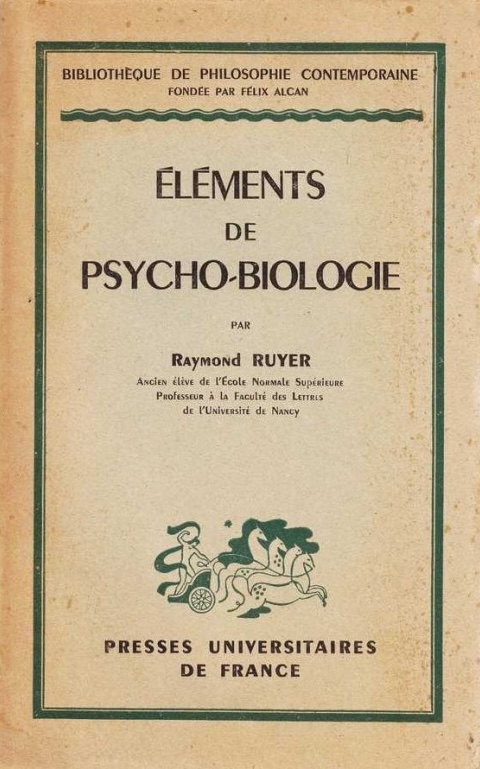
The philosopher Raymond Ruyer drafted his Éléments de psycho-biologie in the same camp between 1942 and 1944, originally entitled Le Psychisme et la Vie. In the preface to the book he acknowledges the conversations he had there with Ellenberger, Wolff and others within the Université de captivité and particularly what he calls the “Cercle biologique”. Isabel Gabel indicates that this encounter with Wolff was fundamental for Ruyer’s philosophical approach, and Frédéric Fruteau de Laclos discusses these formative years in “Comment Ruyer est devenu Ruyer”, adding that Ruyer also wrote books in the camp on values and metaphysics, published after the war as Le Monde des valeurs and Néo-finalisme, the latter of which was translated in 2016 as Neofinalism. Ruyer’s lecture included in the Orientation volume from the camp was republished in 2013 as “L’Esprit philosophique”. Ruyer taught after the war at the University of Nancy, and reviewed Ellenberger’s Le Mystère de la mémoire for Revue Philosophique de la France et de l’Étranger in 1949. I’ve found some other sources about the camp, and in particular about the teaching of geography and mathematics there, on which I’ll write about in a future piece.
The historian Fernand Braudel famously wrote the first draft of The Mediterranean and the Mediterranean World in the Age of Philip II while in German POW camps, initially in Oflag XII-B in Mainz, and from spring 1942 in Lübeck Special Oflag X-C. (Wolff was transferred to the latter camp towards the end of the war; Gusdorf also spent time there.) Braudel taught a course on history in the latter camp, which was published posthumously. Braudel would also later hold a chair in history at the Collège de France. Looking at photographs of professors there, twenty years after the war, it’s striking to see how many of them had spent time in camps, and people who were in the same Oflag standing near to each other.
Many other prisoners wrote memoirs or other accounts of their time in camps after the event. Some of the papers of the literary and theatre historian Georges Mongrédien have been published and discussed in Archives d’une captivité, 1939-1945. In Prisonnier de guerre, 1939-1943, Louis Pape collects a range of texts, drawings and paintings by François Garnier, giving a vivid sense of life in a camp during this period. However rather than more general accounts of being in a camp, for which the literature is enormous, I’m interested in the teaching that took place during this time, and those that wrote books during incarceration. Gisèle Sapiro has written at length about the war-time experience of French writers, in a remarkable book, but her focus is more on publishers, writing under occupation, censorship, collaboration and resistance. She does not mention Althusser, Braudel, Cavaillès, Ellenberger, Leray, Ruyer or Wolff.
The more I look into this, the more I realise that the experience of captivity was important to many intellectual careers and work in the first half of the twentieth century. (There is a personal connection to this interest. Although he was not an academic, my grandfather spent the last two years of World War Two as a prisoner in a camp in Eastern Germany. I briefly mention doing some archival research into his story here. I recently found another document relating to his time in captivity for which I’d been looking for some time.) Perhaps there would be an interesting project to explore the experience of French intellectuals in camps, the books they wrote there and perhaps the story of the “Université de Captivité” in the different camps, which seem to be somewhat under-researched.
References
Orientation: Recueil de conférences faites au Centre universitaire de l’Oflag XVII A, Paris: Éditions de Champagne, 1946. Includes thirteen lectures from the 1941-42 academic year.
Louis Althusser, Journal de captivité: Stalag XA 1940-1945, ed. Olivier Corpet and Yann Moulier Boutang, Paris: Stock/IMEC, 1992.
Fernand Braudel, La Méditerranée et le monde méditerranéen à l’époque de Philippe II, Paris: A. Colin, three volumes, 1949, second edition 1966; The Mediterranean and the Mediterranean World in the Age of Philip II, trans. Siân Reynolds, London: Fontana, two volumes, 1975.
Fernand Braudel, Les Ambitions de l’histoire: Écrits de Fernand Braudel Vol 2, eds. Paule Braudel and Roselyne de Ayala, Editions de Fallois, Paris 1997.
Georges Canguilhem, Vie et mort de Jean Cavaillès, Paris: Allia, 1996.
Jacques Cantier, “Innover en captivité: Les universités de prisonniers de guerre français dans les oflags (1939-1945)” in Véronique Castagnet-Lars and Caroline Barrera eds. Décider en education: Entre norms institutionnelles et pratiques des acteurs du XVe siècle à nos jours, Septentrion: presses Universitaires de Septentrion, 2019, 181-94.
Jean Cavaillès, Sur la logique et la théorie de la science, Paris: Presses Universitaires de France, 1947; trans. Robin Mackay and Knox Peden, Falmouth: Urbanomic, 2021.
Howard Caygill, “Levinas’s Prison Notebooks”, Radical Philosophy 160, 2010, 27-35.
Christophe Eckes, “Captivité et consécration scientifique: Reconsidérer la trajectoire académique du mathématicien prisonnier de guerre Jean Leray (1940-1947)”, Genèses 121, 2020, 31-51.
François Ellenberger, Le mystère de la mémoire: L’intemporel psychologique, Geneva: Éditions du Mont-Blanc, 1947.
Lucien Febvre, “De l’histoire au martyre: Marc Bloch 1886-1944”, Annales d’histoire sociale 8 (1), 1945, 1-10.
Frédéric Fruteau de Laclos, “Comment Ruyer est devenu Ruyer: Entre épistémologie et psycho-biologie”, Philosophia Scientiæ 2017/2, 2017, 47-64.
François Garnier, Prisonnier de guerre, 1939-1943, ed. Louis Pape, Rennes: Presses Universitaires de Rennes, 2013.
Isabel Gabel, “La biologie, la réflexivité et l’histoire: Réinscrire Canguilhem dans son milieu”, Revue d’histoire des sciences 71 (2), 2018, 155-78.
Évelyne Gayme, “Les OFLAGS, centres intellectuels”, Inflexions 29, 2015, 125-32, https://inflexions.net/la-revue/29/pour-nourrir-le-debat/gayme-evelyne-les-oflags-centres-intellectuels
Jean Guéhenno, Diary of the Dark Years, 1940-1944: Collaboration, Resistance, and Daily Life in Occupied Paris, trans. David Ball, Oxford: Oxford University Press, 2016.
W.C. Hackett, Outside the Gates, Brooklyn: Angelico, 2021.
Seán Hand, “Salvation through Literature: Levinas’s Carnets de captivité”, Levinas Studies 8, 2013, 45-65.
W.B. Henning, Sogdica, London: The Royal Asiatic Society, 1940.
Ernst Jünger, A German Officer in Occupied Paris: The War Journals, 1941-1945, trans. Thomas S. Hansen and Abby J. Hansen, New York: Columbia University Press, 2019.
Andreas Kusternig, “Entre université et resistance: Les officiers français prisonniers au camp XVII A à Edelbach”, in Jean-Claude Catherine ed. La Captivité des prisonniers de guerre (1939-1945): Histoire, art, et mémoire. Pour une approche européenne, Rennes: Presses Universitaires de Rennes, 2008, 55-77.
Andreas Kusternig, “OFFIZIERLAGER (OFLAG) XVII A” in Alexandra Lohse and Oliver Parken, eds., Encyclopedia of Camps and Ghettos, trans. Kathleen Luft, Washington, DC: United States Holocaust Memorial Museum, 2025, Vol IV, 272-75, https://doi.org/10.1353/document.4576
Emmanuel Levinas, Œuvres 1: Carnets de captivité et autres inédits, eds. Rodolphe Calin and Catherine Chalier, Paris: Bernard Grasset/IMEC, 2009.
Robert Levy, “Sur la passade pétainiste de Paul Ricoeur: un bref épisode?” Sens Public, 26 March 2008, https://sens-public.org/articles/537/
Allan Mitchell, The Devil’s Captain: Ernst Jünger in Nazi Paris, 1941-1944, New York: Berghahn, 2011.
Anne-Marie Pathé, Yann Potin and Fabien Théofilakis eds., Archives d’une captivité, 1939-1945: L’évasion littéraire du capitaine Mongrédien, Paris: Éditions Textuels, 2010.
John Mullan, “Ten of the best books written in prison”, The Guardian, 19 September 2009, https://www.theguardian.com/books/2009/sep/19/books-written-in-prison
Antonio Negri, L’anomalia selvaggia: Saggio su potere e potenza in Baruch Spinoza, Milano: Giangiacomo Feltrinelli Editore, 1981; The Savage Anomaly: The Power of Spinoza’s Metaphysics and Politics, trans. Michael Hardt, Minneapolis: University of Minnesota Press, 1991.
Raymond Ruyer, Éléments de psycho-biologie, Paris: Presses Universitaires de France, 1946.
Raymond Ruyer, Le Monde des valeurs: Études systèmatiques, Aubier, 1948.
Raymond Ruyer, “Le mystère de la mémoire d’après F. Ellenberger”, Revue Philosophique de la France et de l’étranger 139, 1949, 72-79.
Raymond Ruyer, Néo-finalisme, Paris: Presses Universitaires de France, 1952; Neofinalism, trans. Alyosha Ruyer, Minneapolis: University of Minnesota Press, 2016.
Raymond Ruyer, “L’Esprit philosophique”, Revue philosophique de la France et de l’étranger 203 (1), 2013, 7-19.
Evariste Sanchez-Palencia, “Recherche et enseignement en captivité: Leray à Edelbach”, Histoire des sciences / Evolution des disciplines et histoire des découvertes, 2015, https://www.academie-sciences.fr/pdf/hse/evol_Sanchez3.pdf
Gisèle Sapiro, La Guerre des écrivains 1940-1953, Paris: Fayard, 1999; The French Writers’ War, 1940-1953, Durham, NC: Duke University Press, 2014.
Jean-Paul Sartre, Les Carnets de la drôle de guerre: Septembre 1939-Mars 1940, Paris: Gallimard, second edition, 1995 [1983]; War Diaries: Notebooks from a Phoney War, 1939-40, trans Quintin Hoare, London: Verso, 1984. (The English is missing the first notebook, discovered later, and added to the second French edition).
Anna Maria Sigmund, Peter Michor, Karl Sigmund, “Leray in Edelbach”, The Mathematical Intelligencer 27 (2), 2005, 41-50.
Étienne Wolff, Les Changements de sexe, Paris: Gallimard, 1946.
Étienne Wolff, La science des monstres, Paris: Gallimard, 1948.
This is the 39th post of a weekly series, where I post short essays with some indications of further reading and sources, but which are not as formal as something I’d try to publish more conventionally. They are usually tangential to my main writing focus, a home for spare ideas, asides, dead-ends and possible futures. I hope there is some interest in them. They are provisional and suggestions are welcome. A few shorter pieces in a similar style have been posted mid-week.
The full chronological list of ‘Sunday histories’ is here, with a thematic ordering here.
Discover more from Progressive Geographies
Subscribe to get the latest posts sent to your email.


lit crit
https://newbooksnetwork.com/before-borders
The intro to this reads like a testimonial that prisoners do not give up their humanity, and may experience it more deeply. It’s great! Its white European focus has me wondering about other entries. There must be books by US Civil Rights Leaders, South American or Caribbean revolutionaries, the Subaltern group, or anti-colonial leaders from Africa or Asia that were written in captivity? MLK’s Letter from a Birmingham Jail is an essay, not a book, but it is widely studied and influential; Castro’s book from prison is not widely known, but he himself had considerable influence. France jailed colonial opposition leaders frequently; certainly some of them must have written while they were confined. For that matter, slavery is captivity, so anything written in that state would fit the criteria as written, but I can see that your time frame doesn’t include major waves of global slavery.
Thanks for your thought-provoking piece.
Jennifer
Thanks for the comment. An earlier draft mentioned Martin Luther King, but I took it out because it was not a book. Yes, you are right that there would be many more examples, and the colonial angle is an interesting one.
My focus, at least at the moment, is on French prisoners in World War Two. Non-white French prisoners were treated quite differently – often in work camps rather than the ones for officers, for example. Two sources I know on this are Raffael Scheck, French Colonial Soldiers in German Captivity during World War II, Cambridge: Cambridge University Press, 2014 and Armelle Mabon, Prisonniers de guerre «indigènes»: Visages oubliés de la France occupée, Paris: La Découverte, 2019.
I’ll be doing more on this topic, so will think on these questions.
thanks again and best wishes
Stuart
Pingback: Books received – Levinas, de Menasce, Braudel, Bloch and Febvre | Progressive Geographies
Pingback: Books received – Gusdorf, Foucault, Wolff, Ellenberger, Ramnoux, Dosse, Mabon | Progressive Geographies
Pingback: Indo-European Thought in Twentieth-Century France update 30 – archive work in Paris, Bern and Cambridge, MA, and Benveniste’s library | Progressive Geographies
Pingback: Fernand Braudel and the Writing and Teaching of History in Captivity | Progressive Geographies