
In a retrospective of his long career, first published in 2021, David Harvey made the following claim:
I have written quite a few books over the course of my academic career, beginning with Explanation in Geography (Harvey, 1969) and most recently Marx, Capital and the Madness of Economic Reason (Harvey, 2017). I am often asked which of these many books I consider to be the most important. My invariable answer is Limits to Capital (Harvey, 1982) and Paris, Capital of Modernity (Harvey, 2003), the first draft of which appeared in Consciousness and the Urban Experience (Harvey, 1985) (“Reflections on an Academic Life”, p. 2).
I wonder whether others were as surprised by this as me. Not by the inclusion of The Limits to Capital, which is arguably the most important book written by a geographer in my lifetime, but by its pairing with Paris, Capital of Modernity.
Today, 31 October 2025, David Harvey turns 90. To mark this anniversary, through October Verso have been running a series of pieces on his books, and I want this piece to be a minor additional tribute to his life and work, especially his writings on Paris. By Harvey and Paris, I mean his writings on this city, and particularly this book, rather than his links to French theorists or, as he describes it, his “frustrating sabbatical year in Paris in 1975-1976” (“Reflections on an Academic Life”, p. 3; though see Spaces of Capital, p. 12 which says it was 1976-77).
He explains the relation between Limits and Paris in an interesting and compelling way:
Having read Marx’s Eighteenth Brumaire of Louis Bonaparte and the Civil War in France, I thought it would be fascinating to read more about what happened to Paris between the revolution of 1848 and the Commune of 1871. I became particularly fascinated by the building and symbolism of the Basilica of Sacré Coeur and began a study of it more or less as an enjoyable side-line. There was something creepy about being inside that building and I was determined to find out what it was. And so the parallel historical-geographical study of urbanization that I planned shifted to Second Empire Paris, even as I ploughed ahead step by step with my Marx studies. The Paris project turned into a labor of love, a respite from the world particularly when everything else seemed to be going very badly. I relished spending summers in Paris reading all sorts of accounts and documents in the stunningly beautiful Biblioteque [sic] Historique de la Ville de Paris in the Marais.
Thus I arrived at the core of my interests: to redirect and advance Marx’s theoretical exploration of the laws of motion of capital in relation to a historical-geographical materialist enquiry into the transformation of Paris between 1848 and 1871. The Paris study was always in the back of my mind as I was writing Limits just as Limits was in my mind while exploring what happened in Second Empire Paris. Bouncing back and forth between the two perspectives was a thrilling intellectual experience. The “bouncing” was in part between theory and practices but it went far deeper than that: it was anchored by the sense of a contradictory unity between social relations in constant transformation on the ground and alien processes of capital accumulation and overaccumulation that rule the economic system as real abstractions. What I learned from doing these two studies in dialogue made the subsequent writing of The Condition of Postmodernity incredibly easy. What I learned from that whole experience has underpinned my work ever since (“Reflections on an Academic Life”, p. 4).
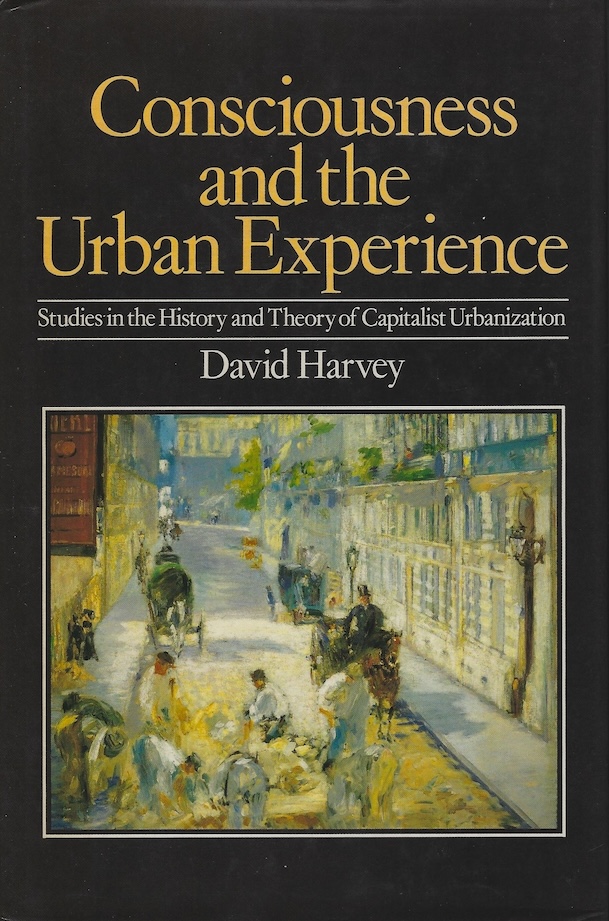
However, the pairing of Limits and Paris are of books almost two decades apart, when this discussion indicates their parallel production. I knew Harvey had written on Paris earlier in his career, as he indicates in this piece, but the original version of the essay is long out of print. It was originally published in one of two hardback volumes with The Johns Hopkins University Press and Basil Blackwell in 1985, a few years after The Limits to Capital (1982). Consciousness and the Urban Experience and The Urbanization of Capital were both subtitled Studies in the History and Theory of Capitalist Urbanization and clearly form a pair of connected studies. Neither was reprinted in paperback in the same form, but instead The Urban Experience, published in 1989, compiled several of the previously published essays. As he says in that book:
I have chosen the essays for this paperback version with an eye to their theoretical coherence and utility in providing an interpretation of why the urban experience under capitalism takes the form it does. I have added one essay not included in the original volumes because I think it helps illustrate some of the ways in which the theory might be put to work to interpret recent trends. I also felt it useful to transform the original ‘Preface’ into a lengthier ‘Introduction’ and to engage in an extensive re-write of the essay on ‘The Urbanization of Consciousness’ which here appears as chapter 8. Otherwise, the original texts remain unchanged, except of minor alterations to ensure consistency and to eliminate duplication (The Urban Experience, Preface, p. ix).
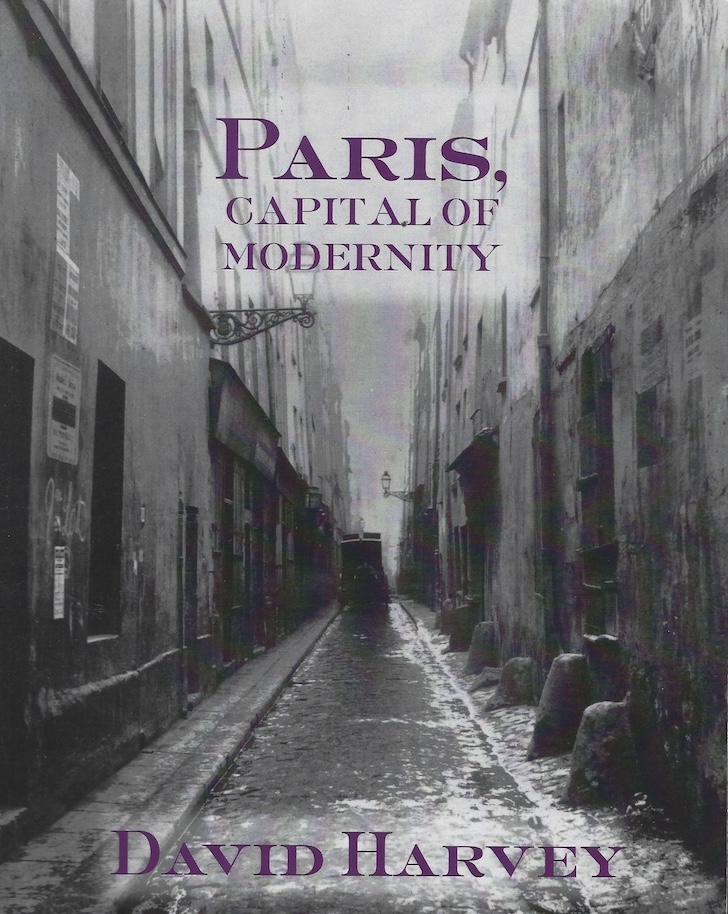
Some of the essays from Consciousness and the Urban Experience and The Urbanization of Capital which not included in The Urban Experience have been reprinted elsewhere. “The Geography of Capitalist Accumulation: Towards a Reconstruction of the Marxian Theory” is included in Spaces of Capital in 2001, and by far the longest essay in Consciousness and the Urban Experience, “Paris, 1850-1870” (pp. 62-220), is the text reworked as the second part of the 2003 book Paris: Capital of Modernity.
The original long essay, which could have easily been a short book on its own, is a historico-geographical analysis of a tumultuous period in the city, an example of historical-geographical materialism. Paris: Capital of Modernity also includes a reprint of “Monument and Myth: The Building of the Basilica of the Sacred Heart”, also taken from Consciousness and the Urban Experience, as Part III, though this essay had been included in The Urban Experience. Paris: Capital of Modernity starts with a new Introduction, and its Part I comprises “The Myths of Modernity: Balzac’s Paris”, previously published as two book chapters, and a new chapter “Dreaming the Body Politic: Revolutionary Politics and Utopian Schemes, 1830-1848” (see Paris: Capital of Modernity, p. 20).
When asked about the use of literature in his work on Paris, Harvey said that he had always been reading this material, but had never considered using it until this work: “Once I started to do so, I discovered how many historical ideas poetry or fiction can set alight. And once I made that turn, everything came flooding out”. He says this shift was partly because of the security of his academic position, but also partly the “pleasure of the texts themselves, after the hard grind of Limits” (Spaces of Capital, p. 12).
The themes are important, politically and geographically – the 1848 revolution and the reactionary birth of the Second Empire; Baron Haussmann’s transformation of the spaces of Paris; the Paris commune and its violent suppression; and the building of Sacré Coeur on its ruins. Harvey’s purpose is to show how the pivotal year of 1848 was anticipated by longer historical transformations, whether this is in literature, revolutionary politics or urban transformation. Modernity, as seen in these artistic, political and spatial forms, is not the break it is sometimes supposed to be, but a process, a modernization. This is viewed through the clash between a bourgeois, capitalist vision of property, the market and consumption, and a socialist vision of support, improvement and justice.
I don’t remember many reviews at the time of publication, and a quick search now does not produce many pieces. I’ve added references to a few below. And by Harvey’s standards, the citations of the Paris are more limited, though they are the sort of numbers most of us would be delighted by, of course.
As Patricia Tilburg said of the book, describing it as a work of synthesis, “Harvey’s ability to weave place and ideas is one of this eminently readable study’s greatest strengths” (p. 821). Harvey himself describes the book as synthetic, recognising how his book “depends heavily on archival work by others”, but (not entirely convincingly) claiming that because the archives have been “so richly mined” it was possible to use these secondary sources alone (p. 19). Richard A. Walker, in the Verso series for Harvey’s 90th birthday calls the Paris book “his finest piece of writing”. In that Verso series, Andy Merrifield has a much fuller discussion of the historical account of Paris. From a review at the time:
Paris: Capital of Modernity works in multiple registers. It is part urban history, part social history, part political history, and it is the book’s particular virtue to attempt a synthesis of them all. Something of the open-ended, multivalent character of the idea of modernity, however, is lost in the process. The modern has multiple political meanings. It takes a variety of cultural forms, depending on time and place. It has a productivist face as well as a spectacular one. It can be provincial as well as metropolitan. The meaning of the term “modernity” has been the subject of endless debate. Harvey weighs in with a particular take of his own, but it is worth remembering that his take is just one among many (Nord, p. 731).
The same year the Paris book appeared Harvey also published The New Imperialism, bringing his analyses into the present moment – it was one of the first books by a geographer engaging with the ‘war on terror’. Since then, his books have appeared at a regular rhythm of one every year or two – the companions to Marx’s Capital and the Grundrisse and a series on contemporary political economic issues. It’s been an astonishing run of publications in his 70s, 80s and now 90s, with The Story of Capital:What Everyone Should Know About How Capital Works due for publication in early 2026. But Harvey has never quite returned to the kind of historical-geographical materialism on display in his work on Paris.
References
Euan Hague, “Paris, Capital of Modernity. David Harvey”, Urban Geography 27 (3), 2006, 293-96.
David Harvey, The Limits to Capital, Oxford: Basil Blackwell, 1982.
David Harvey, Consciousness and the Urban Experience: Studies in the History and Theory of Capitalist Urbanization, Oxford: Basil Blackwell, 1985.
David Harvey, The Urbanization of Capital: Studies in the History and Theory of Capitalist Urbanization, Oxford: Basil Blackwell, 1985.
David Harvey, The Urban Experience, Baltimore: The Johns Hopkins University Press, 1989.
David Harvey, Spaces of Capital: Towards a Critical Geography, New York: Routledge, 2001.
David Harvey, Paris: Capital of Modernity, New York: Routledge, 2003.
David Harvey, The New Imperialism, London: Verso, 2003.
David Harvey, “Reflections on an Academic Life”, Human Geography 15 (1), 2021, 14-24, also available at https://davidharvey.org/2021/12/reflections-on-an-academic-life/
Douglas Kellner & Rhonda Hammer, “Paris, Capital of Modernity, by David Harvey”, American Journal of Sociology, 112 (4), 2007, 1250-52.
Andy Merrifield, “The Marxist Restless Analyst”, Verso Blog, 10 October 2025,https://www.versobooks.com/blogs/news/the-marxist-restless-analyst
Philip Nord, “Paris: Capital of Modernity by David Harvey”, The Journal of Modern History 78 (3), 2006, 730-31.
Patricia Tilburg. “David Harvey, Paris, Capital of Modernity. New York: Routledge, 2003”, Comparative Studies in Society and History 50 (3), 2008, 820-21.
Richard A. Walker, “Harvey’s Urbanization of Capital”, Verso Blog, 7 October 2025, https://www.versobooks.com/blogs/news/harveys-urbanization-of-capital
This piece is in the same style as the ‘Sunday histories‘ posts that I’ve been posting every week through 2025, though this is out of sequence because I wanted to post on Harvey’s birthday. The ‘Sunday Histories’ are short essays with some indications of further reading and sources, but which are not as formal as something I’d try to publish more conventionally. They are usually tangential to my main writing focus, a home for spare ideas, asides, dead-ends and possible futures. I hope there is some interest in them. They are provisional and suggestions are welcome. A few shorter pieces in a similar style have been posted mid-week. This Sunday’s post will be on Foucault’s recently published manuscript, Les Hermaphrodites [update: now available here].
The full chronological list of ‘Sunday histories’ is here, with a thematic ordering here.
Discover more from Progressive Geographies
Subscribe to get the latest posts sent to your email.


Pingback: The Early Edward Said, Michel Foucault and Jonathan Swift – reposted for the 90th anniversary of Said’s birth | Progressive Geographies
Pingback: Foucault’s Hermaphrodites – from Herculine Barbin to a planned volume of the History of Sexuality and the recently published manuscript | Progressive Geographies
Pingback: Indo-European Thought in Twentieth-Century France update 30 – archive work in Paris, Bern and Cambridge, MA, and Benveniste’s library | Progressive Geographies