
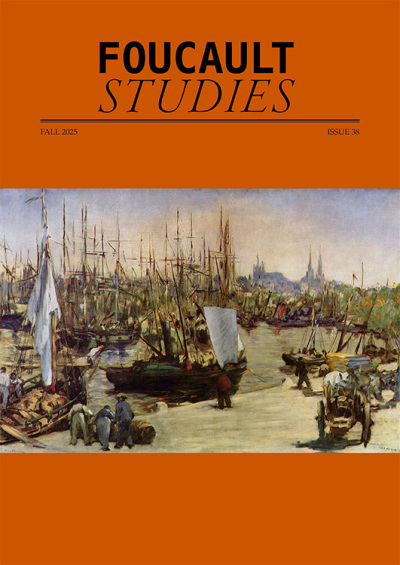
Foucault Studies 38 is now published
There are essays by Johanna Oksala and Philipp Kender, and a special section on Foucault’s reading of Nietzsche, with pieces by Orazio Irrera, Federico Testa, Emmanuel Salanskis, Daniele Lorenzini and Frédéric Porcher.
This issue includes a ‘Buffalo dossier’ – an article by me about what the University at Buffalo archives tell us about Foucault’s two visiting posts there in 1970 and 1972, and an article by Leonhard Riep with a detailed discussion of Foucault’s 1972 Buffalo course.
All essays and reviews are available open access.
From the editorial:
Foucault visited the State University of New York at Buffalo twice at the beginning of the 1970s. In 1970, he gave a course on the desire for knowledge in French literature in the nineteenth and twentieth centuries. He came back two years later to lead a seminar on the figure of the criminal in the literature of the eighteenth and nineteenth centuries, and to give an important lecture series on the “History of Truth,” which was recorded and has just been published in French under the title Histoire de la vérité (ed. H.-P. Fruchaud and O. Irrera, Paris: Vrin, 2025). This dossier offers an invaluable overview of Foucault’s teaching at SUNY Buffalo in those years, with special focus on his lectures on the history of truth.
In “Foucault at Buffalo in 1970 and 1972: The Desire for Knowledge, The Criminal in Literature, and The History of Truth,” Stuart Elden (University of Warwick, UK) provides an invaluable survey of the archival material available at the University at Buffalo concerning Foucault’s visits. In particular, using the personnel files and correspondence with John K. Simon, as well as the audio recordings of the 1972 lectures on the history of truth and parts of the 1970 course on the desire for knowledge, Elden reports on what we know of Foucault’s teaching there and its role in the initial reception of his thought in the United States.
In “‘The History of Truth’: Foucault in Buffalo, 1972,” Leonhard Riep (Goethe University Frankfurt am Main, Germany) offers a reading of Foucault’s 1972 lecture series on the “History of Truth” based on the audio recordings available in the archives at the University at Buffalo. In particular, Riep reconstructs the two main knowledge-power complexes that Foucault analyzes there: the “truth of measure” in relation to the question of justice in the ancient Greek legal system and the “truth of investigation” within the discourse on war and the appeasement of society in medieval law. Riep shows that these lectures provide invaluable insight into the methodological foundations of Foucault’s archaeological approach.
Discover more from Progressive Geographies
Subscribe to get the latest posts sent to your email.


