
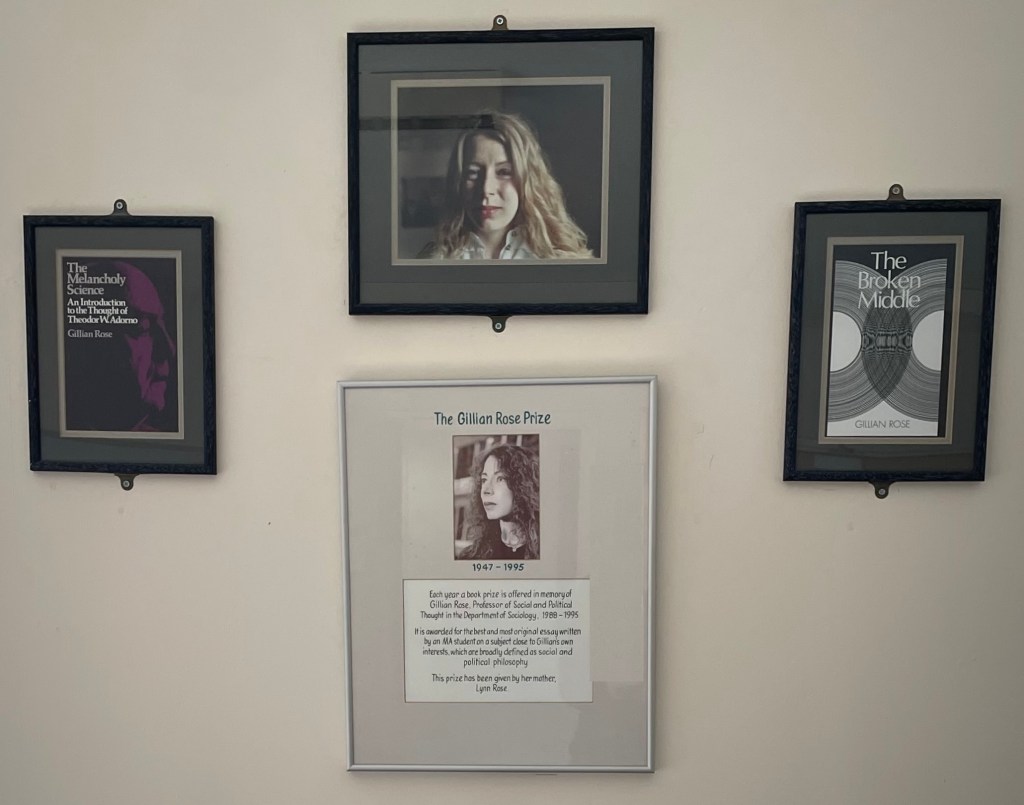
Today marks thirty years since Gillian Rose died so tragically young, at the age of just 48.
I’ve shared these links before, but Marxist Modernism: Introductory Lectures on Frankfurt School Critical Theory, edited by James Gordon Finlayson and Robert Lucas Scott, was published by Verso last year. Love’s Work was reissued by Penguin, and Jenny Turner reviews them both in London Review of Books. There was a discussion of the book and her work generally at the London Review Bookshop with James Butler, Rebekah Howes and Rowan Williams – recording available here.
Maya Krishnan, The Risk of the Universal: The Philosophy of Gillian Rose in The Point is a very interesting discussion of her work.
There are some recent essays in a special issue of Thesis Eleven, edited by Michael Lazarus and Daniel Andrés López – ‘Critical Theory, Aesthetics and Speculative Philosophy: A Special Edition on the Thought of Gillian Rose‘. Several papers, including a previously unpublished piece by Rose on Marx, are open access.
The papers from a London event on Rose in June 2025 are due to be published and Gillian Rose: History, Marxism, and the Turn to Law was held at the University of Warwick on 3 December 2025. Nick Gane and I are trying to bring a few other papers together for a theme section.
Earlier this year, as part of the ‘Sunday Histories’ series, I wrote a short piece on Gillian Rose and the Indo-Europeanists – thinking about how books by several of the people I’ve been reading for my current project were in her library, which is now part of the University of Warwick collection, but that the explicit mentions of their work are limited in her publications. My suggestion for the reason was that Rose was working across the Graeco-Christian and Jewish traditions, which Dumézil, Benveniste and Eliade never really did. The Semitic was outside of the language and cultural groups that they were interested in, which is most surprising in the case of Benveniste, who was Jewish and whose parents were teachers for the Alliance israélite universelle. I end with a few thoughts on Maurice Olender’s remarkable book Languages of Paradise, which relates the Semitic and Indo-European language families in some fascinating ways.
Finally, there is a remarkable radio interview The RTE interview of Gillian Rose, which was transcribed and edited by Vincent Lloyd for Theory, Culture and Society in 2008 (requires subscription). While that transcription, and that of Marxist Modernism, give a sense of her spoken style, the recording is irreplaceable.
Update 19 December 2025: Robert Lucas Scott, What Gillian Rose Saw in Auschwitz, New Statesman, 9 December 2025
Discover more from Progressive Geographies
Subscribe to get the latest posts sent to your email.


