
Among many other topics, the Romanian historian of religion Mircea Eliade wrote about alchemy. His 1937 book Cosmologie Şi Alchimie Babiloniană was translated into French as Cosmologie et alchimie babyloniennes, but only in 1991. A substantial part of this text appeared in English in 1938 in the first volume of the Zalmoxis journal which Eliade edited. Although this was an important early book on the topic, a later book circulated much more.
This was Forgerons et alchimistes, first published in French in 1956. It was not entirely new, since it used and expanded material from both Cosmologie and the earlier Alchimia Asiaticǎ (see Forgerons et alchimistes, pp. 37-38). This blend of translation and new material was quite common as he tried to rebuild a career in France after the Second World War and he made his work available in French, and later English. Unable to return to newly Communist Romania because of his past links to the fascist Iron Guard and the Antonescu dictatorship, Eliade moved to Paris from Lisbon, where he had been working for the Romanian government as a cultural attaché. With the support of Georges Dumézil and Henri-Charles Puech, he taught at the École Pratique des Hautes Études. As well as reworking material from earlier Romanian publications in French, he was beginning to write directly in that language. I will be discussing the network of academics, journals and publishers which supported him in my book on Dumézil and Benveniste.
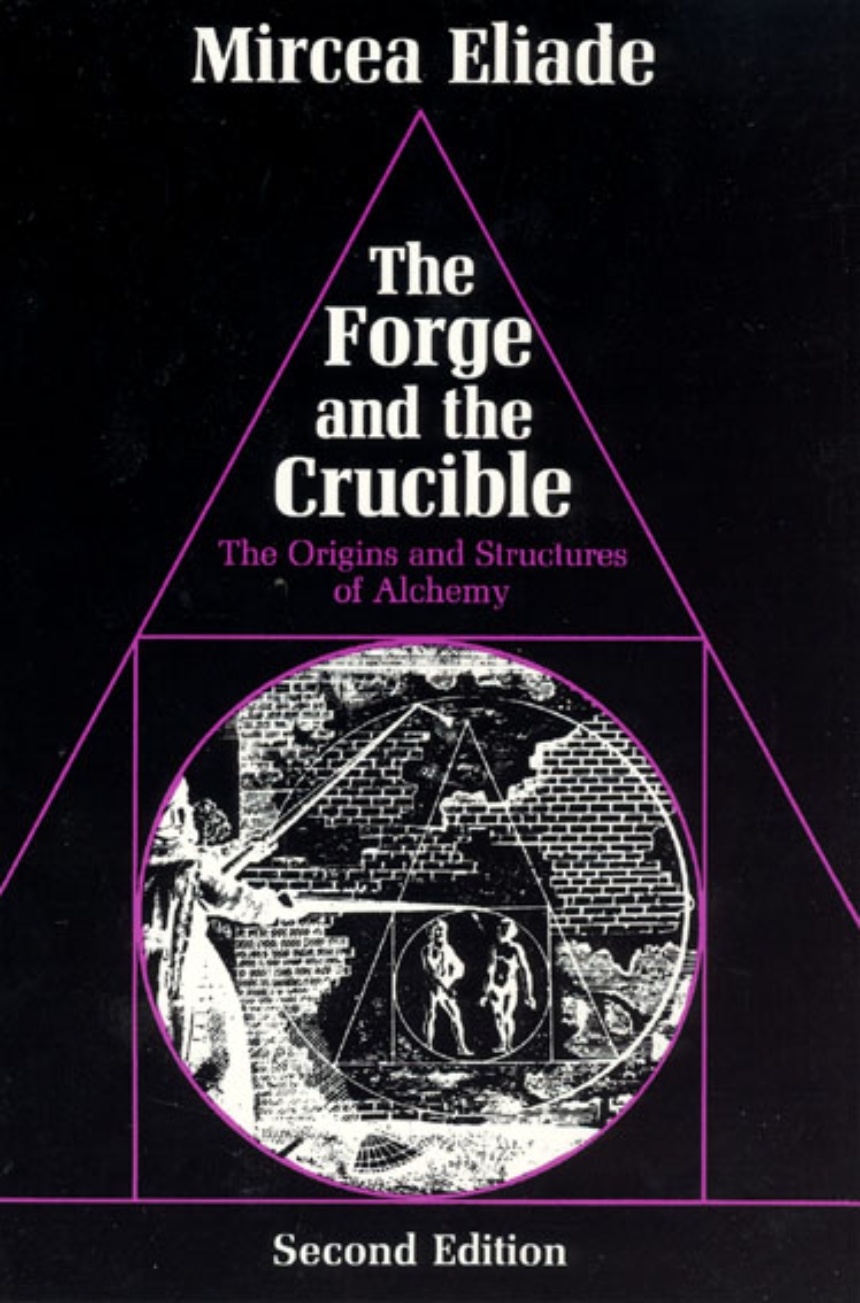
Forgerons et alchimistes was the last book which came from Eliade’s decade in Paris, before he moved to the University of Chicago. Eliade notes that in updating it he made use of translations of Chinese material, articles in the Ambix journal – founded in 1936 by the Society for the History of Alchemy and Chemistry – and the writings of Carl Jung, who had met Eliade through the Eranos conferences held in Ascona, Switzerland. It was translated as The Forge and the Crucible over twenty years later, shortly after Eliade had revised the French version.
I was greatly surprised when preparing a new edition in 1977 to realise that I had filled a whole shelf with recent monographs and articles, to which were added several files of notes and extracts. (I haven’t yet dared to burn them, as I did with the files and notes of many works, from the second edition of Shamanism to the third volume of Histoire des croyances et des idées religieux.) (Eliade, Autobiography Volume II, p. 172).
The original edition of Forgerons et alchimistes appeared in the ‘Homo Sapiens’ series, directed by Marie-Madeleine (sometimes Magdeleine) Davy. She was a writer on medieval mysticism, a former student of Étienne Gilson. She was born in 1903 and died in 1998. Some publications appear as M.M. or M.-M. Davy – presumably as a reaction to a male-dominated academy. Other authors in the ‘Homo Sapiens’ series included Henry Corbin, Jean Grenier and Gabriel Marcel.
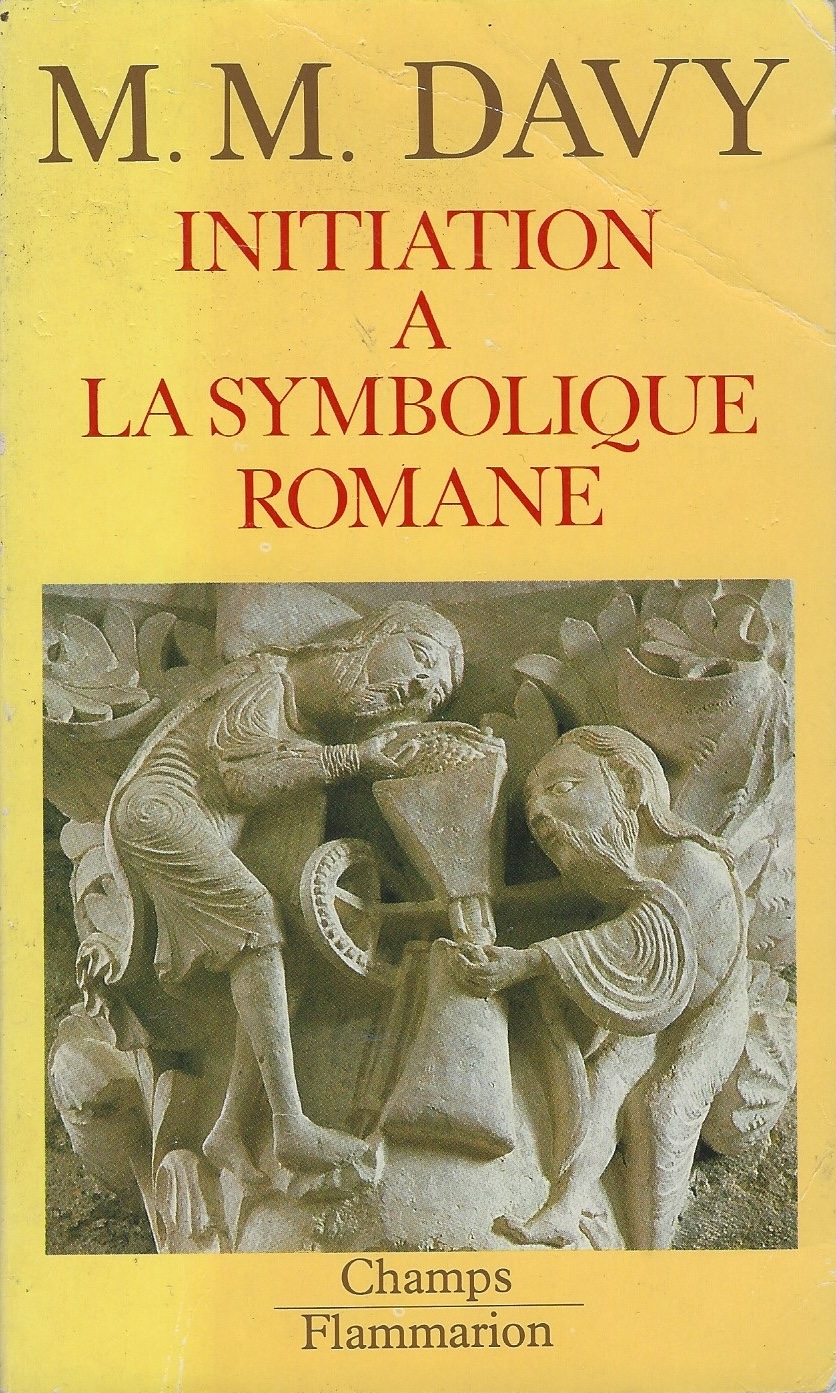
Davy’s book Essai sur la symbolique romane, revised as Initiation à la symbolique romane (XIIe siècle), which was in her series, is an interesting study of medieval imagery, artefacts, texts and architecture. A summary of some of its argument can be found in an article in Roger Caillois’s multilingual UNESCO journal, Diogenes, as “The Symbolic Mentality of the Twelfth Century”. Although best known as a medievalist, writing about Bernard of Clairvaux, William of Saint Thierry, Pierre de Blois and others, Davy also wrote a book on Marcel, Un Philosophe itinérant, books about Nikolai Berdyaev and Henri Le Saux (Swami Abhishiktananda), and also edited a collection of Le Saux’s writings. (As far as I’m aware, of these books only the one on Berdyaev is in English.)
Davy is an intriguing figure who was active in the French resistance to Nazi occupation, but who rarely wrote about this. Her links with Eliade, and to a lesser extent, Corbin, are therefore surprising. She was also a friend of Simone Weil, and after Weil’s death was involved in the collection of her papers to create an archive and the posthumous publication programme. Davy wrote the first book on Weil, a short study first published in English as The Mysticism of Simone Weil, based on earlier French articles but only later published as a book in French. On this, Brenna Moore’s work is very useful, especially Chapters 3 and 4 of her Kindred Spirits: Friendship and Resistance at the Edges of Modern Catholicism, and a shorter piece online. Jean Moncelon’s tribute is also helpful. Moore however only briefly mentions the friendship between Davy and Eliade (Kindred Spirits, p. 142), though notes the contrast between their politics:
In the face of anti-Semitism and authoritarianism, she was an active resister: forging documents for the safe escape of Jews, political prisoners, and airmen; shifting her teaching to include Judaism; and convening conferences that helped ensure Jewish, Russian, and Islamic scholarship was published in the French presses. We are missing a great deal of the politics in the history of the comparative study of religion because stories almost always exclude people on the margins of its intellectual history—that is, women. Davy’s work and insights did not emerge from any privileged vantage point as a woman, but her borderland position in relation to the mainstream certainly brought a new perspective. When we include women like Davy in our scholarship, not only do we diversify intellectual history, but familiar fields—comparative religion, theology, philosophy of religion—actually look different. In her realism, scholarship, and political action, she stood with a community that worked against both the theosophists and New Agers, who spurned serious linguist study and careful attention to differences and politics, as well as the militants, nationalists, and xenophobes, who believed in blood purity and were enraptured by the dream of Catholic renewal (p. 143).
Davy briefly mentions her friendship with Eliade in her memoir, Traversée en solitaire (p. 134). She says she got to know Eliade during his decade in Paris, but that after he moved to Chicago she saw him only rarely. She says that one of these later meetings was in Ascona. It was through Eliade that she met Dumézil. The long second part of her memoir, “Rencontres et croisements”, gives some interesting detail on her situation within a wider network of scholars in Paris, including many philosophers and historians. She mentions, for example, Georges Bataille and Corbin (pp. 123-24, 139-42). But the third part of the memoir, “Solitude et paradoxes”, indicates how important it was for her own work to be alone. This part comes with two epigraphs, from Cicero, “Man is never less lonely than when he is alone”* and Lev Shestov, “The most intense spiritual work is done in absolute solitude” (p. 173).
References
Marie-Magdeleine Davy, The Mysticism of Simone Weil, trans. Cynthia Rowland, London: Rockliff, 1951.
M.M. Davy, Essai sur la symbolique romane, Paris: Flammarion, 1956; revised edition as Initiation à la symbolique romane (XIIe siècle), Paris: Flammarion, 1964.
M.-M. Davy, Un Philosophe itinérant: Gabriel Marcel, Paris: Flammarion, 1959.
Marie-Madeleine Davy, “La mentalité symbolique du XIIe siècle”, Diogène 32, 1960, 111-22; “The Symbolic Mentality of the Twelfth Century”, trans. Wells F. Chamberlain, Diogenes 8 (32), 1960, 94-106.
M.-M. Davy, Nicolas Berdiaev: L’homme du huitième jour, Paris: Flammarion, 1964; Nicolas Berdyaev: Man of the Eighth Day, trans. Leonora Siepman, London: Geoffrey Bles, 1967.
Marie-Madeleine Davy, Traversée en solitaire, Paris: Albin Michel, 1989.
Mircea Eliade, “Metallurgy, Magic and Alchemy”, Zalmoxis: Revue des études religieuses 1, 1938, 85-129.
Mircea Eliade, Forgerons et alchimistes, Paris: Flammarion, 1956, second edition, 2018 [1977]; The Forge and the Crucible: The Origins and Structures of Alchemy, trans. Stephen Corrin, Chicago: University of Chicago Press, 1978.
Mircea Eliade, Autobiography Volume II 1937-60: Exile’s Odyssey, trans. Mac Linscott Ricketts, Chicago: University of Chicago Press, 1988.
Mircea Eliade, Cosmologie Şi Alchimie Babiloniană, Iaşi: Éditions Moldava, 1991 [1937]; Cosmologie et alchimie babyloniennes, trans. Alain Paruit, Paris: Gallimard, 1991.
Mircea Eliade, Alchimia Asiaticǎ, Buçaresti: Humanitas, 2003 [1935].
Jean Moncelon, “Marie Madeleine Davy ou le désert intérieur”, Les cahiers d’orient et d’occident, 2006, https://www.moncelon.fr/MARIE%20MADELEINE%20DAVY.pdf
Brenna Moore, “The Extraordinary Marie Magdeleine Davy”, Genealogies of Modernity, 2021, https://genealogiesofmodernity.org/journal/2021/9/21/extraordinary-marie-magdeleine-davy
Brenna Moore, Kindred Spirits: Friendship and Resistance at the Edges of Modern Catholicism, Chicago: University of Chicago Press, 2021.
Brenna Moore, “Marie-Magdeleine Davy and the Memory of Simone Weil”, Attention, 2022, https://attentionsw.org/marie-magdeleine-davy-and-the-memory-of-simone-weil/
* The Cicero reference is De Officiis (On Duties), Book III, Chapter I, where he credits it to Publius Scipio Africanus.
This is the 55th post of a weekly series, posted every Sunday throughout 2025, and now entering a second year. The posts are short essays with indications of further reading and sources. They are not as formal as something I’d try to publish more conventionally, but are hopefully worthwhile as short sketches of histories and ideas. They are usually tangential to my main writing focus, a home for spare parts, asides, dead-ends and possible futures. I hope there is some interest in them. They are provisional and suggestions are welcome. A few, usually shorter, pieces in a similar style have been posted mid-week. I’m not sure I’ll keep to a weekly rhythm in 2026, but there will be at least a few more pieces.
The full chronological list of ‘Sunday histories’ is here, with a thematic ordering here.
Discover more from Progressive Geographies
Subscribe to get the latest posts sent to your email.


I’ve always been fascinated by Mircea Eliade’s work on alchemy, what drew him to this topic initially? 🤔
Pingback: Indo-European Thought in Twentieth-Century France update 31 – Paris archives, library problems, and working towards a complete draft | Progressive Geographies