
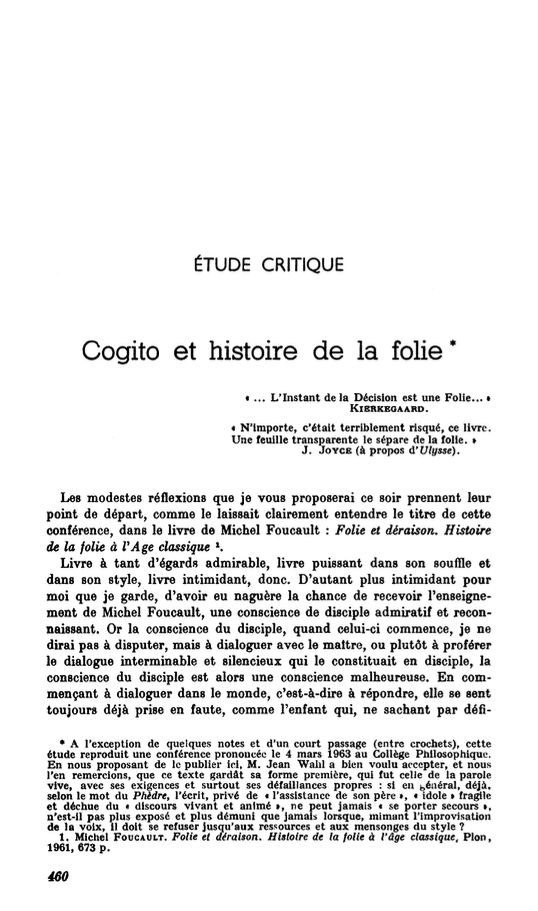
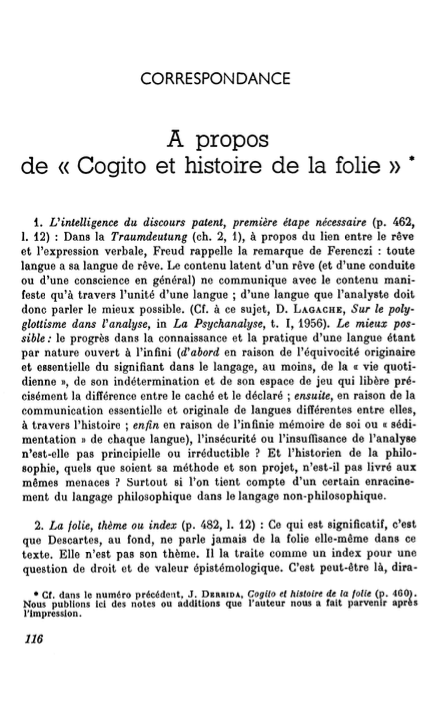
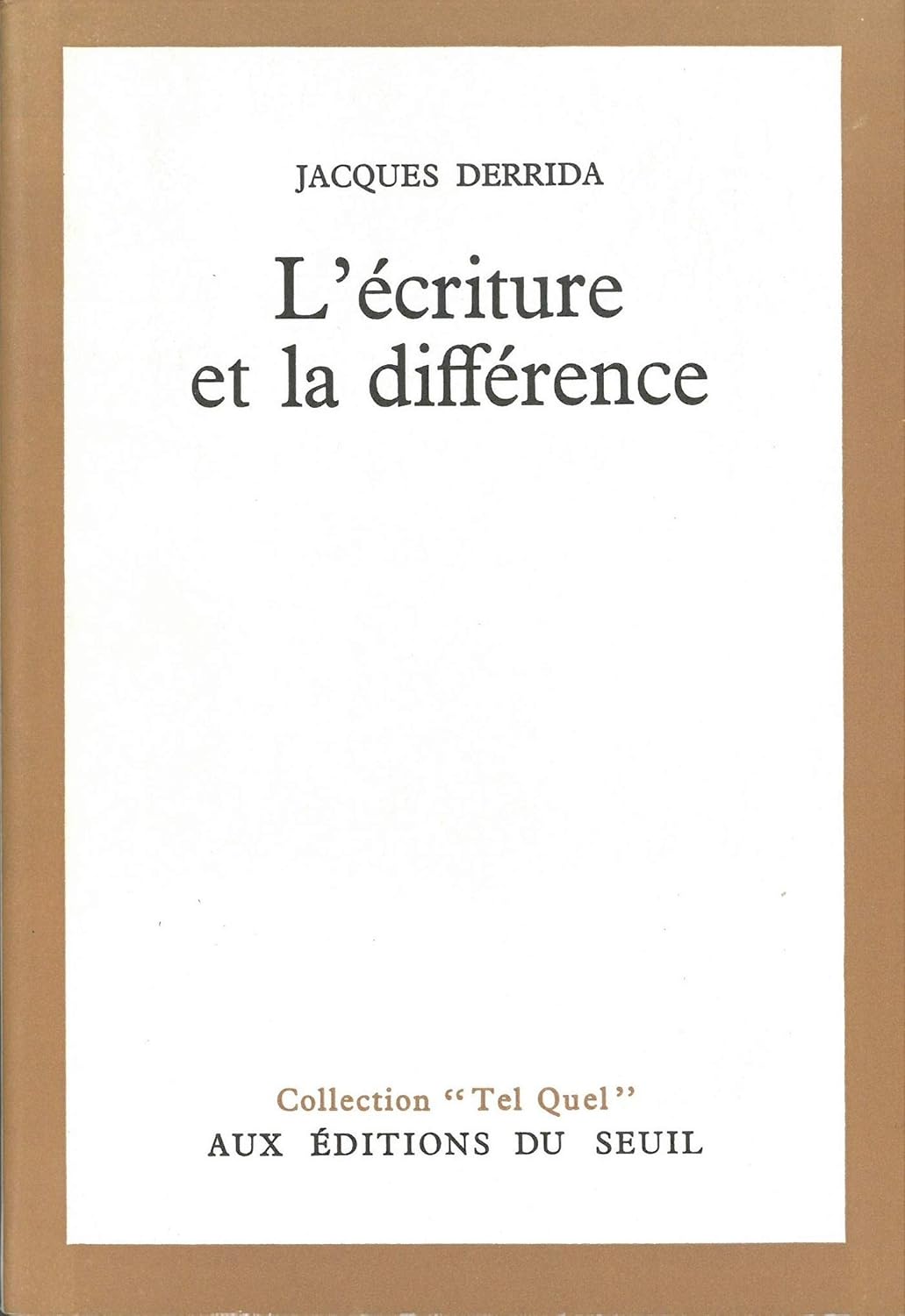
There are lots of small changes made by Jacques Derrida to his critique of Foucault between the 1963 article “Cogito et histoire de la folie” and its republication in the 1967 book L’écriture et la différence, translated by Alan Bass as Writing and Difference. As I indicated on Sunday, these changes included the incorporation of six notes first published in a short addendum to the article in 1964.
Note 1 (1964 article, p. 116) = L’écriture et la différence, pp. 53-54 n. 1; Writing and Difference, p. 390 n. 3.
Note 2 (1964 article, pp. 116-17) = L’écriture et la différence, p. 79 n. 1; Writing and Difference, p. 392 n. 15.
Note 3 (1964 article, p. 117) = L’écriture et la différence, p. 81 n. 1; Writing and Difference, p. 392 n. 16.
Note 4 (1964 article, p. 117) = L’écriture et la différence, p. 83 n. 1; Writing and Difference, pp. 392-93 n. 21.
Note 5 (1964 article, pp. 117-18) = L’écriture et la différence, p. 89-90 n. 1; Writing and Difference, pp. 393-94 n. 27.
Note 6 (1964 article, pp. 118-19) = L’écriture et la différence, pp. 90-91 n. 1; Writing and Difference, pp. 294-95 n. 28. Derrida adds “Mais Dieu, c’est l’autre nom de l’absolu de la raison elle-même, de la raison et du sens en général” to the start of the note in 1967.
I discuss the way those notes are integrated into the text here. There is no indication in 1967 that the notes are not in the original 1963 publication – the first footnote about how some notes were not in the lecture is also in the 1963 article.
Beyond the addition of these notes, there are quite a few stylistic changes between the two versions – capitalisation, introductory words to paragraphs or quotations, a few changes of person – je to nous, vous to on – and so on. There are a few substitutions of words. Many of those I couId imagine an author changing at proof stage for one or other text. I don’t intend to list all of those.
The more significant changes are these:
“Cogito et histoire de la folie”, p. 466: “… on ne peut protester contre elle qu’en elle. Ce qui revient à faire comparaître une détermination historique de la raison devant le tribunal de la Raison en général. La révolution contre la raison…”
L’écriture et la différence, p. 59: “… on ne peut protester contre elle qu’en elle, elle ne nous laisse, sur son propre champ, que le recours au stratagème et à la stratégie. Ce qui revient à faire comparaître une détermination historique de la raison devant le tribunal de la Raison en général. La révolution contre la raison…”
Writing and Difference, p. 42: “… that one can protest it only from within it; and within its domain, Reason leaves us only the recourse to strategems and strategies. The revolution against reason…”
Alan Bass translates Derrida’s addition, but omits the phrase “This amounts to bringing a historical determination of reason before the court of Reason in general”. I’d see the additional phrase in 1967 as linked to the next passage, which is probably the most important change beyond the notes.
“Cogito et histoire de la folie”, p. 466: “Un peu comme la révolution anti-colonialiste ne peut se libérer de l’Europe ou de l’Occident empiriques de fait, qu’au nom de l’Europe transcendantale, c’est-à-dire de la Raison, et en se laissant d’abord gagner par ses valeurs, son langage, ses sciences, ses techniques, ses armes ; contamination ou incohérence irréductible qu’aucun cri – je pense à celui de Fanon – ne peut exorciser, si pur et si intransigeant soit-il”.
L’écriture et la différence, p. 59: “On ne peut sans doute pas écrire une histoire, voire une archéologie contre la raison, car, malgré des apparences, le concept d’histoire a toujours été un concept rationnel. C’est la signification « histoire » ou « archie » qu’il eût peut-être fallu questionner d’abord. Une écriture excédant, à les questionner, les valeurs d’origine, de raison, d’histoire, ne saurait se laisser contenir dans la clôture métaphysique d’une archéologie”.
Writing and Difference, pp. 42-43: “A history, that is, an archaeology against reason doubtless cannot be written, for, despite all appearances to the contrary, the concept of history has always been a rational one. It is the meaning of ‘history’ or archia that should have been questioned first, perhaps. A writing that exceeds, by questioning them, the values ‘origin,’ ‘reason,’ and ‘history’ could not be contained within the metaphysical closure of an archaeology.
This passage is discussed by Edward Baring in “Liberalism and the Algerian War: The Case of Jacques Derrida”. Baring translates the 1963 text: Much like “the anticolonial revolution can only liberate itself from factual Europe or the empirical West, in the name of transcendental Europe, that is Reason, and first win with [Western] values, language, sciences, techniques, and weapons; an irreducible contamination or incoherence, that no cry—I am thinking of Fanon’s—can exorcise, however pure and intransigent it may be.” (p. 257; Baring’s addition in brackets). In 1967 Derrida drops the discussion of anti-colonial struggles and replaces it with a stronger criticism of writing a history or archaeology against reason.
“Cogito et histoire de la folie”, p. 469: “(Entzweiung hegelienne).”
L’écriture et la différence, p. 62: “Le dehors (est) le dedans, s’y entame et le divise selon la déhiscence de l’Entzweiung hegelienne”.
Writing and Difference, p. 46: “The exterior (is) the interior, is the fission that produces and divides it along the lines of the Hegelian Entzweiung”.
A useful expansion of what is rather cryptic in 1963 – Entzweiung is usually translated as diremption, as the word is stronger than division and means something closer to forcible separation or splitting or breaking in two.
“Cogito et histoire de la folie”, p. 471: “Pour l’enfermer.
A vrai dire…”
L’écriture et la différence, p. 65: “Pour l’enfermer.
A vouloir écrire l’histoire de la décision, du partage, de la différence, on court le risque de constituer la division en événement ou en structure survenant à l’unité d’une présence originaire; et de confirmer ainsi la métaphysique dans son opération fondamentale”.
A vrai dire…”
Writing and Difference, p. 48: “In order to lock it up.
The attempt to write the history of the decision, division [SE: distribution], difference runs the risk of construing the division as an event or a structure subsequent to the unity of an original presence, thereby confirming metaphysics in its fundamental operation”
Truthfully…”
Alan Bass translates both partage and division as ‘division’ – the first should probably be something different, and I’ve suggested distribution. Derrida’s expansion more clearly links the discussion of Foucault to his wider project of the examination of the metaphysics of presence.
“Cogito et histoire de la folie”, p. 483: “Elle est, pour reprendre une expression que Foucault propose ailleurs, renfermée à l’intérieur de l’extérieur.”
L’écriture et la différence, p. 80: “Elle est, pour reprendre une expression que Foucault propose ailleurs, renfermée à l’intérieur de l’extérieur et à l’extérieur de l’intérieur”.
Writing and Difference, p. 62: “Madness, to use an expression proposed elsewhere by Foucault, is confined to the interior of the exterior and to the exterior of the interior”.
Derrida simply completes the idea that these terms are interrelated.
“Cogito et histoire de la folie”, p. 486: “Tant que le doute ne sera pas levé évidemment”.
L’écriture et la différence, p. 85: “Du moins tant que le doute ne sera pas levé. Car la fin du doute pose un problème que nous retrouverons dans un instant”.
Writing and Difference, p. 67: “at least for as long as doubt remains unresolved. For the end of doubt poses a problem to which we shall return in a moment”.
A minor addition in the revised text.
“Cogito et histoire de la folie”, p. 487: “Il n’y a ni exclusion ni contournement”.
L’écriture et la différence, p. 86: “Elle vaut même si je suis fou. Suprême assurance qui semble ne requérir ni exclusion ni contournement”.
Writing and Difference, p. 67: “It is valid even if I am mad—a supreme self-confidence that seems to require neither the exclusion nor the circumventing of madness”.
The original reads “There is neither exclusion nor circumvention”. The revision stresses the validity of the cogito even for the mad, to justify the point.
“Cogito et histoire de la folie”, p. 487: “Il est tard. Il me faut conclure. Je le ferai dans un style qui, faute de temps, sera, je vous en demande pardon, plus dogmatique”.
In L’écriture et la différence, p. 86/Writing and Difference, p. 68, this comment about it being late and the move to a conclusion in more abbreviated and dogmatic style is deleted. (Derrida goes on for several more pages, so would have kept his audience for quite a while still.) Another comment about the lack of time on “Cogito et histoire de la folie”, p. 490 is also deleted from L’écriture et la différence, p. 91/Writing and Difference, p. 71.
“Cogito et histoire de la folie”, p. 489: “…se rassurer dans l’ordre des raisons pour reprendre possession des vérités abandonnées. C’est ici que l’errance hyperbolique et folle…”
L’écriture et la différence, p. 90: “…se rassurer dans l’ordre des raisons pour reprendre possession des vérités abandonnées. Dans le texte de Descartes du moins, le renfermement se produit à ce point. C’est ici que l’errance hyperbolique et folle…”
Writing and Difference, p. 70: “… are given reassurance within the order of reasons, in order once more to take possession of the truths they had left behind. Within Descartes’s text, at least, the internment takes place at this point. It is here that hyperbolical and mad wanderings…”
A one sentence addition in 1967.
“Cogito et histoire de la folie”, p. 491: “Ne peut-on prendre pour exemple, pour exemple seulement, d’une telle répétition du Cogito cartésien, dans le moment où il échappe encore à l’ordre des raisons, à l’ordre en général et aux déterminations de la lumière naturelle, ne pourrait-on prendre pour exemple d’une telle répétition le Cogito husserlien et la critique de Descartes qu’elle suppose ? Ce serait un exemple seulement car on découvrira bien un jour quel est le sol dogmatique et historiquement déterminé – le nôtre – sur lequel la critique du déductivisme cartésien, l’essor et la folie de la réduction husserlienne de la totalité du monde ont dû se reposer puis déchoir pour se dire. On pourrait refaire pour Husserl ce que Foucault a fait pour Descartes : montrer comment la neutralisation du monde factuel est une neutralisation (au sens où neutraliser, c’est aussi maîtriser, réduire, laisser libre dans une camisole), une neutralisation du non-sens, la forme la plus subtile d’un coup de force. Et en vérité, Husserl associait de plus en plus le thème de la normalité et celui de la réduction transcendantale”.
L’écriture et la différence, pp. 92-93: “Quant au fonctionnement de l’hyperbole dans la structure du discours de Descartes et dans l’ordre des raisons, notre lecture est donc, malgré l’apparence, profondément accordée à celle de Foucault. C’est bien Descartes — et tout ce qui s’indique sous ce nom —, c’est bien le système de la certitude qui a d’abord pour fonction de contrôler, maîtriser, limiter l’hyperbole en la déterminant dans l’éther d’une lumière naturelle dont les axiomes sont d’entrée de jeu soustraits au doute hyperbolique, et en faisant de son instance un point de passage solidement maintenu dans la chaîne des raisons. Mais nous pensons que ce mouvement ne peut être décrit en son lieu et en son moment propres que si l’on a préalablement dégagé́ la pointe de l’hyperbole, ce que Foucault, semble-t-il, n’a pas fait. Dans le moment si fugitif et par essence insaisissable où il échappe encore à l’ordre linéaire des raisons, à l’ordre de la raison en général et aux déterminations de la lumière naturelle, est-ce que le Cogito cartésien ne se laisse pas répéter, jusqu’à un certain point, par le Cogito husserlien et par la critique de Descartes qui s’y trouve impliquée ?
Ce serait un exemple seulement car on découvrira bien un jour quel est le sol dogmatique et historiquement déterminé — le nôtre — sur lequel la critique du déductivisme cartésien, l’essor et la folie de la réduction husserlienne de la totalité́ du monde ont dû se reposer puis déchoir pour se dire. On pourra refaire pour Husserl ce que Foucault a fait pour Descartes : montrer comment la neutralisation du monde factuel est une neutralisation (au sens où neutraliser, c’est aussi maîtriser, réduire, laisser libre dans une camisole), une neutralisation du non-sens, la forme la plus subtile d’un coup de force. Et en vérité́, Husserl associait de plus en plus le thème de la normalité et celui de la réduction transcendantale. L’enracinement de la phénoménologie transcendantale dans la métaphysique de la présence, toute la thématique husserlienne du présent vivant est l’assurance profonde du sens en sa certitude”.
Writing and Difference, pp. 72-73: “As for the functioning of the hyperbole in the structure of Descartes’s discourse and in the order of reasons, our reading is therefore, despite all appearances to the contrary, profoundly aligned with Foucault’s. It is indeed Descartes—and everything for which this name serves as an index—it is indeed the system of certainty that first of all functions in order to inspect, master, and limit hyperbole, and does so both by determining it in the ether of a natural light whose axioms are from the outset exempt from hyperbolical doubt, and by making of hyperbolical doubt a point of transition firmly maintained within the chain of reasons. But it is our belief that this movement can be described within its own time and place only if one has previously disengaged the extremity of hyperbole, which Foucault seemingly has not done. In the fugitive and, by its essence, ungraspable moment when it still escapes the linear order of reasons, the order of reason in general and the determinations of natural light, does not the Cartesian Cogito lend itself to repetition, up to a certain point, by the Husserlian Cogito and by the critique of Descartes implied in it?
This would be an example only, for some day the dogmatic and historically determined grounds—ours—will be discovered, which the critique of Cartesian deductivism, the impetus and madness of the Husserlian reduction of the totality of the world, first had to rest on, and then had to fall onto in order to be stated. One could do for Husserl what Foucault has done for Descartes: demonstrate how the neutralization of the factual world is a neutralization (in the sense in which to neutralize is also to master, to reduce, to leave free in a straitjacket) of nonmeaning, the most subtle form of an act of force. And in truth, Husserl increasingly associated the theme of normality with the theme of the transcendental reduction. The embedding of transcendental phenomenology in the metaphysics of presence, the entire Husserlian thematic of the living present is the profound reassurance of the certainty of meaning.
In 1967 Derrida expands the point about the relation between the Cartesian and Husserlian cogito. There is a sentence replaced with a paragraph, a shared passage (“Ce serait un exemple… réduction transcendantale”, and then another sentence, again linking this to his wider critique of the metaphysics of presence.
“Cogito et histoire de la folie”, p. 493: “… dans la folie et dans la mort. Ce vouloir-dire-l’hyperbole-démonique n’est pas un vouloir parmi d’autres”.
L’écriture et la différence, p. 95: “dans la folie et dans la mort. Au plus haut d’elle-même, l’hyperbole, l’ouverture absolue, la dépense anéconomique est toujours reprise et surprise dans une économie. Le rapport entre la raison, la folie et la mort, est une économie, une structure de différance dont il faut respecter l’irréductible originalité. Ce vouloir-dire-l’hyperbole-démonique n’est pas un vouloir parmi d’autres…”
Writing and Difference, p. 75: “in madness or in death. At its height hyperbole, the absolute opening, the uneconomic expenditure, is always reembraced by an economy and is overcome by economy. The relationship between reason, madness, and death is an economy, a structure of deferral whose irreducible originality must be respected. This attempt-to-say-the-demonic-hyperbole is not an attempt among others…”
I’d also see this addition as linking the specific critique of Foucault to some wider themes of Derrida’s work.
“Cogito et histoire de la folie”, p. 493: “… et aussi une passion première”.
L’écriture et la différence, p. 96: “… est aussi une passion première. Il garde en lui la trace d’une violence. Il s’écrit plutôt qu’il ne se dit, il s’économise. L’économie de cette écriture est un rapport réglé entre l’excédant et la totalité excédée : la diffêrance de l’excès absolu”.
Writing and Difference, p. 75: “…is also a first passion. It keeps within itself the trace of a violence. It is more written than said, it is economized. The economy of this writing is a regulated relationship between that which exceeds and the exceeded totality: the différance of the absolute excess”.
This addition is also important because it introduces some of the key themes of Derrida’s wider project, particularly here the spelling of différance with an ‘a’. This change is significant for the dating of Derrida’s use of this key term: despite some claims, it is not in the 1963 version, and this essay is therefore not its first use. Daniele de Santis has indicated that Derrida’s essay on Antonin Artaud, “La Parole soufflée”, published in Tel Quel in 1965, is the first instance in print, but that it was apparently said in 1959 in a piece on “‘Genèse et structure’ et la phénoménologie”, also first published in 1965. Those essays are included, again with revisions, in L’écriture et la différence in 1967. That book was published around the same time as the use of différance in Speech and Phenomena, and before the 1968 lecture “La Différance” (which is in English both as an appendix to Speech and Phenomena and in Margins of Philosophy).
As I indicated in the previous piece: “It’s often remarked that Foucault took a long time to reply to Derrida’s 1963 critique. It’s less often mentioned that the text he was responding to was not fixed until 1967…”
As with all these textual comparisons, I’m happy to receive corrections for anything I’ve missed. There are lots more comparisons of texts by Foucault listed here.
References
Edward Baring, “Liberalism and the Algerian War: The Case of Jacques Derrida”, Critical Inquiry 36 (2), 2010, 239-61.
Jacques Derrida, ‘Cogito et histoire de la folie’, Revue de métaphysique et de morale 68 (4), 1963, 460-94.
Jacques Derrida, “A propos de «Cogito et histoire de la folie»”, Revue de métaphysique et morale 69 (1), 1964, 116-19.
Jacques Derrida, L’Écriture et la différence, Paris: Seuil, 1967; Writing and Difference, trans. Alan Bass, London: Routledge, 1978.
Jacques Derrida, La Voix et le phenomenon, Paris: Presses Universitaires de France, 1967; Speech and Phenomena, and Other Essays on Husserl’s Theory of Signs, trans. David B. Allison and Newton Garver, Evanston: Northwestern University Press, 1973.
Jacques Derrida, Marges – De la philosophie, Paris: Minuit, 1967; Margins of Philosophy, trans. Alan Bass, Brighton: Harvester, 1982.
Daniele de Santis, “The Double Meaning of différance: Remarks on its First Appearance”, Alter: Revue de phénoménologie 18, 2010, 297-304.
This note is a supplement to the most recent piece in the ‘Sunday histories‘ series, Foucault and his Critics – two minor notes on his exchanges with Jacques Derrida and J.M. Pelorson. This was the 58th post of a weekly series, posted every Sunday throughout 2025, and now entering a second year. The posts are short essays with indications of further reading and sources. A few, usually shorter, pieces in a similar style have been posted mid-week.
The full chronological list of ‘Sunday histories’ is here, with a thematic ordering here.
Discover more from Progressive Geographies
Subscribe to get the latest posts sent to your email.


Pingback: Foucault and his Critics – two minor notes on his exchanges with Jacques Derrida and J.M. Pelorson | Progressive Geographies
Pingback: fabiosulpizioblog
Harvey talking up his new book
https://podcasts.apple.com/us/podcast/behind-the-news-how-capital-works-w-david-harvey/id791564318?i=1000748963516
Pingback: Indo-European Thought in Twentieth-Century France update 31 – Paris archives, library problems, and working towards a complete draft | Progressive Geographies