
Andrea Bardin, Hobbes’s Materialist Agenda: The Politics of Early Modern Science – Edinburgh University Press, January 2026
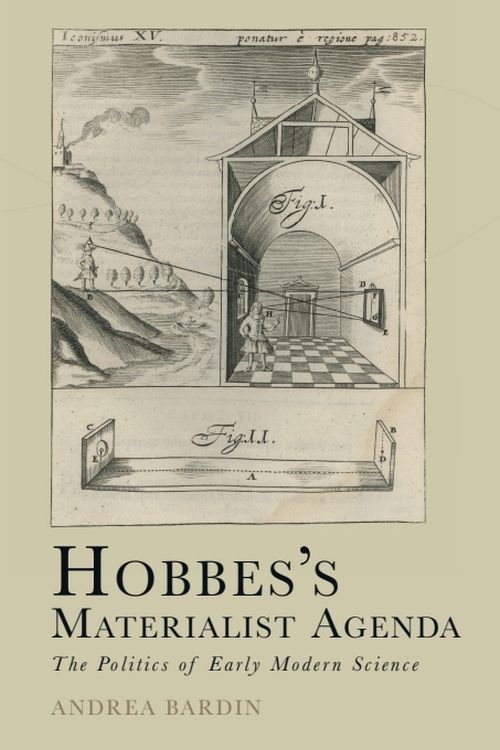
Details the evolution of Hobbes’s political theory in connection with his philosophical materialism
- Analyses how Hobbes’s political theory developed in relation to his philosophical system
- Sheds new light on the political significance of Hobbes’s concepts of liberty, determinism, right reason, void, conatus, power, imagination and representation
- Conceptualises the tension between Hobbes’s materialism and Descartes’s idealism to critique the ideology implicit in mechanical philosophy
- Brings together political philosophy, the history of political thought and the history of science to interrogate the political stakes of early-modern science
In this major contribution to our understanding of Hobbes’s political thought, Andrea Bardin contends that it should be analysed in relation to the ‘materialist agenda’ Hobbes was pursuing when confronting Descartes’s project. Bardin pinpoints the changes in Hobbes’s political thought to the intellectual context in which he elaborated his materialist ontology and epistemology. He investigates the classical sources that initially shaped Hobbes’s political thinking, including Thucydides and Aristotle, as well as the broad materialist agenda that Hobbes drew from Bacon and elaborated in opposition to Descartes. He studies Hobbes’s exchanges with his contemporary interlocutors in the Mersenne circle, including Descartes and Gassendi, with whom he discussed first philosophy and natural philosophy. In this way, Bardin vindicates materialist critiques of the idealist foundations of early modern mechanical philosophy.
Discover more from Progressive Geographies
Subscribe to get the latest posts sent to your email.


