
The draft of the Mapping Indo-European Thought manuscript is slowly coming together. I’ve just begun a Fernand Braudel fellowship at the European University Institute in Florence. My plan was to come here with a complete draft, and to leave with a better one. I nearly managed the first – there were still a few bits which needed to be added, but it was just about there. The purpose of a draft is to exist, since something which exists can be improved. It still needs a lot of work, and I’m hoping the weeks I will be in Florence will allow me to develop it.
I had a few days in Paris in late 2025, where I spent the time moving between the Collège de France and the Bibliothèque nationale. At the Bibliothèque nationale I was going back over some boxes of the Benveniste archive, things which I’d looked at before but mainly with a focus on the Vocabulaire. This time I was interested in the remnants of his teaching, which are patchy but can be interesting. I’m relating them to the short reports published in the Annuaire of the Collège de France, and to some student notes which exist in different places. Some also relate to publications – he sometimes wrote up material from teaching, but also sometimes used publications, recently published or in press, as the basis for lectures. I also looked at a couple of boxes of the Foucault archive relating to his interest in hermaphrodites (on which, see here and here), and one box of the Lévi-Strauss papers concerning his opposition to language reform, which I write about here. I also read some more of the Foucault-Dumézil correspondence, which is in different places. That box also has his correspondence with, among others, Derrida, which led to a couple of pieces about the Foucault-Derrida exchange – here and here.
At the Collège de France, I looked at two boxes of the Georges Dumézil papers relating to very late book projects, one of which was published posthumously as Le Roman des jumeaux et autre essais, since it was almost complete; and another, the planned fourth volume of Mythe et Épopée, which was abandoned. I also returned to a couple of boxes of the much smaller Benveniste collection, and asked to see, again, another box they had relating to him. As is often the way, it was the last thing I looked at, on the last day, which was the biggest surprise – a set of notes from a student for a very early Benveniste course. I’d like to get back again and take a more thorough look at this.
The vast majority of the archival work is, however, complete. My Leverhulme fellowship is now over, even with the no-cost extension, and so I am currently without external funding. Any further archival work will therefore be limited – I think I need at least one more week in Paris, and there are a couple of other places I’d like to visit if I can. But there is always more which could be done.
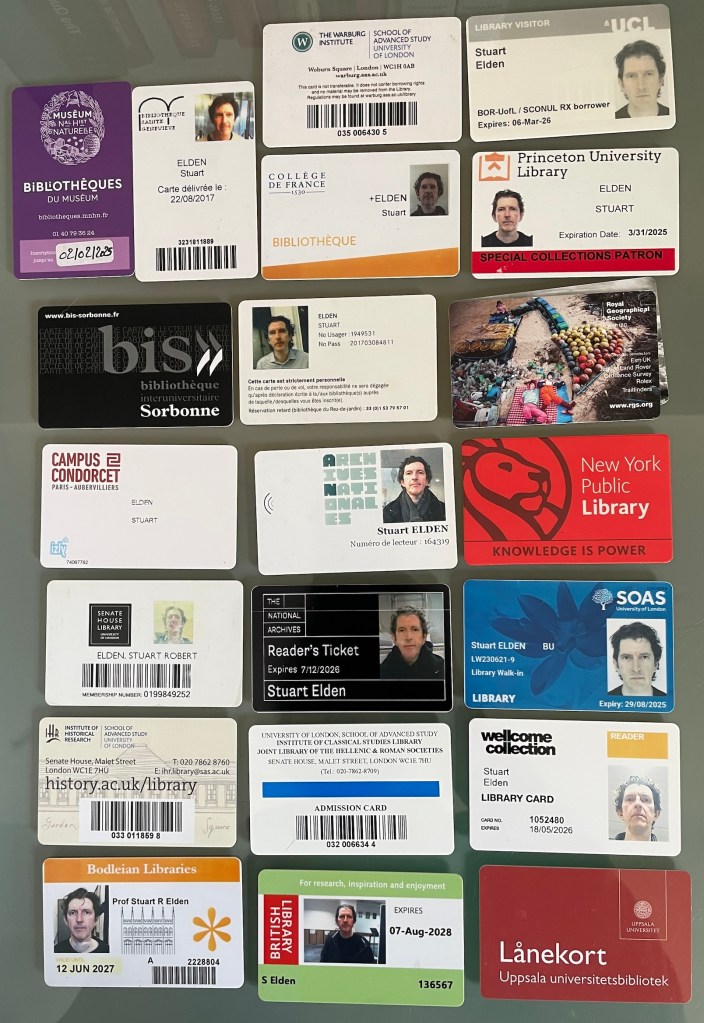
I have also been working in London libraries. I’ve mentioned before the challenges of working at the British Library since the cyber-attack in October 2023, and only in December 2025, more than two years later, were they able to have a full online catalogue and ordering system working. In recent months, an interim catalogue had linked to an online form to request things, but it was clunky and there wasn’t an online way to check if things you’d ordered were actually available. You would get an email to say effectively that they had begun looking for it. Before the new catalogue went online there was a pause of a week when it wasn’t possible to order anything to reading rooms – understandable, and worth it to make the new system work, but it coincided with some days I was planning to be in London. It then was delayed for a week. For me that’s not a huge problem, but I was thinking of what it would have been like for me if a similar pause was in place at the Bibliothèque nationale when I was in Paris, and wondering what this meant for others for whom London is a more involved trip. In November the beleaguered and underpaid staff of the BL were on strike for two weeks, a revised offer was rejected, and the chief executive resigned after less than a year in post. Another strike took place in December, part of the reason for the new catalogue being delayed. A great institution, so valuable for research, education and public access seems to go from one crisis to another. Hetan Shah has written a useful piece about this, though strangely doesn’t mention the staff dispute.
When the library was effectively out of action I used other London libraries, particularly the Warburg Institute which is somewhere I’ve always liked working. But then that was closed for nearly a week after a burst pipe, flooding and damage both to the building and some of the collection. When it reopened, the lower ground floor was inaccessible, and that’s where the periodicals are stored, which is the main thing I needed to consult.
More positively, I returned to various sets of notes and draft text for parts of the book manuscript. They are intended to be interludes between the longer alternating chapters on Benveniste and Dumézil. One is on Mircea Eliade’s decade in Paris after the Second World War, another is one Dumézil’s lifelong parallel career working on Caucasian linguistics and mythology, and a third on Lévi-Strauss’s links to Benveniste and Dumézil. I managed to get these into decent shape with some intense days of work in December and January. Some of this was making decisions about content and structure, and then going with that, moving stuff around and cutting. Nothing is ever completely thrown away, but some things just didn’t fit. I will probably have to be more ruthless with these at a later stage, but they are now parked for this version.
With that attitude, I was then able to edit some long note files into discussions of the importance of Dumézil and/or Benveniste to some more famous names of ‘French theory’ – including Barthes, Kristeva, Derrida, Deleuze and Guattari, Foucault and Lacan. I then moved to a long section on the importance of this work for French classicists – mainly focusing on Vernant, Detienne and Ramnoux, with some reference to others.
At the EUI, I’m now working through each chapter of the draft in sequence, trying to fix things which were unresolved and make lists of what I’ll need to do when back in the UK. Although being in Florence is very nice, and the library here is good, there are inevitably a lot of things which they don’t have.
The ‘Sunday Histories’ series has continued with pieces on Foucault’s Multiple Plans for his History of Sexuality and a shorter piece on his 24 May 1979 paper about hermaphrodites at the Arcadie conference; on Gordon and Tina Wasson, Slavic Studies in the Cold War, and the Hallucinogenic Mushroom; on Huguette Fugier’s study of the vocabulary of the sacred in Latin, and Giorgio Agamben’s other sources for the notion of the homo sacer, on Boris Porshnev’s parallel research careers on peasant revolts in 17th century France and cryptozoology and the quest for the Soviet Yeti, and a more political piece on 100 years since the Locarno Treaties and territorial integrity today, posted to coincide with the centenary of the signing of the treaties in London. The most recent are on Lévi-Strauss and Roger Caillois, about tracking down an incorrect reference in Foucault’s Birth of the Clinic, about Fernand Braudel and the Writing and Teaching of History in Captivity, on Clémence Ramnoux – Mythology, Psychology, Philosophy, and Mircea Eliade on alchemy; Marie-Madeleine Davy on mysticism and symbolism. Several of these connect in some way to the Indo-European manuscript, while others relate to previous research interests or some potential future projects.
Some of the long file I’ve drafted a while ago on Roland Barthes didn’t fit this book manuscript, although there is a discussion of his debt to Benveniste in the current draft. So some of the parts I didn’t use became draft material for two linked posts on Roland Barthes and the Question of Territory – Animals, Spaces and Sound and Roland Barthes’s Seminar on the Metaphor of the Labyrinth, which also discusses the presentations in that seminar by Detienne, Deleuze and Rosenstiehl. I have a developed discussion of a 1970 conference on structuralism in draft (which I mention briefly here), and a few other ideas for future posts. Some of the other material I’d drafted or taken notes on for this book might end up being shared in this series, as I make decisions on what I can’t include. I’m not sure how much longer I’ll keep up a weekly rhythm to these posts, but so far I don’t seem to be running out of ideas.
Previous updates on this project can be found here, along with links to some research resources and publications. The re-edition of Georges Dumézil’s Mitra-Varuna is available open access. My recent articles include “Foucault, Dynastics and Power Relations” in Philosophy, Politics and Critique and “Foucault and Dumézil on Antiquity” in Journal of the History of Ideas (both require subscription, so ask if you’d like a copy); and “Alexandre Koyré and the Collège de France” in History of European Ideas (open access).
The full chronological list of ‘Sunday histories’ is here, with a thematic ordering here.
Discover more from Progressive Geographies
Subscribe to get the latest posts sent to your email.


