
With only rare exceptions, I’ve not tended to buy second-hand books with a view to the edition or dedications. Generally, I’ve been getting hold of copies because of the content, and the relatively few times I’ve looked for a first edition has been when that is different from later reprints. This was the case, for example, with some of Foucault’s early books.
One of the exceptions was getting a book from the sale of Georges Bataille’s library – a copy of Musset, dedicated by Henri Lefebvre. That copy is briefly mentioned and photographed here.
With Georges Dumézil, tracking down some of his books can be a challenge in any edition or condition, and one of the few times I tried hard to get a first edition was with Mitra-Varuna, in part because of changes between it and the second edition, and the editorial work I was doing. I did eventually get a copy, and I say a bit more about the challenges of finding the first edition here.
With his other books, with two exceptions I have found copies, and by chance, a couple of them have dedications. They were not especially expensive – I’m not sure that the sellers realised it was his handwriting, which is hard to read, and Dumézil hardly has the premium to his name that, for example, a signed book by Foucault would have.
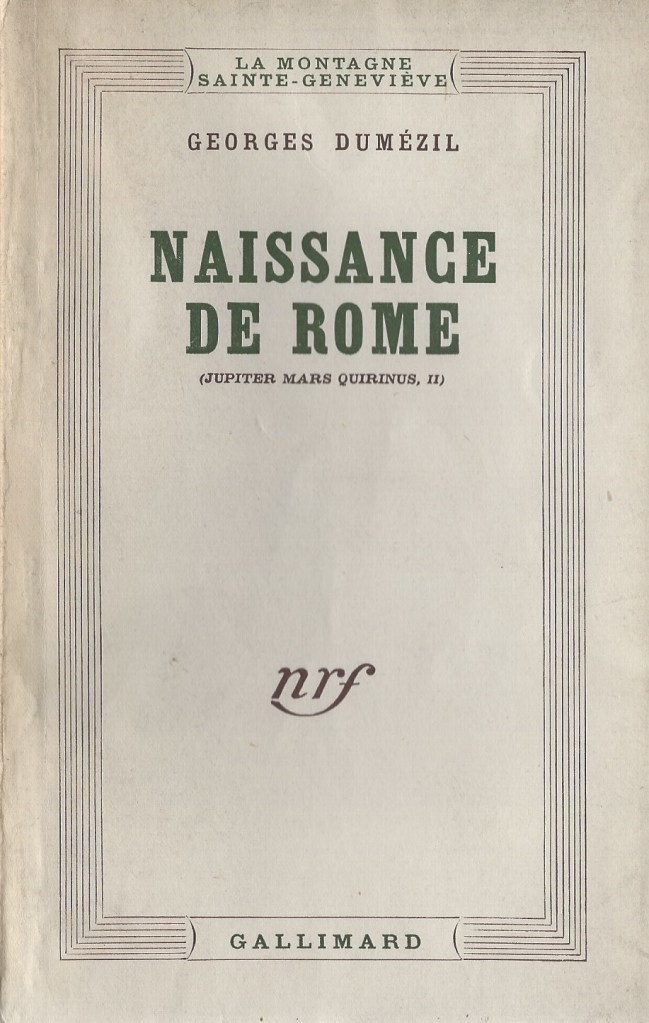


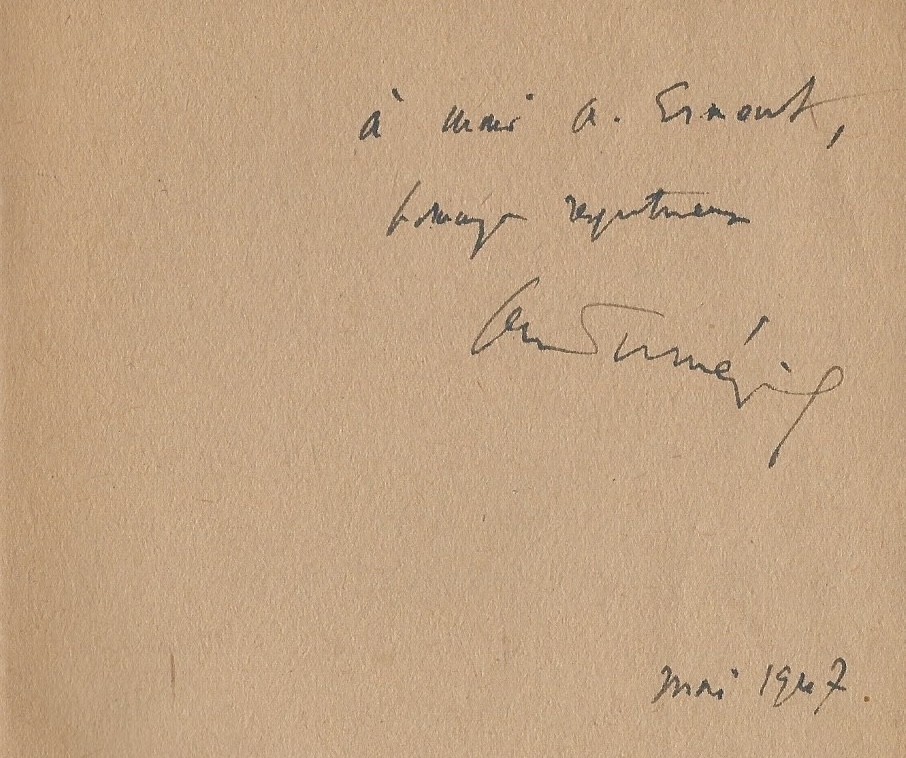
The copy of Naissance de Rome has the dedication: “à Monsieur Luc Estang / hommage de Dumézil”.
The copy of Tarpeia says “à Monsieur A. Ernest, hommage respectueux / Georges Dumézil / mai 1947”.
The dedicatees are in themselves interesting. Alfred Ernout was a colleague of Dumézil’s at the Collège de France and a specialist on Latin. He and Antoine Meillet co-authored an etymological dictionary of Latin. But Ernout had known Dumezil for decades, teaching him at a lycée in Troyes.
Luc Estang was the pen-name of the unfortunately named Luc Bastard, a novelist, poet and literary critic. I know little about his links to Dumezil, though it is not surprising they would have known each other.
References
Georges Dumézil, Tarpeia, Paris: Gallimard, 1947 (Les Mythes Romaines series).
Georges Dumézil, Naissance de Rome (Jupiter, Mars, Quirinus II), Paris: Gallimard, 1944.
Alfred Ernout and Antoine Meillet, Dictionnaire étymologique de la langue latine: Histoire des mots, Paris: Klincksieck, revised fourth edition, 2001 [1932].
This note is in the same style as the ‘Sunday histories‘ posts, though its minor status means I’ve posted it mid-week.
Discover more from Progressive Geographies
Subscribe to get the latest posts sent to your email.


