Authorship Regained: An Interview with Julien Stout about L’auteur retrouvé – Journal of the History of Ideas blog

Authorship Regained: An Interview with Julien Stout – Journal of the History of Ideas blog

Interview by Carolina Iribarren, in relation to Stout’s book L’auteur retrouvé : l’avènement des premiers recueils à collections auctoriales de langue française au Moyen Âge central – Droz, 2025).

Posted in Uncategorized | Leave a comment

Francesco Biagi, Renewing Urban Critical Theories Rediscovering Thinkers, Reimagining Texts, and Reframing Questions – Routledge, November 2025

Francesco Biagi, Renewing Urban Critical Theories Rediscovering Thinkers, Reimagining Texts, and Reframing Questions – Routledge, November 2025

This book presents an interdisciplinary and international reevaluation of urban critical theories, bringing together key perspectives from around the world on contemporary urban studies.

Engaging with a wide range of issues related to the urban question – including urban sprawl, housing, and the accelerating rates of urbanization globally – it weaves together interconnected dimensions of urban inequality, analyzing how class, gender, and race serve as fundamental axes shaping contemporary social phenomena. The book also possesses a crucial capacity to integrate various interrelated issues within urban studies while fostering dialogue between established scholars and emerging researchers, ultimately seeking to move beyond the confines of the Global North by devoting only one-third of its content to this context, while emphasizing perspectives from other regions and problematizing the imperialism issue in an urban context. Additionally, it aspires to offer a book that not only serves an academic audience but also possesses a broader, accessible character, appealing to politically engaged individuals, including those involved in progressive political parties and social movements.

As such, the volume will appeal to scholars across disciplines, as well as politically engaged individuals, who are interested in critical theoretical analyses of contemporary urban and spatial transformations, as well as the phenomenon of planetary urbanization. Its primary objective is to bring together diverse perspectives and ongoing debates on the urban question.

Posted in Uncategorized | 1 Comment

Engin Isin, The Birth of Sensory Power: Doing Things with Words, Numbers and Neurons – Edinburgh University Press, November 2025

Engin Isin, The Birth of Sensory Power: Doing Things with Words, Numbers and Neurons – Edinburgh University Press, November 2025

How have datasciences and neurosciences converged to create a new form of power, polity and citizenship?

  • Proposes a theory of sensory power and re-examines theories of sovereign, disciplinary, and regulative powers
  • Offers a revised history of datasciences and neurosciences
  • Develops a revised theory of the brain-machine imitation game, offering an account of how the imitation game affects cities, states, and empires and produces the autopoietic subject

This book examines the transformation of historical forms of power and the emergence of new polities and citizen-subjects produced by a new form of power – sensory power – in the 21st century. Engin Isin highlights how sensory power, driven by artificial intelligence and machine learning, transforms historical forms of power (sovereign, disciplinary and regulative), reconfigures cities, states, and empires, and engenders the autopoietic subject. Drawing from thinkers like Spinoza, Nietzsche, Deleuze, and Foucault, and reworking their theories of power with Austin and Derrida, the book offers a critical perspective on these changes.

Posted in Engin Isin, Uncategorized | 1 Comment

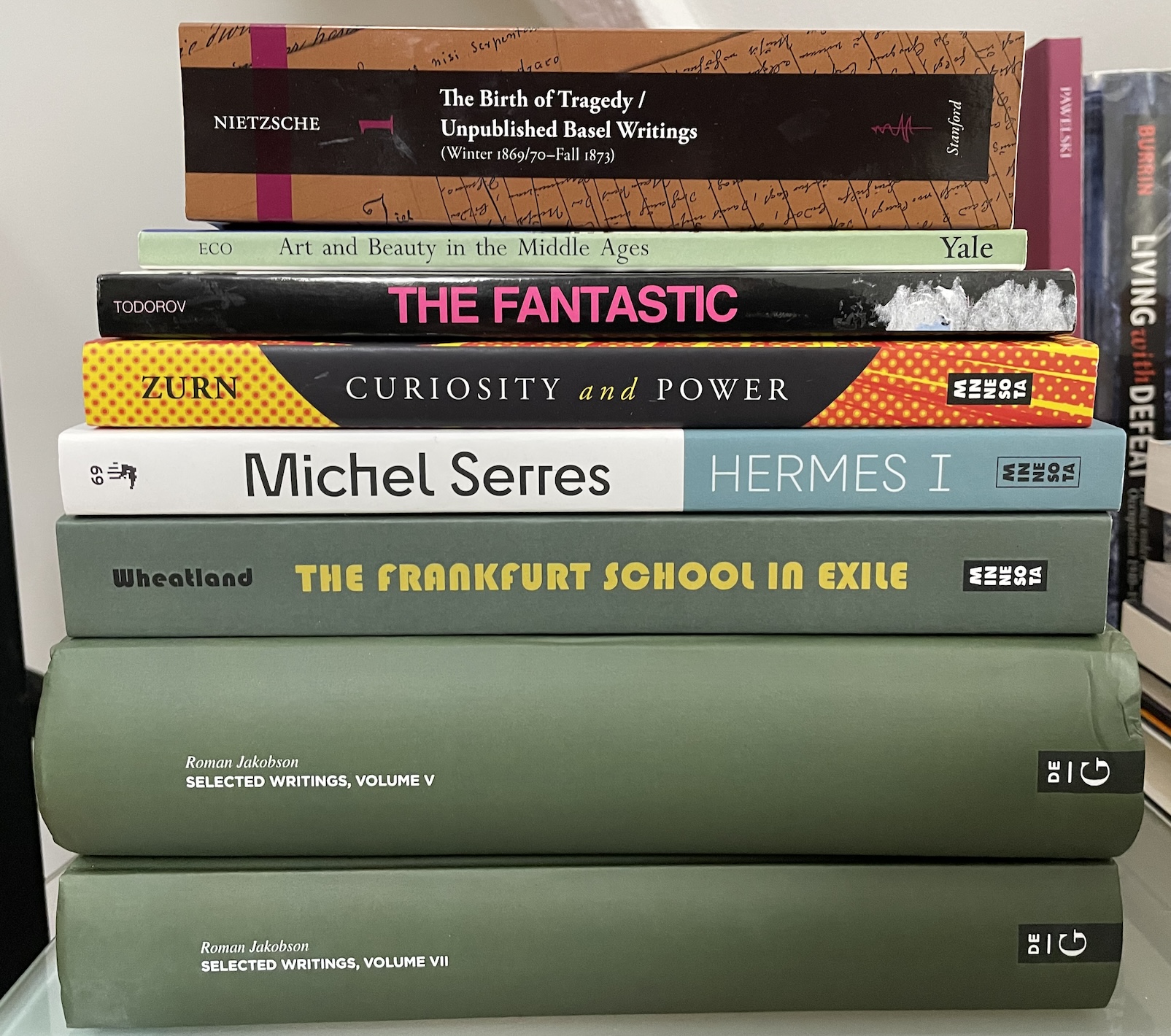
Books received – Porshnev, Jameson, Coveney, de Menasce, Foucault, Medby, Chimisso, Blencowe, Braudel, Jakobson

A few books bought recently, mostly second-hand; Fredric Jameson, The Political Unconscious, Cristina Chimisso, Hélène Metzger, Historian and Historiographer of the Sciences, Ingrid Medley, Arctic State Identity and Claire Blencowe, Spirits of Extraction, in recompense for review work; and Foucault’s Binswanger and Existential Analysis, sent by Columbia University Press.

Posted in Boris Porshnev, Fernand Braudel, Fredric Jameson, Ludwig Binswanger, Michel Foucault, Roman Jakobson, Uncategorized | Leave a comment

Cyanne E. Loyle, Escaping Justice: Impunity for State Crimes in the Age of Accountability – Cambridge, October 2025 (print and open access)

Cyanne E. Loyle, Escaping Justice: Impunity for State Crimes in the Age of Accountability – Cambridge, October 2025 (print and open access)

Now more than ever the international community plays a central role in pressing governments to hold their own to account. Despite pressure to adhere to global human rights norms, governments continue to benefit from impunity for their past crimes. In an age of accountability, how do states continue to escape justice? This book presents a theory of strategic adaptation which explains the conditions under which governments adopt transitional justice without a genuine commitment to holding state forces to account. Cyanne E. Loyle develops this theory through in-depth fieldwork from Rwanda, Uganda, and Northern Ireland conducted over the last ten years. Research in each of these cases reveals a unique strategy of adaption: coercion, containment, and concession. Using evidence from these cases, Loyle traces the conditions under which a government pursues its chosen strategies and the resulting transitional justice outcomes. This title is also available as Open Access on Cambridge Core.


Posted in Uncategorized | Leave a comment

Iftekhar Iqbal, The Range of the River: A Riverine History of Empire across China, India, and Southeast Asia – Stanford University Press, December 2025

Iftekhar Iqbal, The Range of the River: A Riverine History of Empire across China, India, and Southeast Asia – Stanford University Press, December 2025

Spanning nearly 4 million square kilometers, the Tibetan river system—including the Brahmaputra, Irrawaddy, Salween, Mekong, Red, and Yangzi—forms the largest contiguous network of rivers on the planet, stretching across eastern South Asia, mainland Southeast Asia, and southern China. The Range of the River uncovers the entwined histories of these vast waterways and the empires, human actors, and other-than-human forces that have shaped Asia since the 1850s. Both ethnodiverse and biodiverse, these rivers were more than contested imperial spaces—they were also channels of communal and material exchange, linking near and distant contact zones. They fostered connections across Asia, driving commerce, mobility, and cultural encounters that transformed them into shared, living commons bridging societies, political powers, and economic interests.

Tracing six major rivers across eight countries, Iftekhar Iqbal argues that these river systems formed the core of a discursive space where empires, regional political forces, ethnic groups, boaters, peddlers, explorers, merchants, and mules encountered each other in layered meanings and movements. This groundbreaking book reimagines the river not as merely a tool of empire but as a dynamic force in itself, shaping a truly transregional Asia. By weaving together diverse riverine life-worlds, The Range of the River invites us to rethink Asia’s spatial history.

Posted in Uncategorized | 1 Comment

Sebastian Truskolaski, Adorno and the Ban on Images – Bloomsbury, December 2020 and New Books discussion

Sebastian Truskolaski, Adorno and the Ban on Images – Bloomsbury, December 2020

New Books discussion with Lukas Hoffman – thanks to dmf for the link

This book upends some of the myths that have come to surround the work of the philosopher Theodor W. Adorno – not least amongst them, his supposed fatalism. 

Sebastian Truskolaski argues that Adorno’s writings allow us to address what is arguably the central challenge of modern philosophy: how to picture a world beyond suffering and injustice without, at the same time, betraying its vital impulse. By re-appraising Adorno’s writings on politics, philosophy, and art, this book reconstructs this notoriously difficult author’s overall project from a radically new perspective (Adorno’s famous ‘standpoint of redemption’), and brings his central concerns to bear on the problems of today.

On the one hand, this means reading Adorno alongside his principal interlocutors (including Kant, Marx and Benjamin). On the other hand, it means asking how his secular brand of social criticism can serve to safeguard the image of a better world – above all, when the invocation of this image occurs alongside Adorno’s recurrent reference to the Old Testament ban on making images of God.

By reading Adorno in this iconoclastic way, Adorno and the Ban on Imagescontributes to current debates about Utopia that have come to define political visions across the political spectrum.

Posted in Uncategorized | 1 Comment

Joel Wainwright, The End: Marx, Darwin, and the Natural History of the Climate Crisis – Verso, November 2025

Joel Wainwright, The End: Marx, Darwin, and the Natural History of the Climate Crisis – Verso, November 2025

How Marx provides new insights into our environmental crisis when read alongside Darwin

In this pathbreaking study, Joel Wainwright shows how deeply Darwin influenced Capital. Marx’s thinking about history and nature changed, generating a distinctive ecological critique of capitalism as a social formation. Marx even called Capital a study of natural history.

Posted in Uncategorized | Leave a comment

Federico Marcon, Fascism: The History of a Word – University of Chicago Press, June 2025 and JHI blog interview with Jonathon Catlin

Federico Marcon, Fascism: The History of a Word – University of Chicago Press, June 2025

I’ve shared news of the book before, now there is a two-part interview at the Journal of the History of Ideas blog (part I; part II) with Jonathon Catlin

A wide-ranging history of the term “fascism,” what it has meant, and what it means today.
 
The rise and popular support for authoritarianism around the world and within traditional democracies have spurred debates over the meaning of the term “fascist” and when and whether it is appropriate to use it. The landmark study Fascism: The History of a Word takes this debate further by tackling its most fundamental questions: How did the terms “fascism” and “fascist” come to be in the first place? How and in what circumstances have they been used? How can they be understood today? And what are the advantages (or disadvantages) of using “fascism” to make sense of interwar authoritarianism as well as contemporary politics?
 
Exploring the writings and deeds of political leaders, activists, artists, authors, and philosophers, Federico Marcon traces the history of the term’s use (and usefulness) in relation to Mussolini’s political regime, antifascist resistance, and the quest of postwar historians to develop a definition of a “fascist minimum.” This investigation of the semiotics of “fascism” also aims to inquire about people’s voluntary renunciation of the modern emancipatory ideals of freedom, equality, and solidarity.

Posted in Uncategorized | 1 Comment

Elena Del Rio, Techno-Ecologies of Bill Viola and Gilbert Simondon: The Birth of Form – Edinburgh University Press, November 2025

Elena Del Rio, Techno-Ecologies of Bill Viola and Gilbert Simondon: The Birth of Form – Edinburgh University Press, November 2025

Jointly explores Bill Viola’s video art and Gilbert Simondon’s philosophy of individuation through their shared understanding of the interpenetration of nature and technology

  • Expands the study of Viola’s art beyond aesthetics and beyond representation
  • Situates Viola’s aesthetic practice in relation to Simondon’s theory of individuation, and his philosophy of nature and technology
  • Emphasises the dimension of Viola as technical innovator – the artist-technician
  • Provides a thorough analysis of 18 major Viola works and discusses the cinematic significance of his art
  • Makes Simondon’s philosophy accessible by reference to the specific analysis of Viola’s art

Both Viola and Simondon prioritise a techno-aesthetic experience that reveals a consistent pattern of interdependence between form and matter, nature and culture, human and nonhuman. Inspired by Simondon’s ideas on individuation as process, and by other major figures of process philosophy such as Raymond Ruyer, Deleuze and Guattari, and Brian Massumi, Elena del Río delves deep into Viola’s art and finds a politics of nature that is also a politics of the affects. In taking full account of the interrelation between collective affects and living milieus, this politics exceeds the still anthropocentric project of a politics reductively focused on environmental degradation. 

The book works with a broad concept of ecology that encompasses a nature-culture continuum – from Simondon’s associated milieu to Guattari’s tripartite ecological praxis, from Deleuze and Guattari’s existential territories to Massumi’s affective events. Attending to this nature-culture continuum and activating our collective energies are prime strategies in tackling the overwhelming psycho-social and environmental crises we face.

Posted in Uncategorized | Leave a comment