Indo-European Thought in Twentieth-Century France update 20: writing about Dumézil and Benveniste’s archives

In the previous update on the research for this project, I said I had begun work on a chapter on Dumézil’s career from the late 1930s to the late 1940s. That has also been the main focus on this last month too, trying to weave together a story of the books with the career and political questions of this period. Much of this period is familiar to me from the work editing Mitra-Varuna, though I’ve been digging a bit deeper into the story. One thing I’m trying to do is show how many of Dumézil’s books developed out of courses, for which the various teaching records are really helpful. I’ve been pulling various works of mythology and early Roman history off the shelves at home to check things and I’m grateful I have so many of these – and that things like the Perseus digital library and the Internet Archive exist. The former has many classical texts, in original language and translation; and the latter is invaluable for checking Dumézil’s references to older books that would otherwise require tracking down obscure copies in various libraries. There is some of that, of course, but it’s a lot easier than it might be. I know from editing Mitra-Varuna that his references cannot always be trusted as complete and are sometimes inaccurate. In terms of the context, in drafting this chapter I’ve learned a bit more about Vichy laws concerning freemasons, and the work of the academic who became education minister, Jérôme Carcopino. I’ve been reading Ernst Jünger’s war journals, A German Officer in Occupied Paris, which are both fascinating and disturbing. Allan Mitchell’s book about Jünger at this time, The Devil’s Captain, is also useful. I’ve just begun to read Jean Guéhenno’s Diary of the Dark Years.

But, as ever, I’ve also been following some other lines of research. Some of this is related to the linguistic atlas project of Georges Redard, which I mentioned in a previous update, and most recently something of the work of his colleague Charles Kieffer. I also had a morning back at the Royal Asiatic Society archives for papers relating to the International Congress of Orientalists. These congresses were held in places across the world – all in Europe initially, then India, the USA, Australia, Mexico and Hong Kong in later years. The proceedings are interesting, many of which I’ve already looked at. Benveniste was a regular attender at the Congress, as were some of the other people my work is touching on, including Harold Bailey, Walter Henning and Redard. Each congress had a local organisation, and they were responsible for publishing the proceedings. But I don’t think there was a central organisation with archives held in one place. Michael Kemper’s interesting discussion of the 1960 congress held in Moscow, for example, makes use of archives in St Petersburg, and the archives of the American Council of Learned Societies at the Library of Congress. There is one quite interesting file about this Moscow congress in the National Archives in Kew. But the Royal Asiatic Society has a large box of papers, mainly consisting of correspondence between them and the different congress organisers over more than a century. Much of it is organisational, but there are some useful documents here, and it is especially helpful having material relating to so many of the congresses all in one place. In particular I was interested in a letter protesting possible German involvement in a future congress, given their actions during the war. But it was written in 1916, particularly concerning what they had done in Belgium. The box also includes the drinking horn donated to the congress by the King of Sweden in 1889, which the Royal Asiatic Society kept, and regularly insured so it could be taken to the various congresses. There is a photo here.

I’ve also been reading more about France’s military in the Second World War, trying to find out some information about Benveniste’s service before he was captured in June 1940. Researchers before me had, as far as I can tell, been unable to find much specific, partly due to his lowly status as a second-class soldier. I think I’ve found just a little more, and I say a bit about that line of research here. It took a bit of archival work and then following up leads in some published sources. I’m not sure how much more could be discovered, but the little I’ve found accords with other information which is better-documented – and coming to the same conclusion from two different directions provides support to each.

I went back to the Warburg archives again, to look at the correspondence they have from and to Alexandre Koyré. The specific content of the letters there isn’t especially relevant for this project, though Koyré is likely to be important in other ways. But I’m trying to get a sense of what material about or relating to Koyré is available in different archives for some possible future work. As I’ve mentioned before I’ve also been working on the piece about his failure to get elected to the Collège de France, on the basis of archival material.

In Paris I began work on the Benveniste papers at the Bibliothèque nationale – a much larger collection than the one held by the Collège de France, and more focused on his academic work. It was the last major collection in Paris for this project which I had not even begun to look. There is a lot, and I only consulted a few early bound volumes on this visit. There is some information about the contents online, and a few parts of this material are available digitally on Gallica, but much was a surprise. The boxes I’ve looked at are not organised by any obvious logic – there might be draft material for a late book, lecture notes, reading material, correspondence about visiting lectures or conferences, from the 1960s, 1940s and 1950s, all bound together as a heavy volume. The only way I know to work through this is by going through everything, fairly quickly, to make an inventory for myself, before going back to specific things at a later stage. I know that some of the other boxes contain more bound volumes, but some are unbound papers. There are 38 boxes in total, and each of the ones I’ve looked at so far have 400-600 pages of material. It’s going to take some time, and multiple visits, even to do the first pass through. 

Last year I talked about how Benveniste’s former student and friend, Jean de Menasce, was also a friend and translator of T.S. Eliot. There are archives at Balliol College in Oxford which I visited. What I didn’t know at the time is that in these Paris papers (PapOr 36, folder 50), there are Benveniste’s translations of Eliot’s Four QuartetsChloé Laplantine has dated these to 1947. As her abstract notes, there is no context to the translations in the file. But it was interesting to see them.

At the Collège de France I looked at some of their Benveniste material again, particularly material gathered by Redard about Benveniste’s time in Switzerland, and various Collège administrative papers relating to Dumézil’s election in 1949 and Koyré’s failure in 1951. Although Dumézil was elected, the voices against set out some clear lines of opposition to his project and his work. I also looked at a very few things from the Paul Pelliot, Antoine Meillet and Henri Hubert-Marcel Mauss collections. Antoine Meillet kept the letters from Prince Nicolai Trubetzkoy which outlined his position in the dispute he had with Dumézil in the 1930s, on which Jamie Phillips and Stefanos Geroulanos wrote an excellent piece a few years ago. All the documents about that in the Meillet papers I’ve seen are in the Dumézil archive too, but both Dumézil and Trubetzkoy sent copies of their pieces to prominent linguists, and it’s interesting that Meillet kept them. Meillet’s archive also has a few letters from Benveniste, from a very early period, which provided a tiny bit of detail on some almost empty parts of his biography. (I then discovered these were published, in a really obscure outlet, which I’m trying to locate.) Mauss kept some letters from Dumézil, and a few to him. Pelliot has a few letters from Aurel Stein, though copies are also in the various Stein archives; and a useful one from Benveniste.

At the Archives Nationales I looked at some restricted things for which I had previously applied for permission or exemptions from restrictions, mainly teaching administrative records. While these records can be quite dry, they are also potentially useful for dates of positions, periods of absence and sometimes clarification of the courses taught. In particular there is some useful information in the file about Dumézil’s teaching of Armenian at the École Nationale des Langues Orientales vivantes. But one file which claims to be about Emile Benveniste is actually, I think, about Adrien Benveniste – who I don’t think is a relation.There were also some things in private collections. One of these was a lecture by Benveniste with an introduction and response by Lacan, which had been kindly shared with me before, but there was a letter here too. These files were interesting and mostly useful, though I know that on future visits I really need to give as much time to the main Benveniste archive as possible, rather than continuing to follow up some of these more peripheral lines of inquiry. 

I am off to Switzerland for a few days in June, for an initial look at archives in Geneva and Fribourg. I hope I will be able to go back later to visit some other archives, mainly in Berne, and possibly return to these ones. But a short initial trip should give a better indication of how much time I will need. It’s almost five years since I was last in Switzerland, doing some research for the Foucault project. The archivists I’ve contacted have been very helpful, with one alerting me to a relevant file in a different archive. 

So, a lot of different things this month. But apart for the short trip to Switzerland, June really has to be with a concentration on the Dumézil chapter and, hopefully, its complete draft.

Previous updates on this project can be found here, along with links to some research resources and forthcoming publications. The re-edition of Georges Dumézil’s Mitra-Varuna is now scheduled for December 2024. There is a lot more about the earlier Foucault work here. The final volume of the series is The Archaeology of Foucault and the special issue of Theory, Culture & Society I co-edited on “Foucault before the Collège de France” has some important contributions on the earlier parts of Foucault’s career. My article “Foucault and Dumézil on Antiquity” is due out in the next issue of Journal of the History of Ideas.

Posted in Alexandre Koyré, Aurel Stein, Emile Benveniste, Georges Dumézil, Mapping Indo-European Thought in Twentieth Century France, Michel Foucault, Stefanos Geroulanos, Uncategorized | 2 Comments

British Academy – A manifesto for the Social Sciences, Humanities and the Arts

British Academy – A manifesto for the Social Sciences, Humanities and the Arts (short document; free download)

The British Academy has today published their manifesto in which we outline three ways the next government can harness the vast potential of the humanities and social sciences and ensure that the UK maintains its global reputation for excellence in these disciplines.

The British Academy calls on the next government to:

·       Support an educational system that is sustainable, sparks creativity and offers opportunities to all

·       Use insights and evidence — from all disciplines — to address society’s biggest challenges

·       Recognise and support the international strength of our research and higher education sector

Posted in Uncategorized | 1 Comment

Henri Bergson, Freedom: Lectures at the Collège de France, 1904–1905 – edited by Nils F. Schott and Alexandre Lefebvre, translated by Leonard Lawlor, Bloomsbury, May 2024

Henri Bergson, Freedom: Lectures at the Collège de France, 1904–1905 – edited by Nils F. Schott and Alexandre Lefebvre, translated by Leonard Lawlor, Bloomsbury, May 2024

now published

For 15 years, Henri Bergson, the most important French philosopher of the early 20th-century, taught at the Collège de France. Speaking without notes, most of his classes are now lost to history, but records of a handful of courses fortuitously survived thanks to stenographic transcripts. Conveying Bergson’s very voice, these extraordinary documents are finally presented here in English.

The 1904–1905 lectures are dedicated to the topic of freedom, or as Bergson put it, “the evolution of the problem of freedom.” Building on the philosophy of freedom from his first book, Time and Free Will, he proposes that freedom is not only a fundamental human experience but characteristic of all life as such. By retracing how ancient and modern philosophers have dealt with the delicate question of freedom, Bergson demonstrates the necessity, and also the radically new character, of his own theory of freedom.

Bergson’s lectures are a feast for many audiences. For philosophers, they give a fuller picture of his thought and contain deep reflections on many core topics in philosophy today, from the nature of time to the difference between brain and mind, the relation between memory and perception, and the vindication of freedom over determinism. For intellectual historians, the lectures are a treasure trove: as a slice of the living thought of a great thinker; as an extended analysis of the natural and human sciences of his day; and as a rich commentary on the history of ancient and modern philosophy. Finally, for cultural historians and literary scholars, the lectures were the cultural capital of Belle Époque France, consumed by elites and a vast educated public. They are also part of an exceedingly rare genre in modern philosophy: spoken, not written, lectures and expressed as a veritable stream of philosophical consciousness that is remarkably structured and analytically lucid.

Posted in Uncategorized | Leave a comment

CFP: Foucault and Marx: Ambivalences, Legacies, and Future Struggles – 18-19 October 2024, Vienna

CFP: Foucault and Marx: Ambivalences, Legacies, and Future Struggles (2024)

PDF of program and other details

Foucault and Marx Ambivalences, Legacies, and Future Struggles
International Symposium
18–19 October 2024
University of Vienna, Austria

The symposium aims to explore the tense relationship between Foucault and Marx and, on the occasion of the 40th anniversary of Foucault’s death in 2024, to put it into perspective with regard to Foucault’s intellectual legacy. Foucault is generally perceived as a harsh critic of Marxism, both in terms of its analytical possibilities and political dangers. This contrasts strongly not only with Foucault’s repeated emphasis on the centrality of Marx, but also with clear theoretical parallels. The subject of the symposium is therefore the question of how this ambivalence is to be understood, what it means for possible continuations of the Foucauldian project and to what extent the Foucault-Marx connection can be made fruitful for current and future questions. 

The event takes place at the Department of Philosophy of the University of Vienna and is part of the World Congress Foucault: 40 years after which is coordinating over 50 events worldwide to mark the 40th anniversary of Foucault’s death in 2024.

Posted in Karl Marx, Michel Foucault | Leave a comment

Stuart Hall, Selected Writings on Visual Arts and Culture: Detour to the Imaginary – edited by Gilane Tawadros, Duke University Press, August 2024

Stuart Hall, Selected Writings on Visual Arts and Culture: Detour to the Imaginary – edited by Gilane Tawadros, Duke University Press, August 2024

Stuart Hall’s work on culture, politics, race, and media is familiar to readers throughout the world. Equally important was his decades-long commitment to visual art. As the first collection to bring together Hall’s work on the visual, this volume assembles two dozen of Hall’s essays, lectures, reviews, catalog texts, and conversations on art, film, and photography. Providing rare insights into Hall’s engagement with the “radically different” intellectual and aesthetic space of the visual imaginary, these works articulate the importance of the visual as a site of contestation at the same time as it is a space in which Black artists and filmmakers reframe questions about diaspora, identity, and globalization. Selected Writings on Visual Arts and Culturedemonstrates the breadth and range of Hall’s thinking on art, film, photography, archives, and museums. In so doing, it enables us to arrive at radical and innovative ways of understanding the world.

Posted in Stuart Hall | Leave a comment

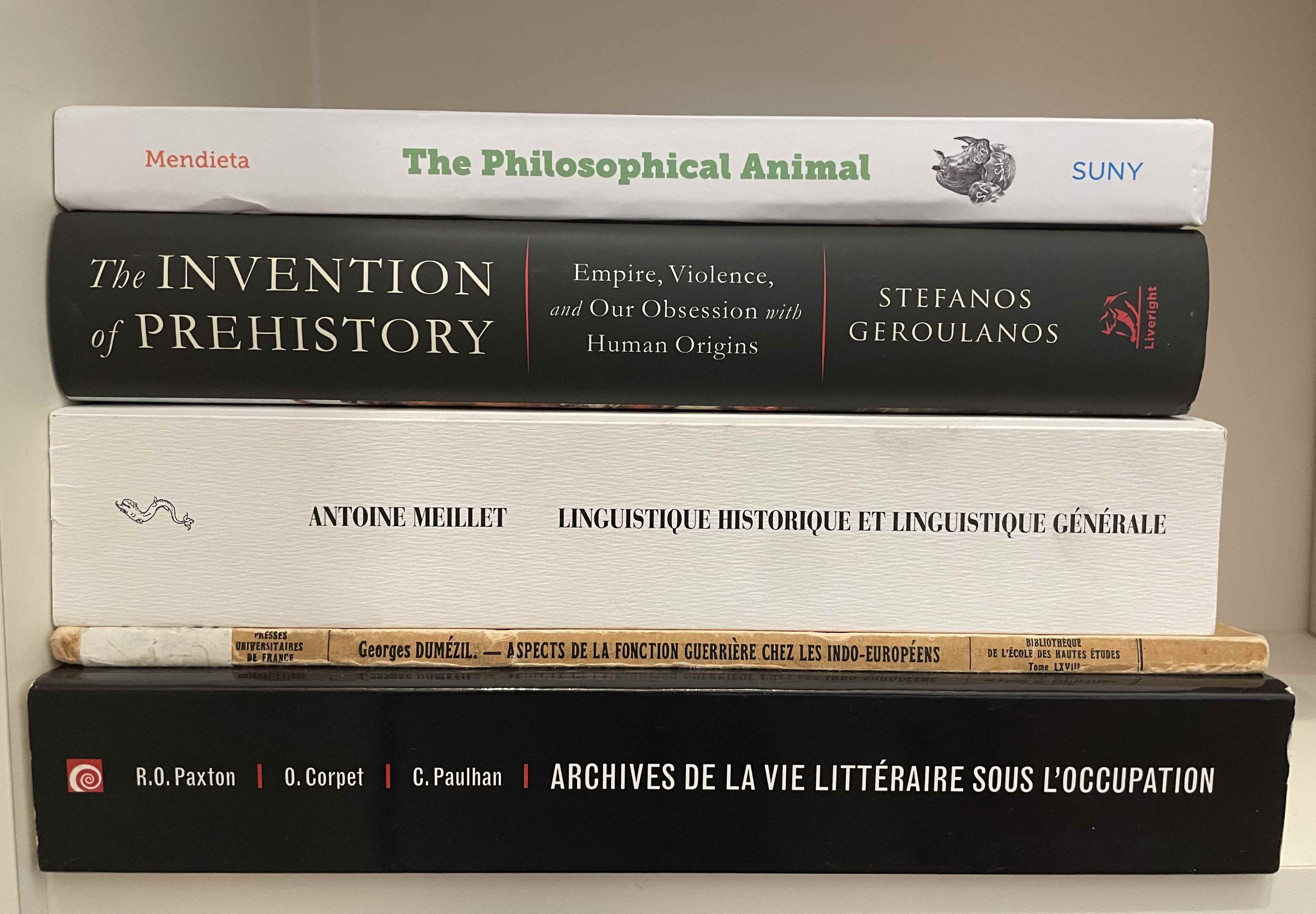
Books received – Mendieta, Geroulanos, Meillet, Dumézil, and Paxton, Carpet & Paulhan

Two books by friends – Stefanos Geroulanos, The Invention of Prehistory and Eduardo Mendieta, The Philosophical Animal, the reprint edition of Antoine Meillet’s Linguistique historique et linguistique générale, a hard-to-find copy of Georges Dumézil’s Aspects de la fonction guerrière chez les indo-européens, and R.O. Paxton, O. Corpet and C. Paulhan’s Archives de la vie littéraire sous l’occupation.

I discuss how this book of Dumézil’s is revised into Heur et malheur du Guerrier: Aspects mythiques de la fonction guerrière chez les Indo-Européens, in two editions, the first of which is in English as The Destiny of the Warrior, here.

Many thanks to Eduardo and W.W. Norton for sending those books.

Posted in Eduardo Mendieta, Georges Dumézil, Mapping Indo-European Thought in Twentieth Century France, Stefanos Geroulanos | 3 Comments

Videos from the Foucault: Genealogies for the Future conference, Rice University, April 18-19 2024

Niki Kasumi Clements, Welcome Address, Foucault: Genealogies, Rice University, April 18, 2024

The other papers are available here – papers by Frédéric Gros, Lynne Huffer, Laurie Laufer, Arianna Sforzini, Judith Revel, Orazio Irrera, Selin Islekel, Zachary Schwarze, Biko Mandela Gray, Daniel Wyche, Federico Testa, Sandra Boehringer, Philippe Chevallier, Philippe Sabot and others…

Thanks to dmf for the link – and to Niki Kasumi Clements for organising this event and sharing the material.

Posted in Uncategorized | 1 Comment

Bryan Nelson, Democracy and Defiance: Rancière, Lefort, Abensour and the Antinomies of Politics – Edinburgh University Press, April 2024

Bryan Nelson, Democracy and Defiance: Rancière, Lefort, Abensour and the Antinomies of Politics – Edinburgh University Press, April 2024

Puts forward a bold, polemical interpretation of democracy as an emancipatory political project through the work of Jacques Rancière, Claude Lefort and Miguel Abensour
  • For the first time in a single volume, this book carefully assembles, introduces and critically evaluates some of the most important strains of the political thought of Jacques Rancière, Claude Lefort and Miguel Abensour specifically tailored for the English reader and student of social and political theory
  • Through a series of detailed exegetical studies of important primary sources, this book cultivates a bold, polemical interpretation of democracy as an emancipatory political project irreducible to a form of government, collection of institutions or State-form
  • Situating its analysis in the context of the history of political philosophy and integrating a breadth of recent scholarship, this book contributes to a range of fiercely debated topics in the current academic literature on democracy and political theory (including domination and emancipation; democratisation and social transformation; anarchy, indeterminacy and social contingency; the identity of the demos or political subject; the nature and function of political philosophy; the symbolic constitution of society; rule, government and governmentality; the State and its forms; the continuity between ancient and modern democracy)

This book explores an often neglected current in contemporary French political thought that challenges the limits of the concept of democracy. It situates the projects of Jacques Rancière, Claude Lefort and Miguel Abensour in relation to each other, as well as to the larger philosophical question of the nature of democracy itself. In doing so, Bryan Nelson illuminates democracy’s potential as a profound emancipatory and transformative project, offering an unprecedented challenge to modes of domination, strategies of inequality and hierarchies of all kinds. Against prevailing interpretations, the author draws on the central concepts, problems and polemics in the works of Rancière, Lefort and Abensour to develop a bold conception of democracy that allows us to rethink its character, power and broader social and political.

Posted in Uncategorized | Leave a comment

Pierre-Frédéric Daled, Mathias Girel and Nathalie Queroux (eds.), Georges Canguilhem, 80 ans après Le Normal et le pathologique – Éditions rue d’Ulm, May 2024

Pierre-Frédéric Daled, Mathias Girel and Nathalie Queroux (eds.), Georges Canguilhem, 80 ans après Le Normal et le pathologique – Éditions rue d’Ulm, May 2024

En 1943, au terme d’études de médecine entamées en 1936, l’agrégé de philosophie Georges Canguilhem (1904-1995) soutient une thèse de doctorat en médecine intitulée Essai sur quelques problèmes concernant le normal et le pathologique. Éclairant de manière magistrale l’histoire du concept de norme, distinguant anomalie et anormalité dans le fonctionnement organique, soutenant que la « maladie » doit être rapportée à la mesure du sujet individuel que constitue le patient évaluant son propre état, cette thèse demeure le plus célèbre de ses ouvrages.

Mais qui a contribué à cette célébrité ? Quelle est l’histoire de la réception de l’Essai ? Qu’est-ce qui en a fait une référence majeure, y compris dans le domaine de la psychiatrie ou de la psychanalyse ? Et, plus de quatre-vingts ans après, quelles hypothèses et quels concepts de ce livre décisif ont gardé toute leur pertinence sur le plan philosophique, biologique ou médical ?

Avec les contributions de Jean-François BRAUNSTEIN, Claude DEBRU, Pierre-Frédéric DALED, Giulia GANDOLFI, Guillaume LE BLANC, Anne-Marie MOULIN, Tiago SANTOS ALMEIDA, Henning SCHMIDGEN, Maël MONTÉVIL, Nathalie QUEYROUX, Élisabeth ROUDINESCO, Frédéric WORMS.

Posted in Georges Canguilhem | 1 Comment

Engin Isin, Citizenship: New Trajectories in Law – Routledge, May 2024

Engin Isin, Citizenship: New Trajectories in Law – Routledge, May 2024

This book outlines a critical theory of citizenship, with an emphasis on how citizenship institutes power relations and organises the rights and obligations of those who become its subjects.

Whether it is the question of the rights of animals, children, migrants, minorities, mothers, or mountains, and whether such rights are protected or guaranteed by national law, international law, or human rights law, the issue of citizenship has already indelibly marked the 21st century. As an institution, citizenship governs the relationship between a polity and its peoples by dividing them into citizens and noncitizens, with differentiated rights and obligations. So necessarily, this book argues, citizenship is an institution of domination and emancipation that brings into play the struggles of those who want to protect certain privileges and the struggles of those who are against being caught in either second-class or noncitizen categories. Deconstructing dominant theories and practices of citizenship, a critical theory of citizenship must, therefore, not only analyse intersecting rights, but also connect citizenship to these broader social struggles. For it is these struggles, the book maintains, that give meaning to citizenship itself.

The book will be of interest to scholars and students in sociolegal studies, sociology, politics, and as well as those working in citizenship, migration, and refugee studies.

Posted in Engin Isin, Uncategorized | Leave a comment