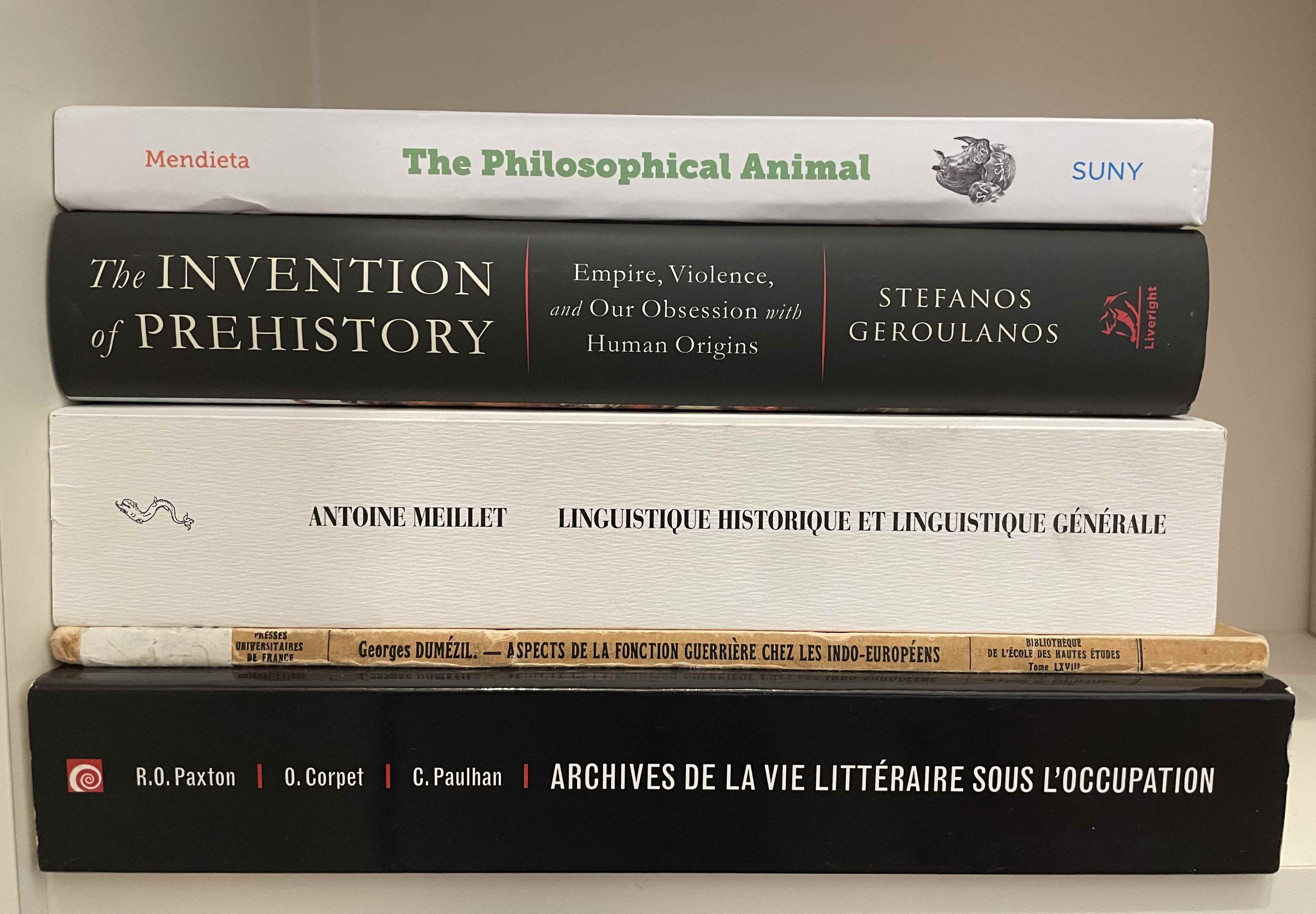
Two books by friends – Stefanos Geroulanos, The Invention of Prehistoryand Eduardo Mendieta, The Philosophical Animal, the reprint edition of Antoine Meillet’s Linguistique historique et linguistique générale, a hard-to-find copy of Georges Dumézil’s Aspects de la fonction guerrière chez les indo-européens, and R.O. Paxton, O. Corpet and C. Paulhan’s Archives de la vie littéraire sous l’occupation.
I discuss how this book of Dumézil’s is revised into Heur et malheur du Guerrier: Aspects mythiques de la fonction guerrière chez les Indo-Européens, in two editions, the first of which is in English as The Destiny of the Warrior, here.
Many thanks to Eduardo and W.W. Norton for sending those books.
The other papers are available here – papers by Frédéric Gros, Lynne Huffer, Laurie Laufer, Arianna Sforzini, Judith Revel, Orazio Irrera, Selin Islekel, Zachary Schwarze, Biko Mandela Gray, Daniel Wyche, Federico Testa, Sandra Boehringer, Philippe Chevallier, Philippe Sabot and others…
Thanks to dmf for the link – and to Niki Kasumi Clements for organising this event and sharing the material.
Puts forward a bold, polemical interpretation of democracy as an emancipatory political project through the work of Jacques Rancière, Claude Lefort and Miguel Abensour
For the first time in a single volume, this book carefully assembles, introduces and critically evaluates some of the most important strains of the political thought of Jacques Rancière, Claude Lefort and Miguel Abensour specifically tailored for the English reader and student of social and political theory
Through a series of detailed exegetical studies of important primary sources, this book cultivates a bold, polemical interpretation of democracy as an emancipatory political project irreducible to a form of government, collection of institutions or State-form
Situating its analysis in the context of the history of political philosophy and integrating a breadth of recent scholarship, this book contributes to a range of fiercely debated topics in the current academic literature on democracy and political theory (including domination and emancipation; democratisation and social transformation; anarchy, indeterminacy and social contingency; the identity of the demos or political subject; the nature and function of political philosophy; the symbolic constitution of society; rule, government and governmentality; the State and its forms; the continuity between ancient and modern democracy)
This book explores an often neglected current in contemporary French political thought that challenges the limits of the concept of democracy. It situates the projects of Jacques Rancière, Claude Lefort and Miguel Abensour in relation to each other, as well as to the larger philosophical question of the nature of democracy itself. In doing so, Bryan Nelson illuminates democracy’s potential as a profound emancipatory and transformative project, offering an unprecedented challenge to modes of domination, strategies of inequality and hierarchies of all kinds. Against prevailing interpretations, the author draws on the central concepts, problems and polemics in the works of Rancière, Lefort and Abensour to develop a bold conception of democracy that allows us to rethink its character, power and broader social and political.
En 1943, au terme d’études de médecine entamées en 1936, l’agrégé de philosophie Georges Canguilhem (1904-1995) soutient une thèse de doctorat en médecine intitulée Essai sur quelques problèmes concernant le normal et le pathologique. Éclairant de manière magistrale l’histoire du concept de norme, distinguant anomalie et anormalité dans le fonctionnement organique, soutenant que la « maladie » doit être rapportée à la mesure du sujet individuel que constitue le patient évaluant son propre état, cette thèse demeure le plus célèbre de ses ouvrages.
Mais qui a contribué à cette célébrité ? Quelle est l’histoire de la réception de l’Essai ? Qu’est-ce qui en a fait une référence majeure, y compris dans le domaine de la psychiatrie ou de la psychanalyse ? Et, plus de quatre-vingts ans après, quelles hypothèses et quels concepts de ce livre décisif ont gardé toute leur pertinence sur le plan philosophique, biologique ou médical ?
Avec les contributions de Jean-François BRAUNSTEIN, Claude DEBRU, Pierre-Frédéric DALED, Giulia GANDOLFI, Guillaume LE BLANC, Anne-Marie MOULIN, Tiago SANTOS ALMEIDA, Henning SCHMIDGEN, Maël MONTÉVIL, Nathalie QUEYROUX, Élisabeth ROUDINESCO, Frédéric WORMS.
This book outlines a critical theory of citizenship, with an emphasis on how citizenship institutes power relations and organises the rights and obligations of those who become its subjects.
Whether it is the question of the rights of animals, children, migrants, minorities, mothers, or mountains, and whether such rights are protected or guaranteed by national law, international law, or human rights law, the issue of citizenship has already indelibly marked the 21st century. As an institution, citizenship governs the relationship between a polity and its peoples by dividing them into citizens and noncitizens, with differentiated rights and obligations. So necessarily, this book argues, citizenship is an institution of domination and emancipation that brings into play the struggles of those who want to protect certain privileges and the struggles of those who are against being caught in either second-class or noncitizen categories. Deconstructing dominant theories and practices of citizenship, a critical theory of citizenship must, therefore, not only analyse intersecting rights, but also connect citizenship to these broader social struggles. For it is these struggles, the book maintains, that give meaning to citizenship itself.
The book will be of interest to scholars and students in sociolegal studies, sociology, politics, and as well as those working in citizenship, migration, and refugee studies.
When we look at the artworks on display in museums, there is always a real possibility that some of these objects once belonged to victims of the Nazis – a possibility that has remained unacknowledged for far too long. Countless artworks were seized or forcibly sold, with many ending up in museum collections around the world, even in countries which actively fought to defeat Nazi Germany.
Nazi-Era Provenance of Museum Collections equips readers with the knowledge and strategies essential for confronting the shadow of the Nazi past in museum collections. Jacques Schuhmacher provides the vital historical orientation required to understand the Nazis’ complex campaign of systematic dispossession and extermination, and highlights the current environment in which museum-based Nazi-era provenance research takes place.
This book introduces readers to the research methods and resources that can be used to reveal the moving stories behind the objects, highlighting the absorbing work of provenance researchers as it plays out in practice.
Provenance research not only seeks to recover erased names and experiences and to reinsert them into a historical record, but also to ensure that the Nazis’ actions and worldview do not remain unchallenged in the galleries and storerooms of our museums today.
The executive, associate, and advisory editors and all of the editorial board members of one of the most influential journals in moral and political philosophy, Philosophy & Public Affairs, have resigned en masse.
According to their statement (below), crucial aims of scholarly journals are “not well-served by commercial publishing.” Philosophy & Public Affairs is published by Wiley, the sixth largest publishing corporation in the world by revenue (over $2 billion annually).
En un sens, la vie quotidienne, c’est ce qu’il y a de plus simple, de plus évident. Comment vit-on ? S’il est difficile de répondre, la question n’en est pas moins claire. En un autre sens, c’est ce qu’il y a de plus insaisissable, de plus difficile à cerner et à déterminer. En un sens, rien de plus superficiel : c’est la banalité, la trivialité, le répétitif. En un autre sens, rien de plus profond. C’est l’existence et le « vécu » non transcrits spéculativement, dévoilés : ce qu’il faut changer et ce qu’il y a de plus difficile à changer.
En 1947, Henri Lefebvre publie le premier volume de sa Critique de la vie quotidienne, projet qu’il poursuit avec deux autres volumes en 1961 et 1981. Durant plus de trente ans, le philosophe cherche à répondre à cette question d’apparence simple : comment vit-on ? Face à une transformation accélérée des modes de vie, au développement des villes nouvelles, au sacrifice des familles prolétaires pour accéder à l’électroménager dans les années 1950 ou à l’ambivalence du capitalisme qui facilite certaines vies tout en ravageant le monde, le projet évolue et change, déviant des chemins annoncés mais cherchant toujours à comprendre l’aliénation à l’œuvre au quotidien.
Rédigé à la naissance du consumérisme d’après-guerre, ce grand texte a marqué la jeunesse révolutionnaire en France et reçu un écho considérable à l’étranger, influençant la constitution des études culturelles. Pour la première fois en un seul volume, cette nouvelle édition de la Critique de la vie quotidienne redonne à lire les interrogations d’une figure majeure du marxisme français.
Nouvelle édition intégrale contenant : vol. I : Introduction (1947), vol. II : Fondements d’une sociologie de la quotidienneté (1961), vol. III : De la modernité au modernisme (1981).
Préface de Kristin Ross, traduite par Étienne Dobenesque.
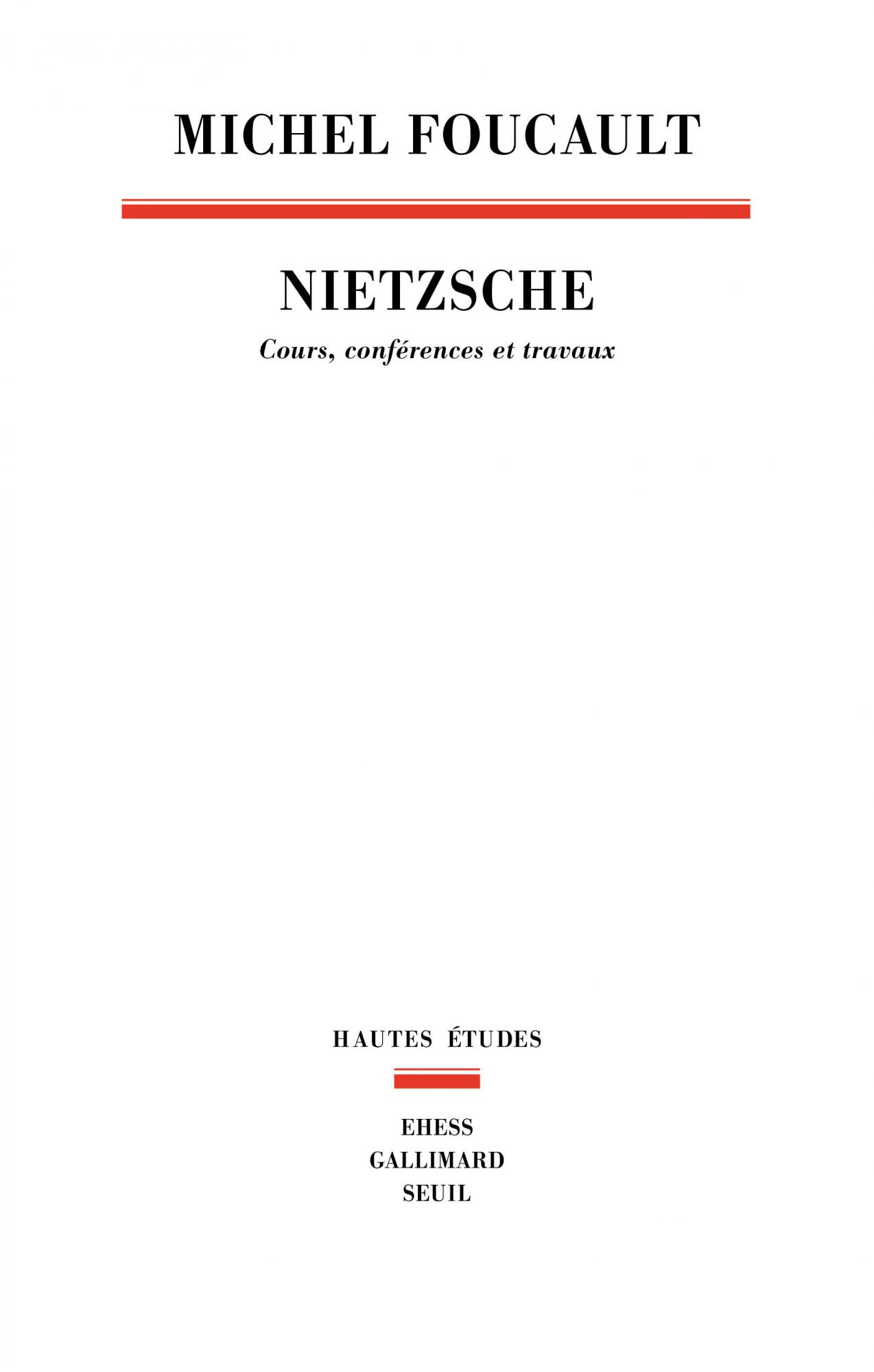
« Nietzsche et Heidegger, ça a été le choc philosophique ! Mais je n’ai jamais rien écrit sur Heidegger et je n’ai écrit sur Nietzsche qu’un tout petit article ; ce sont pourtant les deux auteurs que j’ai le plus lus », dira Michel Foucault à la fin de sa vie. Puis, il précise : « Je crois que c’est important d’avoir un petit nombre d’auteurs avec lesquels on pense, avec lesquels on travaille, mais sur lesquels on n’écrit pas. » Les Cours, conférences et travaux sont des témoignages inédits du « travail » de Foucault avec Nietzsche. Ces textes datent des deux grandes périodes de sa vie intellectuelle : d’abord le début des années 1950, quand il s’intéresse à Hegel et à la phénoménologie, ainsi qu’au marxisme. Le jeune Foucault expérimente alors de nouvelles approches pour développer une philosophie fondée sur l’expérience et l’analyse du discours. Ensuite, après la publication des Mots et les Choses en 1966, lorsque Foucault revient avec élan à Nietzsche pour élaborer sa propre méthode généalogique, relançant ainsi son projet d’une histoire de la vérité et du dire vrai. C’est à travers la confrontation avec Nietzsche que Foucault aura construit sa propre manière de philosopher. Ces Cours, conférences et travaux sont indispensables pour comprendre comment Foucault a lu Nietzsche, en particulier au moment décisif où il le découvre. Ils sont essentiels pour saisir le Nietzsche de Foucault.