Julia Caterina Hartley, Iran and French Orientalism: Persia in the Literary Culture of Nineteenth-Century France – I.B. Tauris/Bloomsbury, December 2023

Julia Caterina Hartley, Iran and French Orientalism: Persia in the Literary Culture of Nineteenth-Century France – I.B. Tauris/Bloomsbury, December 2023
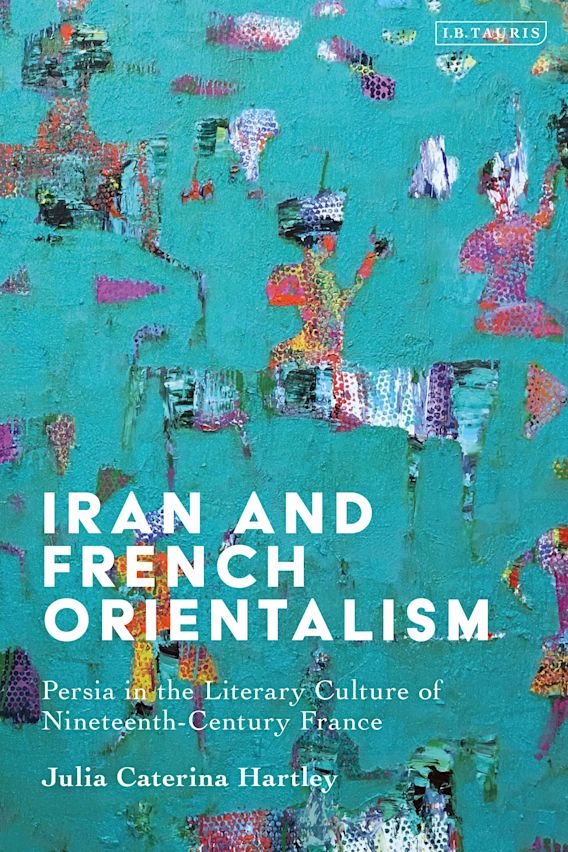
New translations of Persian literature into French, the invention of the Aryan myth, increased travel between France and Iran, and the unveiling of artefacts from ancient Susa at the Louvre Museum are among the factors that radically altered France’s perception of Iran during the long nineteenth century. And this is reflected in the literary culture of the period. In an ambitious study spanning poetry, historiography, fiction, travel-writing, ballet, opera, and marionette theatre, Julia Hartley reveals the unique place that Iran held in the French literary imagination between 1829 and 1912. Iran’s history and culture remained a constant source of inspiration across different generations and artistic movements, from the ‘Oriental’ poems of Victor Hugo to those of Anna de Noailles and Théophile Gautier’s strategic citation of Persian poetry to his daughter Judith Gautier’s full-blown rewriting of a Persian epic. Writing about Iran could also serve to articulate new visions of world history and religion, as was the case in the intellectual debates that took place between Michelet, Renan, and Al-Afghani. Alternatively joyous, as in Félicien David’s opera Lalla Roukh, and ominous, as in Massenet’s Le Mage, Iran elicited a multiplicity of treatments. This is most obvious in the travelogues of Flandin, Gobineau, Loti, Jane Dieulafoy, and Marthe Bibesco, which describe the same cities and cultural practices in altogether different ways. Under these writers’ pens, Iran emerges as both an Oriental other and an alter ego, its culture elevated above that of all other Muslim nations. At times this led French writers to critique notions of European superiority. But at others, they appropriated Iran as proto-European through racialist narratives that reinforced Orientalist stereotypes. Drawing on theories of Orientalism and cultural difference, this book navigates both sides of this fascinating and complex literary history. It is the first major study on the subject.
Posted in Uncategorized | 1 Comment

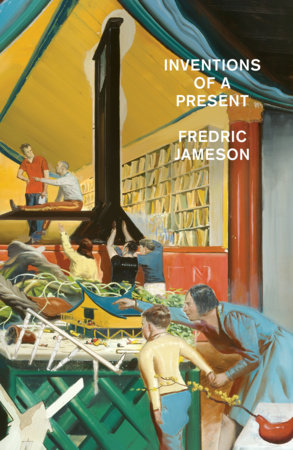
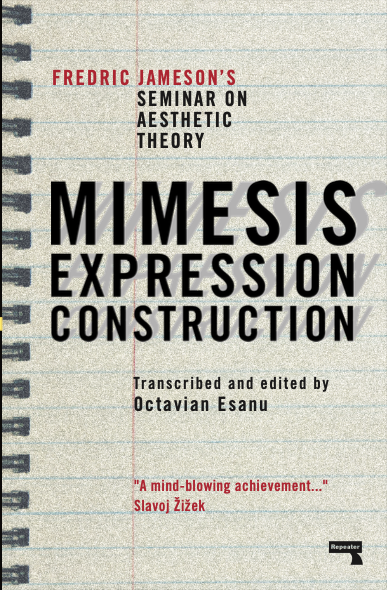
Fredric Jameson, Inventions of a Present – Verso, May 2024 and Mimesis, Expression, Construction: Fredric Jameson’s Seminar on Aesthetic Theory, ed. Octavian Esanu – Repeater, 2024

As if the book The Years of Theory I posted about earlier this week wasn’t enough, two more works by Fredric Jameson this year…

Inventions of A Present: The Novel in its Crisis of Globalisation, Verso, May 2024 [updated to Verso page from US distributor]

The giant of literary theory analyses the novel: Conrad, James, Atwood, Oe, Mailer, Grass, Grossman, Garcia Marquez, Gibson, Knausgaard and more

A novel is an act, an intervention, which, most often, the naïve reader takes as a representation. The novel intervenes to modify or correct our conventional notions of a situation, and, in the best and most intense cases, to propose a wholly new idea of what constitutes an event or of the very experience of living.

The most interesting contemporary novels are those which try – and sometimes succeed – in awakening our sense of a collectivity behind individual experience; opening up a relationship between the isolated subjectivity and class or community. But even if this happens (rarely!), one must go on to find traces of collective praxis hidden away within the mere awakening of a feeling of multitude.

And, since it is in the sense of the nation and nationality that collectivity is most often expressed, it is urgent to disengage the possibilities of genuine action within these nationalisms.

This sweeping collection of essays ranges from the elusive politicality of North American literature to the sometimes frozen narrative experiences of the eastern countries and the old Soviet Union; from East Germany to Japan, Latin America and the Nordic countries. Like any such voyage, it is an arbitrary movement across the world of historical situations which, however, seeks to dramatize their common kinship in late capitalism itself.

Mimesis, Expression, Construction: Fredric Jameson’s Seminar on Aesthetic Theory, ed. Octavian Esanu – Repeater, 2024

Transcribed and edited from audio recordings taken by Octavian Esanu of the original seminar at Duke University in 2003, Mimesis, Expression, Construction reproduces Jameson and his students’ engagement with Aesthetic Theory, one of the most influential theories of modernist aesthetics.

The first and only published record of Jameson’s teaching and pedagogic style, the seminar delves into modern and modernist aesthetics through the perspectives of Kant, Hegel, Freud, Schopenhauer, and Nietzsche; Benjamin and other members of the Frankfurt School; the literary works of Thomas Mann and Samuel Beckett; the music of Schoenberg, Webern and Berg; the films of Chaplin, Vertov and Eisenstein; the aesthetic implications of psychoanalysis and biblical exegesis; classical music; and more.

Presented in the format of a play, with stage setting, student interruptions and exchanges, interjections, auditory noises, and ambient sounds, and complemented with scans of students’ notes, Mimesis, Expression, Construction is a groundbreaking addition to the work of one of the greatest modern cultural critics.

Posted in Fredric Jameson | 1 Comment

Broadly Speaking: An Interview with Ana Antić at Journal of the History of Ideas blog

Broadly Speaking: An Interview with Ana Antić

Ana Antić is a professor in the Department of English, Germanic and Romance Studies at the University of Copenhagen. Her research focuses on the history of modern Europe and its global connections, history of war and violence, and history of the ‘psy’ sciences. Antić’s first monograph is Therapeutic Fascism: Experiencing the Violence of the Nazi New Order (Oxford University Press, 2017); she is currently completing the second one, titled Non-aligned Psychiatry in the Cold War.

She spoke with Thomas Furse about her recent JHI review essay “Psychiatry and Decolonization: Histories of Transcultural Psychiatry in the Twentieth Century” (volume 85, issue 1).

Posted in Uncategorized | Leave a comment

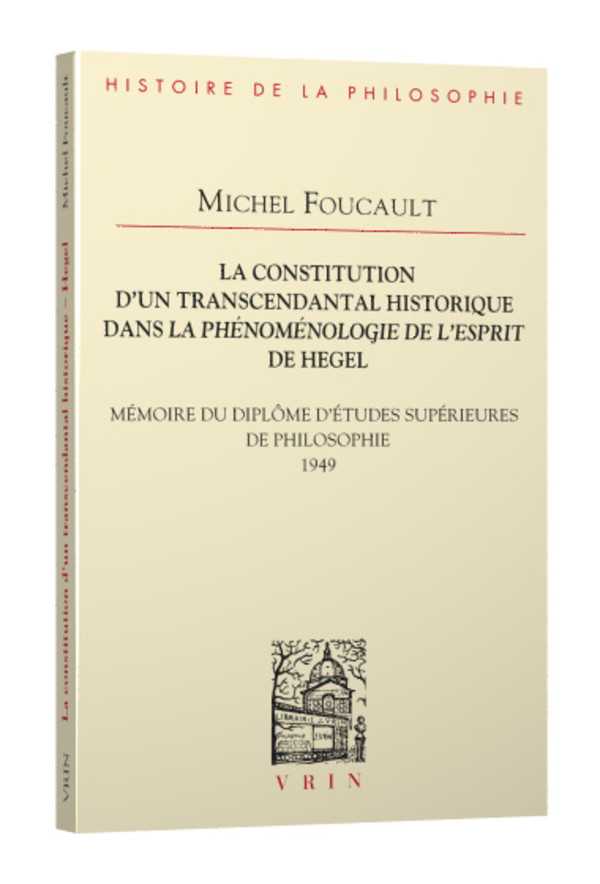
Michel Foucault, La constitution d’un transcendantal historique dans la Phénoménologie de l’esprit de Hegel: Mémoire du diplôme d’études supérieures de philosophie – Vrin, February 2024

Michel Foucault, La constitution d’un transcendantal historique dans la Phénoménologie de l’esprit de Hegel: Mémoire du diplôme d’études supérieures de philosophie – Vrin, February 2024

Le 11 juin 1949, Foucault soutient en Sorbonne son mémoire de diplôme d’études supérieures de philosophie intitulé « La constitution d’un transcendantal historique dans La Phénoménologie de l’esprit de Hegel », qu’il avait préparé sous la direction de Jean Hyppolite. Dans ce texte que la présente édition offre pour la première fois au public, on découvre un jeune Foucault fin lecteur de la philosophie allemande classique, qui joue Hegel contre Kant afin de repenser la question « Que puis-je savoir? ». La Phénoménologie de l’esprit est interprétée comme une historicisation du transcendantal, qui culmine dans la figure énigmatique du « savoir absolu ». Un programme philosophique est par là même esquissé : « toute philosophie sera science de l’histoire et de l’envers de l’histoire ».

Texte édité et présenté par Christophe Bouton.

Thanks to Daniele Lorenzini for the alert.

Posted in Georg Wilhelm Friedrich Hegel, Michel Foucault, Uncategorized | Leave a comment

Youjin B. Chung, Sweet Deal, Bitter Landscape: Gender Politics and Liminality in Tanzania’s New Enclosures – Cornell University Press, 2024 and New Books discussion

Youjin B. Chung, Sweet Deal, Bitter Landscape: Gender Politics and Liminality in Tanzania’s New Enclosures – Cornell University Press, 2024

Sweet Deal, Bitter Landscape brings us to the mid-2000s, when the Tanzanian government struck a deal with a foreign investor to convert more than 20,000 hectares of long-settled coastal land to establish a sugarcane plantation. Ten years on, the deal was abruptly abandoned. Popularly deemed a case of hubristic global development, critics classified this project another in a line of failed modern resource grabs.

Youjin B. Chung argues such tidy accounts conceal myriad and profound implications: not only how gender, history, and culture shaped the project’s trajectory, but also how, even in its stalled state, the deal upended social life on the land by setting in motion incomplete processes of development and dispossession.

With rich ethnographic detail and visual storytelling, Sweet Deal, Bitter Landscape traces the lived experiences of diverse rural women and men as they struggled for survival under a seemingly endless condition of liminality. In so doing, she raises critical questions about the directions and stakes of postcolonial development and nation-building in Tanzania, and the shifting meanings of identity and belonging for those on the margins of capitalist agrarian transformation.

There is a New Books Discussion here. Thanks to dmf for the link.

Posted in Uncategorized | Leave a comment

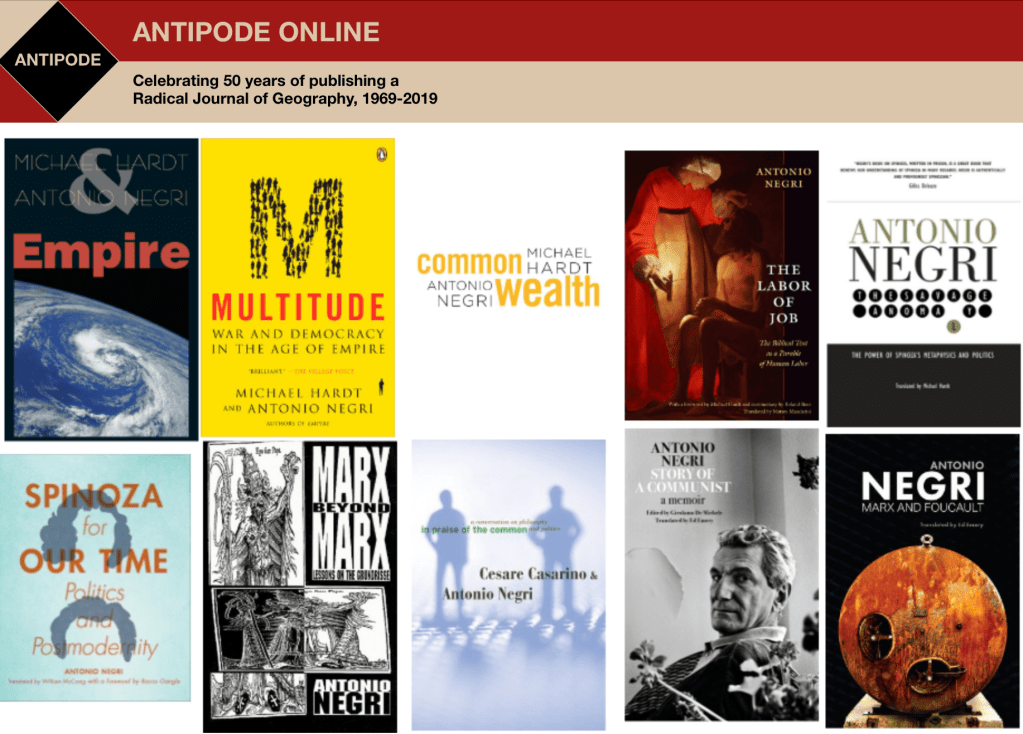
Antipode virtual issue – “Antonio Negri and Antipode”

Antipode virtual issue – “Antonio Negri and Antipode”

Joel Wainwright introduces a selection of papers in tribute to Negri, free to download for a limited time.

Posted in Uncategorized | 1 Comment

Paul Allen Miller, Theory does not Exist: Comparative Ancient and Modern Explorations in Psychoanalysis, Deconstruction, and Rhetoric – Anthem, May 2024

Paul Allen Miller, Theory does not Exist: Comparative Ancient and Modern Explorations in Psychoanalysis, Deconstruction, and Rhetoric – Anthem, May 2024

This book is a wide-ranging collection of essays that makes the case for the humanities as central to our self-understanding, for theory as the latest incarnation of a perennial concern with the relation between words and things, and for the ancient as constitutive of the modern. Theory Does Not Exist: Comparative Ancient and Modern Explorations in Psychoanalysis, Deconstruction, and Rhetoric makes a strong argument for a comparative approach to what we term “theory” today. It argues that our disciplinary boundaries create artificial divisions between philosophy, rhetoric, and literature, which historically would not have been recognized and have come to function as conceptual straitjackets.

These essays contend that a concerted engagement with the crucial texts in these debates over the last 2500 years not only offers a better understanding of the issues involved but also provides the necessary political, ethical, and existential tools for fashioning a better and more inclusive life. They offer extended readings of Plato, Cicero, and Sophocles, as well as Derrida, Foucault, Irigaray, Kristeva, Žižek, and Lacan. Theory Does Not Exist offers a full-throated defense of the humanities and crucial counterarguments against the reduction of education to the vocational and the operational.

Posted in Uncategorized | Leave a comment

Jamie Draper and David Owen (eds.), The Political Philosophy of Internal Displacement – Oxford University Press, March 2024

Jamie Draper and David Owen (eds.), The Political Philosophy of Internal Displacement – Oxford University Press, March 2024

The situation of internally displaced persons has been a matter of international concern – and legal debate – since at least the late 1990s and early 2000s, and its salience has only increased in the context of extreme weather events produced by intensifying climate change. Research in political philosophy, however, has so far barely touched on this issue, despite its close connection to and relevance for lively and expansive debates on migration, refugees, territorial rights, state sovereignty, and climate change. This volume aims to set the philosophical agenda for articulating a political ethics of internal displacement, and to highlight the importance of the phenomenon for these wider theoretical issues. Across 12 chapters that explore different aspects of internal displacement, authors working at the forefront of these debates construct a compelling research agenda for the political philosophy of internal displacement.

Posted in Uncategorized | 1 Comment

Jacques Derrida, Répondre – du secret. Séminaire (1991-1992) – Seuil, February 2024

Jacques Derrida, Répondre – du secret. Séminaire (1991-1992) – Seuil, February 2024

«Le secret, dit-on, c’est ce qui ne se dit pas » : c’est sur cette phrase que s’ouvre le séminaire Répondre – du secret, le tout premier de la série « Questions de responsabilité » que Jacques Derrida donnera à l’École des hautes études en sciences sociales (EHESS) de 1991 à 2003. Ce cycle de recherches portant sur les enjeux actuels du concept de responsabilité (philosophique, littéraire, éthique, juridique, psychanalytique, politique) privilégie d’entrée de jeu le thème du secret puis celui du témoignage, qui sera déployé de 1992 à 1995.

Qu’est-ce qu’un secret et comment se lie-t-il à un appel à la responsabilité ? Pour répondre à ces questions, Jacques Derrida examine d’abord la sémantique du secret à travers divers registres (scientifique, technique, social, politique et religieux), où le secret trouble l’opposition entre le privé et le public. Suivant la généalogie du cryptique ou de l’hermétique dans différentes familles de langues (grecque, latine, allemande), il explore l’histoire et les valeurs culturelles qui lui sont associées (secret d’État ou militaire, secret professionnel, société secrète), analyse la thématique et les « effets » de secret dans certaines œuvre littéraires (notamment celles de Melville, de Baudelaire, de James et de Poe), puis élabore une problématique de la « curiosité » et du « souci » à partir de textes de Freud et de Heidegger.

Explorant trois « logiques » entrelacées du secret (le cogito cartésiano-kantien, le sujet de l’inconscient freudien, l’être-caché de la dissimulation heideggérienne comme vérité), Jacques Derrida s’engage ensuite dans une lecture approfondie du secret abrahamique dans les Essais hérétiques… de Patočka et Crainte et Tremblement de Kierkegaard, où se découvre la figure par excellence du secret comme mort donnée. Il poursuit également le « dialogue fictif », amorcé en 1975-1976 dans son séminaire La Vie la mort, entre Freud et Heidegger au sujet du concept de l’Unheimlichkeit, tout en interrogeant les effets de la pulsion secrétariale à l’œuvre dans son propre enseignement.

Le texte de ce séminaire a été établi par Ginette Michaud et Nicholas Cotton.

There is a piece about the book at Slate.

Posted in Jacques Derrida | 1 Comment

Fredric Jameson, The Years of Theory: Lectures on Modern French Thought – Verso, October 2024

Fredric Jameson, The Years of Theory: Lectures on Modern French Thought – Verso, October 2024

No other information at the moment, but it is 544 pages long…

Posted in Fredric Jameson, Uncategorized | 3 Comments