Alexandre Kojève, Kant, trans. Hager Weslati – Verso, May 2024

Alexandre Kojève, Kant, trans. Hager Weslati – Verso, May 2024

The French publication was with Gallimard in 1973.

Kant forms the centerpiece of Alexandre Kojeve’s intriguing discovery of objective reality and its repressed history in Western philosophy

During the early 1950s, Alexandre Kojève resumed his ambitious project to bring the analytic reason of Kantianism in line with Hegel’s logic and philosophy of history. Kant is one of the most extensive text fragments where Kojève turned his attention to the gaps left open in the system of critical philosophy.

Published in its raw, unedited form in 1973, in the aftermath of the anti-Hegelian drift of the student-led revolt of May 68, the book has remained largely unexplored, despite its protean influence on various “returns” to Kant, from Weil to Deleuze, and from Foucault to Tosel and beyond. Kant is a deep and provocative text, equal in breadth and depth of insight to the famous Introduction to the Reading of Hegel.

Kant’s philosophical system, Kojeve argues, is haunted by the Thing-in-itself, as the ultimate expression of ‘bourgeois hypocrisy’ and its internally divided reason between action and discourse.

Making a case for the post-historical moral imperative to turn away from infinite progress and the practical justification of the ideas of God and the immortality of the soul, Kant outlines the material conditions of possibility of revolutionary action within the twin horizon of accomplished and recollected history.

Posted in Immanuel Kant | 1 Comment

Gerard Toal, Oceans Rise Empires Fall: Why Geopolitics Hastens Climate Catastrophe – Oxford University Press, February 2024

Gerard Toal, Oceans Rise Empires Fall: Why Geopolitics Hastens Climate Catastrophe – Oxford University Press, February 2024

A powerful explanation of why geopolitical competition makes implementing effective climate change policies so difficult. As the Russia-Ukraine war has shown, great-power competition drives states to prioritize fossil fuel acquisition over working toward a zero-carbon future.

In the last few years, it has become abundantly clear that the effects of accelerating climate change will be catastrophic, from rising seas to more violent storms to desertification. Yet why do nation-states find it so difficult to implement transnational policies that can reduce carbon output and slow global warming? In Oceans Rise, Empires Fall, Gerard Toal identifies geopolitics as the culprit. States would prefer to reduce emissions in the abstract, but in the great global competition for geopolitical power, states always prioritize access to carbon-based fuels necessary for generating the sort of economic growth that helps them compete with rival states. Despite what we now know about the long-term impacts of climate change, geopolitical contests continue to sideline attempts to halt or slow down the process. 

The Ukraine conflict in particular exposes our priorities. To escape reliance on Russia’s vast oil and gas reserves, states have expanded fossil fuel production that necessarily increases the amount of carbon in the atmosphere. The territorial control imperatives of great powers preclude collaborative behavior to address common challenges. Competitive territorial, resource, and technological dramas across the geopolitical chessboard currently obscure the deterioration of the planet’s life support systems. In the contest between geopolitics and sustainable climate policies, the former takes precedence-especially when competition shifts to outright conflict. In this book, Toal interrogates that relationship and its stakes for the ongoing acceleration of climate change.

Posted in Uncategorized | Leave a comment

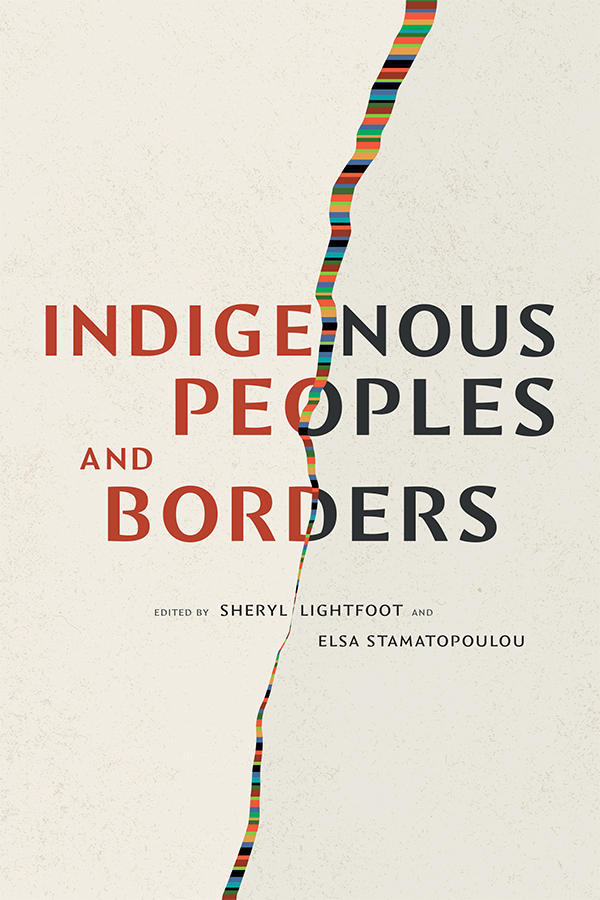
Sheryl Lightfoot and Elsa Stamatopoulou (eds.), Indigeneous People and Borders – Duke University Press, January 2024

Sheryl Lightfoot and Elsa Stamatopoulou (eds.), Indigeneous People and Borders – Duke University Press, January 2024

The legacies of borders are far-reaching for Indigenous Peoples. This collection offers new ways of understanding borders by departing from statist approaches to territoriality. Bringing together the fields of border studies, human rights, international relations, and Indigenous studies, it features a wide range of voices from across academia, public policy, and civil society. The contributors explore the profound and varying impacts of borders on Indigenous Peoples around the world and the ways borders are challenged and worked around. From Bangladesh’s colonially imposed militarized borders to resource extraction in the Russian Arctic and along the Colombia-Ecuador border to the transportation of toxic pesticides from the United States to Mexico, the chapters examine sovereignty, power, and obstructions to Indigenous rights and self-determination as well as globalization and the economic impacts of borders. Indigenous Peoples and Borders proposes future action that is informed by Indigenous Peoples’ voices, needs, and advocacy.

Contributor(s): Andrea Carmen, Hana Shams Ahmed, Tone Bleie, Jacqueline Gillis, Rauna Kuokkanen, Elifuraha Laltaika, David B. MacDonald, Toa Maldonado, Bina Nepram, Melissa Zeba Patel, Manoel Prado, Liubov Sulyandziga, Rodion Sulyandziga, Yifat Susskind, Erika Yamada

The Introduction is available open access.

Posted in Uncategorized | Leave a comment

Radical online collections and archives – New Historical Express

Radical online collections and archives – New Historical Express

I am very interested in the growing amount of radical literature from around the world that is being scanned and digitised. As there are so many and from many different places, I thought it would be useful to make a list. All of those that are included are free to access (there are others that require some form of subscription). If there are any that I have missed or if any links are broken, do let me know, either by commenting below or sending me an email.

Edit (Feb 2022): I have added categories of the list below for ease of finding the relevant collections.

Posted in Uncategorized | 1 Comment

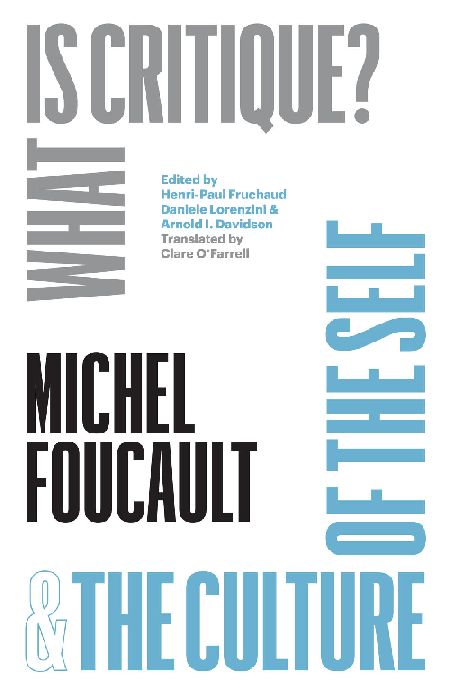
Michel Foucault, What Is Critique? & The Culture of the Self – trans. Clare O’Farrell, University of Chicago Press, January 2024

Michel Foucault, What Is Critique? & The Culture of the Self, edited by Henri-Paul Fruchaud, Daniele Lorenzini, and Arnold I. Davidson, translated by Clare O’Farrell, University of Chicago Press, January 2024

Newly published lectures by Foucault on critique, Enlightenment, and the care of the self.

On May 27, 1978, Michel Foucault gave a lecture to the French Society of Philosophy where he redefines his entire philosophical project in light of Immanuel Kant’s 1784 text, “What Is Enlightenment?” Foucault strikingly characterizes critique as the political and moral attitude consisting in the “art of not being governed in this particular way,” one that performs the function of destabilizing power relations and creating the space for a new formation of the self within the “politics of truth.”

This volume presents the first critical edition of this crucial lecture alongside a previously unpublished lecture about the culture of the self and three public debates with Foucault at the University of California, Berkeley in April 1983. There, for the first time, Foucault establishes a direct connection between his reflections on Enlightenment and his analyses of Greco-Roman antiquity. However, far from suggesting a return to the ancient culture of the self, Foucault invites his audience to build a “new ethics” that bypasses the traditional references to religion, law, and science.

Posted in Michel Foucault | Leave a comment

Open Access e-books from Pluto Press

Open Access e-books from Pluto Press – here

Posted in Uncategorized | 1 Comment

Ananya Agustin Malhotra, Tran Duc Thao’s Anticolonial Phenomenology: In Theory and in Practice – JHI blog

Ananya Agustin Malhotra, Tran Duc Thao’s Anticolonial Phenomenology: In Theory and in Practice – JHI blog

In February 1946, before the outbreak of the first Indochina War, the Vietnamese Marxist philosopher Tran Duc Thao (1917–93) outlined for the French reading public a nascent philosophy on the phenomenology of colonized existence. From the pages of Les Temps Modernes, Thao argued that the French and the Vietnamese lived in different worlds of possibilities. “Annamites,” he wrote, “live in a world where the possibilities of an independent Vietnam are part of a project, a Vietnam free to industrialize, to create the number of schools it would have seen fit, to send its students to all the universities of Europe and America.” In contrast, the French are “taught in school that Indochina is French” and that it is “contradictory” to think “something that is part of French domain” could ever “have an independent existence. This is unthinkable.”

Posted in Uncategorized | Leave a comment

In Conversation: Achille Mbembe and David Theo Goldberg on ‘Critique of Black Reason’ – Theory, Culture & Society, 2017 (open access)

In Conversation: Achille Mbembe and David Theo Goldberg on ‘Critique of Black Reason’ (2017)

Achille Mbembe, The Critique of Black Reason. Duke University Press, 2016

Posted in Uncategorized | Leave a comment

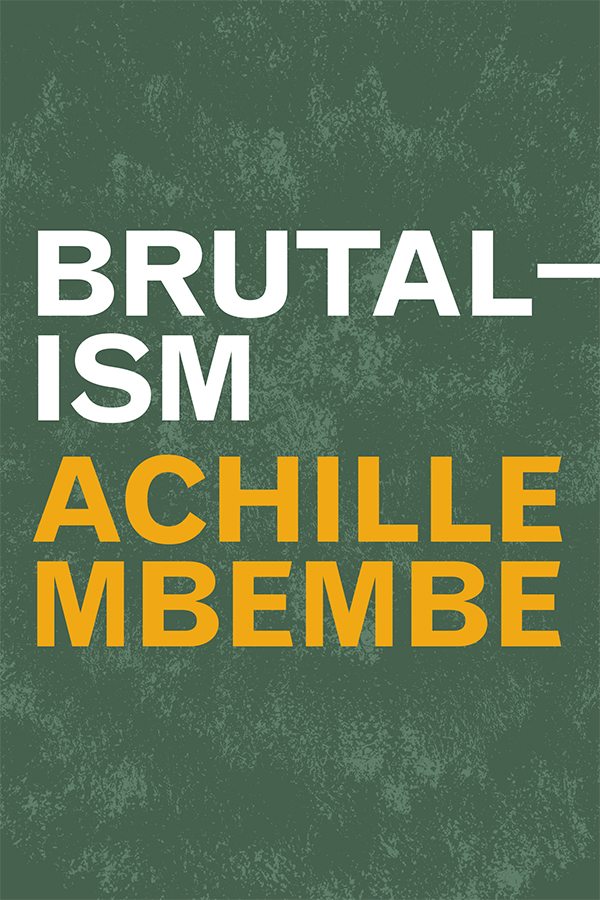
Achille Mbembe, Brutalism – Duke University Press, January 2024 (open access Introduction)

Achille Mbembe, Brutalism – Duke University Press, January 2024

In Brutalism, eminent social and critical theorist Achille Mbembe invokes the architectural aesthetic of brutalism to describe our moment, caught up in the pathos of demolition and production on a planetary scale. Just as brutalist architecture creates an affect of overwhelming weight and destruction, Mbembe contends that contemporary capitalism crushes and dominates all spheres of existence. In our digital, technologically focused era, capitalism has produced a becoming-artificial of humanity and the becoming-human of machines. This blurring of the natural and artificial presents a planetary existential threat in which contemporary society’s goal is to precipitate the mutation of the human species into a condition that is at once plastic and synthetic. Mbembe argues that Afro-diasporic thought presents the only solution for breaking the totalizing logic of contemporary capitalism: repairing that which is broken, developing a new planetary consciousness, and reforming a community of humans in solidarity with all living things.

The Introduction is available open access

Posted in Uncategorized | Leave a comment

Jacques Derrida, Hospitality – two volumes of the seminar, November 2023 and April 2024

Jacques Derrida, Hospitality – two volumes, University of Chicago Press

Volume I, translated by E. S. Burt, edited by Pascale-Anne Brault and Peggy Kamuf, November 2023

Volume II, translated by Peggy Kamuf, edited by Pascale-Anne Brault and Peggy Kamuf, April 2024

Hospitality reproduces a two-year seminar series delivered by Jacques Derrida at the École des hautes études en sciences sociales in Paris between 1995 and 1997. In these lectures, Derrida asks a series of related questions about responsibility and “the foreigner”: How do we welcome or turn away the foreigner? What does the idea of the foreigner reveal about kinship and the state, particularly in relation to friendship, citizenship, migration, asylum, assimilation, and xenophobia? Derrida approaches these questions through readings of several classical texts as well as modern texts by Heidegger, Arendt, Camus, and others. Central to his project is a rigorous distinction between conventional, finite hospitality, with its many conditions, and the aspirational idea of hospitality as something offered unconditionally to the stranger. This volume collects the first year of the seminar.

… This volume collects the second year of the seminar, which considers an Islamic problematic of hospitality, the relevance of forgiveness, and the work of Emmanuel Levinas.

Posted in Jacques Derrida | Leave a comment