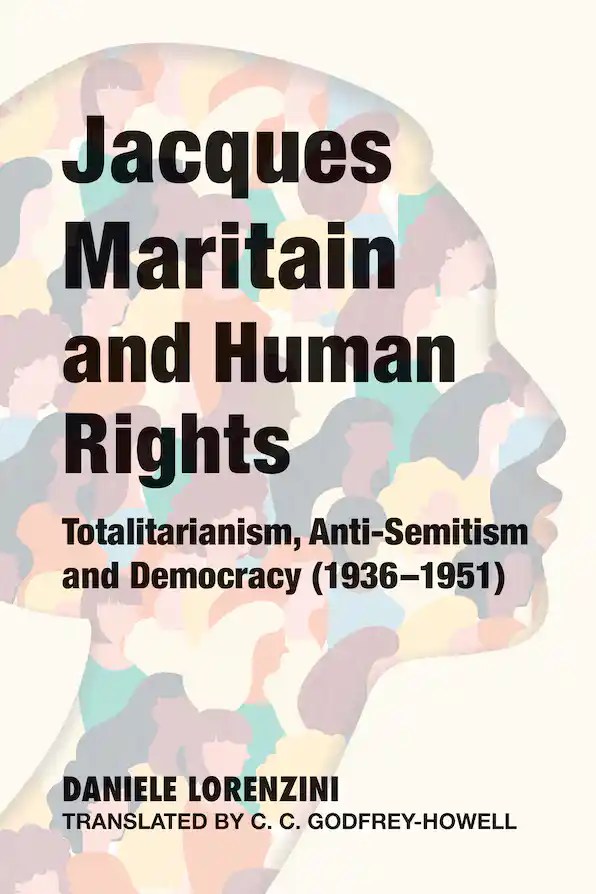
The influence of Jacques Maritain in the post-war era’s embrace of human rights is undeniable. Scholars, however, overlook a major shift in his use of language. Daniele Lorenzini argues the turn from Maritain’s use of the expression “rights of the person” to ”the rights of man” is packed with meaning. Reconstructing the historical context in which this shift occurred is key to fully grasping what Maritain accomplished. It is also essential if one seeks to defend Maritain against accusation that he enacted a victory of the American and French modern revolutionary spirit over ecclesiastical teaching when he legitimized “the rights of man.”
The notion that Maritain may have taken up the cause of the civic-secular citizen when these secularly articulated rights were consciously never embraced by Catholic magisterium (that instead promulgated the rights of the person) merits serious attention. Lorenzini reconstructs Maritain’s historical context and theoretical trajectory shaped by particular circumstances––most evidently World War II, but also his time in the United States and his work with the Committee of Catholics for Human Rights. Lorenzini is not suggesting that Maritain staged a siege of Catholic thought, but that he did in fact lay the foundations for turning the conversation away from the tenets upheld by ecclesiastical authority on the concept of rights toward an articulation that more pointedly connects such rights to the actual possession and protection.
How and why this happens, Lorenzini demonstrates, is “grasped only if critically situated in the union of history of history and biography that makes this possible and encourages it, as does Maritain’s residency in the United States––an exile that obliged the French philosopher to render a deep seated account of the unbelievable (and tragic) political and intellectual panorama.” In short, Maritain set in motion the innovative redefinition of the elements that would soon be known as the human rights. But to Maritain these elements were always proper to the new ideal of the “vitally Christian” political city, the city “founded essentially on the two ‘pillars’ of democracy and the safeguarding of the rights of man.”
What originally began as a purely linguistic investigation of Maritain’s use of terminology has led Lorenzini to ask whether Maritain himself was won over from the act of conversing of rights associated with personhood to the real-time struggle for these rights, an evolution not just of Maritain’s language but of the man himself.
Lorenzini’s work is a formidable contribution to the literature pertaining to the period of post-war thought and Maritain on human rights. In his labors to carefully digest the full span of Maritain’s intellectual trajectory on rights, Lorenzini brings Jacques Maritain alive both as a man of vision but also fervent action, and defends him from critics and historians that accuse him of spurning Church teaching and papal authority. As Lorenzini’s study shows, the human rights of the secular-civic world––whose lineage scholars attribute in large part to Maritain––were always derived from Catholic teaching and intended for use in constructing the truly Christian city.
This work stands out in a vast repertoire of work on the subject of Jacques Maritain, and accomplishes both high level philosophical and historical sleuthing. It is of particular interest to American readers who may not fully realize the depth of Maritain’s maturation of thought during his residency in the United States. This is an astounding read for historians, scholars of political philosophy, and students of Jacques Maritain.
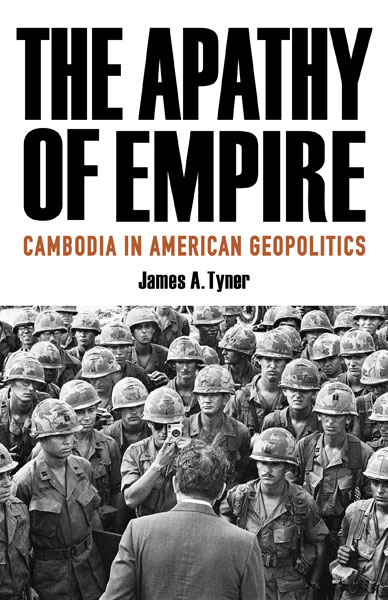
The Apathy of Empire reveals just how significant Cambodia was to U.S. policy in Indochina during the Vietnam War, broadening the lens to include more than the often-cited incursion in 1970 or the illegal bombing after the Paris Peace Accords in 1973. This theoretically informed and thoroughly documented case study argues that U.S. military intervention in Cambodia evinced America’s efforts to construct a hegemonic spatial world order.
James A. Tyner documents the shift of America’s post-1945 focus from national defense to national security. He demonstrates that America’s expansionist policies abroad, often bolstered by military power, were not so much about occupying territory but instead constituted the construction of a new normal for the exercise of state power. During the Cold War, Vietnam became the geopolitical lodestar of this unfolding spatial order. And yet America’s grand strategy was one of contradiction: to build a sovereign state (South Vietnam) based on democratic liberalism, it was necessary to protect its boundaries—in effect, to isolate it—through both covert and overt operations in violation of Cambodia’s sovereignty. The latter was deemed necessary for the former.
Questioning reductionist geopolitical understandings of states as central or peripheral, Tyner explores this paradox to rethink the formulation of the Cambodian war as sideshow, emphasizing instead that it was a crucial site for the formation of this new normal.
A major collection of essays and speeches from pioneering freedom fighter Angela Y. Davis For over fifty years, Angela Y. Davis has been at the forefront of collective movements for abolition and feminism and the fight against state violence and oppression. Abolition: Politics, Practices, Promises, the first of two important new volumes, brings together an essential collection of Davis’s writing over the years, showing how her thinking has sharpened and evolved even as she has remained uncompromising in her commitment to collective liberation. In pieces that address the history of abolitionist practice and thought in the United States and globally, the unique contributions of women to abolitionist struggles, and stories and lessons of organizing inside and beyond the prison walls, Davis is always curious, always incisive, and always learning.
Rich and rewarding, Abolition: Politics, Practices, Promises will appeal to fans of Davis, to students and scholars reflecting on her life and work, and to readers new to feminism, abolition, and struggles for liberation.
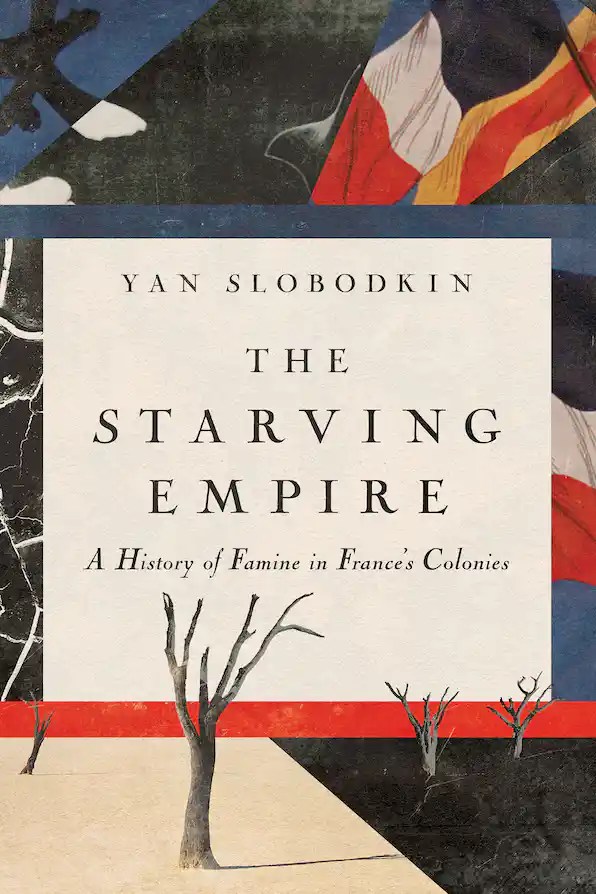
The Starving Empire traces the history of famine in the modern French Empire, showing that hunger is intensely local and sweepingly global, shaped by regional contexts and the transnational interplay of ideas and policies all at once. By integrating food crises in Algeria, West and Equatorial Africa, and Vietnam into a broader story of imperial and transnational care, Yan Slobodkin reveals how the French colonial state and an emerging international community took increasing responsibility for subsistence, but ultimately failed to fulfill this responsibility.
Europeans once dismissed colonial famines as acts of god, misfortunes of nature, and the inevitable consequences of backward races living in harsh environments. But as Slobodkin recounts, drawing on archival research from four continents, the twentieth century saw transformations in nutrition, scientific racism, and international humanitarianism that profoundly altered ideas of what colonialism could accomplish. A new confidence in the ability to mitigate hunger, coupled with new norms of moral responsibility, marked a turning point in the French Empire’s relationship to colonial subjects—and to nature itself.
Increasingly sophisticated understandings of famine as a technical problem subject to state control saddled France with untenable obligations. The Starving Empire not only illustrates how the painful history of colonial famine remains with us in our current understandings of public health, state sovereignty, and international aid, but also seeks to return food—this most basic of human needs—to its central place in the formation of modern political obligation and humanitarian ethics.
The earth is a hot topic. Accelerating crises have steadily replaced the fantasy of a global village with dreadful anticipation of the geographies of destitution, paranoia and oblivion to come. For most, modernity has already been a cruelly enticing catastrophe. There has accordingly been a surge of investigations into topics such as blackness, decolonisation, sexuality and revolution, which have reinvigorated theorisation in geography. Geotheory publishes work across geography, philosophy, critical theory, environmental humanities and cultural studies, wresting from the convulsions of the 21st century ways of spatial thinking that could yet reorient collective life. Perhaps the pervasive dread can be traversed with a newfound love of this old earth.
“I want to plunge into animality to draw from it new vigor” — Gramsci, New Year’s Day, 1916
One of the central “living” attractions of Testaccio’s Non-Catholic cemetery is its stray cats, a colony of twenty-five or so semi-feral moggies. We know from old paintings of the nearby Pyramid, especially those by the Roman artist Bartolomeo Pinelli, that cats have freely roamed the area for over 150 years. Nowadays, tourists and locals alike come to see the cemetery’s gatti, longtime beneficiaries of well-wisher donations and skilled volunteer caregivers, cat men and women who regularly nourish and tend the cat colony’s veterinarian needs. (The most famous of the cemetery’s felines is the late “Romeo,” a three-legged tabby who passed away in 2006, laid to rest in his own mini-tomb not far from Gramsci’s.)
Alexandre Kojève, Kant, trans. Hager Weslati – Verso, May 2024
The French publication was with Gallimard in 1973.
Kant forms the centerpiece of Alexandre Kojeve’s intriguing discovery of objective reality and its repressed history in Western philosophy
During the early 1950s, Alexandre Kojève resumed his ambitious project to bring the analytic reason of Kantianism in line with Hegel’s logic and philosophy of history. Kant is one of the most extensive text fragments where Kojève turned his attention to the gaps left open in the system of critical philosophy.
Published in its raw, unedited form in 1973, in the aftermath of the anti-Hegelian drift of the student-led revolt of May 68, the book has remained largely unexplored, despite its protean influence on various “returns” to Kant, from Weil to Deleuze, and from Foucault to Tosel and beyond. Kant is a deep and provocative text, equal in breadth and depth of insight to the famous Introduction to the Reading of Hegel.
Kant’s philosophical system, Kojeve argues, is haunted by the Thing-in-itself, as the ultimate expression of ‘bourgeois hypocrisy’ and its internally divided reason between action and discourse.
Making a case for the post-historical moral imperative to turn away from infinite progress and the practical justification of the ideas of God and the immortality of the soul, Kant outlines the material conditions of possibility of revolutionary action within the twin horizon of accomplished and recollected history.
A powerful explanation of why geopolitical competition makes implementing effective climate change policies so difficult. As the Russia-Ukraine war has shown, great-power competition drives states to prioritize fossil fuel acquisition over working toward a zero-carbon future.
In the last few years, it has become abundantly clear that the effects of accelerating climate change will be catastrophic, from rising seas to more violent storms to desertification. Yet why do nation-states find it so difficult to implement transnational policies that can reduce carbon output and slow global warming? In Oceans Rise, Empires Fall, Gerard Toal identifies geopolitics as the culprit. States would prefer to reduce emissions in the abstract, but in the great global competition for geopolitical power, states always prioritize access to carbon-based fuels necessary for generating the sort of economic growth that helps them compete with rival states. Despite what we now know about the long-term impacts of climate change, geopolitical contests continue to sideline attempts to halt or slow down the process.
The Ukraine conflict in particular exposes our priorities. To escape reliance on Russia’s vast oil and gas reserves, states have expanded fossil fuel production that necessarily increases the amount of carbon in the atmosphere. The territorial control imperatives of great powers preclude collaborative behavior to address common challenges. Competitive territorial, resource, and technological dramas across the geopolitical chessboard currently obscure the deterioration of the planet’s life support systems. In the contest between geopolitics and sustainable climate policies, the former takes precedence-especially when competition shifts to outright conflict. In this book, Toal interrogates that relationship and its stakes for the ongoing acceleration of climate change.