
The Theory Variations: An Interview with Fredric Jameson by Jason Demers (open access)
Thanks to Robert Tally for the link. Some interesting discussion of the early days of ‘French theory’ in the United States.
The Theory Variations: An Interview with Fredric Jameson by Jason Demers (open access)
Thanks to Robert Tally for the link. Some interesting discussion of the early days of ‘French theory’ in the United States.
At his relatively new Half Thoughts blog, Dave Beer has assembled a number of pieces into a virtual book, some of which are open access.
Over several years I’ve been working on a little background project that I’ve called ‘Reading Critical Data Studies’. The idea was quite simple. I tried to read and write about books in the field that I thought would be useful for teaching or that might help with research. It wasn’t possible to write about every book I encountered, there’s never enough time, so I picked out things that seemed important in some way or that covered a range of issues. In the pieces I wrote, I tried to respond to the ideas and perspectives in the books, offering thoughts and questions too. Together these pieces would hopefully add something to the debates.
I thought about it as a kind of book that would never actually be a book. So, instead, I’ve created a contents page below with links to the pieces. I’ve not included all the reviews I’ve done over the last few years, instead I’ve picked out eleven pieces that capture different issues in critical data studies (broadly conceived) and that might work alongside one another. Each chapter aims to find a way into the field through a focus on one book.
The full contents and links to all the pieces are here.
Andreas Malm on Palestine, Climate Activism and over-shooting 1.5 °C – interview on video with Sebastian Budgen
Andreas Malm is a Swedish climate activist, associate professor of human ecology at Lund University, and author of the best-selling How to Blow Up a Pipeline: Learning to Fight in a World on Fire. Naomi Klein describes him as “one of the most original thinkers on the subject” of climate change.
In this interview with his Verso editor, Sebastian Budgen, he discusses the origins of his climate activism, strategic failures of the climate movement, his pro-Palestinian politics, and eco-socialism.
You can find all his work, including How to Blow Up a Pipeline, here: https://www.versobooks.com/en-gb/blog…
Jean-Numa Ducange and Anthony Burlaud (eds.), Marx, A French Passion: The Reception of Marx and Marxisms in France’s Political-Intellectual Life – trans. David Broder, Brill, 2023
Paperback after 12 months with Haymarket

Despite the collapse of Soviet-style socialism, the spectre of Marx still haunts the French imagination. This is no accident, in a country whose intellectual life and political history have long been marked by his multiple presences.
This volume offers a historical and sociological insight into the way his thought has been received in the French context, from his own lifetime to the present. Analysing Marx’s place and influence in the French intellectual, political and artistic debate – across the political spectrum and even in the French-speaking colonial world – it helps us understand the uses and misuses of an œuvre of paramount importance.
Charlotte Thevenet, Derrida et ses doubles – Presses Universitaires de Vincennes, November 2023

Qu’on la pourfende, la déplore ou la célèbre, l’obscurité du style de Derrida semble mettre d’accord disciples et adversaires du philosophe. Plutôt que de prendre parti, ce livre prend à la lettre la fameuse illisibilité derridienne pour la comprendre comme l’un des effets d’une rhétorique singulière.
Afin de comprendre au mieux l’opacité déployée par Derrida dans toute son œuvre, ce livre s’est attaché à l’étude de cas-limites : Glas, livre en deux colonnes consacré à Hegel et Genet, mais aussi d’autres textes et livres du philosophe mettant en œuvre la division de la page (Tympan et La double séance). Analyser le discours philosophique avec les outils de la rhétorique rend la philosophie à sa nature textuelle, souvent oubliée au profit de la doctrine, et permet d’en proposer une lecture.
Call for Papers 2023: Global Histories of International Thought and Geopolitical Concepts
RUG-NUPI Research Workshop in the History and Theory of International Relations
Keynote speaker: Prof. Lucian Ashworth
Location: University of Groningen, 9712 CP Netherlands
Date: Thursday 23th – Friday 24th, May 2024
full details in pdf below
Mathias Albert, Dina Brode-Roger, Lisbeth Iversen, Svalbard Imaginaries: The Making of an Arctic Archipelago – Palgrave Macmillan, November 2023

Hardback and e-book at present; paperback due in December 2024
By drawing on a broad range of disciplinary backgrounds, this book illustrates the immense complexities of Svalbard as a place, point of reference, or social concept. It portrays the multiple, situated perspectives that characterize understandings and imaginings of Svalbard, and brings together contributions from academic fields that rarely interact with each other.
Svalbard Imaginaries contributes to a number of research contexts, ranging from a broadly conceived, multi-disciplinary field of ‘Arctic Studies’ to more disciplinary specific debates on how places are reworked at the interstices of various global flows and vice versa. It assembles contributions on imaginaries that cover a wide array of issues, including—but not limited to—Svalbard as a geopolitical site, a landscape, an image, a (mining) heritage assemblage, a tourist destination, a wilderness, a built environment, a site of knowledge production, a site of artistic engagement, and projections of the future. It deliberately assembles analyses that refer to a variety of timescales and covers representations of the past, the present, and possible futures of Svalbard.
Tilman Schwarze, Space, Urban Politics, and Everyday Life: Henri Lefebvre and U.S. City – Springer, November 2023
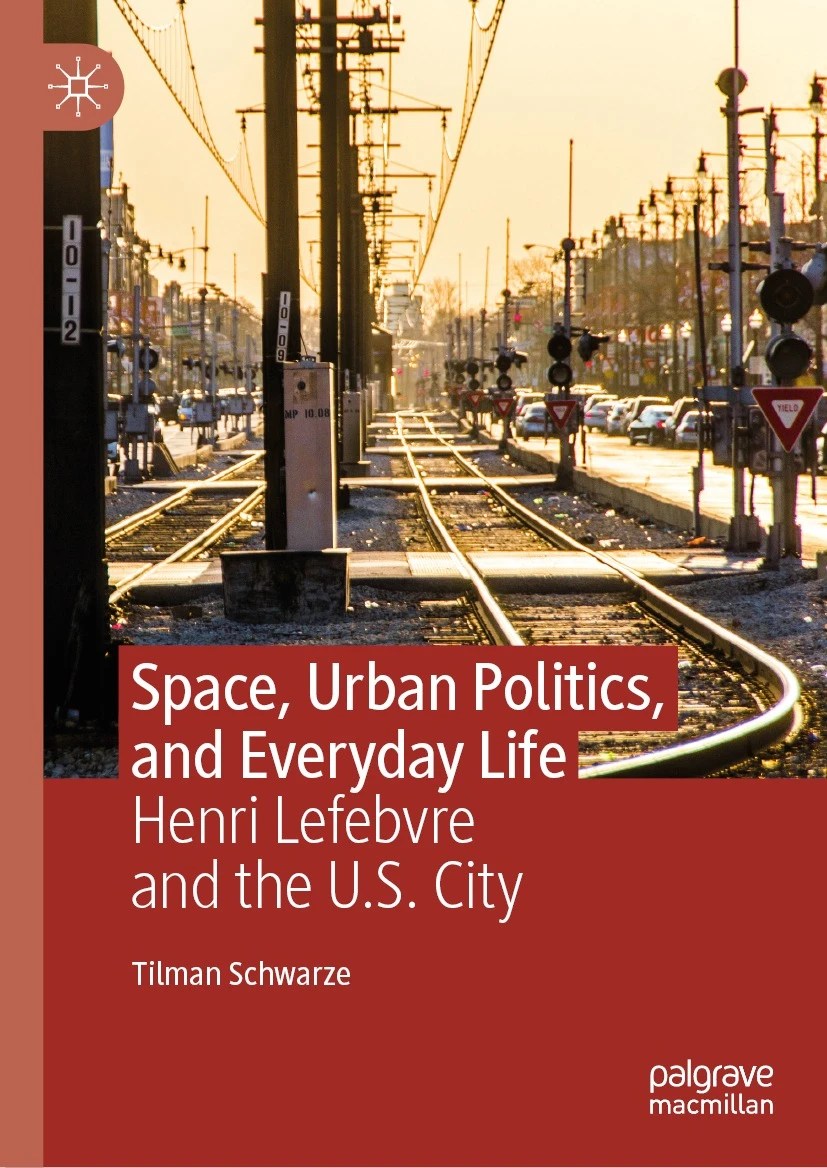
This Book develops a novel and innovative methodological framework for operationalising Henri Lefebvre’s work for empirical research on the U.S. city. Building on ethnographic research on Chicago’s South Side, Tilman Schwarze explores the current situation of urbanisation and urban life in the U.S. city through a critical reading and application of Lefebvre’s writings on space, everyday life, the urban, the state, and difference. Focusing on territorial stigmatisation, public housing transformation, and urban redevelopment, this book makes an important contribution to critical urban scholarship, foregrounding the relevance and applicability of Henri Lefebvre’s work for geographical and sociological research on urban politics and everyday life.
Raymond Ruyer, Cybernetics and the Origin of Information, trans. Amélie Berger-Soraruff, Andrew Iliadis, Daniel W. Smith and Ashley Woodward, Rowman & Littlefield, December 2023
[October 2025: link updated to the Bloomsbury site. They also publish the earlier translation The Genesis of Living Forms.]

One of the lost classics of French philosophy, Cybernetics and the Origin of Information has never before been published in English. Raymond Ruyer—who was a major influence on Simondon and Deleuze, among others—originally wrote this book, one of the first critiques of Norbert Wiener’s cybernetics program, in 1954. At once critical and analytical, it is a deep exploration of information theory, cybernetics, and the philosophical assumptions and implications of both. Among the themes covered in the book are the main types of information machines, information’s relationship to behavior and communication, and the nature of entropy and time in cybernetics. This translation contributes to understanding the rich history of cybernetics and the philosophy of information. A true hidden gem in the history of philosophical thought, this text will help readers understand foundational criticisms of ideas that have led to artificial intelligence.
Robert Zaretsky, The Subversive Simone Weil: A Life in Five Ideas – University of Chicago Press, 2021, paperback 2023
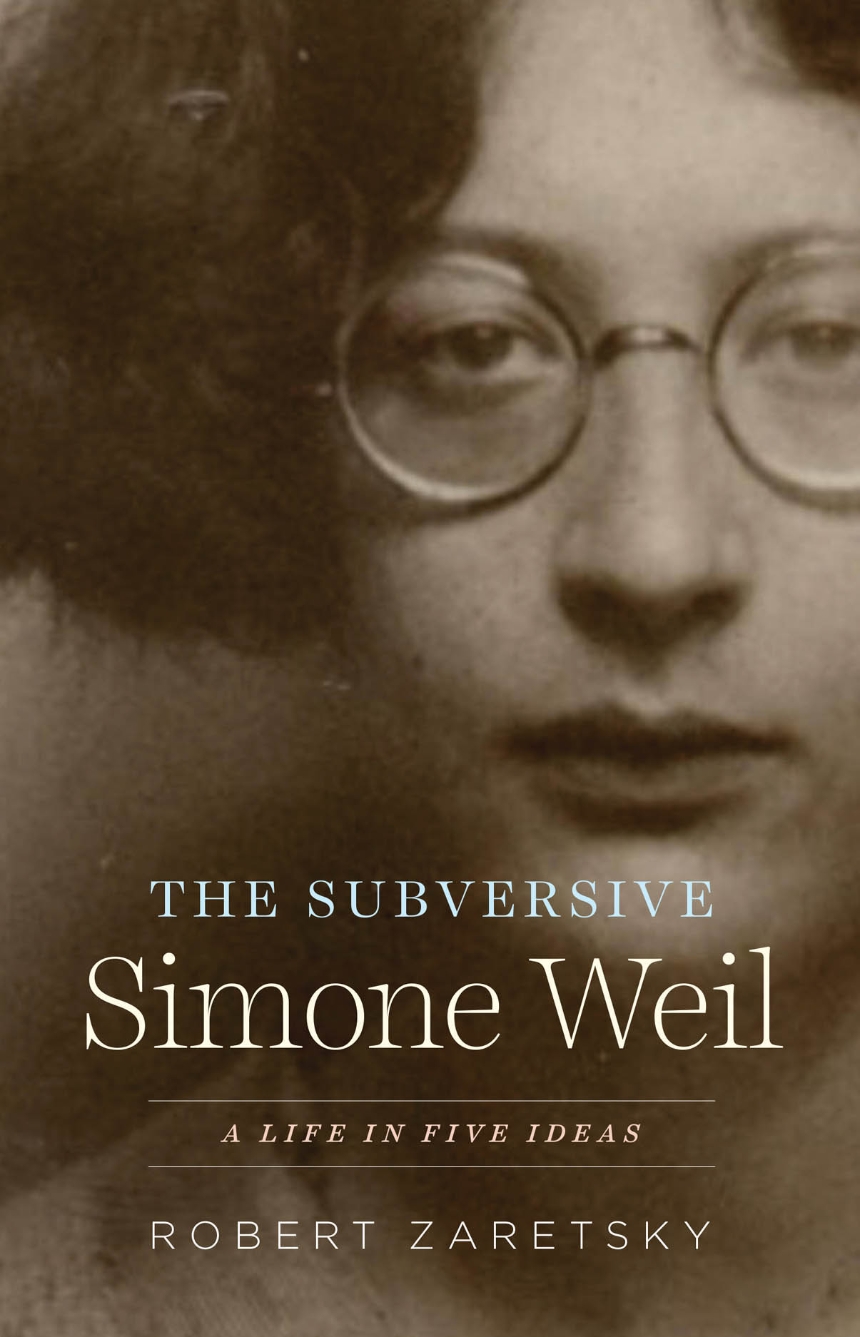
Known as the “patron saint of all outsiders,” Simone Weil (1909–43) was one of the twentieth century’s most remarkable thinkers, a philosopher who truly lived by her political and ethical ideals. In a short life framed by the two world wars, Weil taught philosophy to lycée students and organized union workers, fought alongside anarchists during the Spanish Civil War and labored alongside workers on assembly lines, joined the Free French movement in London and died in despair because she was not sent to France to help the Resistance.
Though Weil published little during her life, after her death, thanks largely to the efforts of Albert Camus, hundreds of pages of her manuscripts were published to critical and popular acclaim. While many seekers have been attracted to Weil’s religious thought, Robert Zaretsky gives us a different Weil, exploring her insights into politics and ethics, and showing us a new side of Weil that balances her contradictions—the rigorous rationalist who also had her own brand of Catholic mysticism; the revolutionary with a soft spot for anarchism yet who believed in the hierarchy of labor; and the humanitarian who emphasized human needs and obligations over human rights. Reflecting on the relationship between thought and action in Weil’s life, The Subversive Simone Weil honors the complexity of Weil’s thought and speaks to why it matters and continues to fascinate readers today.

