Le roman documenté du voyage de Philippe Sollers, Roland Barthes, Julia Kristeva, Marcelin Pleynet et François Wahl en Chine en 1974. Une satire mordante de la complaisance de ces intellectuels parisiens de grande renommée pour le régime de Mao
Au printemps 1974, cinq grands intellectuels de Saint-Germain-des-Prés – Philippe Sollers, Julia Kristeva et Marcelin Pleynet, représentants de la revue Tel Quel, accompagnés de Roland Barthes et de l’éditeur François Wahl – décident d’effectuer un voyage en Chine. Tandis que Mao Tsé-toung mène une campagne massive contre son successeur pressenti, Lin Biao, et contre Confucius, le petit groupe arpente le pays avec curiosité, enthousiasme, voire fascination. Si certains, gênés par les excès de la propagande, montrent tout de même des signes de déception à cause d’une impression de fadeur générale, de l’absence visible de sexualité ou de la monotonie des paysages, la vision romantique du régime que ces amis partagent sidère aujourd’hui…En s’appuyant sur les témoignages que ces écrivains ont donnés de leur périple et sur d’autres sources, Jean Berthier relate précisément les trois semaines de leur séjour. Il restitue les visites guidées dans les villages, musées, écoles, usines, monuments à la gloire du peuple et de la « Révolution culturelle », leurs conversations privées et leurs pensées intimes, avec une ironie mordante. Une satire vive et réjouissante de l’aveuglement idéologique qui peut parfois s’emparer des esprits apparemment les plus éclairés
The original draft of the Declaration of Independence condemned British kings for supporting slavery in their empire. England’s two seventeenth-century revolutions were in part a reaction to the crown’s proslavery policies, with politicians such as John Locke arguing that all people were born equal and that government should be based on consent. But while these principles would underpin the American Revolution, the treaty that ended that war protected the legal foundations of the plantation system in the new republic. The King’s Slaves untangles this thorny history, arguing that American slavery was borne from authoritarian rule.
In this incisive and thought-provoking book, Holly Brewer challenges the notion that slavery arose naturally in the colonies through the interests of merchants and planters, showing how behind them lay a British crown that believed in absolute power over subjects and granted similar powers to proprietors and masters. British kings used their authority over navies and armies, judges and royal governors to create an elaborate plantation system that produced more crops for export and greater wealth from tariffs. Royal propaganda supported claims that some peoples had no rights while edicts and proclamations circumvented the legislative process. Brewer describes how African and Indigenous peoples resisted the king’s slavery, as did some colonists, English politicians, and reformers. Yet slavery persisted, becoming enshrined after independence as a dehumanizing legal foundation of American capitalism.
A bold work of scholarship by a historian at the height of her powers, The King’s Slaves shares new perspectives on America’s founding, exposing empire’s pervasive role in spreading and justifying slavery in the new world.
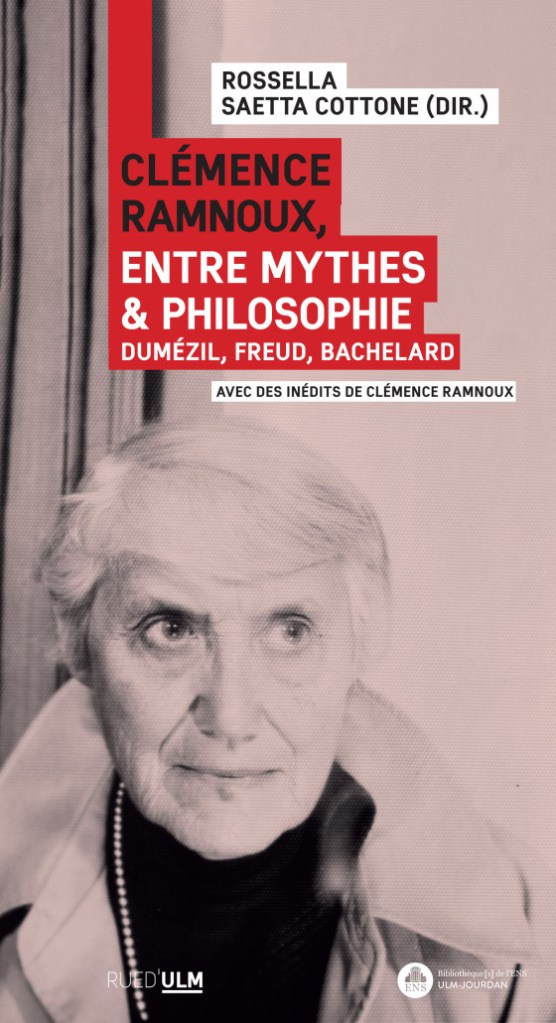
Clémence Ramnoux (1905-1997) was an important French scholar of ancient Greece. She worked mostly on the pre-Socratics, especially Heraclitus. Alongside Simone Pétrement she was one of the first two women who entered the philosophy programme of the École Normale Supérieure in 1927. Simone Weil would join them the year after. As Penelope Deutscher discusses, for her whole career she faced institutional challenges because of the marginalised position of women in the French academy. In French classical studies, Ramnoux was a pioneer, a little older than Jacqueline de Romilly (1913-2010), who also worked on classical Greece, particularly on Thucydides. De Romilly was the first woman to hold a chair at the Collège de France, and the second woman elected to the Académie française (after Marguerite Yourcenar). Deutscher says that Ramnoux’s contribution and originality has been repeatedly marginalised, and indicates how, even at the 1998 memorial conference, “the forgetting of Ramnoux was staged right there at her own commemorative homage” (“‘Imperfect Discretion’”, p. 162).
Ramnoux knew Foucault, attending the 1965 Colloque du Royaumont conference on Nietzsche, organised by Gilles Deleuze and Martial Gueroult, and the Saclay conference on structuralism in 1970 (which I briefly mention here and will discuss in more detail in a future piece). After Foucault’s “Nietzsche, Freud, Marx” lecture at the first of these conferences, she took part in the discussion, though Foucault says he has little to add to her indication of the link Lou Salomé made between Nietzsche and Freud (Dits et écrits, Vol I, pp. 577-78). Foucault knew at least her book on Heraclitus, with some notes in the Fonds Michel Foucault (NAF28730, box 32, folder 1). The recently catalogued library of Foucault’s apartment indicates that she gave him an offprint of her 1965 article on “«Les fragments d’un Empédocle» de Fr. Nietzsche”, with a dedication. This is a very interesting discussion of an early abandoned project by Nietzsche. It was planned around the time of his incomplete book Philosophy in the Tragic Age of the Greeks, the surviving text of which does not cover Empedocles, although the plan was that it would.
Importantly for my current work on Indo-European thought in France, Ramnoux was a former student of Georges Dumézil. She dates her first reading of Dumézil to the Occupation, and says she attended his courses at the École Pratique des Hautes Études from 1944. An attendance list suggests she continued to attend at least as late as 1953 (Fonds Georges Dumézil, box 73, folder 7). Ramnoux’s explicit references to Dumézil are limited, but she described him as her “first master” (Œuvres, Vol II,289). Her essay “Ce que je dois à Georges Dumézil ou de la légende à la sagesse” appeared in the 1981 collection Hommages à Georges Dumézil, and was reprinted in her collection Études présocratiques II, which is included in the second volume of Œuvres (Vol II, pp. 493-512). There she discusses Dumézil’s impact on her work, alongside Lévi-Strauss’s work on myth and her parallel training in psychoanalysis. Dumézil’s focus on Rome, India and Iran (and, we might add, the Caucasus) informed her work on Greece, as it also did for Jean-Pierre Vernant and Marcel Detienne, among others. She says she gained from Dumézil a “knowledge, undoubtedly, of the archaic religions of Europe, but rather more than that: I owe to him an art of reading and deciphering” (p. 512).
The website stresses Ramnoux’s connections to philosophers including Jean Wahl, Pierre-Maxime Schuhl and Gaston Bachelard, as well as classicists such as Vernant and André-Jean Festugière, and international names such as Harold Cherniss. Maurice Blanchot wrote the preface to her Heraclitus book; Wahl to the first volume of her Études présocratiques. Cottone and Reboredo’s site indicates several other possible connections, some of which are explored in the recent collection. This would include her friendship with Pierre Bourdieu in Algeria (see Collard, “Clémence Ramnoux et Pierre Bourdieu”), her time at the Institute for Advanced Study in Princeton, and her work in founding the philosophy department at Université de Paris X Nanterre with Paul Ricœur and Jean-François Lyotard (see Courrier, “L’enseignement de Clémence Ramnoux à Nanterre”).
This site also indicates that Ramnoux’s archive is now at the École Normale Supérieure. There is a useful guide to relevant archives in Clémence Ramnoux, entre mythes et philosophie, 313-15. This says where, for example, to find her letters to Bourdieu, Henri Gouhier, Jean Hyppolite, Jacques Maritain and Wahl, and the geographer Jean Gottmann, and the record of her career at the Archives Nationales. These seem like interesting things to explore. One mistake here though: her archives concerning visiting posts at the IAS are in its own archives, not at Princeton University.
The IAS archives have some correspondence and other documents concerning her visits there for the 1955-56 academic year and the first term of 1960-61. These include letters to the director Robert Oppenheimer, from Cherniss, who was instrumental in her invitation, the cultural advisor to the French ambassador, Edouard Morot-Sir, and about the Fulbright travel grant to support her visits. On her first visit there she worked on Héraclite, ou l’homme entre les choses et les mots, later submitted as her major doctoral thesis; on the second visit she wrote Mythologie, ou la Famille olympienne, published in 1962, and worked on the fragments of Empedocles. It seems she intended to do a more extensive study of Empedocles. She also worked on some translations of Heraclitus, for a small, very limited edition, with illustrations by the sculptor Étienne Hajdú. She later presented a copy to the IAS library.
An interview with Raymond Bellour gives some sense of her intellectual formation, and in particular the importance of G.S. Kirk’s study and Cherniss’s IAS seminar on Heraclitus for her analysis. “I worked with the edition of Diels in the middle, Kirk’s book on the right, the manuscript notes of Cherniss to the left, step by step and fragment by fragment” (Œuvres Vol II, 648). Despite this, Ramnoux’s work can also be a good example of the failed conversation between French classicists and anglophone ones. Herbert Jennings Rose, who had an ongoing feud with Dumézil, among others, wrote a bad-tempered assessment of La nuit et les enfants de la nuit dans la tradition grecque for The Classical Review in 1961.
One of Ramnoux’s earliest essays was published in the first issue of La Psychanalyse, an issue which included Émile Benveniste’s essay on language in Freud’s work, Hyppolite’s discussion of Freud with Jacques Lacan’s introduction and commentary, Lacan’s 1953 lecture known as the Rome discourse, Lacan’s translation of Martin Heidegger’s “Logos” essay, and texts by Hyppolite and Daniel Lagache, among others. The issue had the cover title “Sur la Parole et le Langage”, and the inside cover “De l’usage de la parole et des structures de langage dans la conduit et dans le champ de la psychanalyse”. Lacan’s Rome essay is reprinted in Écrits, as Chapter 12. Ramnoux’s essay was “Hadès et le psychanalyse”, which is reprinted in the first volume of her Études présocratiques, included in Œuvres. She would publish at least one more essay in that journal, “Sur une page de Moïse et le Monothéisme” in 1957, on Freud’s controversial late book Moses and Monotheism.
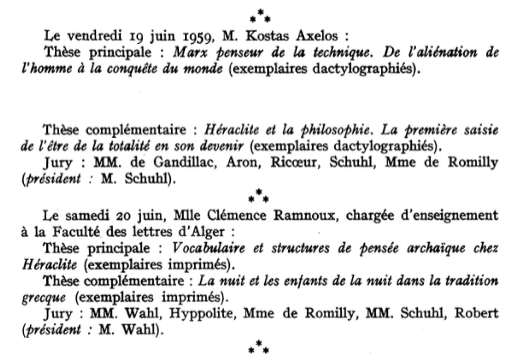
Report of the Axelos and Ramnoux thesis defences, “Nouvelles philosophiques”, Les Études philosophiques 14 (3), 1959, 405-12
Somewhat strangely, given their shared interests, Ramnoux does not seem to mention the work of Kostas Axelos, and I don’t think he makes reference to her work. Ramnoux’s Héraclite, ou l’homme entre les choses et les mots dates from 1959; Axelos’s Héraclite et la philosophie to 1962. Both are briefly mentioned in G.B. Kerferd’s 1965 survey of “Recent Work on Presocratic Philosophy”. Interestingly, Axelos defended his theses for the doctorat d’état on 19 June 1959, with Marx penseur de la technique as the primary thesis; Héraclite as the secondary; and Ramnoux defended the next day. Axelos’s edition of Heraclitus, with Greek text and facing page French translation, had been published in 1958. I suspect there is more to the story, since they must have been aware of each other’s work, but I don’t know what that story might be. The Axelos-Ramnoux relation may have been clouded by Axelos’s Heideggerian approach. As Monique Dixsaut says, Ramnoux “refers briefly to Heidegger, but always to approve or reject his translation of a word, and never to his conception of being and time” (Préface, 16). However, Jean Wahl’s preface to her Études présocratiques suggests Heidegger, “was no stranger to the evolution of her thought, and behind him Nietzsche” (Œuvres Vol II, 11). There are indeed a few mentions of his work across hers, and in the interview with Bellour she discusses reading him but denies too close an influence (Œuvres Vol II, 649). But Axelos seems entirely absent from her work.
Ramnoux’s primary thesis was Vocabulaire et structures de pensée archaïque chez Héraclite, the secondary or complementary thesis was La nuit et les enfants de la nuit dans la tradition grecque. Vocabulaire et structures was retitled Héraclite ou l’homme entre les choses et les mots when it was published; the secondary thesis kept the same title. Both are reprinted in Œuvres, Volume I. Wahl, Hyppolite, de Romilly, Schuhl and someone I assume was Louis Robert were the examining jury. De Romilly and Schuhl were also on Axelos’s jury, along with Maurice de Gandillac, Raymond Aron, and Paul Ricoeur (“Nouvelles philosophiques”, 1959). Formidable lineups for both, and it is worth stressing the scale of what was required for a doctorat d’état: the secondary thesis for both Axelos and Ramnoux was a full-length book, and Axelos had published his bi-lingual edition of Heraclitus while working on his theses.
In Clémence Ramnoux, entre mythes et philosophie, Reboredo provides some supplementary texts – three short radio broadcasts, a couple of unpublished conference papers, and three articles which were not included in Œuvres. The conference papers are the first posthumous publications of Ramnoux’s work. Œuvres comprises most of her work – the bibliography in the new collection indicates that the main omissions are pre-1954 writings, some of her articles, and her book reviews. A striking aspect of Ramnoux’s career is the number of interesting articles she published before the submission of her theses. She also wrote about, among other themes, Parmenides, King Lear, Hegel, Bachelard and the Finn (or Fenian) cycle.
I’m aware much of this initial piece is about her connections to others, mostly men, and not so much about her work in itself, but it hopefully serves as an introduction to some of her interests and where she might be situated in a wider network of ideas. As far as I know, none of her work is translated into English.
References
“Nouvelles philosophiques”, Les Études philosophiques 14 (3), 1959, 405-12.
Les Fragments d’Héraclite d’Éphèse, ed. and trans. Kostas Axelos, Paris, 1958.
Hommages à Georges Dumézil, Aix-en-Provenance: Pandora, 1981.
Textes d’Héraclite, trans. Clémence Ramnoux, illustrations by Étienne Hajdu, Paris: Aux dépens de l’artiste, 1965.
Kostas Axelos, Héraclite et la philosophie, Paris: Minuit, 1962.
Victor Collard, “Clémence Ramnoux et Pierre Bourdieu: Deux générations de normaliens philosophes découvrant la sociologie en Algérie (1958-1960)”, in Rossella Saetta Cottone ed. Clémence Ramnoux, entre mythes et philosophie: Dumézil, Freud, Bachelard (avec des inédits de Clémence Ramnoux), Paris: Éditions Rue d’Ulm, 2025, 51-83.
Yves Courrier with Guy Basset and Paul Lionnet, “L’enseignement de Clémence Ramnoux à Nanterre (1965-1975): Un témoinage et un hommage”, in Rossella Saetta Cottone ed. Clémence Ramnoux, entre mythes et philosophie: Dumézil, Freud, Bachelard (avec des inédits de Clémence Ramnoux), Paris: Éditions Rue d’Ulm, 2025, 109-23.
Penelope Deutscher, “‘Imperfect Discretion’: Interventions into the History of Philosophy by Twentieth-Century French Women Philosophers”, Hypatia 15 (2), 2000, 160-80.
Monique Dixsaut, “Préface”, in Rossella Saetta Cottone ed. Clémence Ramnoux, entre mythes et philosophie: Dumézil, Freud, Bachelard (avec des inédits de Clémence Ramnoux), Paris: Éditions Rue d’Ulm, 2025, 9-19.
Michel Foucault, Dits et écrits, eds. Daniel Defert and François Ewald, Paris: Gallimard, four volumes, 1994.
Sigmund Freud, Der Mann Moses und die monotheistische Religion: Drei Abhandlungen, Amsterdam: Albert de Lange, 1939; Moses and Monotheism: Three Essays,trans. James Strachey, in The Origins of Religion: Totem and Taboo, Moses and Monotheism and Other Works – Penguin Freud Library Volume 13, London: Penguin, 1990.
G.B. Kerferd, “Recent Work on Presocratic Philosophy”, American Philosophical Quarterly 2 (2), 1965, 130-40.
G.S. Kirk, Heraclitus The Cosmic Fragments: A Critical Study, Cambridge: Cambridge University Press, 1962 [1954].
Friedrich Nietzsche, Philosophy in the Tragic Age of the Greeks, trans. Marianne Cowan, Washington, D.C., 1962.
Clémence Ramnoux, “Mythes et métaphysique”, Revue de Métaphysique et de Morale 55 (4), 1950, 408-31.
Clémence Ramnoux, “Hadès et le psychanalyse” (1953), reprinted in Études présocratiques, and in Œuvres, Vol II, 215-28.
Clémence Ramnoux, “Sur une page de Moïse et le Monothéisme”, reprinted in Études présocratiques, and in Œuvres, Vol II, 229-47.
Clémence Ramnoux, La nuit et les enfants de la nuit dans la tradition grecque, Paris, Les Belles Lettres, 1959; reprinted in Ramnoux, Œuvres, Vol I, 5-179.
Clémence Ramnoux, Héraclite ou l’homme entre les choses et les mots, Paris, Les Belles Lettres, 1968 [1959]; reprinted in Ramnoux, Œuvres, Vol I, 179-617.
Clémence Ramnoux, Mythologie, ou la Famille olympienne, París, Armand Colin, 1962; reprinted in Ramnoux, Œuvres, Vol I, 619-772.
Clémence Ramnoux, “«Les fragments d’un Empédocle» de Fr. Nietzsche”, Revue de Métaphysique et de Morale 70 (2), 1965, 199-212; reprinted in Études présocratiques, and in Œuvres, Vol II, 123-37.
Clémence Ramnoux, “Entretien avec Clémence Ramnoux”, in Raymond Bellour, Le Livre des autres: Entretiens, Paris: Union Générale d’Éditions 10/18, 1978, 157-80, reprinted as “Entrétien sur Héraclite” in Œuvres, Vol II, 645-56.
Clémence Ramnoux, “Ce que je dois à Georges Dumézil ou de la légende à la sagesse”, Hommages à Georges Dumézil, Aix-en-Provenance: Pandora, 1981, 101-20; reprinted inRamnoux, Œuvres, Vol II, 493-512.
Clémence Ramnoux, Œuvres, ed. Alexandre Marcinkowski, Paris: Les Belles Lettres, two volumes, 2020.
H.J. Rose, “Symbolism in Greece?” The Classical Review 11 (1), 1961, 77-79.
Rossella Saetta Cottone, “Présentation: Clémence Ramnoux entre les choses et les mots”, in Clémence Ramnoux, Œuvres, ed. Alexandre Marcinkowski, Paris: Les Belles Lettres, two volumes, 2020, Vol I, xv-xxviii.
Rossella Saetta Cottone ed. Clémence Ramnoux, entre mythes et philosophie: Dumézil, Freud, Bachelard (avec des inédits de Clémence Ramnoux), Paris: Éditions Rue d’Ulm, 2025.
Archives
Fonds Georges Dumézil, DMZ, Collège de France
Fonds Michel Foucault, NAF 28730, Bibliothèque nationale de France
Director’s Office files, Shelby White and Leon Levy Archives Center, Institute for Advanced Study, Princeton
Acknowledgements
My thanks to Caitlin Rizzo for providing material from the IAS archives.
This is the 54th post of a weekly series, posted every Sunday throughout 2025, and now entering a second year. The posts are short essays with indications of further reading and sources. They are not as formal as something I’d try to publish more conventionally, but are hopefully worthwhile as short sketches of histories and ideas. They are usually tangential to my main writing focus, a home for spare parts, asides, dead-ends and possible futures. I hope there is some interest in them. They are provisional and suggestions are welcome. A few, usually shorter, pieces in a similar style have been posted mid-week. I’m not sure I’ll keep to a weekly rhythm in 2026, but there will be at least a few more pieces.
The full chronological list of ‘Sunday histories’ is here, with a thematic ordering here.
What does it mean to know, and how is knowledge practiced? How can Indigenous perspectives challenge conventional concepts of knowledge in the Global North? Drawing on Indigenous epistemologies from the Andes and Western Amazon, Southern Epistemologies investigates how knowledge, wisdom, and understanding are shaped by local cultures, languages, bodies, and environments.
Bringing together linguists, philosophers, anthropologists, and Indigenous knowledge holders, the volume examines the dynamic interactions between culture, language, and place, showing how the unique linguistic histories and worldviews of Andean and Amazonian societies inform distinct ways of knowing. By interpreting these perspectives on their own terms, the book offers fresh insights into the plurality and diversity of human knowledge.
As the first volume specifically focused on Indigenous South American epistemologies, Southern Epistemologies foregrounds Indigenous knowledge systems and science while fostering dialogue with academic traditions. By opening new interdisciplinary and cross-cultural conversations, this groundbreaking volume challenges conventional notions of knowledge and illuminates how engagement with Indigenous perspectives can expand and enrich our understanding of what it truly means to know.
In Haunted by the Civil War, Shirley Samuels explores the work of Walt Whitman, Emily Dickinson, Herman Melville, Frederick Douglass, Charlotte Perkins Gilman, and others to investigate the long cultural shadow of America’s cataclysmic sundering. Juxtaposing these texts with images—ranging from paintings by Winslow Homer to newspaper and magazine illustrations of political controversies—Samuels argues that the Civil War still haunts our attitudes toward democracy. The recent toppling of Confederate monuments, the continuing protests over racial and sexual discrimination, immigration, and Indigenous land rights: each of these forms part of the war’s legacy.
Examining the fraught deliberations about an ideal American democracy in the early republic, Samuels turns to the language of sensation in the poetry of Melville, Dickinson, and Whitman alongside Lincoln’s relation to the poetic and visual culture of his time. She considers the haunted afterlives of war in the work of Louisa May Alcott and Harriet Beecher Stowe as well as in popular nineteenth-century inspirational fiction. And she investigates the literature of men at sea (and on rivers, enabling both connection and escape), as seen in Melville and Mark Twain, while examining women’s wartime work and experience, in writings by Gilman and Frances Harper.
Why does the Civil War still haunt us? To find the answer, Samuels identifies not only the ghosts that cannot rest but also the cultural practices that name them.
Migration: A Critical Introduction offers a fresh and accessible framework for understanding migration through a distinctly geographical lens. Going beyond traditional borders and categories, this book examines the forces that shape migration—historical, political, spatial—and invites readers to think differently about how migration is defined, governed, and experienced.
Challenging conventional understandings of migration by centring geographical concepts, critical theory, and storytelling, the authors explore the production of migration knowledge and the power relations that underpin it. Readers are introduced to various forms of migration, from labour and family migration to displacement caused by climate change and conflict. Each chapter builds on practical, ethical, and conceptual tools for critically engaging with migration research and narratives, whilst fostering more inclusive and emancipatory imaginaries of migration futures.
Migration: A Critical Introduction is an essential resource for upper-level undergraduate and postgraduate students of Geography, Sociology, Anthropology, International Relations, and related fields. It is particularly suitable for courses on Human Geography, Migration Studies, and Political Geography as part of broader degree programmes in the social sciences and humanities.
« L’année des cheveux longs et de la minijupe », résume le journal rétrospectif des Actualités françaises le 27 décembre 1966. Sommet des Trente Glorieuses, arrivée des enfants du baby-boom à l’âge adulte, début d’une révolution accélérée des moeurs et entrée dans la société d’abondance, 1966 a été une année tournant sur de nombreux fronts — démographique, économique, politique, social et culturel. C’est à restituer le tissu de ses jours que s’attache cette enquête profondément novatrice où se croisent, entre marée structuraliste et Nouvelle Vague, Georges Perec, Michel Foucault, le briquet jetable, André Malraux, les livres de poche, La Grande Vadrouille, la microcassette Philips, ainsi que Marguerite Duras, Aragon, Jean-Luc Godard, Roland Barthes et bien d’autres. Il y est question de choses et de mots, de sons et d’images, mais encore d’histoire et de sociologie, de cinéma et de télévision, de poésie et de musique, de révolte aussi — deux ans avant Mai —, et de mémoire, avec le débat sur les camps d’extermination. Il n’en faut pas moins pour recomposer cet incendie prodigieux qui marque un seuil entre deux époques.
The Criminal State offers a gripping account of how law has confronted the most radical forms of state violence. Beautifully written, broad in scope, and bracingly original, it weaves history with political thought to trace the shifting legal response to state aggression and atrocities, from Leopold’s rule over the Congo to Putin’s war in Ukraine.
At its heart is Lawrence Douglas’s fresh interpretation of the law’s reckoning with Nazi aggression and atrocity. He shows how the Nuremberg trials challenged centuries of thought—rooted in Hobbes and other canonical thinkers—that shielded sovereigns from legal scrutiny. Yet Nuremberg’s bid to frame aggression as the cornerstone of a new order of international criminal law largely failed, giving way to a system now centrally concerned with crimes against humanity and genocide—while leaving unresolved the legality and effectiveness of using force to stop the worst violations of human rights.
Providing rare historical perspective on the dilemmas facing international courts, The Criminal State is a sweeping, provocative history of the struggle to bring perpetrators of state violence to justice.