Andrea Marston, Subterranean Matters: Cooperative Mining and Resource Nationalism in Plurinational Bolivia – Duke University Press, March 2024

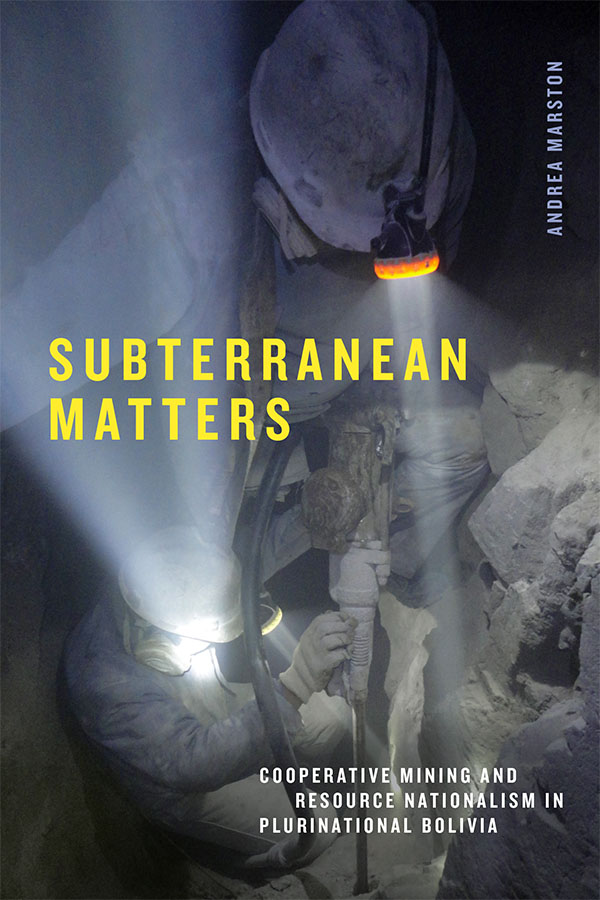
Andrea Marston, Subterranean Matters: Cooperative Mining and Resource Nationalism in Plurinational Bolivia – Duke University Press, March 2024

In Subterranean Matters, Andrea Marston examines the ongoing history of Bolivian mining cooperatives, an economic formation that has been central to Bolivian politics and to the country’s economy. Marston outlines how mining cooperatives occupy a contradictory place in Bolivian politics. They were major backers of left-wing president Evo Morales in 2006 and participated significantly in the crafting of the constitution that would declare Bolivia a plurinational state. At the same time, many Bolivians regard them as thieves because they derive personal profits from the subterranean mineral resources that are the legal inheritance of all Bolivians. Through extensive fieldwork underground in Bolivian cooperative mines, Marston explores how these miners—and the subterranean spaces they occupy—embody the tensions at the heart of Bolivia’s plurinational project. Marston shows how a shared feature of left-wing and right-wing politics in Bolivia is a persistent commitment to nation and nationalism, illustrating how bodies, identities, and resources fit into this complex political matrix.

Posted in Uncategorized | Leave a comment

CFP: The Aesthetics of Geopower: Imagining Planetary Histories and Hegemonies, 4 & 5 April 2024, University of Amsterdam

Call for Papers: The Aesthetics of Geopower: Imagining Planetary Histories and Hegemonies, 4-5 April 2024, University of Amsterdam

Deadline for proposals: 15 October 2023.

For this two-day, single-stream, and in-person conference, sponsored by the Amsterdam School for Cultural Analysis and Dutch Research Council, scholars are invited to explore how the human and nonhuman forces shaping and emerging from the earth are articulated in art and cultural practice.

Keynote Speakers: 

Macarena Gómez-Barris (Brown University, author of The Extractive Zone: Social Ecologies and Decolonial Perspectives, Duke University Press, 2017)

Federico Luisetti (University of St. Gallen, author of Non-human Subjects: An Ecology of Earth Beings (Cambridge University Press, forthcoming)

If the earth was once passed off as a neutral backdrop to human life, in the present age of ecological derangement it has reemerged as fraught with relations of power and politics. In this context, cultural theorists have put forward the rubric of geopower to conceptualize the ways that power is exerted over and through but also by the earth (Clare 2013; Neyrat 2019; Yusoff 2018). Having long been entangled with extractive, racial capitalism (Bain 2023, 1-2), geopower is becoming especially visible amid climate change and discourses of the Anthropocene. From proposals for solar geoengineering to legislation extending legal personhood to ecological entities such as the Ganga River, contemporary manifestations of geopower indicate how politics and planetarity are colliding in complex ways that are increasingly defining the present and will shape the future. 

Extrapolated from Michel Foucault’s thinking of biopower, geopower—or “geontopower” in Elizabeth A. Povinelli’s alternative formulation (2016)—has been theorized along several overlapping trajectories (Tola 2022; Luisetti 2019). For some, it primarily signifies the “government of the earth” (Diran & Traisnel 2019, 44) and implicates the technologies and tactics through which dominant subjects frame and exploit not just terrestrial environments but those “defined into nature” under patriarchal and colonial orders (Caputi 2020, 183). For another strand of theory, which draws on posthuman philosophies of life and matter (esp. Grosz 2008), geopower names the nonhuman forces of the earth, which permeate, condition, but also often disrupt or imperil humanly regulated environments (Clark 2011; Grosz, Yusoff, & Clark 2017). 

Building on these developments, this conference explores how geopower intersects with aesthetics, taken expansively as referring to art, film, literature, and other forms of cultural practice, as well as sensed materiality and embodied perception. Our premise is that the aesthetic, far from being secondary or supplemental to the forces shaping the earth, is centrally entailed and embedded in dynamics of geopower. This can be seen in the visual construction of “the Earth system” as an object of calculation, conservation, and control, or in scholarly, literary, and filmic narratives of the Anthropocene, which cast different human subjects as planetary culprits or custodians (Bonneuil & Fressoz 2016). The earth’s inhuman forces, meanwhile, have a transgressive vitality that often registers aesthetically and might be articulated in artistic practice (Sheikh 2017). Such forces suffuse cultural practice even when not explicitly thematized, whether because some artistic scenes are economically aligned with particular regimes of resource extraction (Acosta 2020) or because cultural works are necessarily composed of planetary materialities, which precede and exceed discursive or authorial framings of the aesthetic (Parikka 2015). 

To probe the connections among power, planetarity, and the aesthetic, we call on scholars, critics, and practitioners across disciplines to reflect on how diverse formations of geopower are enabled and mediated, but also challenged in cultural practice. How do conceptual, visual, poetic, or narratological framings of the earth calibrate social approaches to environments? Which marginalized perspectives can be brought forward to develop alternative representations or counter-histories of geopower? How is it imbricated with racializing, (neo)colonial, and cisheteropatriarchal orders? And how might theories of geopower be rethought by attending to its material manifestations or reimagined in literary and artistic experiment? 

In addressing these and other questions pertaining to the aesthetics of geopower, contributors are invited to explore narratives, images, and practices relating to any genre or medium, or events, discourses, and materialities in any historical and geographical context. Possible topics might include (but are not limited to): 

—cross-cultural perspectives on/representations of the earth as an aesthetic object; 

—the significance of land and planetary forces in decolonial thought and practice; 

—the aesthetics of geoengineering, from speculation to design; 

—climate fiction and narrative constructions of geopower; 

—articulations of the earth’s materialities in the arts and cultural practice; 

—the role of mapping, remote sensing, and technological mediation in planetary governance; 

—the politics and aesthetics of “deep time” imaginaries; 

—Embodied and multi-sensory apprehensions of planetary power; 

—representations of resource extraction and new commodity frontiers;

—the aestheticization of planetary forces that exceed and transcend the human;

—creative interventions that make visible the inequities and injustices of geopower.

Submission

Please submit abstracts (max. 300 words for 20 minute presentations) and a short biographical note (max. 250 words) to aestheticsgeopower@gmail.com by 15 October 2023.

Kindly send submissions as a single pdf document of max. two pages. To deepen mutual engagement, papers will be circulated a week before the conference; each participant will be assigned a respondent and asked to act as primary respondent to an assigned paper in return. Selected papers will be invited for inclusion in an edited volume. No conference fees will be charged.

Organized by Dr Simon Ferdinand (www.simonferdinand.com) and Dr Colin Sterling (www.colinsterling.com) of the University of Amsterdam. 

Full details and references at the conference website

Posted in Uncategorized | Leave a comment

Ian Merkel, Terms of Exchange: Brazilian Intellectuals and the French Social Sciences – University of Chicago Press, 2022 and Journal of the History of Ideas discussion

Ian Merkel, Terms of Exchange: Brazilian Intellectuals and the French Social Sciences – University of Chicago Press, 2022

A collective intellectual biography that sheds new light on the Annales school, structuralism, and racial democracy.

Would the most recognizable ideas in the French social sciences have developed without the influence of Brazilian intellectuals? While any study of Brazilian social sciences acknowledges the influence of French scholars, Ian Merkel argues the reverse is also true: the “French” social sciences were profoundly marked by Brazilian intellectual thought, particularly through the University of São Paulo. Through the idea of the “cluster,” Merkel traces the intertwined networks of Claude Lévi-Strauss, Fernand Braudel, Roger Bastide, and Pierre Monbeig as they overlapped at USP and engaged with Brazilian scholars such as Mário de Andrade, Gilberto Freyre, and Caio Prado Jr..

Through this collective intellectual biography of Brazilian and French social sciences, Terms of Exchange reveals connections that shed new light on the Annales school, structuralism, and racial democracy, even as it prompts us to revisit established thinking on the process of knowledge formation through fieldwork and intellectual exchange. At a time when canons are being rewritten, this book reframes the history of modern social scientific thought.

There is a Journal of the History of Ideas discussion with Disha Karnad Jani here.

Posted in Uncategorized | Leave a comment

Adriana Zaharijevic, Judith Butler and Politics – Edinburgh University Press, August 2023

Adriana Zaharijevic, Judith Butler and Politics – Edinburgh University Press, August 2023

Just an expensive hardback only at this point unfortunately

Presents Judith Butler’s interest in plurality of bodily lives and her search for a social transformation conducive to a more livable world

  • Offers a novel understanding of Butler’ work as a call for an insurrection at the level of the real
  • Provides a framework based on an intersection of four main pillar-concepts, performativity, agency, livable life and non-violence
  • Reads Butler’s philosophy as centred on bodies
  • Reads Butler’s work as a convincing counter-argument against liberal versions of ontology

This book is the only monograph-length study of the work of Judith Butler to focus on the entire scope of her work, including the last decade of her writing. In light of these texts, it presents a fresh interpretation of Butler’s political thought, oriented by the idea of an insurrection at the level of the real.

Posted in Judith Butler | 1 Comment

Gilles Deleuze, Sur la peinture – ed. David Lapoujade, Minuit, 2023

Gilles Deleuze, Sur la peinture – ed. David Lapoujade, Minuit, 2023

[update August 2025: the English translation On Painting is now published]

De 1970 à 1987, Gilles Deleuze a donné un cours hebdomadaire à l’université expérimentale de Vincennes, puis de Saint-Denis à partir de 1980. Les huit séances de 1981 retranscrites et annotées dans le présent volume sont entièrement consacrées à la question de la peinture.Quel rapport la peinture entretient-elle avec la catastrophe, avec le chaos ? Comment conjurer la grisaille et aborder la couleur ? Qu’est-ce qu’une ligne sans contour ? Qu’est-ce qu’un plan, un espace optique pur, un régime de couleur ?…Cézanne, Van Gogh, Michel-Ange, Turner, Klee, Pollock, Mondrian, Bacon, Delacroix, Gauguin ou le Caravage sont pour Deleuze l’occasion de convoquer des concepts philosophiques importants : diagramme, code, digital et analogique, modulation. Avec ses étudiants, il renouvelle ces concepts qui bouleversent notre compréhension de l’activité créatrice des peintres. Concrète et joyeuse, la pensée de Deleuze est ici saisie au plus près de son mouvement propre.

Posted in Gilles Deleuze, Uncategorized | Leave a comment

CfP: Conference of Critical Legal Geography – 21-23 February 2024, Turin

CfP: Conference of Critical Legal Geography – 21-23 February 2024, Turin

The first critical legal geography conference brings together transdisciplinary scholars to discuss the mutual constitution of space and law, broadly conceived. The conference in February 2024 (in Turin, Italy) will be the first of a series of annual meetings on critical legal geography. This open call intends to create a wide space for application and interpretation of critical legal geography. We do not intend to be prescriptive concerning its method, theory, object, or approach. The conference will be an inclusive and dialogical meeting, with a relaxed discussion and exchange of ideas.

Posted in Uncategorized | Leave a comment

Melvin L. Rogers, The Darkened Light of Faith: Race, Democracy, and Freedom in African American Political Thought – Princeton University Press, September 2023

Melvin L. Rogers, The Darkened Light of Faith: Race, Democracy, and Freedom in African American Political Thought – Princeton University Press, September 2023

Could the African American political tradition save American democracy? African Americans have had every reason to reject America’s democratic experiment. Yet African American activists, intellectuals, and artists who have sought to transform the United States into a racially just society have put forward some of the most original and powerful ideas about how to make America live up to its democratic ideals. In The Darkened Light of Faith, Melvin Rogers provides a bold new account of African American political thought through the works and lives of individuals who built this vital tradition—a tradition that is urgently needed today.

The book reexamines how figures as diverse as David Walker, Frederick Douglass, Anna Julia Cooper, Ida B. Wells, W.E.B. Du Bois, Billie Holiday, and James Baldwin thought about the politics, people, character, and culture of a society that so often dominated them. Sharing a light of faith darkened but not extinguished by the tragic legacy of slavery, they resisted the conclusion that America would always be committed to white supremacy. They believed that democracy is always in the process of becoming and that they could use it to reimagine society. But they also saw that achieving racial justice wouldn’t absolve us of the darkest features of our shared past, and that democracy must be measured by how skillfully we confront a history that will forever remain with us.

An ambitious account of the profound ways African Americans have reimagined democracy, The Darkened Light of Faith offers invaluable lessons about how to grapple with racial injustice and make democracy work.

Posted in Uncategorized | Leave a comment

Jens Bartelson, Becoming International – Cambridge University Press, October 2023

Jens Bartelson, Becoming International – Cambridge University Press, October 2023

When and how did the modern world become an international one? Jens Bartelson, a leading scholar of the history of international thought, provides new answers to this question by analyzing how relations between polities have been conceptualized across different historical contexts from the sixteenth century to the present day. A global intellectual history of the international system, this book challenges the widespread assumption that this system emerged as a result of a transition from empires to states, instead proposing that the international realm is but a continuation of imperial relations by other means. Showing how the international system spread through the creative appropriation of European concepts of nation and state by non-Europeans, Bartelson argues that this system has taken on a life of its own, to the point of becoming an empire in its own right.

  • Provides the first comprehensive intellectual history of the international system, allowing readers to understand the key aspects of political modernity 
  • Revises received views of empires and states, and explores the consequences of nationalism
  • Delivers a new account of the global spread of the nation-state which will aid understanding of the rise and return of nationalism in international affairs
Posted in Uncategorized | Leave a comment

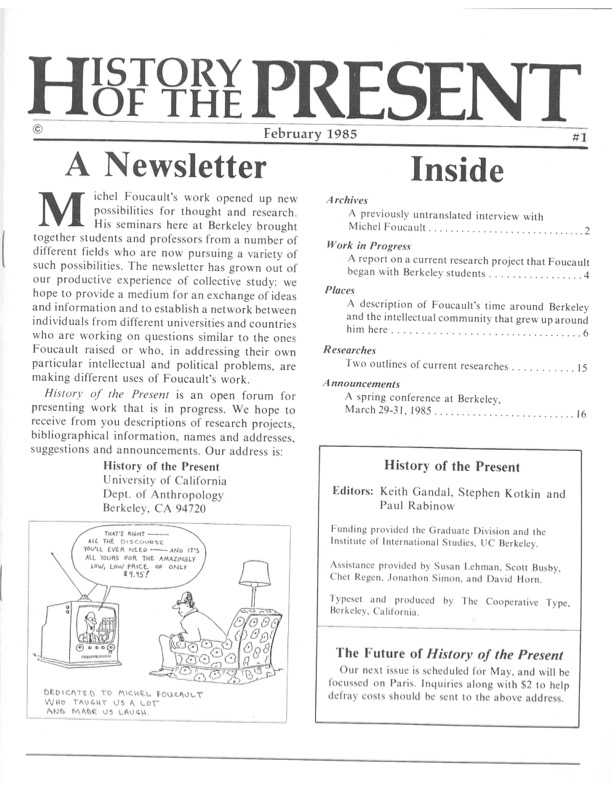
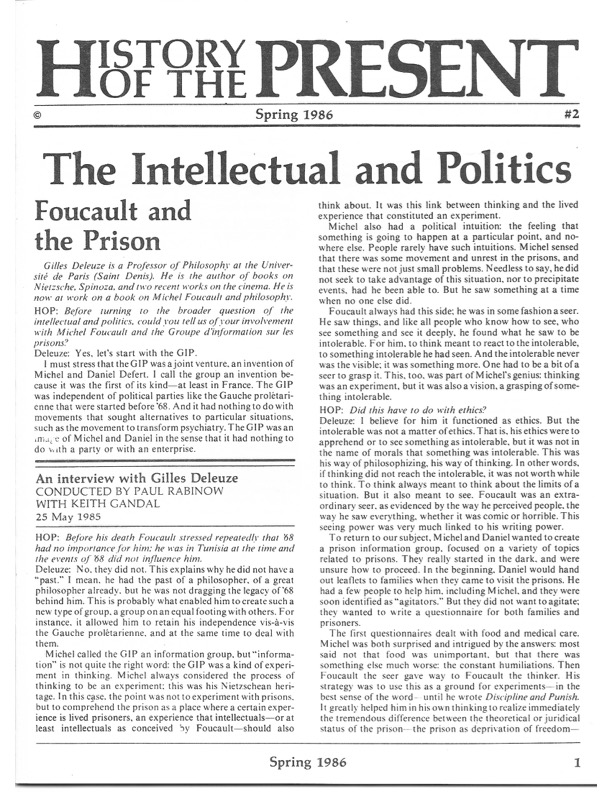
History of the Present – the Berkeley newsletter on Foucault’s work online via the Wayback Machine

Quite a while ago I posted about History of the Present, the newsletter devoted to Foucault’s work published by Paul Rabinow and edited by him and other people at Berkeley. It used to be online via Rabinow’s Anthropos Lab. At the time I’d been looking for copies in libraries, and the online version took a little while to find, so I hoped others will find it helpful.

In 2018 I noticed that these links no longer worked, but thanks to a comment on the original post, I can now provide links via the Wayback Machine: issues 1; 2; 3; 4

They include translations of interviews with Foucault, interview with Gilles Deleuze and François Ewald, reviews, pieces by researchers using Foucault’s ideas, and so on.

I’ve also added these updated links to the list of uncollected notes, lectures and interviews by Foucault on this site.

Posted in Michel Foucault, Uncategorized | 1 Comment

Andrew Drummond, The Dreadful History and Judgement of God on Thomas Müntzer: The Life and Times of an Early German Revolutionary – Verso, February 2024

Andrew Drummond, The Dreadful History and Judgement of God on Thomas Müntzer: The Life and Times of an Early German Revolutionary – Verso, February 2024

[Update: thanks to Philippe Theophanidis for a link to the author’s webpage with a lot more information]

‘The princes are nothing but tyrants who flay the people; they fritter away our blood and sweat on their pomp and whoring and knavery.’ These were the words of Thomas Müntzer at the head of the massed ranks of a peasant army in the year 1525. Ranged against him were the might of the princes of the German Nation. How did Müntzer, the son of a coin maker from central Germany, rise in just a few short years to become one of the most feared revolutionaries in early modern Europe?

In this brilliant work of historical excavation, Andrew Drummond charts the life and times of the man Martin Luther denounced as a ‘Ravening Wolf’ and ‘False Prophet’. Drummond shows us Müntzer as a human being. Far from the bloodthirsty devil of legend, he was a man of considerable learning and principle, deeply sympathetic to the misery of the peasantry and the poor. In his short life – he was beheaded at thirty-five – Müntzer promised to fundamentally upend German society.

Seeking to save Müntzer from the condescension of history, Drummond guides us through the religious and political disputes of the Reformation, placing his life and thought in the context of those turbulent years. The result is a portrait of an often contradictory but always radical figure, one who continues to inspire movements of the poor across the globe.

Posted in Uncategorized | Leave a comment