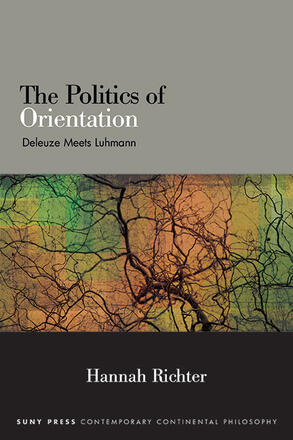
The Politics of Orientation provides the first substantial exploration of a surprising theoretical kinship and its rich political implications, between Gilles Deleuze’s philosophy and the sociological systems theory of Niklas Luhmann. Through their shared theories of sense, Hannah Richter draws out how the works of Luhmann and Deleuze complement each other in creating worlds where chaos is the norm and order the unlikely and yet remarkably stable exception. From the encounter between Deleuze and Luhmann, Richter develops a novel take on postfoundational ontology where subjects and societies unfold in self-productive relations of sense against a background of complexity. The Politics of Orientationbreaks and rebuilds theoretical alliances by reading core concepts and thinkers of Continental Philosophy, from Leibniz to Whitehead and Marx, through this encounter. Most importantly, the book puts Luhmann and Deleuze to work to offer urgently needed insight into the rise of post-truth populism. In our complex democratic societies, Richter argues, orientation against complexity has become the ground of political power, privileging the simplistic narratives of the populist right.
When the Berlin Wall was stormed and the Soviet Union fell apart, the West and above all the United States looked like the sole victors of history. Three decades later, the spirit of triumph rings hollow. What went wrong?
In this sequel to his award-winning history of neoliberal Europe, the renowned historian Philipp Ther searches for an answer to this question. He argues that global capitalism created many losers, preparing the ground for the rise of right-wing populists and nationalists. He shows how the promise of prosperity and freedom did not catch on sufficiently in Eastern Europe despite material progress, and how the West lost Russia and alienated Turkey. Neoliberal capitalism also left the world poorly prepared to cope with Covid-19, and the pandemic further weakened the Western hegemony of the post-1989 period, which is now brutally contested by Russia’s war against Ukraine. The double punch of the pandemic and the biggest war in Europe since 1945 has brought to a close the age of transformation that was inaugurated by the end of the Cold War. This penetrating analysis of the disarray of the post-1989 world will be of great interest to anyone who wishes to understand how we got to where we are today and the tremendous challenges we now face.
Brings a new dimension to thinking about philosophical materialism and realism in the wake of phenomenology and deconstruction
Challenges speculative realism’s critique of contemporary Continental philosophy as correlationism
Uses Merleau-Ponty and Nancy to develop an ontology that respects the materiality and exteriority of what exists without reinstating the mind–world divide
Shows how Merleau-Ponty and Nancy overcome the Cartesian presupposition at work in current realist appeal to step out of our own thoughts to reach the ‘great outdoors’
Provides an alternative to the phenomenological reduction of being to sense
Defends anthropomorphism as a way of overcoming the Cartesian–Sartrian ontology of the object
Marie-Eve Morin proposes a reinterpretation of the philosophy of Merleau-Ponty and Nancy from the perspective of realist and object-oriented tendencies in contemporary philosophy. The realist critique of subject-centred anthropocentric thinking indicates the danger, inherent in the phenomenological approach, of reducing being to sense. Morin demonstrates how Merleau-Ponty and Nancy avoid this pitfall through the development of ontologies that respect the materiality and exteriority of what exists without reaffirming the Cartesian divide between mind and world.
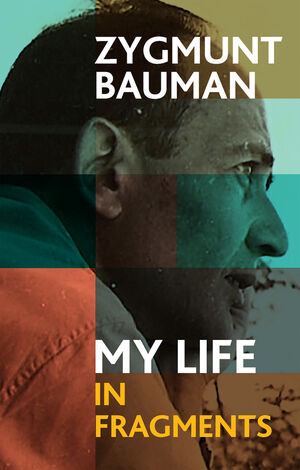
Zygmunt Bauman, My Life in Fragments, ed. Izabela Wagner, trans. Katarzyna Bartoszyńska – Polity, June 2023
Zygmunt Bauman was one of the great social thinkers of our time: inventor of the idea of liquid modernity, he transformed our way of thinking about the social conditions shaping our lives today. His own life was shaped by the great social forces that scarred the second half of the twentieth century – war, communism, antisemitism, forced migration. His work bears the traces of an outsider who knew all too well the enormous impact that social and political forces can have on personal lives.
Bauman never wrote a full biography, but he wrote extended letters to his daughters in which he recounted the details of his life – his childhood and schooling; his experiences during the war and its aftermath; his forced emigration from Poland in 1968 and his subsequent life in exile, first in Israel and then in the UK, where he eventually settled at the University of Leeds. This book makes available for the first time these fragments of a life recounted, woven into a compelling autobiographical narrative that is laced with the broader reflections of a master thinker on some of the great issues of our time: identity, antisemitism and totalitarianism.
Britain was once the leading economy in Europe; it is now the most unequal. In Shattered Nation, leading geographer and author of Inequality and the 1% shows that we are growing further and further apart. Visiting sites across the British Isles and exploring the social fissures that have emerged, Danny Dorling exposes a new geography of inequality. Middle England has been hit hard by the cost-of-living crisis, and even people doing comparatively well are struggling to stay afloat. Once affluent suburbs are now unproductive places where opportunity has been replaced by food banks. Before COVID, life expectancy had dropped as a result of poverty for the first time since the 1930s.
Fifty years ago the UK led the world in child health; today, twenty-two of the twenty-seven EU countries have better mortality rates for newborns. No other European country has such miserly unemployment benefits; university fees so high; housing so unaffordable; or a government economically so far to the right. In the spirit of the 1942 Beveridge Report, Dorling identifies the five giants of twenty-first-century poverty that need to be conquered: Hunger, Precarity, Waste, Exploitation, and Fear. He offers powerful insights into how we got here and what we must do in order to save Britain from becoming a failed state.
Sharad Chari, Gramsci at Sea – University of Minnesota Press Forerunners, August 2023
Exploring how the crisis of the world ocean is produced by capitalism and imperialism
This succinct work reads Antonio Gramsci’s writings on the sea, focused in his prison notes on waves of imperial power in the inter-war oceans of his time. Sharad Chari argues that the imprisoned militant’s method is oceanic in form, and that this oceanic Marxism can attend to the roil of sociocultural dynamics, to waves of imperial power, as well as to the capacity of Black, Drexciyan, and other forms of oceanic critique to “storm” us on different shores.
In an earlier post here I briefly mentioned the medical issues that put me in hospital for three weeks in July. The operation was a success and I am making a good, though slow, recovery. I have been at home for a while now, but am signed off work for several more weeks. Although I’m not yet returning to my own research, over the past few weeks I’ve been sharing quite a lot of links on this blog and on social media, almost all about other people’s work. I have also been slowly thinking about a return to research. Most of this update on this project was written before everything changed for me. I didn’t post an update at the end of June, when the medical problems began. This post therefore reports mainly on the work up to that point.
Since the last update at the end of May, I spent most of June working on Émile Benveniste. I think I’ve completed the work – at least for now – on Benveniste’s very early studies in the Sogdian language, and his work on Persian religion and languages. This is the second part of one of the initial chapters, at least on the current plan. At the moment I think his co-authored book with Louis Renou, Vrtra et Vrθragna: Étude de mythologie indo-iranienne will be discussed in the second Benveniste chapter, though it’s possible that it fits thematically better in this earlier chapter.
Benveniste’s work connects to some other interesting figures, and this work is already showing the challenges of keeping this project to a focus on France alone. While I have to set some limits, I do want to indicate some of the connections to a wider European network of ideas, and one of the things I’m interested in is the movement of various people because of the international situation in the 1930s and 1940s – the build-up to the war, the Second World War itself and its aftermath. As I mentioned in the last update, Benveniste spent much of the war in Switzerland. Others moved before the war, either because they were Jewish or were otherwise fleeing persecution. Later in the story I want to tell, Mircea Eliade was unable to return to Romania after the war, and spent a decade in Paris before moving to Chicago.
Bodleian library, University of Oxford
As part of the research into this question of academic movement, I had a very interesting day in Oxford, mainly working with the Bodleian special collections in the Weston library. Although I was also interested in a lecture series given in Oxford, I was mainly looking at the records of the Society for the Protection of Science and Learning (SPSL). This organisation, now known as the Council for At-Risk Academics, supported one of the people whose work connects to some of Benveniste’s early work, Walter Bruno Henning. Henning was German, and was engaged to a Jewish woman, the daughter of Russian parents who had moved to Berlin after the Revolution. He moved to England and taught at the School of Oriental Studies, which later became the School of Oriental and African Studies (SOAS). There is a lot of information in the Henning file of the SPSL. The story was even more interesting than I expected, and following up on the question led to the work of David Zimmerman, particularly this article, and this issue of the Proceedings of the British Academy. There was also a SPSL file on Ernst Kantorowicz, though they did not support him in the same way.
I planned to use the library and special collections of SOAS in London, but had to postpone that visit when I became unwell. I hope to get there when I’m back at work. SOAS has files on Henning and Harold Bailey, whose main archive is in Cambridge and which has an extensive correspondence with Benveniste. I visited that Cambridge archive in May (discussed in a previous update). Bailey taught at SOAS at the beginning of his career, and was succeeded by Henning, who taught there from 1936-61, apart from a period when he was interned as an enemy alien in 1940. (The SPSL archive at Oxford has a lot on this.)
I did some work on Saussure’s notes on German legends, on which he published almost nothing in his lifetime, but which have been the focus of some posthumous publications. There is a lot of overlap between these, they are not organised in a very reader-friendly way, and it wasn’t always obvious how they related to each other. The most comprehensive collection is Le Leggende Germaniche, but it’s not easy to find, and challenging to use. A more manageable and clearly presented collection is “Légendes et récits d’Europe du Nord: de Sigfrid à Tristan”, ed. Béatrice Turpin, in Le Cahier de l’Herne: Saussure,2003, 351-429. The detailed comparison of these and other collections is here. I hope others find this useful.
I also made a return trip to UCL to look again at the 1955 Italian collection of Dumézil’s Jupiter, Mars, Quirinus. I say a bit about the French texts it includes here – it’s not a translation of a single French book, but parts of four. There are some interesting inclusions and omissions. I also updated the list of Georges Bataille – Oeuvres complètes and other French collections; English translations with details of two recent collections of his texts.
I spoke about this Indo-European research to the Warwick Seminar for Interdisciplinary French Studies on 31 May. It was an online event, and the recording of the talk (though not the discussion) is available here. The focus was on the period immediately after the war, although I begin with two stories – one from the early twentieth century and one from shortly after its end – to frame the project. Having this date to speak was useful for working out how to present some of the key themes of the work. I also spoke more briefly about the editing work on Mitra-Varuna to a department conference in late June – though I was too unwell to attend so sent a pre-recorded talk. That was the last day before I was admitted to hospital.
I won’t return to work until the start of term in October, and even then it may well be part-time. Being on a research fellowship should help with a gradual transition back to things. There is a lot I can do at home, as the recovery allows. I will lose about three months of time, but hopefully can find a way to recover momentum, but without working too much. UK libraries and archival visits can hopefully come in the autumn. In particular I want to do the postponed trip to SOAS, make a return trip to Cambridge and possibly Oxford. Getting back to Paris is probably a bit further off. I had a trip to the Paris archives booked for July, but I was in hospital for most of that time and so the trip was cancelled. When I can get back to Paris I plan to do some work at the Archives Nationales as well as continuing work at the Collège de France and the Bibliothèque Nationale.
The US fellowship I had in place for the beginning of 2024 has been postponed until late 2024 or early 2025. That’s a great shame, but the only possible option in the circumstances. There are a lot of things I wanted to do in the US, but I have to keep telling myself the archives will wait. For the moment I need to prioritise recovery, though I am keen to return to this work as soon as I can. It will be probably be a couple of months before the next research update. Thank you to all who have shown an interest in this project, and for the best wishes for my health.
Previous updates on this project can be found here, along with links to some research resources and forthcoming publications, including the delayed re-edition of Dumézil’s Mitra-Varuna. There is a lot more about the earlier Foucault work here. The final volume of the series, The Archaeology of Foucault, is now out worldwide. The special issue of Theory, Culture & Society I co-edited on “Foucault before the Collège de France” is also now published.
The capacious visual archive studied in this volume includes a trove of materials such as annotated or illuminated manuscripts, Renaissance costume books and travel books, maps and cartographic volumes produced by Europeans as well as Indigenous peoples, mass-printed pamphlets, jewelry, decorative arts, religious iconography, paintings from around the world, ceremonial objects, festival books, and play texts intended for live performance.
Contributors explore the deployment of what coeditor Noémie Ndiaye calls “the racial matrix” and its interconnected paradigms across the medieval and early modern chronological divide and across vast transnational and multilingual geographies. This volume uses items from the Fall 2023 exhibition “Seeing Race Before Race”— a collaboration between RaceB4Race® and the Newberry Library — as a starting point for an ambitious theoretical conversation between premodern race studies, art history, performance studies, book history, and critical race theory.
I’ve updated the page on this blog about my series of Foucault books, The page has book descriptions, links to reviews, the updates I wrote while researching and writing the books and other related materials.
Some translations, scans, textual analysis and links are available at Foucault Resources. These were largely things I produced in the course of my own research but which I hope others might find useful.
This book examines career patterns of the professoriate. Professors may appear as specialised individualists in their fields, and yet they follow pathways which are anything but unique. Drawing from a unique data set, the authors analyse the trajectories of the almost 2000 linguists and sociologists who hold full professorships in Germany, France and the UK in 2015. With a background in social theory, they reveal models, structures and rules that organise the professional lives and biographies of the most senior academics. This book presents the results of a systematic empirical study, which will be of interest to specialists in higher education studies as well as to linguists and sociologists, and to all academics more generally.