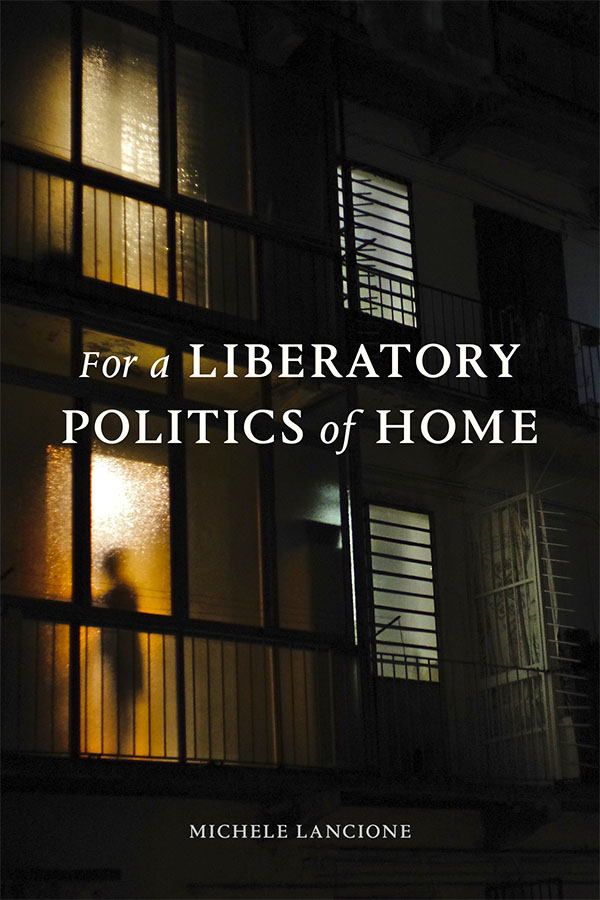
In For a Liberatory Politics of Home, Michele Lancione questions accepted understandings of home and homelessness to offer a radical proposition: homelessness cannot be solved without dismantling current understandings of home. Conventionally, home is framed as a place of security and belonging, while its loss defines what it means to be homeless. On the basis of this binary, a whole industry of policy interventions, knowledge production, and organizing fails to provide solutions to homelessness but perpetuates violent and precarious forms of inhabitation. Drawing on his research and activism around housing in Europe, Lancione attends to the interlocking crises of home and homelessness by recentering the political charge of precarious dwelling. It is there, if often in unannounced ways, that a profound struggle for a differential kind of homing signals multiple possibilities to transcend the violences of home/homelessness. In advancing a new approach to work with the politics of inhabitation, Lancione provides a critique of current practices and offers a transformative vision for a renewed, liberatory politics of home.
Just an expensive hardback and e-book at the moment, unfortunately.
Building on an abolitionist perspective, this book offers an essential critique of migration and border policies, unsettling the distinction between migrants and citizens. This is the only book that brings together carceral abolitionist debates and critical migration literature. It explores the multiplication of modes of migration confinement and detention in Europe, examining how these are justified in the name of migrants’ protection. It argues that the collective memory of past struggles has partly informed current solidarity movements in support of migrants. A grounded critique of migration policies involves challenging the idea that migrants’ rights go to the detriment of citizens. An abolitionist approach to borders entails situating the right to mobility as part of struggle for the commons.
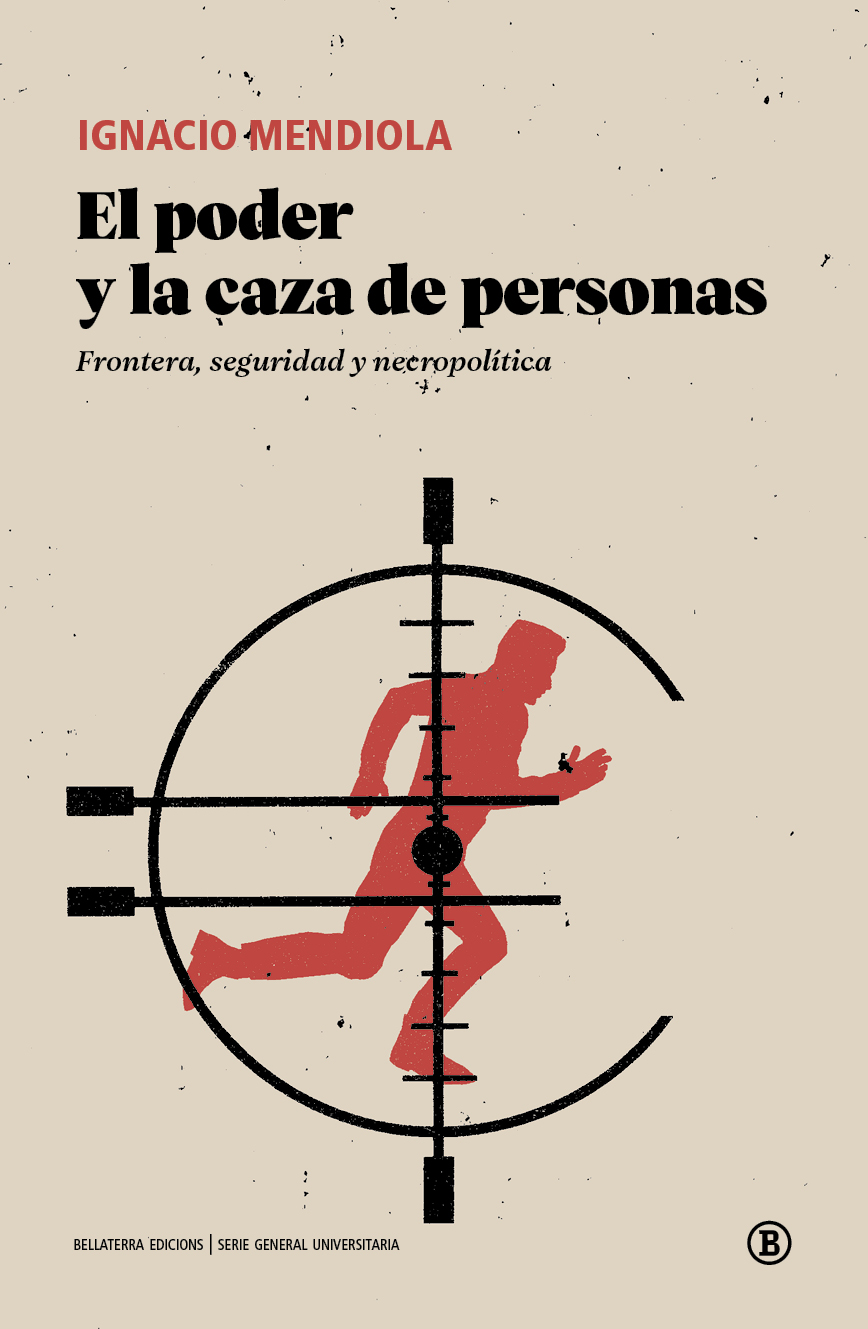
Este libro propone un trasvase del mundo de la caza de animales al mundo de la caza de personas.
A partir de este giro, la caza, con toda la trama de conceptos que la atraviesa, tales como el rastro, la batida, o la pieza, se convierte en el eje central de un relato que nos acercará al modo en que un régimen de poder se abalanza sobre las personas. Pero no de cualquier persona. El poder que caza se cierne sobre aquellas subjetividades que encarnan la existencia de un riesgo y, en torno a ellas, rastreándolas, irrumpirá la necesidad de neutralizarlas, de capturarlas, de expulsarlas. A esas otras subjetividades, que aquí aparecerán mayormente bajo las figuras del (sospechoso de ser) terrorista y del migrante, se las puede cazar y, acaso, se las debe cazar.
La caza de personas nombra una mutación de lo bélico impulsada por el discurso hegemónico de lo securitario, una forma de guerra en constante movimiento que busca dar cuenta del sujeto amenazante. Este libro se adentra en este entramado bélico, en sus condiciones de posibilidad, en su despliegue y en sus violencias constitutivas. El poder y la caza de personas nos narra cómo encaramos hoy otras guerras, otros cazadores y otras presas. No cabe duda que abordamos una temática singular que, desde el inicio mismo, conceptualizada en estos términos, habría de comportar sorpresa, cuando no reticencia. ¿Estamos ante un poder que caza personas?
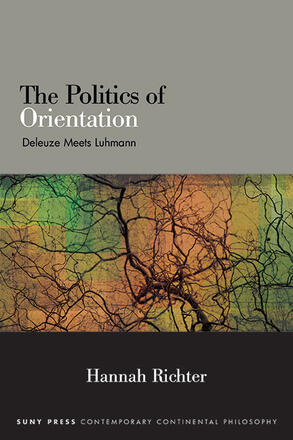
The Politics of Orientation provides the first substantial exploration of a surprising theoretical kinship and its rich political implications, between Gilles Deleuze’s philosophy and the sociological systems theory of Niklas Luhmann. Through their shared theories of sense, Hannah Richter draws out how the works of Luhmann and Deleuze complement each other in creating worlds where chaos is the norm and order the unlikely and yet remarkably stable exception. From the encounter between Deleuze and Luhmann, Richter develops a novel take on postfoundational ontology where subjects and societies unfold in self-productive relations of sense against a background of complexity. The Politics of Orientationbreaks and rebuilds theoretical alliances by reading core concepts and thinkers of Continental Philosophy, from Leibniz to Whitehead and Marx, through this encounter. Most importantly, the book puts Luhmann and Deleuze to work to offer urgently needed insight into the rise of post-truth populism. In our complex democratic societies, Richter argues, orientation against complexity has become the ground of political power, privileging the simplistic narratives of the populist right.
When the Berlin Wall was stormed and the Soviet Union fell apart, the West and above all the United States looked like the sole victors of history. Three decades later, the spirit of triumph rings hollow. What went wrong?
In this sequel to his award-winning history of neoliberal Europe, the renowned historian Philipp Ther searches for an answer to this question. He argues that global capitalism created many losers, preparing the ground for the rise of right-wing populists and nationalists. He shows how the promise of prosperity and freedom did not catch on sufficiently in Eastern Europe despite material progress, and how the West lost Russia and alienated Turkey. Neoliberal capitalism also left the world poorly prepared to cope with Covid-19, and the pandemic further weakened the Western hegemony of the post-1989 period, which is now brutally contested by Russia’s war against Ukraine. The double punch of the pandemic and the biggest war in Europe since 1945 has brought to a close the age of transformation that was inaugurated by the end of the Cold War. This penetrating analysis of the disarray of the post-1989 world will be of great interest to anyone who wishes to understand how we got to where we are today and the tremendous challenges we now face.
Brings a new dimension to thinking about philosophical materialism and realism in the wake of phenomenology and deconstruction
Challenges speculative realism’s critique of contemporary Continental philosophy as correlationism
Uses Merleau-Ponty and Nancy to develop an ontology that respects the materiality and exteriority of what exists without reinstating the mind–world divide
Shows how Merleau-Ponty and Nancy overcome the Cartesian presupposition at work in current realist appeal to step out of our own thoughts to reach the ‘great outdoors’
Provides an alternative to the phenomenological reduction of being to sense
Defends anthropomorphism as a way of overcoming the Cartesian–Sartrian ontology of the object
Marie-Eve Morin proposes a reinterpretation of the philosophy of Merleau-Ponty and Nancy from the perspective of realist and object-oriented tendencies in contemporary philosophy. The realist critique of subject-centred anthropocentric thinking indicates the danger, inherent in the phenomenological approach, of reducing being to sense. Morin demonstrates how Merleau-Ponty and Nancy avoid this pitfall through the development of ontologies that respect the materiality and exteriority of what exists without reaffirming the Cartesian divide between mind and world.
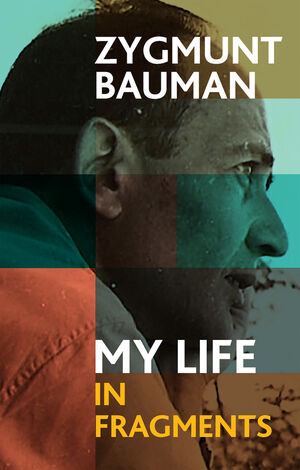
Zygmunt Bauman, My Life in Fragments, ed. Izabela Wagner, trans. Katarzyna Bartoszyńska – Polity, June 2023
Zygmunt Bauman was one of the great social thinkers of our time: inventor of the idea of liquid modernity, he transformed our way of thinking about the social conditions shaping our lives today. His own life was shaped by the great social forces that scarred the second half of the twentieth century – war, communism, antisemitism, forced migration. His work bears the traces of an outsider who knew all too well the enormous impact that social and political forces can have on personal lives.
Bauman never wrote a full biography, but he wrote extended letters to his daughters in which he recounted the details of his life – his childhood and schooling; his experiences during the war and its aftermath; his forced emigration from Poland in 1968 and his subsequent life in exile, first in Israel and then in the UK, where he eventually settled at the University of Leeds. This book makes available for the first time these fragments of a life recounted, woven into a compelling autobiographical narrative that is laced with the broader reflections of a master thinker on some of the great issues of our time: identity, antisemitism and totalitarianism.
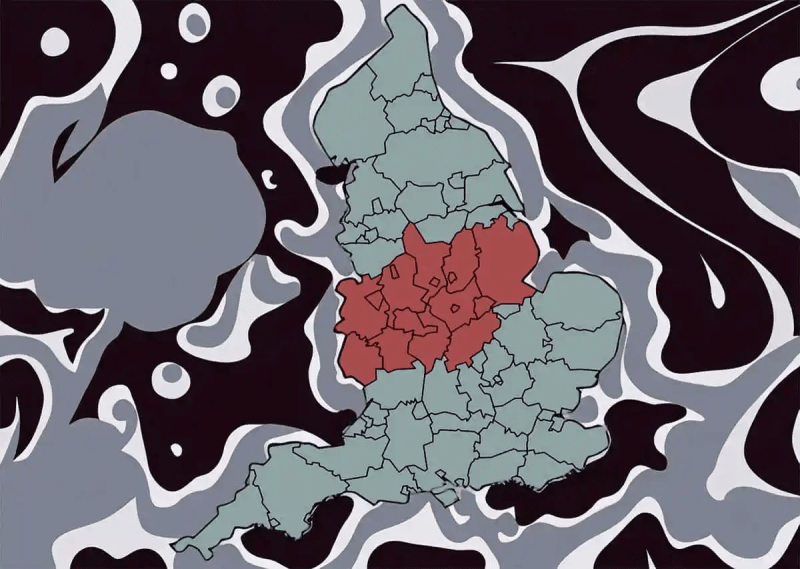
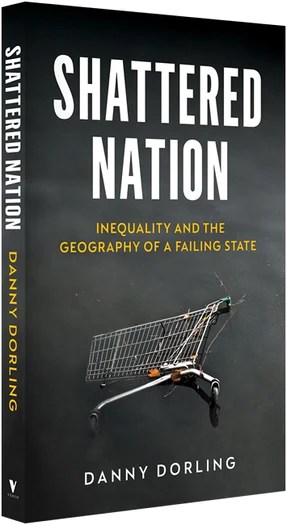
Britain was once the leading economy in Europe; it is now the most unequal. In Shattered Nation, leading geographer and author of Inequality and the 1% shows that we are growing further and further apart. Visiting sites across the British Isles and exploring the social fissures that have emerged, Danny Dorling exposes a new geography of inequality. Middle England has been hit hard by the cost-of-living crisis, and even people doing comparatively well are struggling to stay afloat. Once affluent suburbs are now unproductive places where opportunity has been replaced by food banks. Before COVID, life expectancy had dropped as a result of poverty for the first time since the 1930s.
Fifty years ago the UK led the world in child health; today, twenty-two of the twenty-seven EU countries have better mortality rates for newborns. No other European country has such miserly unemployment benefits; university fees so high; housing so unaffordable; or a government economically so far to the right. In the spirit of the 1942 Beveridge Report, Dorling identifies the five giants of twenty-first-century poverty that need to be conquered: Hunger, Precarity, Waste, Exploitation, and Fear. He offers powerful insights into how we got here and what we must do in order to save Britain from becoming a failed state.
Sharad Chari, Gramsci at Sea – University of Minnesota Press Forerunners, August 2023
Exploring how the crisis of the world ocean is produced by capitalism and imperialism
This succinct work reads Antonio Gramsci’s writings on the sea, focused in his prison notes on waves of imperial power in the inter-war oceans of his time. Sharad Chari argues that the imprisoned militant’s method is oceanic in form, and that this oceanic Marxism can attend to the roil of sociocultural dynamics, to waves of imperial power, as well as to the capacity of Black, Drexciyan, and other forms of oceanic critique to “storm” us on different shores.