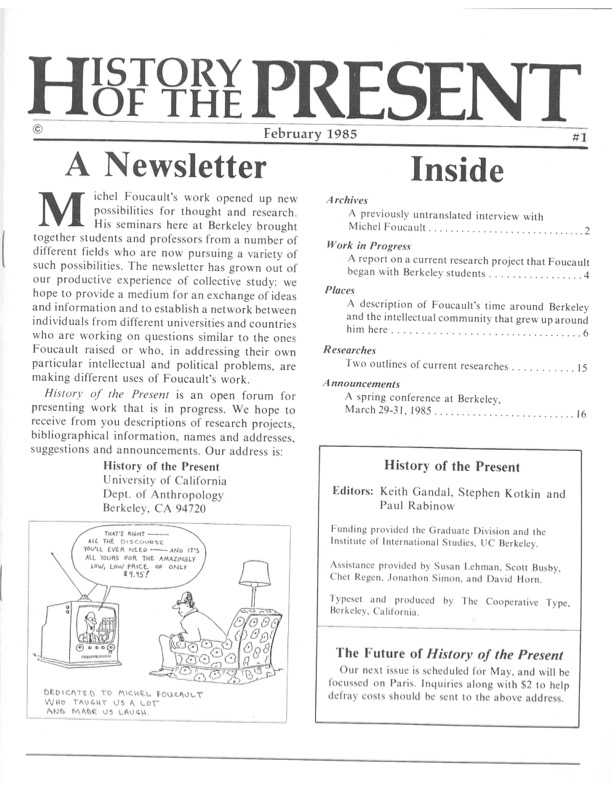
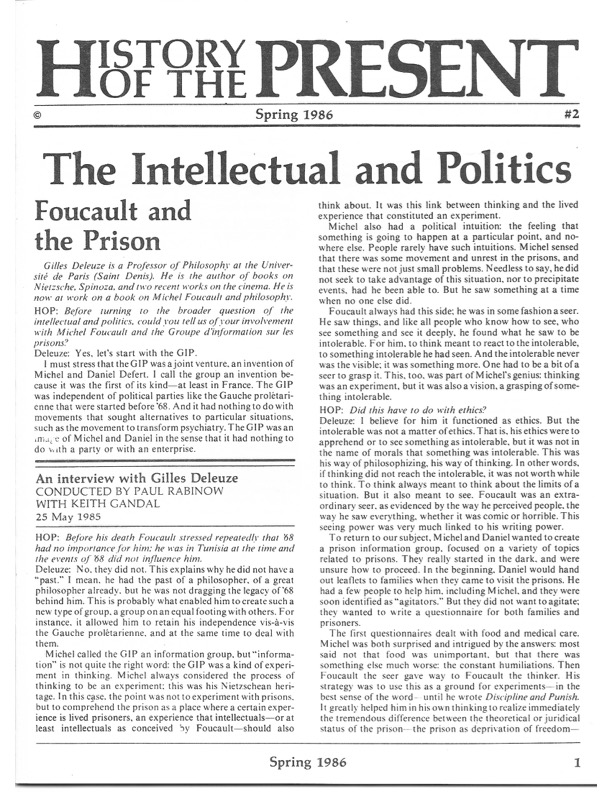
Quite a while ago I posted about History of the Present, the newsletter devoted to Foucault’s work published by Paul Rabinow and edited by him and other people at Berkeley. It used to be online via Rabinow’s Anthropos Lab. At the time I’d been looking for copies in libraries, and the online version took a little while to find, so I hoped others will find it helpful.
In 2018 I noticed that these links no longer worked, but thanks to a comment on the original post, I can now provide links via the Wayback Machine: issues 1; 2; 3; 4
They include translations of interviews with Foucault, interview with Gilles Deleuze and François Ewald, reviews, pieces by researchers using Foucault’s ideas, and so on.
‘The princes are nothing but tyrants who flay the people; they fritter away our blood and sweat on their pomp and whoring and knavery.’ These were the words of Thomas Müntzer at the head of the massed ranks of a peasant army in the year 1525. Ranged against him were the might of the princes of the German Nation. How did Müntzer, the son of a coin maker from central Germany, rise in just a few short years to become one of the most feared revolutionaries in early modern Europe?
In this brilliant work of historical excavation, Andrew Drummond charts the life and times of the man Martin Luther denounced as a ‘Ravening Wolf’ and ‘False Prophet’. Drummond shows us Müntzer as a human being. Far from the bloodthirsty devil of legend, he was a man of considerable learning and principle, deeply sympathetic to the misery of the peasantry and the poor. In his short life – he was beheaded at thirty-five – Müntzer promised to fundamentally upend German society.
Seeking to save Müntzer from the condescension of history, Drummond guides us through the religious and political disputes of the Reformation, placing his life and thought in the context of those turbulent years. The result is a portrait of an often contradictory but always radical figure, one who continues to inspire movements of the poor across the globe.
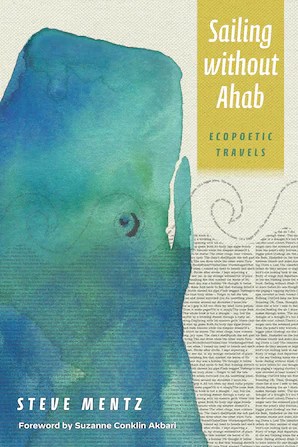
Navigate the Depths of a Timeless Classic, Reimagined.
Come sail with I.
We’re not taking the same trip, though you might recognize the familiarcourse. This time, the Pequod’s American voyage steers its course acrossthe curvature of the Word Ocean without anyone at the helm. We are leaving one man and his madness on shore. Our ship overflows with glorious plurality – multiracial, visionary, queer, conflicted, polyphonic, playful, violent. But on this voyage something is different. Today we sail headless without any Captain. Instead of binding ourselves to the dismasted tyrant’s rage, the ship’s crew seeks only what we will find: currents teeming with life, a blue-watered alien globe, toothy cetacean smiles from vasty deeps. Treasures await those who sail without.
This cycle of one hundred thirty-eight poems – one for each chapter in Moby-Dick, plus the Etymology, Extracts, and Epilogue – launches into oceanic chaos without the stabilizing mad focus of the Nantucket captain. Guided by waywardness and curiosity, these poems seek an alien ecopoetics of marine depths, the refraction of light, the taste of salt on skin. Directionless, these poems reach out to touch oceanic expanse and depth. It’s not an easy voyage, and not a certain one. It lures you forward. It has fixed its barbed hook in I.
Sailing without means relinquishing goals, sleeping at the masthead, forgetting obsessions. I. welcomes you to trace wayward ways through these poems. Read them any way you can – back to front, at random, sideways, following the obscure promptings of your heart. It’s the turning that matters. It’s a blue wonder world that beckons.
Looks great, though tempting to repeat the question of Ernest Mandel’s Late Capitalism– how do we know it’s late?
In a world shaken by ecological, economic and political crises, the forces of authoritarianism and reaction seem to have the upper hand. How should we name, map and respond to this state of affairs?
The rich archive of twentieth-century debates on fascism can steer a path through an increasingly authoritarian present. Developing anti-fascist theory is an urgent and vital task. From the ‘Great Replacement’ to campaigns against critical race theory and ‘gender ideology’, today’s global far right is launching lethal panics about the threats to traditional political, sexual and racial hierarchies.
Drawing especially on Black radical and anti-colonial theories of fascism, Toscano makes clear the limits of associating fascism primarily with the kind of political violence experienced by past European regimes. Rather than looking for analogies from history, we should see fascism as a mutable process, one anchored in racial and colonial capitalism, which both predates and survives its crystallization in Mussolini’s Italy and Hitler’s Germany. It is a threat that continues to evolve in the present day.
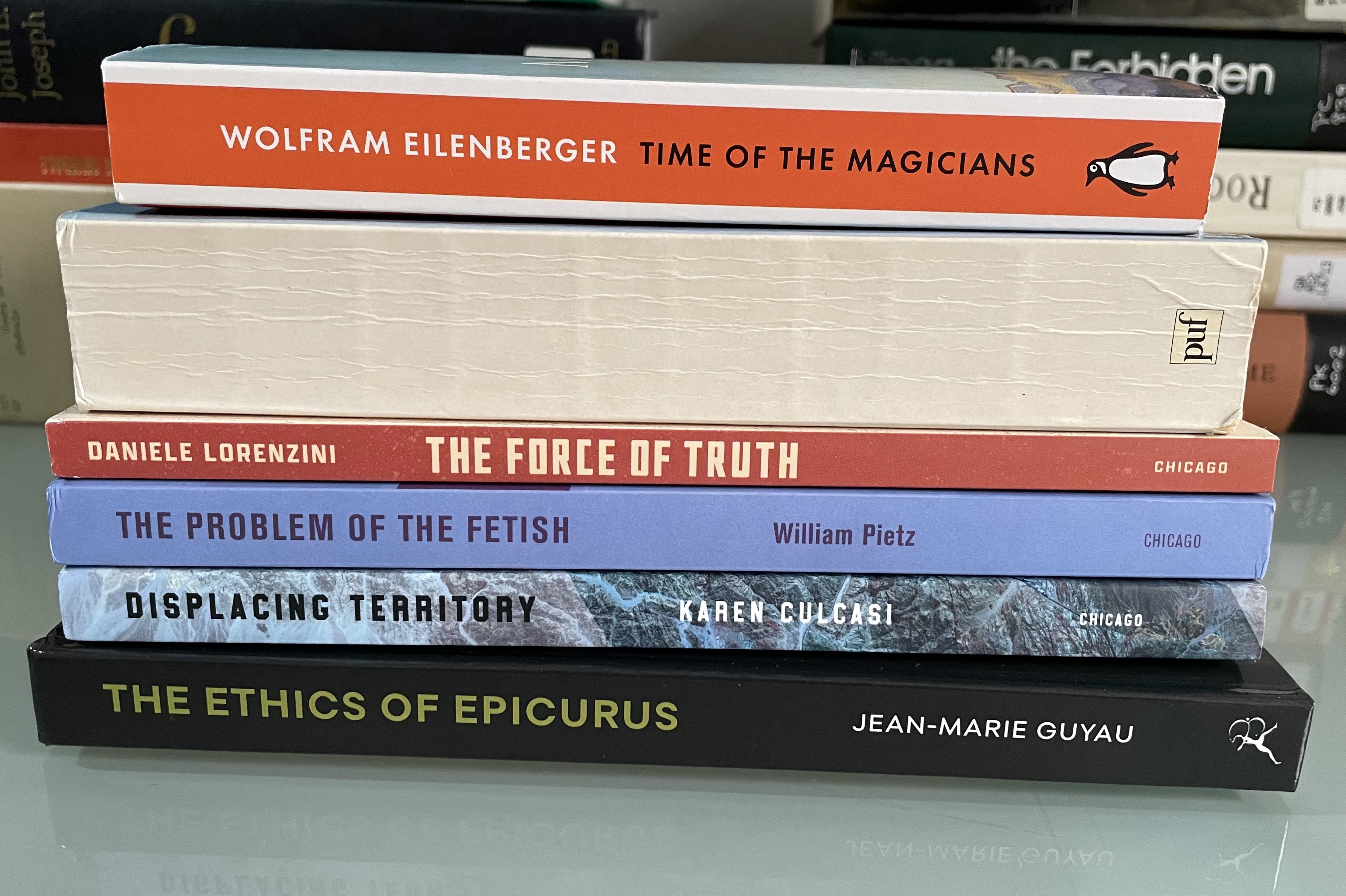
Stef and Federico gave me copies of the books they worked on; I endorsed Karen Culcasi’s book; and University of Chicago Press sent a copy of Daniele’s book on his behalf.
I’m late in noticing this book, published last year. The Introduction is available open access here.
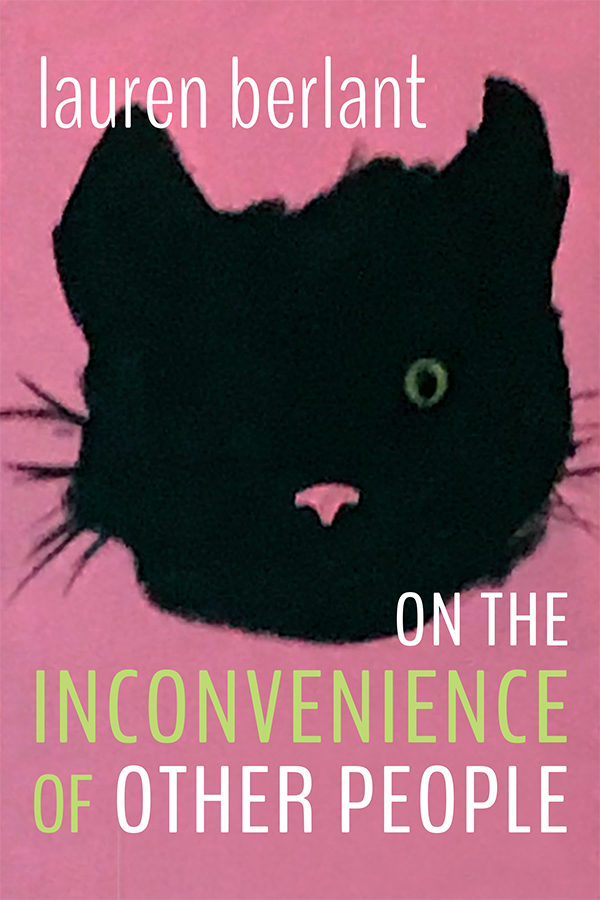
In On the Inconvenience of Other People Lauren Berlant continues to explore our affective engagement with the world. Berlant focuses on the encounter with and the desire for the bother of other people and objects, showing that to be driven toward attachment is to desire to be inconvenienced. Drawing on a range of sources, including Last Tango in Paris, Ralph Waldo Emerson, Claudia Rankine, Christopher Isherwood, Bhanu Kapil, the Occupy movement, and resistance to anti-Black state violence, Berlant poses inconvenience as an affective relation and considers how we might loosen our attachments in ways that allow us to build new forms of life. Collecting strategies for breaking apart a world in need of disturbing, the book’s experiments in thought and writing cement Berlant’s status as one of the most inventive and influential thinkers of our time.
Proposals for activities should be sent to: foucault40after@gmail.com to the Coordinator of the International Scientific Committee: Prof. Rodrigo Castro. Information about activities should include:
a) The title of the activity b) A short description (5 lines) c) The city and country in which the activity is to be held d) The dates on which the activity is to be carried out e) The name of the coordinator or person in charge of the activity and their e-mail address.
The deadline for submission of proposals is 29th of September 2023. Decisions on proposals will be communicated in October 2023.
Not long left to submit proposals for an event to be linked. All details at the Foucault News page.
After the Second World War, Britain’s overseas empire disintegrated. As white settlers from Rhodesia returned home to a country they barely recognised, Commonwealth citizens from Asia and the Caribbean migrated to a motherland that often refused to recognise them. Race riots erupted in Liverpool and Notting Hill even as communities lived and loved across the colour line. In the 1950s and 60s, imperial violence came home too, pervading the policing of immigrant communities, including their sex lives. In the decade that followed, a surge of support for the far-right inspired an invigorated anti-racist movement.
These tensions, and the imperial mindset that birthed them, have dominated Britain’s relationship with itself and the world ever since: from the jingoism of the Falklands War to the simplistic moral equation of Band Aid, from the rise of the gap year abroad to the invasion of Iraq. Most recently, in the tragedy of Stephen Lawrence and the opening ceremony of the 2012 Olympics, we see how Britain’s contradictory relationship with its past has undermined its self-image as a multicultural nation, helping explain the Windrush deportations and Brexit.
Drawing on a mass of new research, from personal letters to pop culture, Imperial Island tells a story of immigration and fractured identity, of social strife and communal solidarity, of people on the move and of a people wrestling with their past. It is the story that best explains Britain today.
There is a New Books discussion with Dave O’Brien here.
There is a New Books discussion between the author, David Norman Smith, Peter Audis and Sean Sayers, moderated by Morteza Hajizadeh here.
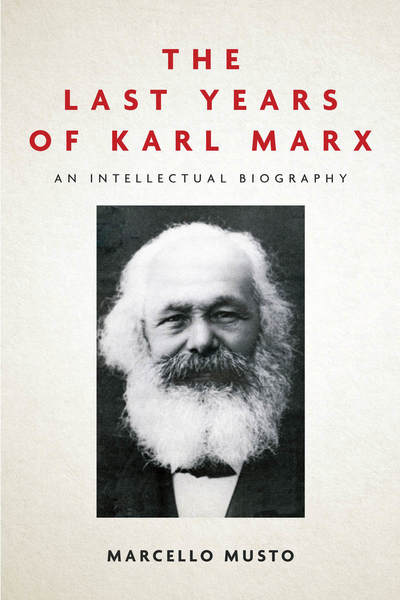
An innovative reassessment of the last writings and final years of Karl Marx.
In the last years of his life, Karl Marx expanded his research in new directions—studying recent anthropological discoveries, analyzing communal forms of ownership in precapitalist societies, supporting the populist movement in Russia, and expressing critiques of colonial oppression in India, Ireland, Algeria, and Egypt. Between 1881 and 1883, he also traveled beyond Europe for the first and only time. Focusing on these last years of Marx’s life, this book dispels two key misrepresentations of his work: that Marx ceased to write late in life, and that he was a Eurocentric and economic thinker fixated on class conflict alone.
With The Last Years of Karl Marx, Marcello Musto claims a renewed relevance for the late work of Marx, highlighting unpublished or previously neglected writings, many of which remain unavailable in English. Readers are invited to reconsider Marx’s critique of European colonialism, his ideas on non-Western societies, and his theories on the possibility of revolution in noncapitalist countries. From Marx’s late manuscripts, notebooks, and letters emerge an author markedly different from the one represented by many of his contemporary critics and followers alike. As Marx currently experiences a significant rediscovery, this volume fills a gap in the popularly accepted biography and suggests an innovative reassessment of some of his key concepts.
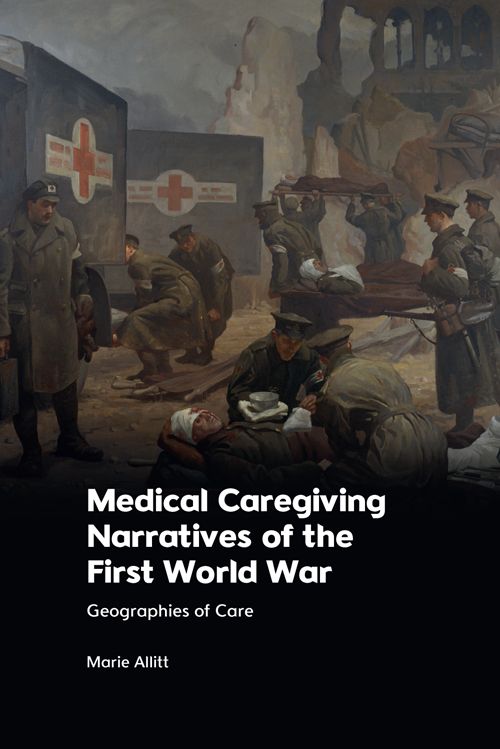
Explores how military medical practitioners articulated and represented their spatial and sensory experiences of caregiving
A sustained literary critical focus on medical caregiving narratives
Novel theorisation of life writing and its relationship to somatic and sensuous geographies
Argues for the centrality of spaces and spatiality in critical medical humanities
A conceptualisation of medical and military-medical spaces
Lays out a new theoretical framework for critical engagements in medical humanities, through the lens of the First World War
This book offers a novel critical intervention in medical humanities, foregrounding the importance of spaces and senses in medical experiences. It explores the distinctive experience and literary representations of somatic and sensuous geographies in First World War medical caregiving life writing. It demonstrates the complex situation of the medic, who is vulnerable both vicariously and directly to the effects of physical and psychological harm. Chapters look at the medic’s relationship with the war environment; the spaces in which medical care takes place; bodies and the wounds of patients in medical narratives; and psychological and imaginative landscapes and textual spaces where complex emotions, trauma, coping and survival are examined.