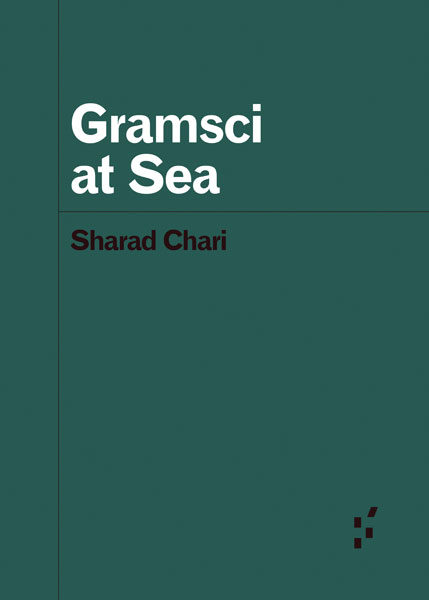
Sharad Chari, Gramsci at Sea – University of Minnesota Press Forerunners, August 2023
Exploring how the crisis of the world ocean is produced by capitalism and imperialism
This succinct work reads Antonio Gramsci’s writings on the sea, focused in his prison notes on waves of imperial power in the inter-war oceans of his time. Sharad Chari argues that the imprisoned militant’s method is oceanic in form, and that this oceanic Marxism can attend to the roil of sociocultural dynamics, to waves of imperial power, as well as to the capacity of Black, Drexciyan, and other forms of oceanic critique to “storm” us on different shores.
In an earlier post here I briefly mentioned the medical issues that put me in hospital for three weeks in July. The operation was a success and I am making a good, though slow, recovery. I have been at home for a while now, but am signed off work for several more weeks. Although I’m not yet returning to my own research, over the past few weeks I’ve been sharing quite a lot of links on this blog and on social media, almost all about other people’s work. I have also been slowly thinking about a return to research. Most of this update on this project was written before everything changed for me. I didn’t post an update at the end of June, when the medical problems began. This post therefore reports mainly on the work up to that point.
Since the last update at the end of May, I spent most of June working on Émile Benveniste. I think I’ve completed the work – at least for now – on Benveniste’s very early studies in the Sogdian language, and his work on Persian religion and languages. This is the second part of one of the initial chapters, at least on the current plan. At the moment I think his co-authored book with Louis Renou, Vrtra et Vrθragna: Étude de mythologie indo-iranienne will be discussed in the second Benveniste chapter, though it’s possible that it fits thematically better in this earlier chapter.
Benveniste’s work connects to some other interesting figures, and this work is already showing the challenges of keeping this project to a focus on France alone. While I have to set some limits, I do want to indicate some of the connections to a wider European network of ideas, and one of the things I’m interested in is the movement of various people because of the international situation in the 1930s and 1940s – the build-up to the war, the Second World War itself and its aftermath. As I mentioned in the last update, Benveniste spent much of the war in Switzerland. Others moved before the war, either because they were Jewish or were otherwise fleeing persecution. Later in the story I want to tell, Mircea Eliade was unable to return to Romania after the war, and spent a decade in Paris before moving to Chicago.
Bodleian library, University of Oxford
As part of the research into this question of academic movement, I had a very interesting day in Oxford, mainly working with the Bodleian special collections in the Weston library. Although I was also interested in a lecture series given in Oxford, I was mainly looking at the records of the Society for the Protection of Science and Learning (SPSL). This organisation, now known as the Council for At-Risk Academics, supported one of the people whose work connects to some of Benveniste’s early work, Walter Bruno Henning. Henning was German, and was engaged to a Jewish woman, the daughter of Russian parents who had moved to Berlin after the Revolution. He moved to England and taught at the School of Oriental Studies, which later became the School of Oriental and African Studies (SOAS). There is a lot of information in the Henning file of the SPSL. The story was even more interesting than I expected, and following up on the question led to the work of David Zimmerman, particularly this article, and this issue of the Proceedings of the British Academy. There was also a SPSL file on Ernst Kantorowicz, though they did not support him in the same way.
I planned to use the library and special collections of SOAS in London, but had to postpone that visit when I became unwell. I hope to get there when I’m back at work. SOAS has files on Henning and Harold Bailey, whose main archive is in Cambridge and which has an extensive correspondence with Benveniste. I visited that Cambridge archive in May (discussed in a previous update). Bailey taught at SOAS at the beginning of his career, and was succeeded by Henning, who taught there from 1936-61, apart from a period when he was interned as an enemy alien in 1940. (The SPSL archive at Oxford has a lot on this.)
I did some work on Saussure’s notes on German legends, on which he published almost nothing in his lifetime, but which have been the focus of some posthumous publications. There is a lot of overlap between these, they are not organised in a very reader-friendly way, and it wasn’t always obvious how they related to each other. The most comprehensive collection is Le Leggende Germaniche, but it’s not easy to find, and challenging to use. A more manageable and clearly presented collection is “Légendes et récits d’Europe du Nord: de Sigfrid à Tristan”, ed. Béatrice Turpin, in Le Cahier de l’Herne: Saussure,2003, 351-429. The detailed comparison of these and other collections is here. I hope others find this useful.
I also made a return trip to UCL to look again at the 1955 Italian collection of Dumézil’s Jupiter, Mars, Quirinus. I say a bit about the French texts it includes here – it’s not a translation of a single French book, but parts of four. There are some interesting inclusions and omissions. I also updated the list of Georges Bataille – Oeuvres complètes and other French collections; English translations with details of two recent collections of his texts.
I spoke about this Indo-European research to the Warwick Seminar for Interdisciplinary French Studies on 31 May. It was an online event, and the recording of the talk (though not the discussion) is available here. The focus was on the period immediately after the war, although I begin with two stories – one from the early twentieth century and one from shortly after its end – to frame the project. Having this date to speak was useful for working out how to present some of the key themes of the work. I also spoke more briefly about the editing work on Mitra-Varuna to a department conference in late June – though I was too unwell to attend so sent a pre-recorded talk. That was the last day before I was admitted to hospital.
I won’t return to work until the start of term in October, and even then it may well be part-time. Being on a research fellowship should help with a gradual transition back to things. There is a lot I can do at home, as the recovery allows. I will lose about three months of time, but hopefully can find a way to recover momentum, but without working too much. UK libraries and archival visits can hopefully come in the autumn. In particular I want to do the postponed trip to SOAS, make a return trip to Cambridge and possibly Oxford. Getting back to Paris is probably a bit further off. I had a trip to the Paris archives booked for July, but I was in hospital for most of that time and so the trip was cancelled. When I can get back to Paris I plan to do some work at the Archives Nationales as well as continuing work at the Collège de France and the Bibliothèque Nationale.
The US fellowship I had in place for the beginning of 2024 has been postponed until late 2024 or early 2025. That’s a great shame, but the only possible option in the circumstances. There are a lot of things I wanted to do in the US, but I have to keep telling myself the archives will wait. For the moment I need to prioritise recovery, though I am keen to return to this work as soon as I can. It will be probably be a couple of months before the next research update. Thank you to all who have shown an interest in this project, and for the best wishes for my health.
Previous updates on this project can be found here, along with links to some research resources and forthcoming publications, including the delayed re-edition of Dumézil’s Mitra-Varuna. There is a lot more about the earlier Foucault work here. The final volume of the series, The Archaeology of Foucault, is now out worldwide. The special issue of Theory, Culture & Society I co-edited on “Foucault before the Collège de France” is also now published.
The capacious visual archive studied in this volume includes a trove of materials such as annotated or illuminated manuscripts, Renaissance costume books and travel books, maps and cartographic volumes produced by Europeans as well as Indigenous peoples, mass-printed pamphlets, jewelry, decorative arts, religious iconography, paintings from around the world, ceremonial objects, festival books, and play texts intended for live performance.
Contributors explore the deployment of what coeditor Noémie Ndiaye calls “the racial matrix” and its interconnected paradigms across the medieval and early modern chronological divide and across vast transnational and multilingual geographies. This volume uses items from the Fall 2023 exhibition “Seeing Race Before Race”— a collaboration between RaceB4Race® and the Newberry Library — as a starting point for an ambitious theoretical conversation between premodern race studies, art history, performance studies, book history, and critical race theory.
I’ve updated the page on this blog about my series of Foucault books, The page has book descriptions, links to reviews, the updates I wrote while researching and writing the books and other related materials.
Some translations, scans, textual analysis and links are available at Foucault Resources. These were largely things I produced in the course of my own research but which I hope others might find useful.
This book examines career patterns of the professoriate. Professors may appear as specialised individualists in their fields, and yet they follow pathways which are anything but unique. Drawing from a unique data set, the authors analyse the trajectories of the almost 2000 linguists and sociologists who hold full professorships in Germany, France and the UK in 2015. With a background in social theory, they reveal models, structures and rules that organise the professional lives and biographies of the most senior academics. This book presents the results of a systematic empirical study, which will be of interest to specialists in higher education studies as well as to linguists and sociologists, and to all academics more generally.
Life, Earth, Colony explores the ideas, life, and historical significance of German zoologist turned geographer Friedrich Ratzel (1844–1904), famous for developing the foundations of geopolitical thought. Ratzel produced a remarkable body of work that revolutionized the study of space, movement, colonization, and war. He also served as a source of intellectual inspiration for national socialism, particularly through his Lebensraum (living space) concept, which understood all life as being caught in an eternal struggle for space. This book closely analyzes this radical conservative intellectual, focusing on his often-overlooked ethnography, biogeography, travel, and creative writing, and colonial activism as well as his more widely-known political geography.
Life, Earth, Colony finds that there is an as yet unexplored necropolitical impulse at the heart of Ratzel’s entire oeuvre, a preoccupation with death and dying, which had a profound impact on twentieth-century history.
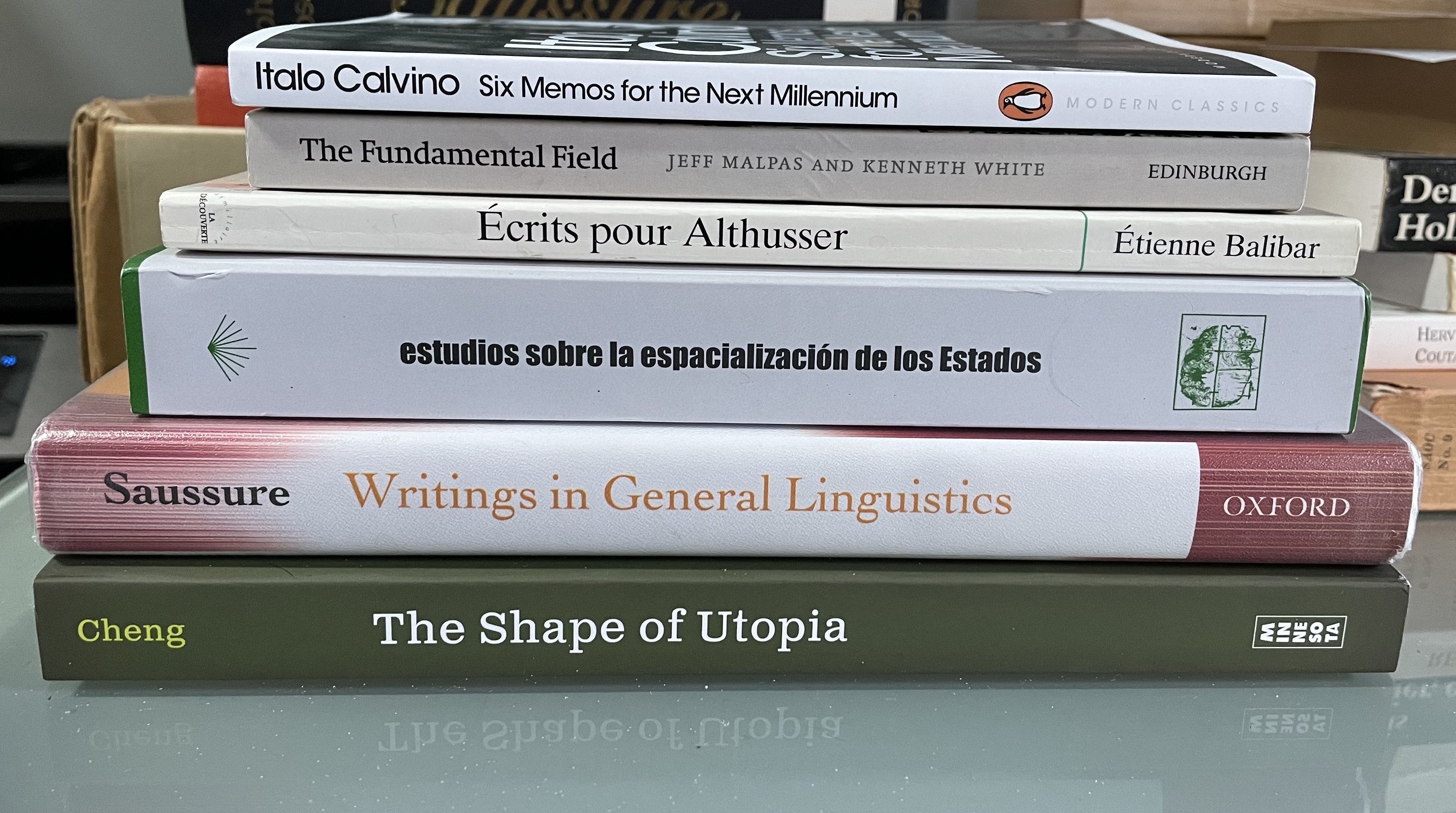
Some books bought or sent recently – Italo Calvino’s Six Memos for the Next Millennium, Jeff Malpas and Kenneth White, The Fundamental Field, Étienne Balibar’s Écrits pour Althusser, Carlos Salamanca Villamizar, Gabriela González and Francisco Astudillo (eds.), Estudios sobre la espacialización de los Estados: Políticas, prácticas, y representaciones, Saussure’s Writings in General Linguistics and Irene Cheng, The Shape of Utopia: The Architecture of Radical Reform in Nineteenth-Century America.
University of Minnesota Press sent the copy of Irene Cheng’s book, and Estudios sobre la espacialización de los Estados has a translation of an old piece by Neil Brenner and me on Lefebvre and was sent by the editors. The collection is available open access here (and the original article here). The other books were bought new or second-hand – I was finally able to find reasonably priced copies of the Saussure and Balibar collections.
Building on the foundational Affect Theory Reader, this new volume gathers together contemporary scholarship that highlights and interrogates the contemporary state of affect inquiry. Unsettling what might be too readily taken-for-granted assumptions in affect theory, The Affect Theory Reader 2 extends and challenges how contemporary theories of affect intersect with a wide range of topics and fields that include Black studies, queer and trans theory, Indigenous cosmologies, feminist cultural analysis, psychoanalysis, and media ecologies. It foregrounds vital touchpoints for contemporary studies of affect, from the visceral elements of climate emergency and the sensorial sinews of networked media to the minor feelings entangled with listening, looking, thinking, writing, and teaching otherwise. Tracing affect’s resonances with today’s most critical debates, The Affect Theory Reader 2 will reorient and disorient readers to the past, present, and future potentials of affect theory.
Contributors. Lauren Berlant, Lisa Blackman, Rizvana Bradley, Ann Cvetkovich, Ezekiel J. Dixon-Román, Adam J. Frank, M. Gail Hamner, Omar Kasmani, Cecilia Macón, Hil Malatino, Erin Manning, Derek P. McCormack, Patrick Nickleson, Susanna Paasonen, Tyrone S. Palmer, Carolyn Pedwell, Jasbir K. Puar, Jason Read, Michael Richardson, Dylan Robinson, Tony D. Sampson, Kyla Schuller, Gregory J. Seigworth, Nathan Snaza, Kathleen Stewart, Elizabeth A. Wilson
No publisher page yet, though it is appearing in online bookstores. There is more info about the book and related essays on the author’s website.
[Update November 2023 – the publisher page is here]
Books about the origins of humanity dominate bestseller lists, while major newspapers present breathless accounts of new archaeological findings and speculation about what those findings might tell us about ourselves. We are obsessed with prehistory―and, in this respect, our current era is no different from any other in the last three hundred years. In this coruscating history of prehistory, Stefanos Geroulanos moves from Rousseau’s “state of nature” and Romantic notions of virtuous German barbarians to theories about Neanderthals, killer apes, and a matriarchal paradise where women ruled. Yet as he shows, such ideas became, for the most part, the ideological foundations of repressive regimes and globe-spanning empires. Accounts of prehistory tell us more about the moment when they are proposed than about the deep past, Geroulanos argues―and if we hope to start improving our future, we would be better off setting aside the search for how it all started.